
A hairline crack in your stucco is rarely just a cosmetic blemish. It’s often the first visible symptom of a deeper failure within your building’s complete outer system, where moisture and environmental stressors begin to compromise the structural integrity of your home. Choosing between stucco repair vs replacement requires a forensic look at what’s happening beneath the surface to prevent long-term decay. You likely want a straightforward solution to maintain your property’s curb appeal, yet the fear of hidden rot or conflicting contractor quotes can make the next step feel uncertain.
We believe in providing the technical truth about a structure’s health rather than offering a low-quality patch that merely hides a problem. This guide explores how to diagnose the underlying origins of damage, the implications of Colorado’s 2025 Wildfire Resiliency Code, and the analytical approach required to preserve your home’s value for decades. By the end, you’ll have the clarity needed to choose a path that ensures lasting protection and true peace of mind.
Key Takeaways
- Distinguish between surface-level hairline cracks and systemic failures that threaten the underlying structure of your home.
- Recognize specific visual indicators, such as localized staining or surface softening, that signal moisture intrusion within the building’s outer system.
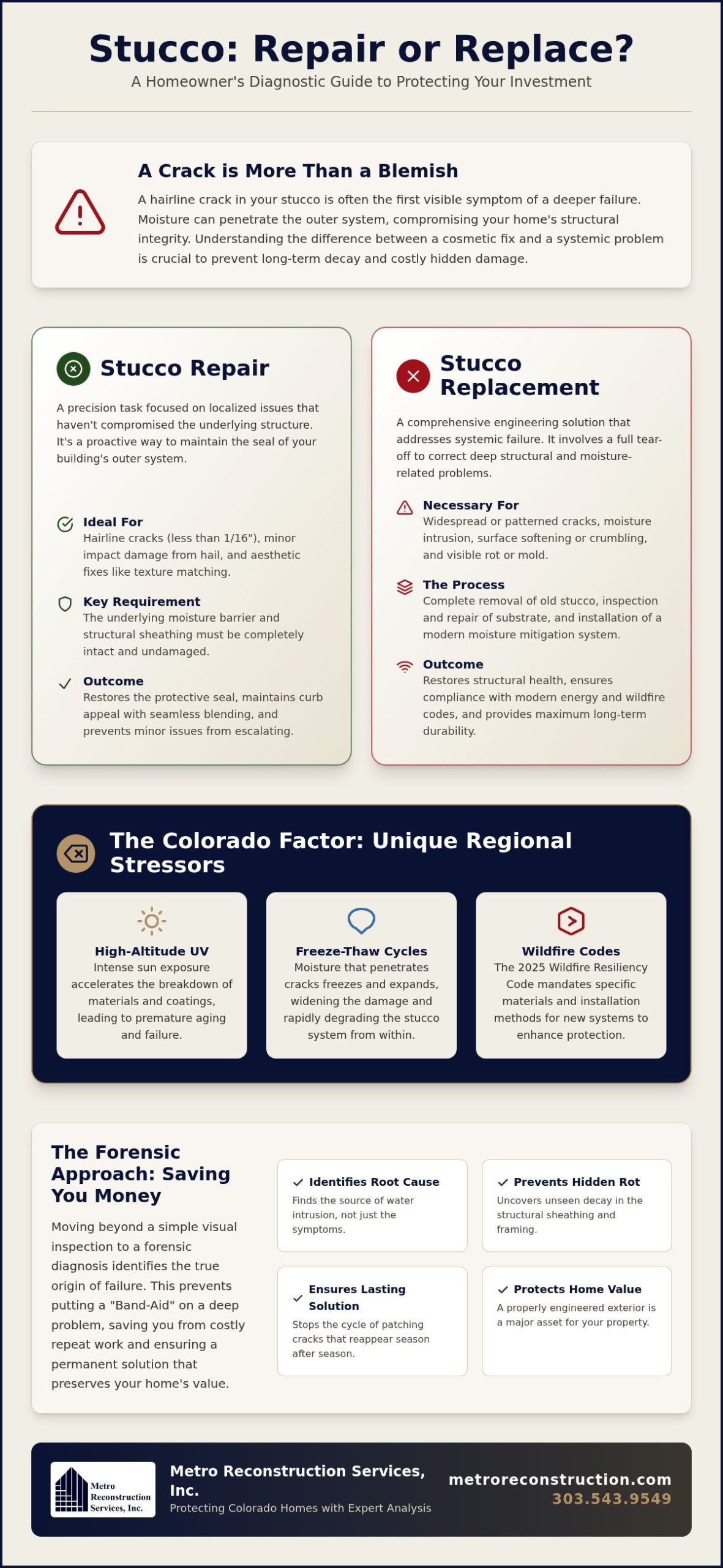
- Evaluate the necessity of stucco repair vs replacement by understanding the difference between a cosmetic fix and a comprehensive restoration.
- Learn how regional environmental stressors like high-altitude UV exposure and seasonal temperature shifts dictate the appropriate method of repair.
- Save on long-term costs by moving beyond visual inspections to a forensic diagnostic approach that identifies the true origin of failure.
For a professional evaluation of your property, reach out to our team at 303.543.9549 or visit our contact page.
Understanding the Difference: Stucco Repair vs. Stucco Replacement
Stucco is a sophisticated material designed to act as a resilient shield for your home. This Stucco overview highlights its historical and technical composition; however, modern application requires a deeper understanding of building science. Determining whether your property requires stucco repair vs replacement is a decision that impacts both immediate cost and long-term structural health. A simple patch might hide a crack, but it won’t stop moisture if the internal drainage system has failed. We view the exterior as a complete outer system where every component must work in harmony to prevent decay.
Treating stucco issues with a “Band-Aid” approach often leads to catastrophic results. When water penetrates the surface, it settles against the underlying moisture barrier. If that barrier is compromised, the water has nowhere to go but into your structural sheathing and framing. This creates an environment for rot and mold that remains hidden until the damage is severe. True restoration requires identifying the origin of the failure rather than just masking the symptoms. You can learn more about our comprehensive approach on our services page.
What Defines a Professional Stucco Repair?
Professional stucco repair is a precision task focused on localized issues that haven’t yet reached the structural core. This typically involves sealing hairline cracks and addressing minor impact points from hail or accidental damage. To maintain your home’s value, we prioritize aesthetic continuity. This means meticulous color and texture matching so the repair is indistinguishable from the original surface. Repair is a responsible choice when the underlying moisture barrier is intact and the damage is strictly limited to the finish coat. It’s a proactive way to maintain the seal of your building’s complete outer system before environmental stressors cause further degradation.
What Does Full Stucco Replacement Entail?
Full stucco replacement is a comprehensive engineering solution. It begins with the complete removal of existing material, which allows us to inspect the structural substrate for any signs of rot or moisture damage that were previously invisible. We then install modern moisture mitigation systems, including high-performance drainage planes that ensure water is channeled away from your home. This process is about more than just looks; it’s about compliance and protection. We ensure the new system meets current Colorado energy requirements and the 2025 Wildfire Resiliency Code. This level of restoration provides a fresh start for your home’s exterior, offering a level of durability that a simple patch cannot match.
If you’re concerned about the integrity of your home’s exterior, don’t wait for a minor crack to become a major failure. Contact Metro Reconstruction Services today at 303.543.9549 or visit our contact page for a professional evaluation of your property.
Diagnostic Signs: When to Choose Repair for Your Exterior Walls
Deciding on stucco repair vs replacement begins with a meticulous visual inspection of your home’s exterior. While some blemishes are purely aesthetic, others serve as early warning signs of a failing building system. Identifying the difference requires a disciplined eye. For instance, hairline cracks measuring less than 1/16th of an inch often result from natural building settling rather than structural failure. These minor fissures are prime candidates for localized repair, provided the underlying moisture barrier remains intact. This Historic Stucco Repair Guide offers a technical foundation for evaluating these surfaces, emphasizing that early intervention is the most effective way to prevent moisture from reaching the structural substrate.
Identifying Minor Surface Issues
Differentiating between a harmless settling crack and a structural stress fracture is a critical diagnostic step. Settling cracks are usually thin and localized; however, structural cracks often appear in patterns or wider gaps that suggest the building’s frame is shifting or the stucco is delaminating. Regular maintenance, such as sealing these small openings, extends the lifespan of the finish and protects your investment. Promptly addressing these small gaps prevents water from bypassing the outer shield, which is essential in Colorado’s demanding environment. If you notice these issues early, a professional repair can restore the seal of your building’s complete outer system without the need for a full tear-off.
Aesthetic and Impact Damage
Localized damage often stems from external factors rather than internal failure. Woodpecker holes, chips from hail, or minor accidental impacts can compromise the finish coat, leaving the inner layers vulnerable to the elements. In these scenarios, we focus on stucco and masonry repairs that integrate seamlessly with your existing texture. While patching is effective for small areas, it has limitations in high-visibility sections where color matching must be perfect to avoid a “quilted” look. Professional stucco painting can often refresh the entire facade after repairs are completed, providing a uniform appearance that bolsters curb appeal. For homeowners unsure of the severity of their damage, our restoration services provide a clear, diagnostic path forward.
Our team at Metro Reconstruction Services is dedicated to property preservation through technical accuracy. If you are concerned about the current state of your exterior, please reach out to us at 303.543.9549 or visit our contact page for a professional evaluation.
Red Flags for Replacement: Identifying Deep Structural Failures
When evaluating stucco repair vs replacement, we must look beyond the surface to identify signs of systemic compromise. Brown streaks appearing below window corners or along floor lines are frequently more than just aesthetic stains; they are often mineral deposits carried by water that has saturated the underlying wood sheathing. This Building Science Corporation analysis details how these “stucco woes” occur when the drainage plane fails to shed water correctly, leading to a “perfect storm” of moisture trapped within the building’s complete outer system. If you see these “stucco tears,” it’s often a sign that the internal layers are already failing.
Moisture Intrusion and Hidden Damage
Soft spots or visible bulging in the facade signal that the stucco has lost its bond with the structural substrate. This typically happens because water has bypassed the facade through failed window flashing or poorly sealed penetrations. Once moisture reaches the wooden sheathing, rot can spread rapidly, compromising the home’s structural integrity from the inside out. Simply cleaning surface mold is a temporary fix that ignores the fungal growth thriving behind the wall. A forensic inspection is necessary when these stains appear near joints or transitions, as superficial patches cannot restore a failed moisture barrier that has reached the end of its functional life.
Extensive Cracking and Systemic Failure
While single settling cracks are often manageable, “spiderweb” cracking across large sections suggests a fundamental installation error or an improper material mix. When these patterns emerge, the system can no longer protect the building from Colorado’s harsh freeze-thaw cycles, which turn minor fissures into major entry points for ice and water. At this stage, the cumulative cost of repeated, localized repairs often exceeds the value of a full replacement. Choosing a comprehensive stucco replacement ensures your property meets modern engineering standards, preventing the significant loss of home value that occurs when structural failures are left to worsen. It’s about moving from a cycle of constant maintenance to a long-term solution that protects your investment.
Our commitment to precision means we would rather explain the difficult truth of a structural failure than offer a low-quality patch. If your home is showing these red flags, contact Metro Reconstruction Services at 303.543.9549 or visit our contact page for a detailed diagnostic evaluation.
The Colorado Factor: Regional Stressors on Stucco Systems
Colorado’s Front Range presents a unique set of environmental challenges that directly influence the decision between stucco repair vs replacement. Our high-altitude environment subjects building materials to intense UV radiation and rapid temperature fluctuations that aren’t found in most other regions. These stressors act on the building’s complete outer system, testing the limits of traditional application methods. Understanding these regional factors is essential for property preservation, as a solution that works in a more temperate climate will likely fail here within a few seasons.
Freeze-Thaw Cycles and High-Altitude Stress
The extreme temperature swings common in Boulder and the surrounding areas create a relentless cycle of expansion and contraction. When moisture enters even a minor crack, it freezes and expands, exerting internal pressure that widens the gap and allows more water to penetrate during the next thaw. Standard stucco mixes often lack the resilience to withstand this movement without the support of high-quality, flexible sealants at every transition point. Intense high-altitude UV rays break down the chemical binders in traditional stucco finishes over time, leading to a brittle surface that is far more prone to cracking. This degradation means that what begins as a surface-level issue can quickly evolve into a structural failure if the material’s elasticity is lost.
Fire Mitigation and Home Hardening
Beyond weather resistance, stucco plays a vital role in our fire mitigation and prevention services. As of July 1, 2026, many local jurisdictions in Colorado have implemented the 2025 Wildfire Resiliency Code, which mandates stricter standards for exterior materials in designated zones. Stucco is an excellent non-combustible material that contributes significantly to a home’s “fireproof” rating. The new code includes a specific provision where replacing 25% or more of an exterior wall surface area may require the entire wall to be brought up to current wildfire standards. This regulatory shift makes the choice of stucco repair vs replacement a matter of both structural safety and legal compliance. High-quality craftsmanship ensures that these systems aren’t just beautiful, but act as a hardened shield against the increasing risk of wildfires in our mountain communities.
If you need an expert to evaluate your home’s resilience against Colorado’s unique climate, schedule a professional diagnostic evaluation today. Our team understands the hidden mechanics of regional failures and provides long-term solutions. Call Metro Reconstruction Services at 303.543.9549 or visit our contact page to begin protecting your investment.
The Forensic Approach: Why Expert Evaluation Saves Money
Choosing between stucco repair vs replacement shouldn’t be a guessing game based on the lowest bid. Many contractors offer a quick visual estimate that only accounts for what’s visible on the surface, which often leads to unforeseen costs once the project begins. We take a different path. By analyzing the building’s complete outer system, we identify the underlying structural origins of failure. This forensic methodology ensures that we aren’t just treating a symptom but solving the actual problem. It’s the difference between a temporary patch and a permanent restoration that protects your home’s value for decades. Because moisture often travels along internal framing, a surface-level stain in one area may actually originate from a failed transition several feet away, making a thorough investigation essential.
Beyond the Surface: The Diagnostic Process
Our process involves diagnostic moisture testing to map out exactly where water is trapped behind the facade. This level of initial accuracy is a foundational brand promise that sets us apart from high-pressure marketing tactics. It allows us to offer fixed-price reconstruction projects, giving you financial certainty before the work begins. We’ve seen too many homeowners caught in a cycle of repetitive repairs because the first contractor didn’t find the root cause. Proper diagnostics eliminate that risk, ensuring the first fix is the only fix. By identifying the specific point where the moisture barrier was compromised, we can determine if a targeted repair is viable or if the entire system has reached its functional limit.
Planning Your Restoration Project
When you partner with our family-owned firm, you’re working with experts who have been protecting Front Range properties since 1982. During a professional consultation, we explain the technical truth of your home’s structural health with transparency and quiet confidence. You’ll receive personalized project management that guides you through every step of a complex structural repair. This engineering-led solution is designed for longevity, providing the peace of mind that comes from knowing your home is truly secure. To ensure your property remains protected and beautiful, we focus on the long-term ROI of a complete system restoration rather than a low-budget patch. We believe that an informed homeowner is our best partner, which is why we take the time to explain how different technical components interact to preserve your investment. Deciding on stucco repair vs replacement is a significant investment, and we are here to ensure that choice is backed by data and decades of expertise.
Don’t let a minor issue turn into a structural failure. Reach out to the specialists at Metro Reconstruction Services at 303.543.9549 or visit our contact page to schedule your forensic evaluation today.
Securing Your Home’s Structural Future
Protecting your investment requires moving beyond the surface to understand how your building’s complete outer system responds to Colorado’s demanding climate. We’ve explored how identifying the true structural origin of damage determines whether stucco repair vs replacement is the right path for your property. Whether you’re addressing minor hairline cracks or navigating the new requirements of the 2025 Wildfire Resiliency Code, the most cost-effective solution is always the one that addresses the root cause correctly the first time.
Since 1982, our family-owned firm has specialized in the forensic diagnostics required for high-quality restoration. With over 40 years of local expertise, we provide the quiet confidence that comes from reliable, engineering-led craftsmanship. Don’t leave your home’s protection to chance with a temporary fix. Ensure your home’s structural integrity with a professional evaluation. Contact Metro Reconstruction Services today or call us at 303.543.9549. We look forward to being your dedicated partner in property preservation.
Frequently Asked Questions
Is it cheaper to repair or replace stucco in the long run?
Repair is more cost-effective for localized surface issues; however, replacement is the more economical long-term choice if damage covers more than 25% of the surface or involves moisture intrusion. Continuous patching of a failing system leads to repetitive costs that eventually exceed the price of a full restoration. A forensic evaluation determines if a repair will actually hold or if it’s merely delaying an inevitable replacement.
Can you match the texture of my old stucco during a repair?
We can achieve a precise texture match by analyzing the aggregate size and application method of your existing finish. Our craftsmen are skilled in replicating various styles, from smooth lace to heavy dash, ensuring the repair blends seamlessly with the building’s complete outer system. While a perfect color match is difficult due to UV fading, professional stucco painting after the repair provides a uniform and beautiful result.
How do I know if the cracks in my stucco are structural?
Structural cracks are typically wider than 1/16th of an inch or appear in specific patterns, such as diagonal lines near the corners of windows and doors. While hairline cracks often result from minor settling, wider gaps suggest that the building’s frame is shifting or the moisture barrier has failed. If you notice cracking that extends through all layers of the stucco, it’s a clear sign that a professional diagnostic evaluation is required.
What happens if I ignore the moisture stains on my stucco?
Ignoring moisture stains, often called “stucco tears,” allows water to continue saturating the wooden sheathing and framing behind the facade. This leads to hidden rot and mold growth that compromises the structural integrity of your home over time. What begins as a cosmetic blemish can evolve into a catastrophic failure, significantly increasing the eventual cost of restoration and decreasing your property’s resale value.
Does insurance cover stucco replacement after hail damage?
Homeowners insurance typically covers stucco damage resulting from sudden, accidental events like severe hail storms or falling trees. It doesn’t, however, cover damage caused by long-term neglect, poor installation, or gradual moisture intrusion. We recommend reviewing your policy for “ordinance and law” coverage, which helps pay for the increased costs of meeting new building codes, such as Colorado’s 2025 wildfire standards.
How long does a full stucco replacement take for a Boulder home?
A comprehensive stucco replacement for a standard residential property usually takes between two and four weeks, depending on the complexity of the structure. This timeline includes the complete removal of old material, inspection of the substrate, and the installation of a modern moisture mitigation system. We prioritize precision at every step to ensure the new system provides a hardened shield against regional environmental stressors for decades to come.
Can I paint over repaired stucco to hide the patches?
What is the difference between traditional stucco and EIFS?
Traditional stucco is a cement-based material applied over a wire lath, whereas EIFS (Exterior Insulation and Finish Systems) is a multi-layered synthetic system that includes an insulation board. While EIFS offers superior energy efficiency, it requires specialized moisture management to prevent water from becoming trapped against the structural sheathing. Traditional stucco is generally more impact-resistant and has been a reliable choice for Colorado homes for over a century.
For more information or to schedule a diagnostic evaluation, contact Metro Reconstruction Services at 303.543.9549 or visit our contact page.