
What if a crack in your stucco finish points to a problem beyond the visible surface? Cracks and discoloration can raise understandable concerns about moisture, but they don’t reveal what is happening inside the wall. The finish coat gives stucco its texture and color; it is only one part of the protective assembly.
Behind that surface, layers and details such as the weather-resistant barrier, flashing, and drainage paths help manage water. If those parts are not working together, moisture can affect materials beneath the finish. A surface patch may hide a symptom without addressing its cause.
Colorado’s strong sun, temperature swings, and freeze-thaw cycles make it useful to assess the complete exterior assembly when evaluating stucco. This guide explains what the finish coat does, how it relates to the wall beneath it, which visible changes warrant a closer look, and what to consider when planning a durable repair or replacement.
Key Takeaways
- The stucco finish is the visible outer coat. Moisture protection also depends on connected layers and details beneath it.
- When comparing finishes, weigh appearance alongside maintenance, compatibility with the existing wall, and how future repairs may meet the finished surface.
- Record where cracks, stains, or other changes appear, including their proximity to windows, doors, and roof-to-wall transitions.
- Base restoration or replacement decisions on the wall assembly’s condition and potential water pathways, not surface appearance alone.
- For stucco restoration, installation, or replacement, contact Metro Reconstruction Services, Inc. or call 303.543.9549.
What Is a Stucco Finish, and What Does It Do for an Exterior Wall?
A stucco finish is the visible outer coat of a stucco wall assembly. It gives the exterior its color and texture, but it does not reveal every layer or detail that helps protect the wall.
Stucco is a plaster-like material applied to building surfaces. For a general overview of its composition and uses, see What is stucco? The finish coat is one part of a larger assembly. A smooth, even appearance cannot confirm whether concealed layers are intact or how the wall manages moisture.
That distinction matters when you assess a wall. A crack or stain may be visible in the finish while the condition of the layers behind it remains unknown. Conversely, an intact-looking surface does not confirm that water is being directed away from vulnerable areas. Appearance is useful evidence to record, but it is not a complete assessment.
How the finish coat fits into a stucco wall
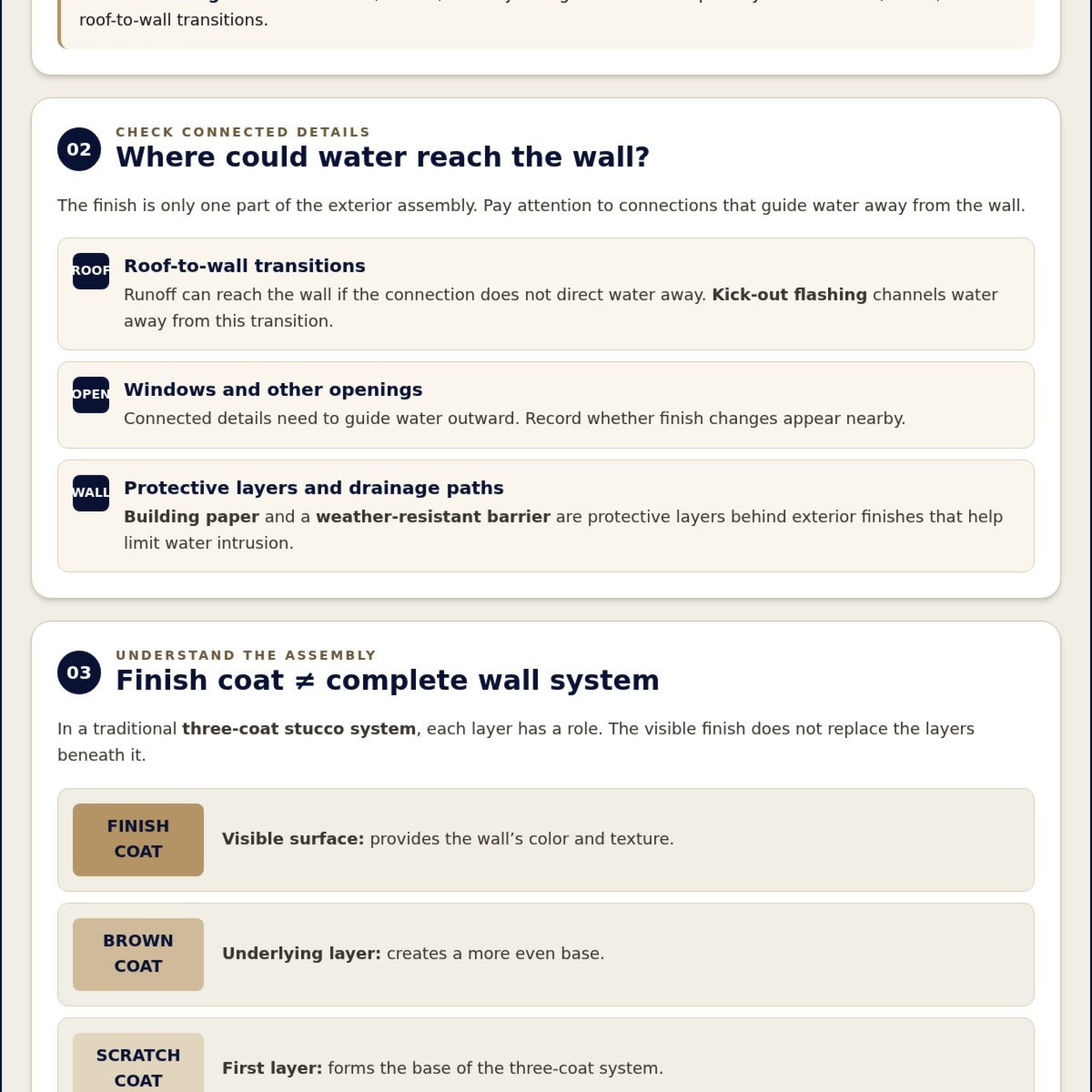
In a traditional three-coat stucco system, the layers are the scratch coat, brown coat, and finish coat. The scratch coat forms the first layer, the brown coat creates a more even base, and the finish coat provides the visible surface. Each layer has a role in the assembly. The finish coat does not replace the layers beneath it.
Wall design and installation details also affect how moisture moves. The finish, the layers behind it, and the connections to other parts of the building need to work as a system. Changing the texture or color addresses appearance, but does not establish the condition of the full wall.
Stucco finish versus the complete exterior wall system
Building paper is a moisture-resistant layer installed behind an exterior finish. A weather-resistant barrier is a protective membrane behind exterior cladding that helps limit water intrusion. Materials and arrangements can vary, but neither term describes the visible stucco surface.
Windows, roof-to-wall transitions, and drainage details also connect to the wall assembly. For example, kick-out flashing at a roof-to-wall transition directs water away from the wall. If water enters at an opening or transition, it may affect concealed materials as well as the finish. The surface alone cannot show the full route water has taken.
Metro Reconstruction Services, Inc. provides stucco restoration, installation, and replacement, considering how the stucco connects to the rest of the exterior. For guidance on your wall assembly, explore stucco services or contact Metro Reconstruction Services, Inc. at 303.543.9549.
How Colorado Exposure and Moisture Details Affect Stucco Finish Durability
Colorado properties can face intense sun, sharp temperature changes, and freeze-thaw cycles. Their effects on exterior materials depend on the building’s design, exposure, and maintenance history. These conditions are reasons to assess the complete wall assembly, not proof that every stucco wall will fail in the same way.
As materials warm and cool, thermal expansion, the increase in material size as temperature rises, can contribute to movement at joints and transitions. Repeated exposure may make existing weaknesses more noticeable. Whether a crack relates to movement, water, installation details, or another factor depends on its location and the wall’s condition.
Where water can reach the stucco wall assembly
Roof-to-wall transitions are worth examining because runoff can reach the wall if the connection does not direct water away. Kick-out flashing is metal flashing at this transition that channels water away from the wall. Behind the exterior finish, building paper and a weather-resistant barrier are protective layers intended to help limit water intrusion to the underlying wall.
Openings such as windows and changes in wall direction also need connected details that guide water outward. If water gets past an exterior surface or transition, it may affect concealed materials as well as the visible finish. That possibility does not identify the source in any particular home. A closer evaluation of the wall and its connections helps determine how water may be moving.
What visible finish changes can, and cannot, tell you
Cracks, stains, and areas where the finish appears to separate are useful observations, not automatic diagnoses. A crack may be associated with movement or a weak point. Staining may appear where water has contacted the surface. Separation can indicate a bond or substrate concern, but appearance alone cannot confirm the cause or whether concealed materials are affected.
A visible symptom can point to an area that needs attention, but it does not confirm where moisture entered or what lies behind the wall. Note the location, extent, and any change over time, especially near roof transitions or openings. This information helps distinguish a surface condition from a wider assembly concern without relying on appearance alone.
Moisture mitigation addresses water pathways and related conditions rather than simply covering a stain or crack. The appropriate scope depends on the finish, underlying layers, and connected exterior components. Metro Reconstruction Services, Inc. provides stucco restoration, installation, and replacement in Colorado. To discuss a concern with your stucco, contact Metro Reconstruction Services, Inc. or call 303.543.9549.
How to Compare Stucco Finish Choices Without Confusing Texture with Performance
Choosing a finish is partly an aesthetic decision, but appearance alone cannot establish whether a finish suits the existing wall. Texture changes how light and shadow read across the surface and how the exterior looks from different distances. It does not confirm the condition of underlying layers or how water is managed.
Appearance, texture, and the limits of visual selection
Start with the appearance you want, then consider it alongside the wall’s condition and the project scope. A finish decision made during restoration may need to account for adjacent areas, existing materials, and work required beneath the surface. Metro Reconstruction Services, Inc. provides stucco restoration, installation, and replacement based on the project’s needs.
Use these considerations to organize the decision:
| Consideration | What it affects | What to assess |
|---|---|---|
| Appearance and texture | How the wall looks and how repairs blend visually | Existing surface character, the area being worked on, and the desired appearance |
| Maintenance expectations | What routine attention the finished surface may need | Care instructions for the selected finish and the property’s maintenance plans |
| Compatibility | How new finish work meets existing layers and adjacent materials | Current wall construction, condition, and transitions at openings or edges |
| Repair context | The extent and boundaries of the work | Whether the work is limited to the surface or tied to broader restoration needs |
Finish compatibility, repair boundaries, and long-term care
At a repair boundary, differences in texture or surface appearance may be noticeable where new work meets older material. The transition also needs to make sense within the wall assembly. How the boundary is handled should reflect the repair scope and the details connecting the wall to openings and other exterior components.
Before choosing a finish, consider whether it can be coordinated with adjacent materials and existing wall layers. If an evaluation identifies concealed damage, the restoration scope may need to address more than the visible coat. Choosing a surface treatment before understanding the scope can leave important repair decisions unresolved.
Maintenance is another practical consideration. Ask what care the selected finish calls for, and keep records of the materials and work completed so future repairs can be planned with that context. No texture is automatically right for every Colorado property. Suitability depends on the specific wall, its condition, and the restoration work required.
Compare your preferred appearance with compatibility, repair boundaries, and the wall’s condition before selecting a finish. For stucco restoration or replacement, contact Metro Reconstruction Services, Inc. or call 303.543.9549.
How to Assess Stucco Finish Damage Before Planning a Repair
A careful first look helps you describe what has changed without guessing why it happened. Record visible conditions and their locations, then use that information to guide a closer evaluation. Cracks, stains, bulges, or areas that appear detached are observations, not proof of a particular failure.
Before applying a patch or another finish layer, the underlying cause should be understood. If water is entering at a transition or another part of the wall assembly needs attention, covering the surface alone may leave the source unresolved.
A practical first look at stucco finish concerns
Take clear photographs from a consistent distance and, where useful, closer views. Note nearby windows, doors, roof edges, or other transitions, and record when you first noticed the change. If the appearance shifts after rain, snow, or other weather exposure, document the timing without assuming the weather caused it.
- Map the location. Note the wall and approximate area where each crack, stain, bulge, or detached-looking section appears. A simple sketch can help you compare separate areas.
- Photograph the condition. Capture an overall view and a closer image. Keep the angle and distance similar in later photos so visible changes are easier to compare.
- Record nearby details. Note whether the symptom is near a window, door, roof edge, roof-to-wall transition, or other change in the wall surface. Proximity is useful context, not a diagnosis.
- Track changes over time. Write down when you observe a change and whether it looks different after weather exposure. Avoid probing or removing material to investigate it yourself.
- Keep a concise history. Record any previous repairs you know about and whether similar signs have returned. This helps distinguish a new observation from a recurring one.
When the wall assembly needs a closer evaluation
Symptoms that recur, spread, or appear in several connected areas may call for looking beyond the visible surface. The goal is to understand the wall, nearby transitions, and possible moisture pathways before setting the repair scope. Your notes and photos can help focus the assessment, but they cannot establish the condition of concealed materials.
Repair scope should follow an evaluation of the wall and its moisture pathways, not the appearance of the finish alone. If moisture mitigation is needed, it should address the source or route of water as part of the restoration plan, rather than simply masking a symptom. Broader work may involve the stucco and connected exterior components, with the scope guided by the observed conditions and evaluation.
How Metro Reconstruction Approaches Stucco Finish Restoration in Colorado
A restoration decision should account for more than the visible surface. Metro Reconstruction Services, Inc. provides stucco restoration, installation, and replacement, with project scope shaped by the property’s condition and the work required. The first step is to understand how the finish relates to the wall behind it and to connected exterior details before deciding what work is appropriate.
Why a whole-wall perspective matters to a finish project
A wall includes more than its stucco surface. Windows, roof-to-wall transitions, drainage details, and moisture-control layers all connect to the exterior assembly. If water enters around an opening or transition, the concern may involve materials behind the finish. Evaluating these connections helps distinguish a surface repair from a broader restoration need.
Metro Reconstruction Services, Inc. approaches stucco restoration and moisture mitigation according to the conditions found at the property. When an evaluation points to a moisture pathway, that information helps shape the repair scope. Covering the visible mark alone may not address the underlying issue. The choice between restoration and replacement depends on the stucco’s condition and that of connected components. For broader exterior concerns, exterior construction guidance can help frame how connected parts of the home are considered.
Based in Boulder, Metro Reconstruction Services, Inc. serves communities across the Front Range and Mountain region, including Parker, Morrison, Boulder, Longmont, Niwot, Evergreen, Cherry Creek, Cherry Hills Village, Golden, Genesee, Littleton, Broomfield, Denver, Silverthorn, Breckenridge, Vail, and Larkspur. Local conditions provide context for evaluating properties in these communities, while the appropriate scope still depends on the building itself. Exposure, wall construction, previous repairs, and the locations of visible changes can inform the assessment. No single finish treatment is right for every wall.
Discussing the right next step for your property
Before discussing a repair, gather a few practical details: where the concern appears, what it looks like, whether it is near a window or roof transition, and whether it has changed over time. Photos and a brief history help describe the issue. They do not replace an evaluation, but they give the conversation a useful starting point.
If you’re deciding what to do about a stucco finish, restoration, installation, or replacement, discuss the visible concern alongside the wall’s moisture pathways and connected exterior components. An accurate initial evaluation helps guide a scope that reflects the property’s condition, rather than assuming every crack or stain calls for the same response.
Contact Metro Reconstruction Services, Inc. to discuss your stucco concerns, or call 303.543.9549. Share where the damage appears and any changes you have observed so the conversation can start with the details that matter.
Make Your Next Stucco Decision With Clarity
A repair plan is a chance to make a considered decision about your home’s exterior, not just its appearance. Before choosing what comes next, focus on understanding the work your property needs and how the stucco finish fits into the wall as a whole. That perspective helps turn uncertainty into a practical plan grounded in the building’s condition.
Metro Reconstruction Services, Inc. brings more than four decades of industry expertise to exterior construction and restoration. If you’re ready to discuss your property, contact Metro Reconstruction Services, Inc. or call 303.543.9549. A conversation about your stucco can help you identify a sensible next step for your home.
Careful evaluation and a project-specific approach help you make informed decisions about your exterior.
Frequently Asked Questions
What is a stucco finish?
A stucco finish is the outer surface that gives a stucco wall its visible color and texture. It shapes the home’s exterior appearance, but it is not the full wall assembly. Choosing a smoother look or a more pronounced texture changes the visual result, not what may be present behind the coat. When comparing finishes, consider how the selected appearance will meet existing stucco and nearby materials.
Is stucco finish the same as a three-coat stucco system?
No. The finish coat is one layer, while a three-coat stucco system refers to the scratch coat, brown coat, and finish coat together. A homeowner looking at a stucco exterior generally sees only the finish coat. Knowing which system is present helps frame renovation discussions, especially if a proposed repair affects more than the exposed surface. Existing construction details can vary from property to property.
Can a cracked stucco finish indicate moisture behind the wall?
It can be a reason to look more closely, but a crack alone does not prove that moisture is behind the wall. Cracks can have different causes, and their location, pattern, and changes over time provide useful context. Note whether a crack is near a window or roof transition and whether it changes after weather exposure. Do not treat the crack as a moisture diagnosis without evaluating the surrounding wall.
How do you know whether stucco needs repair or replacement?
The choice depends on the finish, the underlying wall, and the scope of any related work. A localized surface concern may call for a different plan than damage across connected areas or damage involving concealed materials. An evaluation helps establish those boundaries before work begins. In Boulder and nearby Front Range communities, project decisions should reflect the specific property rather than a one-size-fits-all rule.
Does the stucco finish protect the wall from water by itself?
No single visible layer should be treated as the wall’s only water-management measure. Stucco is part of an exterior assembly that may include protective layers and details around openings and transitions. For example, a window connection needs to work with the adjacent wall so water is directed appropriately. A surface that looks sound cannot show by appearance alone whether those concealed connections are functioning as intended.
Can a new stucco finish be applied over an existing finish?
It depends on the existing surface and the condition of the wall assembly. Before adding finish material, the project needs to account for whether the current surface is sound, how the new work will bond, and whether moisture or concealed damage needs attention. Adding a new layer without considering those factors may leave underlying concerns unresolved. The appropriate approach depends on the property’s condition and the intended repair scope.
How should Colorado homeowners assess visible stucco finish damage?
Document what you see before planning work: photograph the area, note its location, record nearby windows or roof transitions, and track changes over time. Do not assume a stain or crack identifies the cause. Colorado’s Front Range and Mountain communities include varied property conditions, so observations should lead to an evaluation of the specific wall. To discuss your concern, contact Metro Reconstruction Services or call 303.543.9549.