
Is that hairline fracture on your exterior wall a simple cosmetic blemish, or is it the first warning sign of a failing structural system? For many homeowners along the Front Range, spotting a new line in their home’s finish triggers an immediate sense of anxiety about Colorado’s expansive soils and the potential for hidden water damage. You aren’t alone in wondering if a quick patch will suffice or if your home’s integrity is at risk. Effective stucco crack repair requires more than just filling a gap; it demands a forensic understanding of why the barrier failed in the first place.
In this guide, you’ll learn how to distinguish between minor surface settling and serious structural threats so your investment remains protected for decades, not just a single season. We believe in looking at your building’s complete outer system to identify the root cause of every issue. We’ll examine the specific environmental stressors, such as the freeze-thaw cycle and intense sun exposure, that affect local properties. We’ll also provide a clear roadmap for permanent restoration. By the end, you’ll have the confidence to choose a solution that preserves both the safety and the value of your home.
Key Takeaways
- Understand how Colorado’s unique climate and shifting soil create specific stress points on your home’s outer system.
- Learn why a forensic diagnostic phase is essential for successful stucco crack repair to ensure you aren’t just covering up a deeper structural failure.
- Discover why common DIY sealants can actually trap moisture inside your walls and lead to significant damage over time.
- Identify the critical differences between harmless surface blemishes and serious movement cracks that threaten your home’s long-term safety.
- Gain peace of mind by shifting from temporary patches to a holistic restoration strategy that protects your property’s value for decades.
Why Stucco Cracks Appear: Environmental Stressors in the Front Range
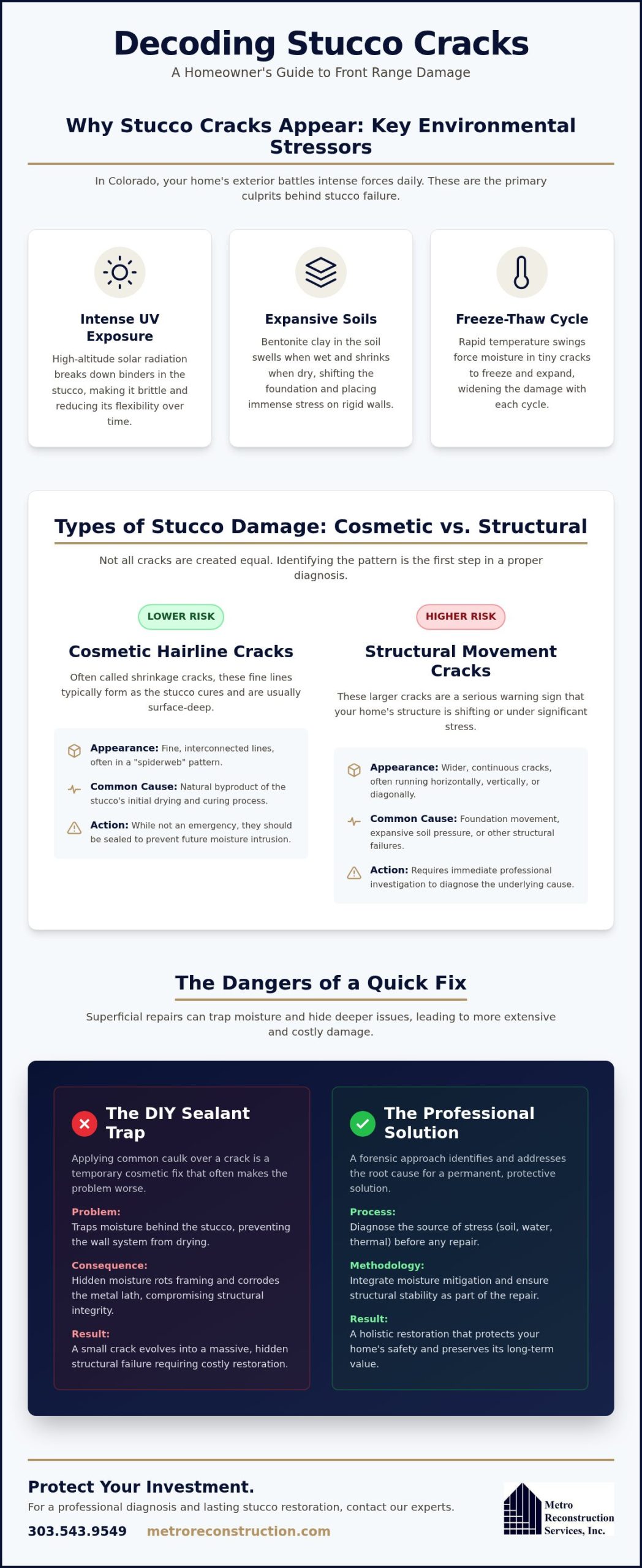
Understanding why your home’s exterior is showing signs of distress requires looking beyond the surface. Stucco is a remarkably durable material, but its rigid nature makes it susceptible to the intense environmental forces found throughout Colorado. To understand the root of the problem, we first look at the material’s composition. What is Stucco? At its core, it is a cement-based plaster that creates a hard, protective shell around your home. While this shell is excellent for fire resistance and insulation, its lack of flexibility means that even slight movements in your home’s structure can lead to visible fractures. When these cracks appear, they act as a signal that the building’s complete outer system is under stress.
The degradation of this system often begins with UV exposure. At our high altitude, intense solar radiation slowly breaks down the binders in the finish, causing the material to lose its limited elasticity. As the stucco becomes more brittle, it can no longer move with the house. This leads to the primary need for professional stucco crack repair. If left unaddressed, these openings allow moisture to reach the metal lath system underneath. Once moisture begins to degrade the lath, the bond between the stucco and the framing is compromised, leading to much larger structural concerns.
The Impact of Expansive Soils on Boulder Homes
The ground beneath your home is rarely as stable as it feels. In Boulder and across the Front Range, the soil contains high levels of bentonite clay. This specific type of soil is known for being “expansive,” meaning it swells significantly when wet and shrinks as it dries. This constant movement shifts foundation footings and places immense pressure on the rigid walls above. This movement creates a tearing effect, where the foundation moves in one direction while the wall remains fixed, forcing the stucco to snap. Expansive soil is a primary driver of structural cracking in our region, making it a factor we always evaluate during a forensic diagnostic phase.
High-Altitude Weather and Thermal Expansion
Colorado’s climate is famous for its volatility. It isn’t unusual to experience 40-degree temperature swings in a single day, which forces building materials to expand and contract at a rapid pace. This thermal expansion puts a relentless strain on the exterior of your home. When moisture finds its way into a tiny hairline fracture during the day, it becomes a major threat overnight. As temperatures drop, that moisture freezes and expands, physically pushing the crack wider. This relentless cycle of freezing and thawing is why mountain communities face unique stucco durability challenges. We don’t just see these cracks as cosmetic flaws; we see them as the result of a high-altitude environment working against the home’s outer shell.
Categorizing Stucco Damage: Hairline Cracks vs. Structural Failures
Effective stucco crack repair begins with a forensic diagnostic phase. We don’t simply look at a crack as a single point of failure; we evaluate it as a symptom of a larger mechanical process. By analyzing the orientation, width, and location of a fracture, we can determine whether the issue is a natural byproduct of the material’s drying phase or a signal of active structural shifting. Understanding this distinction is the difference between a permanent restoration and a temporary patch that will inevitably fail.
Patterns like spiderwebbing often indicate that the base coat was applied improperly or dried too quickly during the initial construction. While these fine, interconnected lines may seem minor, they suggest the outer shell is poorly bonded to the building’s frame. Conversely, horizontal or diagonal cracks usually point to shear stress or settling. These specific patterns require immediate professional attention because they often reveal that the home is moving independently of its exterior skin. Following established building code requirements ensures that repairs address these underlying stresses rather than just hiding them under a new layer of finish.
Identifying Cosmetic Hairline Cracks
Many homes feature small, shallow fractures known as shrinkage cracks. These typically develop during the initial curing process as moisture evaporates from the wet plaster. While these are often surface-deep, they shouldn’t be ignored. Even a thin opening allows Colorado’s intense weather to begin degrading the layers beneath. Sealing these early is a key part of stucco restoration in Boulder. Proper maintenance at this stage prevents water from reaching the lath and causing rust, which would eventually lead to much larger sections of stucco breaking away from the wall.
Warning Signs of Structural and Foundation Issues
When a crack exceeds 1/8 inch in width or shows signs of displacement, the concern shifts from cosmetic to structural. Displacement occurs when one side of the crack sits higher or deeper than the other, indicating that the wall itself is pulling apart. You might notice these issues around the corners of windows or doors. These areas are natural stress points, and cracks here often signal that the headers or framing are under significant pressure from the roof or foundation. These signs often point to a need for professional foundation repair services to stabilize the building’s complete outer system. Identifying these structural origins early is the only way to ensure your home remains safe and sound. If you aren’t sure about the severity of a crack, reaching out to a specialist at 303.543.9549 can provide the clarity you need to protect your investment.
The Risks of Superficial Repairs and DIY Sealants
When a homeowner notices a crack, the instinct is often to reach for a quick fix from a local hardware store. This “caulk and paint” approach frequently does more harm than good by masking a growing moisture problem rather than solving it. While a tube of sealant might hide the visual blemish, it often creates a “trap effect” where moisture that enters through other points, such as roof lines or window flashing, becomes locked behind the exterior finish. Because traditional stucco is designed to be a breathable system, these improper sealants prevent the wall from shedding moisture, which eventually accelerates the degradation of the underlying structure.
Using rigid fillers in active movement joints is another common mistake that leads to recurring issues. These materials cannot handle the natural shifting of a home, resulting in a repair that fails as soon as the next temperature swing occurs. Beyond the structural risks, DIY texture patching almost always results in a visible aesthetic mismatch that can lower your property’s curb appeal. Matching the specific aggregate size and trowel technique of the original finish requires a level of craftsmanship that store-bought kits cannot provide. Achieving a seamless blend requires a deep understanding of professional stucco restoration techniques and material compatibility.
Why Temporary Patches Frequently Fail
DIY materials often lack the chemical bond necessary to stay attached to old cement-based surfaces. Most store-bought patching compounds are acrylic or latex-based, which don’t create a permanent bond with the existing cementitious layers. Because different materials expand and contract at varying rates when exposed to Colorado’s weather, a patch made of inferior materials will typically pop out within a single year. These surface-level fixes are fundamentally flawed because they ignore the building’s complete outer system and fail to address why the crack formed initially.
The Hidden Cost of Delayed Professional Restoration
What starts as a minor fracture can quickly progress into a costly failure. When water is trapped behind the stucco, it creates an environment for wood-destroying mold and rot to take hold in the framing. Once moisture reaches the plywood or sheathing behind the lath, the decay process begins. This rot can spread to the wall studs and insulation, compromising the home’s thermal efficiency and structural stability long before any signs appear on the interior drywall. This transition from a simple stucco crack repair to a full-scale restoration happens silently, often hidden behind the wall until the damage is severe.
At Metro Reconstruction, we prioritize long-term reliability over superficial fixes because we understand that minor structural movement can lead to much larger issues if ignored. We view ourselves as a dedicated partner in your property’s preservation, focusing on accuracy from the very first diagnostic step. If you are concerned about the integrity of your exterior, contacting us at 303.543.9549 or visiting our contact page is the first step toward a permanent solution that protects your home for decades.
Our Methodology: Integrating Moisture Mitigation and Structural Stability
Our approach to stucco crack repair is built on the principle of initial accuracy. While some contractors might suggest a surface-level patch, we recognize that a crack is often just the visible portion of a deeper systemic failure. We treat your home’s exterior as a complete outer system, where every layer must function in harmony to prevent moisture intrusion and structural decay. This forensic mindset allows us to provide solutions that address the underlying mechanics of your building rather than just the symptoms on the surface.
Step 1: Forensic Diagnosis and Moisture Testing
We begin every project by utilizing non-invasive moisture testing tools to identify areas where water may be hiding behind the finish. These specialized scanners allow us to see through the walls without causing unnecessary damage to your property. We also evaluate how your foundation interacts with the exterior walls, as shifting soils often create the tension that leads to cracking. For homes requiring more than just a repair, our Design-Build Services provide a pathway for comprehensive structural remediations that address the root cause of the movement. This diagnostic phase ensures we aren’t guessing about the health of your home.
Step 2: Structural Stabilization and Substrate Repair
Once we identify the problematic areas, we carefully remove the compromised stucco to inspect the underlying components. This step is vital because it reveals the true condition of the metal lath and the weather-resistive barrier. If moisture has reached the wood framing and caused rot, we address these framing issues immediately. We then integrate modern moisture barriers that provide superior protection compared to older, outdated systems. This thorough process is a hallmark of our professional stucco restoration in Boulder County, ensuring that the new layers are supported by a sound and dry foundation. We believe that a restoration is only as good as the materials hidden beneath the surface.
The final phase of our methodology focuses on the aesthetic integrity of your home. Our craftsmen are experts at matching specific aggregate sizes and trowel patterns to ensure the repair is virtually invisible. We don’t just fill a gap; we restore the protective shell of your home with a focus on long-term value. This level of precision ensures your home can reach its full potential lifespan, as properly installed stucco can last between 50 and 80 years in Colorado’s climate. If you’re ready to move beyond temporary fixes and want a dedicated partner in property preservation, contact us today at 303.543.9549 or visit our contact page to schedule a forensic inspection.
Preserving Your Investment with Professional Stucco Restoration
Choosing a holistic restoration approach ensures that your home’s exterior remains a functional barrier rather than a liability. When you invest in a forensic stucco crack repair, you aren’t just buying a cosmetic fix; you’re securing the structural longevity of your property. In high-value markets like Boulder, a documented history of professional restoration is a powerful asset. Savvy buyers and inspectors look for evidence that a building’s complete outer system has been maintained by specialists who understand the mechanics of moisture mitigation. A superficial patch might hide a problem during a walkthrough, but a forensic restoration provides the verifiable safety and integrity that preserves your home’s resale value for decades.
We believe that your home is your most significant investment, and it deserves a partner in property preservation who values substance over style. By addressing the root causes of movement and moisture, we eliminate the cycle of recurring repairs that plagues many Colorado homeowners. This long-term perspective is what distinguishes a premium, engineering-led solution from a low-cost alternative. It’s the difference between worrying about the next heavy rain and having total peace of mind that your home is protected.
The Metro Reconstruction Difference
Our firm has been family-owned and operated since 1982, bringing over four decades of industry expertise to every project we undertake. We approach each challenge with the quiet confidence of a seasoned expert, favoring meticulous diagnostics over high-pressure sales tactics. As a dedicated construction company in Boulder, CO, we have spent years mastering the specific environmental stressors of the Front Range. Whether your property is in Parker, Evergreen, or Cherry Creek, we bring the same level of authoritative professionalism to your doorstep. We don’t just offer a service; we offer the reliability that comes from forty years of successful structural preservation.
Next Steps: Professional Evaluation
The first step toward a permanent solution is a professional evaluation of your home’s exterior. During an initial consultation, we examine the building’s complete outer system to identify the origins of any visible distress. This proactive maintenance is essential for avoiding emergency structural failures that are far more disruptive and expensive to resolve. We will explain the difficult truth of any structural failure we find, providing you with a clear and honest roadmap for restoration. We invite you to become a partner in preserving your property’s future by reaching out to our team today.
To schedule your forensic inspection, please contact us at 303.543.9549. You can also visit our contact page to provide more details about your project. Let’s ensure your home remains safe, beautiful, and structurally sound for the next forty years and beyond.
Secure Your Home’s Future with Expert Diagnostics
Addressing a crack in your home’s exterior is about more than aesthetics; it’s a commitment to long-term property preservation. By adopting a forensic mindset, you move past the risks of temporary sealants and toward a solution that respects the building’s complete outer system. We’ve seen how Colorado’s unique environmental pressures demand a specialized approach to stucco crack repair that prioritizes structural stability and moisture mitigation. Every fracture tells a story of the forces acting upon your foundation and framing. Understanding that story is the only way to ensure a repair that lasts for decades.
As a family-owned firm operating since 1982, we bring over 40 years of local expertise to every diagnostic evaluation we perform. Our team is dedicated to providing the quiet confidence and technical precision your investment deserves. We specialize in forensic structural restoration, ensuring that your home remains both safe and valuable. Protect your home’s structural integrity today. Contact Metro Reconstruction Services or call us at 303.543.9549 for a professional diagnostic evaluation. We look forward to partnering with you to ensure your home remains a safe and lasting sanctuary.
Frequently Asked Questions
Can I just paint over small stucco cracks?
Painting over cracks is a temporary cosmetic fix that fails to solve the underlying problem. While it might hide the fracture, paint doesn’t have the elasticity to bridge an active crack, and it can actually trap moisture against your home’s framing. This trapped water eventually leads to wood rot or mold. Effective stucco crack repair requires a material that bonds with the existing cementitious layers and addresses why the movement occurred in the first place.
How much does professional stucco crack repair cost in Boulder?
The cost of restoration depends entirely on the depth of the damage and the root cause identified during our diagnostic phase. Because every home in Boulder faces different environmental stressors, we avoid generic estimates that might miss hidden structural issues. A minor surface crack requires a different level of intervention than a fracture caused by foundation shifting. We provide fixed-price fees based on a defined scope of work to ensure transparency and long-term reliability.
Is stucco cracking a sign of foundation failure?
While not every crack indicates a foundation issue, specific patterns like diagonal fractures near window corners are classic signs of structural movement. In communities like Niwot and Longmont, expansive soils often shift foundation footings, which places immense stress on the rigid stucco shell. We evaluate the building’s complete outer system to determine if the cracks are simple shrinkage or symptoms of a more serious foundation failure that requires stabilization.
What happens if I leave stucco cracks unrepaired for a winter?
Leaving cracks open during a Colorado winter invites the destructive freeze-thaw cycle into your walls. Snowmelt enters the fractures during the day and freezes at night, expanding with enough force to widen the gaps significantly. By spring, a small hairline fracture can become a major entry point for moisture. This neglect often leads to compromised metal lath and hidden rot, turning a routine stucco crack repair into a much more complex restoration project for your home.
How do I know if my stucco has moisture damage behind it?
Visible signs like brown staining, bubbling paint, or a musty smell near exterior walls often suggest moisture is trapped behind the stucco. However, damage can exist for years without showing surface symptoms. We use non-invasive tools to scan for moisture levels behind the finish, allowing us to identify compromised areas without removing healthy material. This forensic approach ensures we only address the sections where the protective barrier has failed to keep your home dry.
Can woodpecker damage lead to stucco cracking?
Woodpecker holes are a significant threat because they compromise the integrity of the home’s outer shell. Once a bird breaches the finish, moisture easily enters the substrate and begins to degrade the bond between the stucco and the wall. This moisture intrusion leads to cracking and delamination as the internal layers swell and rot. We provide specialized woodpecker repairs that restore the barrier and prevent these pests from causing recurring structural damage to your property.
Why do cracks keep reappearing in the same spot on my stucco?
Recurring cracks usually signal that the initial repair only addressed the surface rather than the underlying structural origin. If a house in Evergreen or Golden is experiencing active settling, a rigid patch will simply snap again as the building moves. Our methodology focuses on identifying these stress points and using materials that can handle natural shifting. We ensure the complete outer system is stabilized so the restoration remains permanent rather than failing after a single season.
Does insurance cover stucco crack repair in Colorado?
Insurance policies in Colorado typically exclude coverage for cracks resulting from expansive soils or general wear. However, coverage might apply if the damage stems from a sudden event like a fire or major storm. It’s best to consult your agent for specific policy language. If you’re concerned about structural safety, call us at 303.543.9549 or visit our contact page for a forensic evaluation that protects your investment.