
What if a crack in your wall is only a surface issue, but movement behind it points to a deeper problem? In Boulder, changing soil moisture can affect the ground around a foundation. Expansive clay soil, for example, can swell when wet and shrink as it dries. Still, a visible crack alone doesn’t confirm structural movement. A patch may hide a symptom without addressing its cause.
Structural foundation repair Boulder homeowners may need starts with finding out what is moving and why. A careful evaluation looks beyond one crack to consider its location and pattern, signs of movement elsewhere in the home, and moisture conditions around the property. Drainage and other exterior conditions may also matter because the building’s parts work together.
This article explains common causes of foundation movement in the Boulder area, what a thorough professional investigation should examine, and how to weigh repair options against surface-level fixes. You’ll come away with a clearer basis for choosing a sensible next step for your property.
Key Takeaways
- A visible crack alone doesn’t establish structural failure. Its pattern and changes over time can help guide an evaluation.
- With structural foundation repair Boulder, the right next step depends on assessing the foundation alongside site conditions and possible contributing factors.
- Record where changes appear and when you notice them. Note any moisture concerns around the property.
- Gather relevant property records before requesting an evaluation. This context can help a professional understand the concern, but it is not a diagnosis.
- For help with a foundation concern, contact Metro Reconstruction Services, Inc. or call 303.543.9549.
Structural Foundation Repair Boulder: What It Addresses and What It Does Not
Structural foundation repair is work intended to address a foundation problem that affects how a building is supported, how stable it is, or how it performs. The goal is to respond to the underlying condition, not simply conceal a mark on a wall. A cosmetic crack patch may improve the surface, but it doesn’t establish whether the foundation is moving or resolve a structural cause.
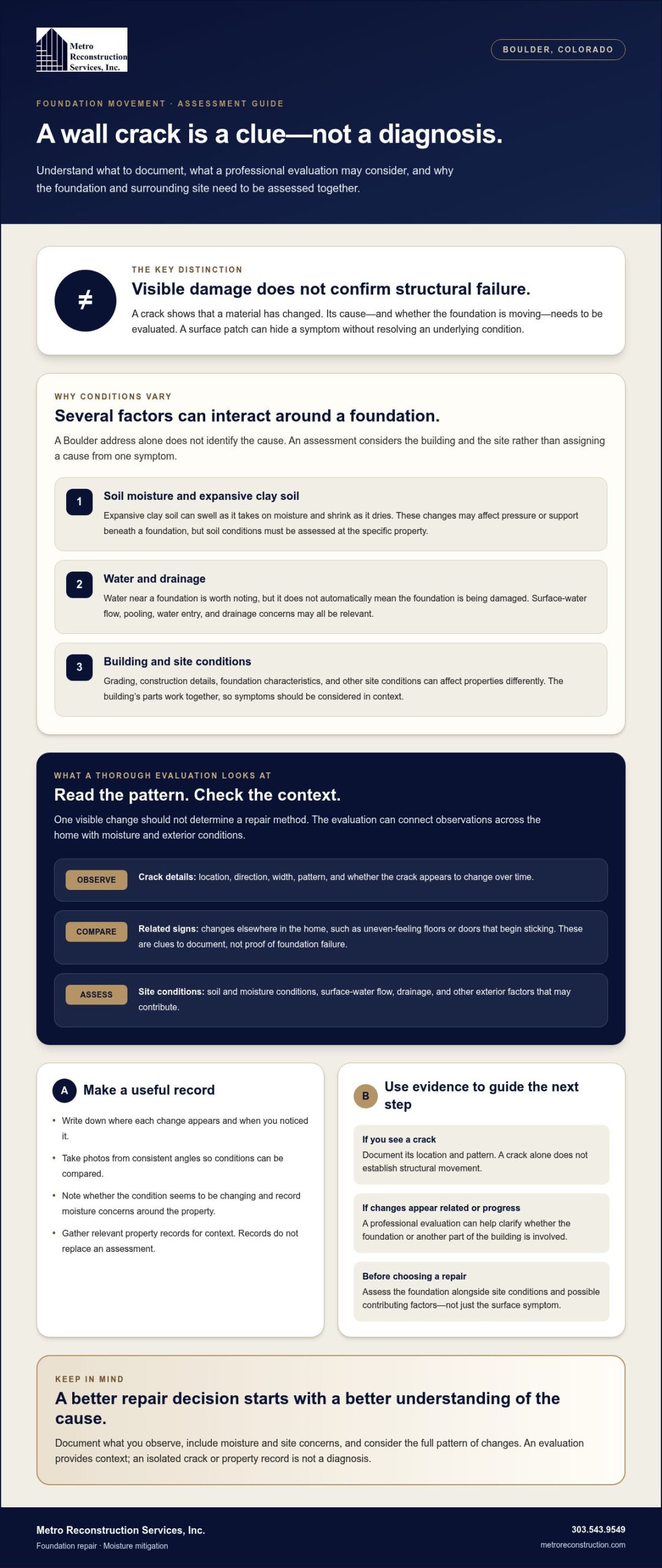
A crack shows that a material has changed, but it does not identify why. Its location, direction, width, and relationship to other signs can help a professional assess what may be happening. Whether it changes over time matters, too. The same visible symptom can have different explanations, so one observation shouldn’t determine a repair method.
When is foundation movement a structural concern?
Changing cracks, uneven-feeling floors, or doors that begin sticking are clues to document, not proof of foundation failure. If several related changes appear or an existing condition seems to progress, a professional evaluation can help clarify whether the foundation or another part of the building is involved.
Keep a simple record. Note the date and location of each observation, take photos from consistent angles, and describe whether the condition appears to be changing. This record can help an evaluator compare conditions over time, but it doesn’t replace an assessment.
Why Boulder property conditions need an individual assessment
Expansive clay soil can swell as it takes on moisture and contract as it dries, potentially creating pressure or changes in support beneath a foundation. Boulder-area soil conditions make this a relevant factor to consider, but they don’t prove that soil movement caused a particular crack or symptom.
Water near a foundation, grading, construction details, and other site conditions can affect properties differently. A useful assessment considers these factors together rather than assigning a cause based on location alone. Structural systems also vary. For general background, deep foundation methods transfer building loads farther below the surface, but that concept alone doesn’t determine what a specific property needs.
For structural foundation repair Boulder homeowners can approach with better information, start by documenting what you see and asking for an evaluation that considers the building and site conditions. Metro Reconstruction Services, Inc. is a family-owned firm with over four decades of experience, offering specialized foundation repair and moisture mitigation services. The company serves Boulder and communities across the Front Range and mountain areas, including Parker, Morrison, Longmont, Niwot, Evergreen, Cherry Creek, Cherry Hills Village, Golden, Genesee, Littleton, Broomfield, Denver, Silverthorn, Breckenridge, Vail, and Larkspur. Contact the team or call 303.543.9549 to discuss your concern.
How Soil, Water, and Building Conditions Can Affect Boulder Foundations
A foundation responds to the ground beneath it and to conditions around the building. Soil moisture, surface drainage, foundation details, and the building envelope can interact, so a crack or other change shouldn’t be assigned to one cause without examining the property. Foundation movement can result from several interacting conditions, and understanding their relationship is more useful than treating one symptom in isolation.
How expansive clay soil may contribute to movement
Expansive clay soil absorbs water and swells, then contracts as it dries. If soil conditions vary around a foundation, those changes may place uneven pressure on parts of the structure. The Colorado Geological Survey explains the behavior of expansive soils in Colorado. Still, soil type and its effects depend on the specific site. A Boulder address alone doesn’t establish that soil movement caused a building change.
A professional assessment can consider soil conditions alongside the location and pattern of visible changes. That helps avoid treating a possible contributing factor as a confirmed cause.
Why moisture management belongs in a foundation evaluation
Water near a foundation is relevant, but it doesn’t automatically mean the foundation is being damaged. An evaluator may consider where surface water flows, whether it collects near the building, and whether water entry or drainage concerns are present. Foundation drainage solutions should be considered alongside structural conditions, not as a substitute for understanding them.
The home’s outer system matters, too. Roof runoff, exterior walls, grading, and foundation details all influence how water moves around the building. A change in one area may affect moisture conditions elsewhere, which is why an evaluation should look at related components rather than one isolated spot.
For more information about the company’s foundation repair services, review its service information. If you’re concerned about moisture or foundation changes, contact Metro Reconstruction Services, Inc. or call 303.543.9549 to discuss the property and possible next steps.
How Professionals Assess Structural Foundation Repair Needs
A useful evaluation follows a sequence: document what you’ve noticed, review the building and site conditions, consider possible causes, then discuss next steps. This separates an initial observation from a confirmed finding and a repair recommendation. For structural foundation repair Boulder properties may need, the aim is to understand the pattern and context before deciding whether work is appropriate.
What to document before requesting an evaluation
Make a record of visible changes before patching or covering them. Note approximate dates, the room or exterior location, and whether the condition seems to have changed. Photos taken from consistent angles can help show changes over time. Also note water entry, changes in drainage, or nearby work that may be relevant to the timeline. These details help describe the concern, but they don’t establish its cause.
Useful information can include:
- Where cracks or other changes appear, and when you first noticed them.
- Whether doors, floors, or other areas have changed since then.
- Any known moisture concerns, drainage changes, or work near the affected area.
How an evaluation moves from observations to next steps
A professional should look for relationships among the observations rather than draw conclusions from one defect. Building records and site conditions may add context. If expansive clay soil is a concern, the Colorado Geological Survey’s information on Colorado’s expansive soils can provide background, but it can’t confirm what is happening at your property. The evaluator can then explain what the findings support and what remains uncertain.
Ask the professional to describe the condition observed, the likely contributing cause, and how the proposed scope would address that cause. The explanation should make clear whether the recommendation responds to an underlying condition or only changes a visible surface. Ask what information supports the recommendation and whether further verification or another specialist’s input may be needed.
A repair plan should also identify the limits of what is known. If the cause cannot yet be confirmed, ask what additional assessment could help resolve that uncertainty before work proceeds. Clear answers make it easier to compare a lasting response with a cosmetic patch, without assuming one repair method is right for every foundation.
Metro Reconstruction Services, Inc. provides specialized foundation repair and moisture mitigation for Boulder and Front Range communities. To discuss your concern, contact the team or call 303.543.9549.
Choosing a Durable Foundation Repair Approach for a Boulder Property
A suitable repair recommendation should connect the observed condition to evidence about its likely cause. The same visible symptom can have different explanations, so a method that fits one property may not fit another. For structural foundation repair Boulder homeowners should compare the reasoning behind recommendations, not just the names of proposed methods.
Use this table to organize questions for a qualified professional. These are possibilities to discuss, not diagnoses or instructions to select a repair.
| Observation | Possible contributing condition | Question to ask |
|---|---|---|
| A crack appears to change over time | Movement, moisture changes, or another building condition | What evidence helps identify the cause, and what remains uncertain? |
| Water collects near part of the foundation | Surface drainage or site conditions affecting soil moisture | How were water patterns considered alongside the foundation condition? |
| Several areas show related changes | More than one building or site factor may be involved | How does the proposed work address the likely cause, not just the visible symptoms? |
How to compare repair recommendations without guessing
For each recommendation, compare four points: the stated problem, the evidence supporting it, the proposed work, and how that work is expected to address the cause. Ask which site conditions could affect the approach and what follow-up may be appropriate. If recommendations conflict or leave important questions unanswered, another qualified opinion can help clarify the basis for the decision.
Don’t assume a particular method is right based on a crack or a general description of the property. A clear recommendation should explain why it fits the findings and identify any limits in what’s known.
Why moisture and the building envelope still matter
Foundation performance can relate to drainage and connected exterior conditions. Roof runoff, grading, walls, and foundation details influence how water moves around the building. Addressing a structural concern without considering relevant moisture conditions may leave part of the problem unexplained. Ask how those conditions were assessed and whether they form part of the proposed scope.
If the International Residential Code (IRC) may apply, verify current requirements with the local building department for your property and proposed work. Requirements can depend on jurisdiction and project scope.
Metro Reconstruction Services, Inc. provides specialized foundation repair and moisture mitigation. Review the company’s construction and restoration services, or contact the team to discuss your property. You can also call 303.543.9549.
Your Next Steps for Structural Foundation Repair in Boulder
You don’t need to diagnose a foundation concern before asking for help. For structural foundation repair Boulder homeowners can approach with useful context, start by organizing what you’ve observed and when. Clear records help a professional understand the concern, but they don’t confirm its cause or determine which repair, if any, is appropriate.
What to prepare before contacting a foundation professional
Gather information that can help describe the property and the timeline of changes:
- Dated photographs of visible conditions, taken from consistent angles when practical.
- Notes describing where symptoms appear and whether they seem to be changing.
- Details about water entry, moisture concerns, or changes in drainage near the building.
- Available property plans, past evaluation notes, and records of earlier repairs.
You can also ask how the evaluation will separate what is directly observed from what has been confirmed about the cause. That distinction matters: photographs and records provide context, while an on-site evaluation can consider the building and its conditions as a whole.
When to request a professional conversation
Consider requesting an evaluation if you notice changes over time or several related concerns. A conversation can help clarify what information is needed and what the next step may be. Photos alone can’t establish the cause or determine urgency. If you believe there’s an immediate hazard, keep people away from the affected area and contact appropriate local emergency or building professionals.
Metro Reconstruction Services, Inc. is a family-owned construction firm serving Boulder and Front Range communities, with over four decades of industry experience and specialized foundation repair and moisture mitigation services. For more about the company’s construction and restoration services, visit its services page.
If you’re ready to discuss your observations, property records, or moisture concerns, contact Metro Reconstruction Services, Inc. or call 303.543.9549. A focused conversation is a sensible next step toward understanding what your property needs.
Take the Next Step With Clear Information
A visible crack doesn’t confirm structural failure, and a surface patch may not address the condition behind it. Soil moisture, drainage, foundation details, and other building conditions can interact, so a sound repair decision begins with understanding the evidence. Document what has changed, note moisture concerns, and ask how an evaluation separates observations from confirmed causes.
For structural foundation repair Boulder homeowners should look for a recommendation that explains the problem, its likely contributors, and how the proposed work responds to them. The right next step depends on the property’s specific conditions, not a one-size-fits-all method.
Metro Reconstruction Services, Inc. is a family-owned firm serving Boulder and Front Range communities, with over four decades of industry experience and specialized foundation repair and moisture mitigation services. To discuss your Boulder foundation concerns, contact Metro Reconstruction Services, Inc. or call 303.543.9549.
Frequently Asked Questions
What is structural foundation repair?
Structural foundation repair addresses a confirmed condition affecting a foundation’s support or the building’s structural performance. The appropriate work depends on the cause and findings at the property, not on a generic list of methods. A crack or uneven floor alone can’t identify the needed repair. Ask a qualified professional to explain what was observed, what remains uncertain, and how any proposed work would address the underlying condition.
Can a foundation crack mean my Boulder home needs structural repair?
A crack can be a reason to request an evaluation, but it doesn’t automatically prove structural failure. Its location, pattern, apparent change over time, and relationship to other observations all matter. If you searched “structural foundation repair Boulder,” keep in mind that a search term can’t diagnose your home. Photograph the crack, note when you first saw it, and ask a professional to consider it alongside soil, drainage, and building conditions.
How does expansive clay soil affect a foundation?
Expansive clay soil can swell as it absorbs water and shrink as it dries, potentially exerting pressure on a foundation. The effect depends on the soil and moisture conditions at a specific property, so it shouldn’t be assumed to explain a crack or other change. A useful evaluation considers soil conditions alongside drainage, construction details, and observed movement before identifying a likely cause or discussing repair options.
What should a foundation repair evaluation include?
An evaluation should explain the observed conditions, likely contributing causes, and how any proposed work would address them. Share dated photographs, notes about changes, moisture concerns, and relevant property records to provide context. Ask the professional to distinguish confirmed findings from possibilities and describe what remains uncertain. The evaluation should be specific to your property. A method selected from a generic list isn’t a substitute for understanding the site.
Should I patch a foundation crack before having it evaluated?
If practical, document the crack and nearby area before covering or changing it. A patch can make the original condition harder to assess, and it doesn’t confirm or resolve an underlying cause. Take clear photographs and note whether the crack appears to change. If you’re also seeing water entry or other changes, record those details and contact a qualified professional for guidance about an appropriate next step.
Can drainage problems contribute to foundation movement?
Drainage and water conditions can affect the ground near a foundation, but they’re only part of a site-specific assessment. Grading, soil, foundation details, and other building conditions may also be relevant. Don’t assume a drainage change is the sole cause of movement. Ask the professional to explain how surface water and moisture conditions relate to the observations and whether they were considered alongside the foundation itself.
When should I contact a foundation repair professional in Boulder?
Consider requesting a professional conversation if cracks appear to change, several related concerns occur, or moisture issues coincide with visible movement. Keep notes on dates and locations, and take photographs where practical. These details help explain what you’ve noticed, but they can’t diagnose the cause or determine safety from images alone. If you believe there’s an immediate hazard, contact appropriate local professionals promptly. To discuss your concern, contact Metro Reconstruction Services or call 303.543.9549.