
You’re closing the front door of your 1940s bungalow when you notice the latch no longer meets the strike plate, requiring a firm lift just to secure your home. It’s easy to dismiss this as the simple character of an aging property, but for Colorado homeowners, these small shifts often signal a deeper conflict between your house and the soil beneath it. Identifying the early signs of foundation problems in older homes is the most effective way to protect your investment from the expansive clay soils that define our region.
We understand the anxiety that comes with spotting a new crack in the plaster or a gap in the exterior masonry. You might find yourself wondering if you’re looking at a harmless cosmetic blemish or a structural failure that could lead to an overwhelming repair bill. This 2026 guide provides the clarity you need by detailing exactly which red flags require immediate attention and how Colorado’s 140 annual freeze-thaw cycles impact your building’s complete outer system. You’ll gain a clear checklist to evaluate your property’s health and a reliable path toward a forensic evaluation that prioritizes long-term stability over temporary patches.
Key Takeaways
- Learn to distinguish between cosmetic age-related settling and the active signs of foundation problems in older homes to avoid unnecessary panic or costly delays.
- Identify why sticking doors and cracks near window corners are often early warnings of deeper structural shifts rather than simple humidity changes.
- Understand how Colorado’s expansive clay soils and frequent freeze-thaw cycles exert immense pressure on your building’s complete outer system.
- Discover the “quarter-inch rule” for crack width and why addressing moisture intrusion is the essential first step in any restoration project.
- See how a forensic approach to structural stabilization can preserve the integrity of your vintage property through specialized mitigation strategies.
Understanding Foundation Movement in Older Colorado Properties
Every house experiences some degree of movement as it ages, but for properties built 40 or more years ago, the line between harmless settling and active failure is often thin. Normal settling usually occurs within the first few years after construction as the weight of the structure finds its balance. In contrast, active foundation failure is an ongoing process where the soil continues to shift the building, leading to the progressive signs of foundation problems in older homes that many owners fear. Identifying the difference requires a forensic approach that looks beyond the surface to understand the hidden mechanics of the structure. We don’t just look at a crack; we analyze why the crack exists by studying the relationship between the building and its environment. Precision matters.
The Role of Expansive Soils in the Front Range
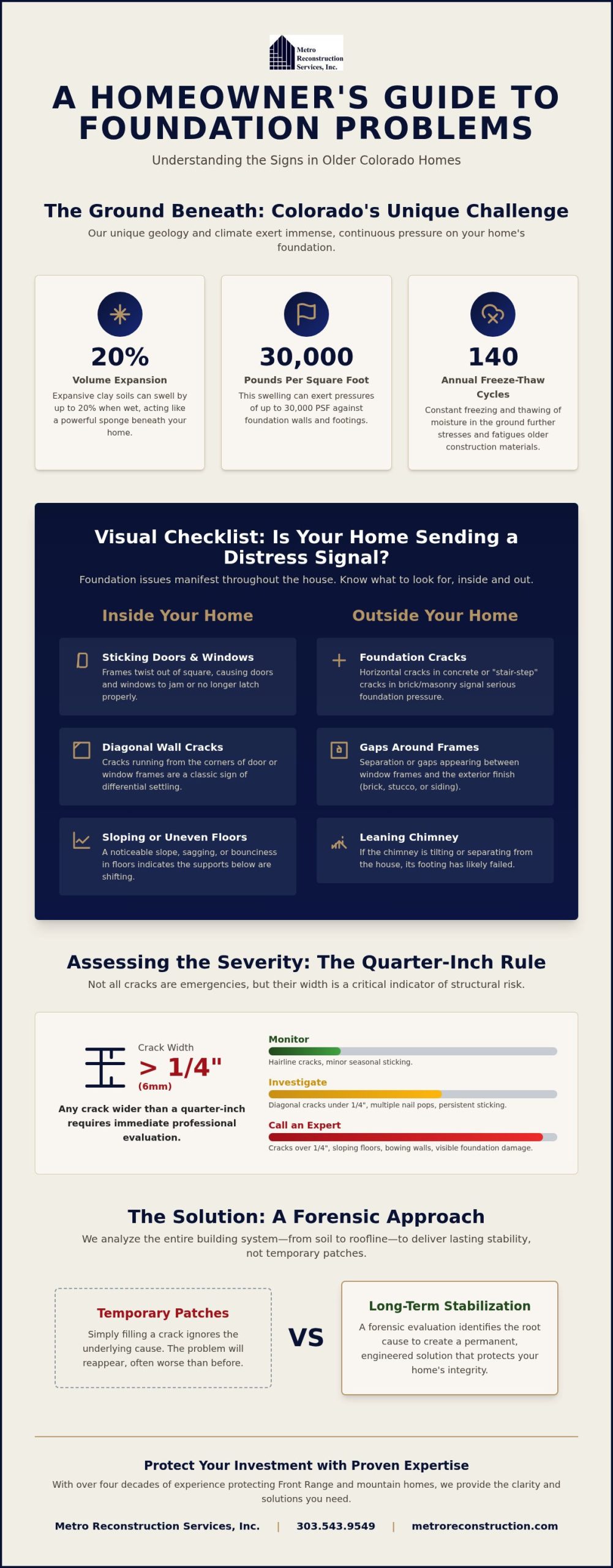
Colorado’s geology presents a specific challenge known as expansive soil, which is common throughout areas like Boulder, Denver, and Parker. These soils act like a sponge; they swell significantly when they absorb moisture and shrink as they dry out. Research indicates that these clay soils can expand by up to 20% in volume, exerting pressures of up to 30,000 pounds per square foot against a foundation. For an older home, this rhythmic stress creates a cycle of pushing and pulling that eventually overcomes the strength of the original footings. Over decades, this environmental pressure leads to significant structural shifts that demand professional stabilization. By recognizing the early signs of foundation problems in older homes, you can implement a long-term solution that preserves the integrity of your property.
Age-Related Vulnerabilities of Vintage Foundations
The construction methods used in the mid-20th century differ significantly from the high-strength poured concrete and reinforced steel used today. Older homes often rely on unreinforced masonry or early concrete mixes that lack the flexibility to withstand Colorado’s 140 annual freeze-thaw cycles. This prolonged exposure leads to structural fatigue, which is the gradual weakening of building materials over time. When these materials reach their limit, they no longer just settle into the ground; they begin to fail under the weight of the house. We view the building’s complete outer system as a single unit. A failure in the foundation eventually manifests as damage in the stucco or masonry above, proving that the foundation is not an isolated component but the base of a complex, interconnected system.
If you suspect your property is experiencing these shifts, it’s vital to act before the damage spreads. Our family-owned firm has over four decades of experience protecting Front Range and mountain homes from these unique soil conditions. You can reach our experts at 303.543.9549 or visit our contact page for a professional evaluation of your home’s structural health.
Interior Red Flags: What Your Walls and Floors Are Telling You
The interior of your home often acts as a sensitive diagnostic tool, reflecting the stress occurring deep within the foundation. When the ground beneath your property shifts, the rigid wooden frame is forced to twist and distort to accommodate the movement. This warping manifests in specific, observable ways that go beyond simple age. Recognizing these signs early is the key to preventing a manageable repair from turning into a structural crisis. We look for the hidden mechanics of the structure to see how these interior symptoms relate to the building’s complete outer system.
Analyzing Wall and Ceiling Cracks
Not all cracks are created equal. Fine, straight hairline fractures in plaster or drywall often result from seasonal temperature changes or minor settling. However, diagonal cracks that originate from the upper corners of door and window frames are definitive signs of foundation problems in older homes. These patterns indicate that one side of the frame is sinking faster than the other, pulling the wall material apart. You might also notice nail pops, where the heads of drywall screws or nails push through the paint. This occurs when the wooden studs behind the wall shift and twist, forcing the fastener out of its original position. For homeowners who discover that these structural shifts have damaged their interior finishes, consulting with experts in high-end renovations, such as Silver Tile & Stone, LLC, can help in planning the eventual restoration of your kitchen or bathroom tile and flooring once the foundation is secured.
If you’ve noticed that your favorite chair seems to sit at an angle, or if a ball placed on the floor consistently rolls toward the same wall, your home likely has a sloping floor. This sensation of bouncy or uneven flooring is a direct result of the support beams beneath the house losing their level position. In many vintage Colorado homes, this movement also causes gaps to appear between the baseboards and the floor, or between the crown molding and the ceiling. These aren’t just cosmetic gaps; they’re evidence of the house pulling itself apart.
When the foundation shifts, it affects every component, including the interior cabinetry. Gaps appearing between your kitchen cabinets and the wall are a significant red flag because it means the wall itself is pulling away or bowing. These issues rarely resolve themselves and often point to a need for professional intervention. Reviewing specialized foundation repair services can provide insight into the stabilization methods required for your specific property. Understanding the underlying structural origins of these interior shifts is the first step toward property preservation. If you’re concerned about your home’s stability, contact us at 303.543.9549 or visit our contact page for a professional evaluation.
Exterior Indicators: Identifying Structural Shifts from the Outside
While interior shifts tell one story, the exterior of your property serves as a visible history of structural stress. In Colorado’s demanding climate, the signs of foundation problems in older homes are often etched into the building’s complete outer system. We look beyond the surface to identify exactly where the ground’s movement has forced the exterior materials to yield. These indicators are rarely isolated; they represent a fundamental conflict between the rigid house frame and the shifting soil beneath it.
Stucco and Masonry as Structural Messengers
Masonry and stucco are rigid materials that lack the elasticity to bend when a foundation settles unevenly. You might observe stair-step cracks following the mortar lines in brickwork, which is a classic indicator of a sinking corner or a failing footing. Similarly, stucco often reacts to foundation shifts by bulging, cracking, or flaking away from the underlying lath. Patching these cracks without addressing the structural origin is merely a temporary aesthetic fix. The movement will inevitably return and reopen the gap because the underlying soil pressure remains unaddressed. For a holistic solution, integrated stucco and masonry repairs must be paired with foundation stabilization to ensure the long-term preservation of the property.
Chimney and Roofline Displacements
The chimney is often the heaviest component of an older home’s exterior, and it frequently rests on its own separate footing. If you notice a visible gap between the chimney and the siding, or if the stack appears to lean away from the roofline, this is a structural emergency that requires immediate forensic attention. Other subtle indicators include gaps at the frieze board where the siding meets the roof, suggesting the entire frame is tilting. You should also inspect the very base of the house for horizontal cracks in the foundation wall itself. These often indicate that water pressure from wet soil is pushing the wall inward, a common result of the 140 annual freeze-thaw cycles we experience in the Front Range.
Precision in the exterior envelope is vital for moisture protection and structural integrity. Gaps appearing around garage door frames or exterior window trim often signal that the house is no longer square. When these openings distort, they allow water to penetrate the complete outer system, leading to wood rot and further destabilization. If you see these shifts, contact our experts at 303.543.9549 or reach out through our contact page for a detailed property assessment. We prefer to explain the difficult truth of a structural failure rather than offer a low-quality patch that will fail in the coming seasons.
Assessing the Severity: When to Call a Forensic Structural Expert
While a single hairline crack might not keep you up at night, knowing exactly when a cosmetic issue becomes a structural emergency is vital for property preservation. Industry standards often point to the quarter-inch rule; if a crack in your foundation or masonry exceeds one-fourth of an inch in width, it has likely surpassed the limit of simple settling. In the context of the Front Range, waiting to see if a crack grows can be a costly mistake. Unlike general advice to monitor cracks for months, our local soil conditions can cause damage to accelerate rapidly during the spring thaw. Identifying these signs of foundation problems in older homes requires a meticulous eye for detail. Ignoring these warning signs invites severe risks, including the compromise of the building’s complete outer system, persistent mold growth in damp crawl spaces, and, in extreme cases, total structural collapse.
The Danger of Superficial Fixes
Many homeowners attempt to address these issues with quick, low-cost patches. Filling a structural gap with caulk or covering it with a fresh layer of stucco might improve the home’s appearance, but it does nothing to stop the underlying soil-structure conflict. These superficial fixes effectively act as a blindfold, hiding deep failures until they become far more difficult and expensive to remediate. In older properties with crawl spaces, hidden moisture intrusion often leads to foundation rot and wood decay that remains unseen by the untrained eye. A forensic evaluation is the only way to identify the structural origin of the movement and ensure a long-term solution rather than a temporary mask.
Moisture Mitigation and Drainage
Water is the primary driver of foundation movement in 90% of cases. In Colorado, our intense weather cycles mean that managing how water interacts with your property is your first line of defense. Improper gutter drainage and soil that slopes toward the foundation are the two most common contributors to structural failure in cities like Parker and Niwot. When water pools near the perimeter, it saturates the expansive clay, leading to the massive pressures discussed earlier. Professional grading and specialized building systems that direct moisture away from the home are essential components of any restoration strategy. If you suspect your drainage is failing, we recommend a professional structural evaluation to protect your investment. You can reach out to our team at 303.543.9549 or visit our contact page for a detailed forensic assessment.
Professional Foundation Mitigation and Restoration Strategies
Once you have identified the signs of foundation problems in older homes, the focus shifts from observation to professional mitigation. We believe that every structural challenge requires a forensic analysis to ensure that the solution addresses the root cause rather than just the symptoms. Unlike competitors who might push a single, proprietary product, our family-owned firm has spent over four decades developing a methodology that respects the unique construction of vintage properties. Since 1982, we’ve provided Front Range homeowners with the peace of mind that comes from precision engineering and long-term stability. Our approach is grounded in the understanding that older footings and masonry react differently to stabilization than modern poured concrete. Precision matters.
Custom Solutions for Older Structures
A vintage residence isn’t a generic structure; it’s a collection of specialized building systems that must work in harmony. Custom home designs from the mid-20th century often require tailored repair strategies that modern, high-pressure firms may overlook. We bring a sense of quiet confidence to every project, utilizing our deep expertise to preserve the original integrity of your property. For homeowners looking for a comprehensive approach that handles both the structural origins and the resulting architectural changes, our design-build services offer an integrated path to restoration. We prioritize accuracy from the very first diagnostic step to ensure your investment is protected for the next forty years.
Restoring the Complete Outer System
Structural stabilization is only half of the restoration puzzle. When a foundation is secured, the movement inevitably impacts the exterior envelope, particularly in homes with stucco or detailed masonry. We specialize in the seamless integration of structural repair with high-quality stucco restoration and masonry work. This holistic focus ensures that your home’s aesthetic matches its newly reinforced structural integrity, leaving no trace of the previous failure. Whether you’re in Boulder, Denver, or the surrounding mountain communities, our team provides the rugged reliability needed for our regional environment. When you notice the signs of foundation problems in older homes, don’t settle for a temporary patch that ignores the hidden mechanics of your home. Contact Metro Reconstruction Services, Inc. today at 303.543.9549 or visit our contact page to schedule a professional forensic evaluation of your property.
Securing the Structural Integrity of Your Vintage Property
Preserving a vintage property in the Front Range requires more than just aesthetic maintenance; it demands a deep understanding of how your house interacts with Colorado’s unique environment. By learning to identify the signs of foundation problems in older homes, you can address structural shifts before they compromise your building’s complete outer system. We’ve explored how a forensic approach identifies the underlying origins of movement, allowing for restoration strategies that offer long-term stability rather than temporary, superficial fixes. Taking proactive steps today prevents the accumulation of structural fatigue and protects your investment from the region’s intense soil pressures.
Our family-owned firm brings over 40 years of specialized expertise to every project, ensuring that your home’s legacy is guarded by meticulous craftsmanship and engineering-led solutions. We’re dedicated to providing the quiet confidence and reliability your property deserves. Protect your home’s legacy. Contact Metro Reconstruction Services, Inc. today or call us at 303.543.9549 for a professional forensic evaluation. Your home is a significant investment, and it’s our mission to help you preserve it for the next generation.
Frequently Asked Questions
Are cracks in an old house always a sign of foundation problems?
Not every crack indicates a structural failure. Small hairline fractures often result from thermal expansion or the natural aging of building materials. However, if you notice diagonal cracks exceeding a quarter-inch in width, especially near door frames, these are definitive signs of foundation problems in older homes. We recommend a forensic evaluation to determine if the movement is active or if the building has simply reached a point of stable settling.
How much do foundation repairs typically cost for older homes?
The total investment for structural restoration depends entirely on the complexity of the engineering requirements and the specific soil conditions at your property. Because we prioritize long-term solutions over superficial patches, we provide fixed-price fees based on a detailed scope of work. This approach ensures that your project budget covers the precise materials and specialized equipment needed to stabilize your home’s complete outer system without the surprise of unquoted costs.
Can I sell a house with foundation issues in Colorado?
A typical stabilization project can take anywhere from a few days to several weeks depending on the severity of the shift. We focus on accuracy and precision, ensuring that the structural origin of the problem is fully resolved. Projects in mountain communities or those requiring integrated stucco restoration may take longer to ensure a seamless finish. Our team provides a clear timeline after completing an initial assessment of your property’s unique needs.
Is foundation damage covered by standard home insurance?
Most standard insurance policies in the Front Range exclude damage resulting from earth movement, soil expansion, or gradual settling. Coverage is generally only available if the damage was caused by a sudden, covered event like a major plumbing failure. Because these repairs are often an out-of-pocket expense, identifying issues early is the best way to protect your investment. Delaying repair often leads to more extensive damage to your home’s complete outer system.
What is the most common cause of foundation failure in Boulder?
The primary cause of failure in Boulder and Niwot is the presence of expansive clay soils that swell and shrink with moisture changes. These soils exert thousands of pounds of pressure against older footings that weren’t designed for such intense environmental stress. When combined with our 140 annual freeze-thaw cycles, the soil creates a rhythmic cycle of movement that eventually causes masonry and concrete to crack. Proper moisture mitigation is essential for stopping this cycle.
How can I tell if a crack is structural or just cosmetic?
Structural cracks are usually wider than a quarter-inch and follow a diagonal or stair-step pattern through brickwork or stucco. You should also look for secondary symptoms like doors that stick in their frames or gaps appearing between your walls and the ceiling. If you spot these signs of foundation problems in older homes, it’s time to call a specialist. Cosmetic cracks are typically thin, straight, and don’t grow or change over the seasons.
Why is stucco cracking often linked to foundation movement?
Stucco is a rigid material that serves as a sensitive indicator for the building’s complete outer system. When the foundation shifts, the wooden frame beneath the stucco twists, forcing the exterior finish to buckle under the pressure. Patching these cracks without addressing the foundation is a temporary fix that will inevitably fail. For a permanent solution, contact us at 303.543.9549 or visit our contact page for a professional forensic evaluation.