
A remodeling project payment schedule should track the work, not just the calendar. It divides the contract into payments due at agreed milestones or set intervals, with the amount and timing tied to the project plan. It should also explain retainage, the portion held until completion, and how changes affect payments.
It makes sense to want predictable payment dates and a fair connection between payments and progress. But if demolition reveals concealed damage or a selection changes the work, a fixed schedule may no longer match the project. Clear milestone descriptions and written updates help keep payment expectations aligned with the work underway.
This article explains how milestone-based and time-based schedules work, when retainage may apply, and how payment timing supports cash flow. You’ll also learn how to document a scope change so the schedule reflects revised work, materials, and timing instead of creating confusion.
Key Takeaways
- Connect each payment to a clearly described milestone or agreed time interval so both sides can follow the schedule.
- Set deposit and final payment terms in the agreement, including what must be complete before the final payment is due.
- Use measurable signs of completed work instead of relying only on a general estimate of project progress.
- Define how retainage is held and when it is released to keep completion expectations clear.
- Document changes to the work and update payment timing to reflect revised tasks and project progress.
What Is a Construction Payment Schedule?
A construction payment schedule divides the agreed project amount into payments tied to dates or completed work. For a remodel, it states when the deposit, progress payments, and final payment are due.
Deposit and Final Payment Arrangements
A deposit is an initial payment, while the final payment is due after the agreed work is complete. Listing both in the contract helps you understand the payment sequence before construction begins.
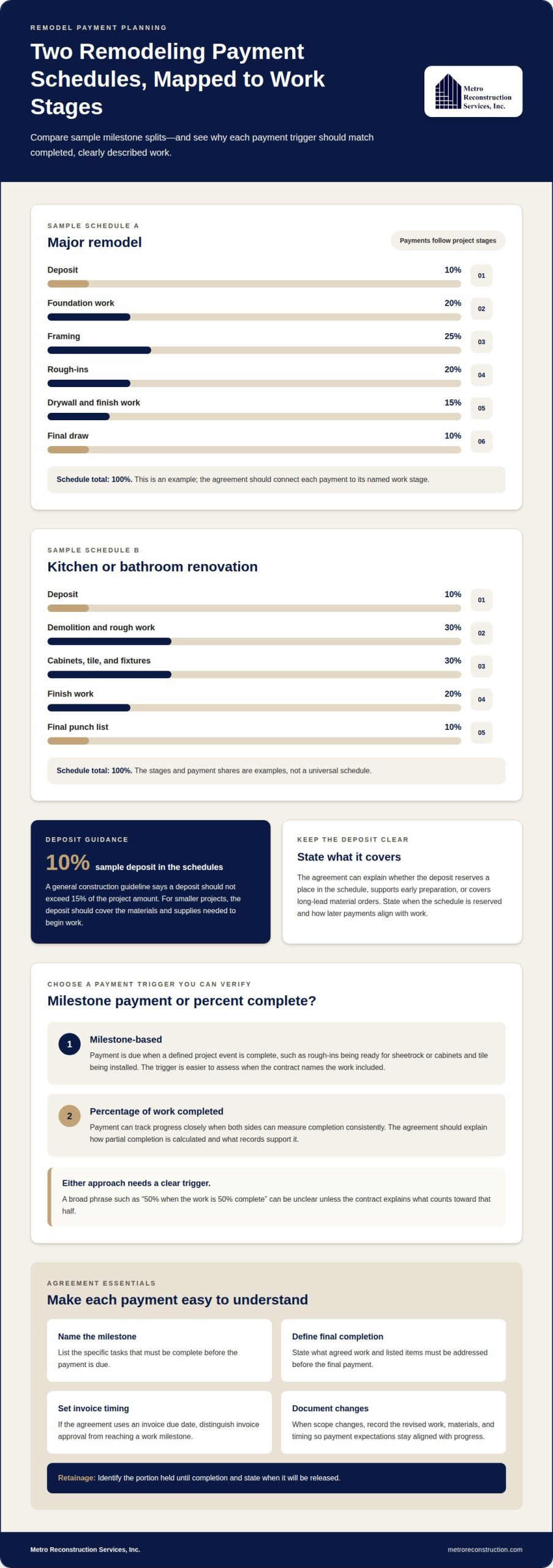
For example, one sample renovation schedule calls for a 10% deposit when the proposal is signed, followed by payments at defined work stages. The agreement should state what work triggers each payment and how the remaining balance is calculated. It should also describe what counts as completion before the final payment is due, such as finishing agreed work and addressing listed items.
Payment terms can also set an invoice due date. Some agreements specify payment within 15 days or 30 days after invoice approval. These are examples of possible terms, not a universal deadline. Clear wording lets you plan for each payment and distinguish an invoice’s approval date from the date work reaches a milestone.
Deposits and Construction Start Dates
A deposit may reserve a place in the construction schedule and support early project preparation. For example, a builder may use a 10% deposit to reserve a time slot and pre-purchase long-lead items.
The agreement should state what the deposit covers, such as scheduling or ordering materials, rather than leaving its purpose unclear. Material orders and site work may happen at different stages. A written start-date arrangement can explain when the schedule is reserved and how later payments align with actual work, rather than implying that the entire project begins as soon as the deposit is paid.
Deposit Limits and Project Scale
Deposit guidance differs by project, and a general construction guideline says a deposit should not exceed 15% of the project amount. For a smaller project, the deposit should cover the materials and supplies needed to begin work.
Small renovations often involve fewer stages, so their schedules may include a deposit, one or more progress payments, and a final payment. Major remodels typically spread payments across more milestones because the work may move through structural, framing, mechanical, and finish stages. The schedule should reflect the actual sequence, not simply copy a template. Project scope and work order determine the payment plan.
Typical Home Remodeling Payment Schedules
A typical schedule uses a deposit, milestone payments, and a final payment, but the percentages vary by project type. One major-remodel example assigns 10% to the deposit, 20% to foundation work, 25% to framing, 20% to rough-ins, 15% to drywall and finish work, and 10% to the final draw.
A kitchen or bathroom example uses 10% as a deposit, then 30% after demolition and rough work, 30% after cabinets, tile, and fixtures, 20% after finish work, and 10% for the final punch list. These examples show how a remodeling project payment schedule can follow completed stages. Your agreed schedule should name each trigger clearly and add up to the full contract amount.
Question: Why not have percentage payments due based on percentage of work done instead of milestones driven installment payments?
Payments based on the percentage of work completed can reflect progress closely, but only when both sides can measure that progress consistently. A contractor who completes 30% of the contracted work in a given month may submit an invoice for that completed portion. The challenge is agreeing on how the actual percentage is measured, especially when separate tasks advance at different rates.
Milestone-based installment payments are tied to defined project events. Common remodeling milestones include demolition and structural work, rough-ins, cabinet or tile installation, finish work, and final completion. Each payment becomes due when the agreed stage is complete, rather than when someone estimates the job has reached a certain percentage.
For example, a completion-based plan might trigger payment at every 20% of project completion, or at every 10%. Those intervals still depend on a reliable measure of completion. A term such as “50% when the work is 50% complete” can be unclear if the contract doesn’t explain what counts toward that half. Measurable criteria make a based payment easier to assess and document.
- Demolition and structural work: Define which removal and structural tasks must be finished.
- Rough-ins: State which rough work must be ready before the next stage.
- Finish installation: Identify the specific cabinets, tile, fixtures, or trim included.
- Completion: Describe the remaining work required before the final payment is due.
A sample renovation schedule sets a 20% payment at the rough-in milestone, described as ready for sheetrock. That phrase gives the client and contractor a visible point in the work sequence. The contract can also identify the work covered by the milestone, so an invoice does not depend on a broad impression of progress.
Milestones are most useful when they match the project’s actual sequence. Structural work may need to finish before rough-ins begin, while materials, inspections, or access can affect later tasks. If payments are based on percentage of completion, the agreement should explain how partial completion is calculated and what records support it. Either way, connect each payment to a clear scope, documented progress, and an agreed trigger. This reduces disputes about whether payment is due and helps align orders with work stages.
Retainage
Retainage is the portion of a contract payment withheld until an agreed completion point. State its percentage, release trigger, and timing clearly in the contract.
Retainage Practices
Retainage holds back part of progress payments, creating a balance due after specified work is complete. Construction retainage commonly withholds 5% to 10% of each payment until substantial or final completion.
Practices vary by project and agreement. Retainage typically is not used on residential remodels under $100,000, while commercial projects may use 5% to 10%. A contract template should identify whether retainage applies, which payments it affects, and how withheld amounts relate to the contract value. That detail helps you understand the expected payment total at each stage.
Retainage Rules and Release Terms
Release terms specify when withheld funds become payable and which completion conditions trigger release. In California, retainage for construction work must be paid within 45 days of project completion, according to California Legislative Information.
California law requires retainage to be given to subcontractors within 10 days of project completion, according to California Legislative Information. These timelines concern California construction work; the agreement should make the applicable release process clear for the project.
For a residential remodel, the contract can state whether retainage is withheld from each progress payment or reserved as a final balance. If substantial completion and final completion trigger different releases, define both. A clear trigger prevents uncertainty about whether remaining work, inspections, or agreed corrections must be finished first.
Retainage also affects the amounts available during construction. For example, if a contract withholds 5% from each progress payment, the contractor receives the remaining portion when that payment is approved. The accumulated balance is released under the stated terms, rather than treated as an undefined discount or an extra charge.
Use a written schedule that connects each withheld amount to its payment and release condition. Include the retainage percentage, which payments are subject to withholding, the completion standard, and the release timing. If the project changes, document whether the contract value or completion conditions have changed, then revise the retainage terms in writing. This creates a clear record of what is held and when it becomes due.
Why payment schedules matter for cash flow and timely payment
A defined payment schedule connects approved work to expected payments, helping both sides plan cash flow. For example, you can forecast a rough-in payment when the work reaches its agreed milestone, rather than treating it as an uncertain future receipt. This timing helps a contractor plan labor, material orders, and subcontractor payments. You can also see when funds are expected to leave your account.
Construction cash flow depends on when money comes in and goes out. A contractor may need to pay for materials before installation, while subcontractors may be paid after completing their work. If payment dates don’t align with these project events, a timing gap can develop. A written schedule makes the dates visible and gives the project team a shared basis for planning.
Payment timing also affects subcontractor coordination. For example, framing may need to be completed before another trade begins rough-ins. If payment approval is delayed or the completion trigger is unclear, the contractor’s cash flow plan can be disrupted, affecting subcontractor payments and the start of later work. A schedule helps by linking invoices to documented progress and clear approval terms.
To build a useful cash flow projection, map expected payments against major project stages. Include the deposit, each progress payment, material orders, subcontractor commitments, and the final balance. Record what makes each payment due, such as completed rough work or installed finish materials. When the sequence changes, update the projection and document why. This turns the forecast into a working project record, not a set of dates detached from construction.
Clear terms can also reduce payment disputes. A contract should define the amount due, the work or event that triggers payment, the invoice process, and the due date. If you and the contractor disagree about whether a milestone is complete, photos, progress notes, and an itemized invoice can clarify the work being billed. Keeping these records together makes it easier to resolve questions before they affect later payments.
The safest practical payment method is one stated in the signed contract and supported by an invoice and a transaction record. Keep the invoice, proof of payment, and related milestone documentation together; this creates a clear record if questions arise.
For a remodeling project, predictable payment timing supports more than bookkeeping. It helps coordinate material orders, crew scheduling, and subcontractor payments while giving you a clear view of upcoming obligations. The schedule works best when each payment trigger is clear, approval terms are recorded in the contract, and changes are documented before they alter the forecast.
Adjusting the payment schedule when projects change
A remodeling plan can change after demolition exposes concealed conditions, a material selection changes, or the agreed scope is revised. Each change can affect labor, material orders, and work sequence, so the original billing dates may no longer match progress. Review the payment schedule when the scope changes instead of leaving it tied to tasks that have been altered or removed.
A remodeling contract should state when payments are due, what work triggers each payment, and how written change orders affect billing. It should also explain how a change is approved and documented before revised work proceeds. These terms create a clear record of the new scope and its payment timing.
For example, opening an exterior wall may reveal damage that requires additional work. The contractor can document the condition, describe the added work, and revise the affected milestone. The change order should link the added scope to its revised billing trigger, rather than treating the original milestone as complete when the work has changed.
A useful change record can include:
- The original milestone and the work it covered.
- The changed condition or requested scope revision.
- The added, removed, or revised tasks.
- Labor logs, receipts, and progress documentation supporting the change.
- The adjusted payment trigger and its relationship to the revised work.
These records help distinguish a schedule adjustment from a disagreement about completed work. For example, if a selected finish changes after materials have been ordered, the record can show which tasks remain, which need revision, and how the next payment milestone is affected. Keep the revised terms with the contract so everyone is working from the same schedule.
Review the payment plan as the project evolves. If a change delays a milestone, the next payment date may need to move. If added work creates a new stage, the schedule may need another billing point. Tie each adjustment to documented progress and the agreed scope. This keeps the revised schedule useful for forecasting, rather than leaving outdated dates in place.
Clear documentation also supports a fair discussion if you and the contractor interpret a change differently. Compare the signed scope, change order, and progress record for the affected task. Then update the payment schedule in writing before relying on revised timing. Discuss the project change so its scope and payment timing can be considered together.
Metro Reconstruction Services, Inc.
Metro Reconstruction Services, Inc. handles exterior remodeling projects, including stucco restoration, masonry work, and stucco installation and replacement. For this type of work, payment terms are clearest when they follow the agreed scope and recognizable stages, rather than a general estimate of progress.
Before work begins, align the written schedule with project milestones, invoice timing, final payment conditions, and the process for documenting changes. If the scope shifts, record the revised work and its effect on payment timing. This keeps the agreement connected to the work being performed and gives you a clear reference as the project advances.
Contact Metro Reconstruction Services, Inc. to discuss your exterior remodeling project.
Set Your Project Up for Clear Decisions
Before committing to a remodel, make sure the written agreement reflects the work you expect, how decisions will be recorded, and how revisions will be handled. A remodeling project payment schedule is most useful when it supports clear communication throughout the work, especially when a condition or selection changes the plan.
Exterior projects may involve connected materials and surfaces, so precise scope descriptions matter alongside payment terms. Metro Reconstruction Services, Inc. works on exterior remodeling, including stucco and masonry projects. A clear discussion of your project’s scope can help establish a practical starting point for planning.
Contact Metro Reconstruction Services, Inc. to discuss your remodeling project and its next steps. A thoughtful plan gives you a stronger foundation for moving forward with confidence.
Frequently Asked Questions
Should I issue final payment prior to completion?
Generally, no. The final payment is usually tied to completion of the contracted work, not an earlier date. If a project pauses because of a selection or scheduling issue, compare the agreement’s completion terms with the work actually finished. For example, distinguish completed installation from materials still awaiting installation, and record any remaining tasks before treating the project as complete.
Why are payment schedules important?
A written payment schedule gives you a record for matching invoices to the agreed work. That record is useful if a bill includes a task you understood to be part of another stage, or if project documentation shows the task is still underway. Keep the signed agreement, approved changes, invoices, and payment receipts together so you can trace how each billed amount relates to the project. For project questions, call 303.543.9549.
How much deposit can a remodeling contractor legally require by state?
Deposit limits depend on the state whose rules apply to the project. In California, a construction deposit is capped at 10% or $1,000, whichever is less. That California limit should not be assumed to apply in Colorado or another state. For a project in Parker, Boulder, or elsewhere in Colorado, make sure the written agreement reflects the requirements that govern that project.
How should payments be tied to completed work and inspections?
Connect each payment trigger to an identifiable task and any inspection required for that stage. For example, the agreement can state that payment follows completion of specified work and the relevant inspection approval, when applicable. Identify the record that shows the milestone is reached, such as an inspection result or dated progress report. This makes the payment condition easier to distinguish from work still underway.
What percentage of a remodeling contract should be paid upfront?
There is no single percentage that fits every remodeling contract. One sample renovation schedule uses a 10% deposit, but that is an example, not a universal requirement. The amount should be clearly stated and connected to the project’s agreed start arrangements and initial needs. Review how the remaining payments are distributed, too, so the upfront amount does not leave later work without defined payment terms.
Should homeowners withhold final payment until punch-list work is complete?
Use the contract’s definition of completion and final payment rather than relying on an informal understanding of the punch list. Record each remaining item, its location, and whether it affects an agreed part of the work. For example, distinguish a correction to installed work from a new request outside the original scope. Clear records help both sides identify what remains before final payment is due.
What are the risks of paying a contractor too much before work is completed?
Paying ahead of documented progress can leave you with less unpaid contract balance to address unfinished or incomplete work. It can also make it harder to reconcile an invoice with tasks that have not been performed. Before releasing a progress payment, compare the invoice with the written scope and project record. Keep proof of payment and approved change documentation with your agreement.