
What if the most critical component of your home’s exterior isn’t the finish you see, but the invisible moisture management system hidden beneath it? Many homeowners in the Front Range view stucco primarily as an aesthetic choice, yet they often share a valid anxiety regarding hidden water damage or the impact of intense freeze-thaw cycles on their property’s value. You deserve a solution that prioritizes structural health over superficial fixes. This article demonstrates how a technically precise stucco installation protects your investment from Colorado’s unique environmental stressors through a holistic, system-based approach.
Achieving a durable, fire-resistant exterior requires more than just applying a coating; it demands a forensic understanding of how different building elements interact with our local climate. We’ll examine the functional differences between traditional three-coat systems and synthetic EIFS, while detailing how adherence to ASTM C926 and the latest building codes ensures your home remains protected. Whether you’re following the 2021 I-Codes adopted by Boulder County in March 2025 or the 2024 City of Boulder standards effective August 2025, a holistic approach is essential. By focusing on the building’s complete outer system, you’ll secure lower energy bills and the peace of mind that comes from a technically sound installation.
Key Takeaways
- Discover how a system-based approach to stucco installation mitigates the structural risks posed by Colorado’s rapid temperature fluctuations and intense solar exposure.
- Understand the critical role of the drainage plane and why precise moisture management is the foundation of any high-performance exterior cladding.
- Evaluate the technical trade-offs between traditional hard-coat systems and synthetic EIFS to select the best thermal and impact protection for your home.
- Learn why window-to-stucco transitions are the primary source of moisture intrusion and how to integrate these components into a unified outer system.
- Gain clarity on why local expertise and fixed-price reconstruction models provide the most reliable path toward protecting your property’s long-term value.
Understanding Stucco Installation in Colorado’s Demanding Climate
Stucco is far more than a simple layer of plaster; it’s a sophisticated, multi-layered exterior cladding system designed to act as a building’s primary defense against the elements. Whether the system utilizes a traditional cementitious mix or a modern acrylic formulation, its purpose is to provide a durable, weather-resistant skin that protects the underlying structure. To appreciate the complexity of these materials, one might first ask, What is Stucco? At its core, it’s a protective barrier, but its success depends entirely on the precision of the application. We approach every project with forensic accuracy, identifying potential failure points in the building’s envelope before the stucco installation even begins. This diagnostic phase ensures that we aren’t just covering up problems, but rather solving them at their source.
In Boulder’s mountain and foothills communities, the choice of exterior materials carries significant weight beyond mere curb appeal. Stucco provides an essential ignition-resistant barrier, offering a critical layer of protection for homes situated in wildfire-prone areas. This inherent fire resistance, coupled with the material’s longevity, makes it a premier choice for homeowners who prioritize safety and property preservation. However, achieving this level of protection requires a deep understanding of how local environmental stressors interact with the building’s complete outer system. A standard application that might suffice in a milder climate will quickly deteriorate under Colorado’s relentless 300+ days of annual sunshine and extreme temperature shifts.
The Impact of High-Altitude UV and Temperature Fluctuations
At an elevation of 5,000 feet and higher, UV radiation is significantly more intense than at sea level, which can cause inferior finish coats to become brittle and lose their pigment over time. Even more challenging are the rapid freeze-thaw cycles common along the Front Range, where a sixty-degree temperature swing can occur in a single afternoon. When moisture enters microscopic gaps and subsequently freezes, the resulting expansion forces the material apart; consequently, we mitigate this risk through the use of premium materials and strategically placed expansion joints. These joints are essential components that allow for the natural thermal movement of the building, ensuring the rigid surface doesn’t buckle or crack under environmental stress.
Addressing Expansive Soils and Structural Movement
Boulder County is characterized by expansive bentonite soils, which swell significantly when moisture is present and contract during dry periods. This constant soil movement exerts immense pressure on a home’s foundation, often leading to subtle shifts that can manifest as structural cracks in an unforgiving exterior finish. Because a rigid stucco shell cannot survive on a shifting base, it’s often necessary to evaluate the underlying stability of the home. This reality underscores the importance of foundation repair services to ensure a stable, immobile substrate for any new work. By addressing these structural origins, we ensure that your stucco installation remains a long-term asset rather than a temporary fix. Precision at the foundation is the only way to guarantee integrity at the surface.
The Anatomy of a High-Performance Three-Coat Stucco System
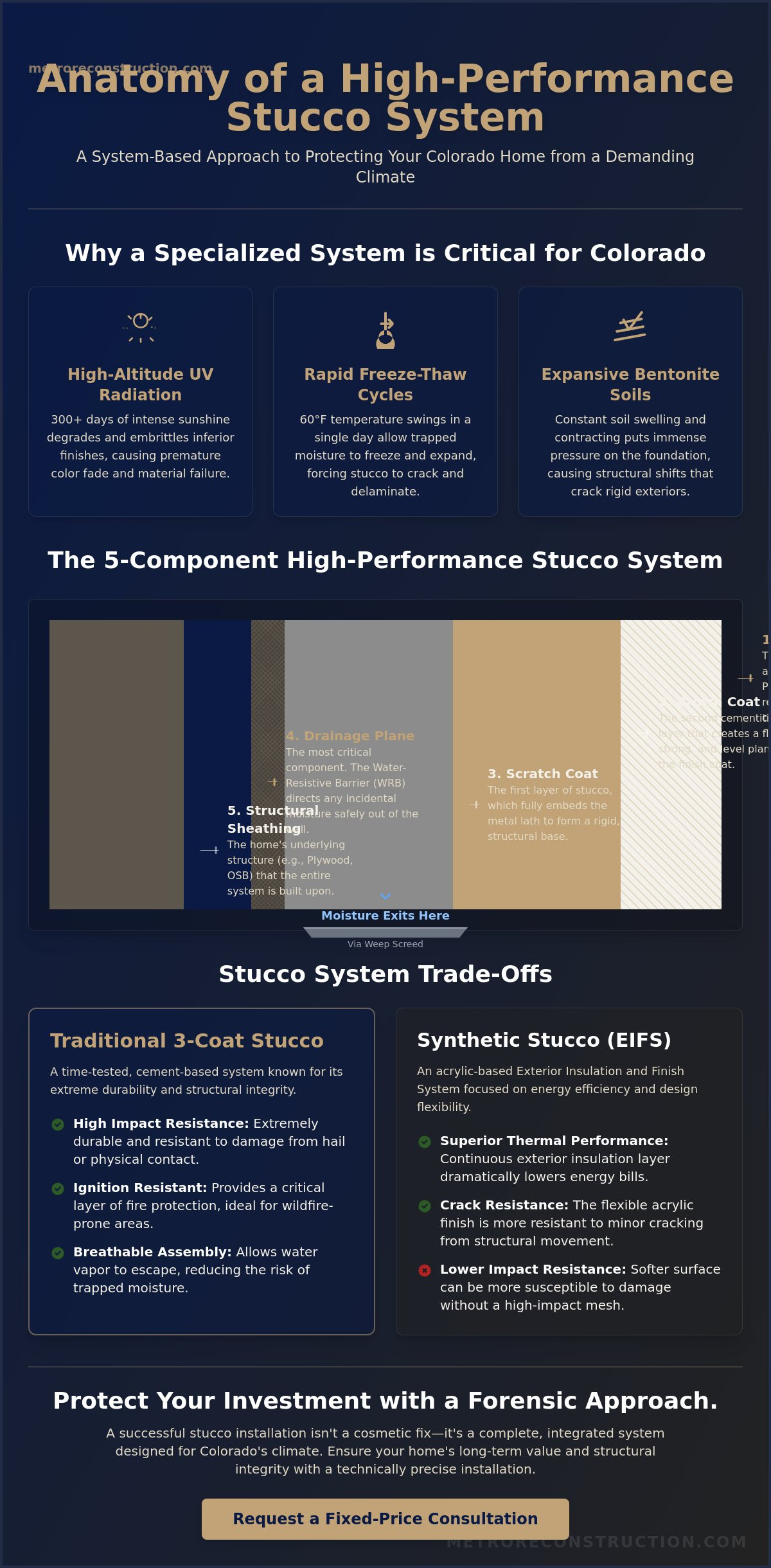
A successful stucco installation is defined by the integrity of its layers rather than the final appearance of its texture. In our technical view, a high-performance system functions as a managed drainage assembly. It’s designed to accept that a small amount of moisture may inevitably bypass the outer skin. By utilizing a forensic approach to the drainage plane, we ensure that any incidental water is safely directed away from the structural sheathing and out of the building via weep screeds. Without this intentional moisture management, water becomes trapped, leading to the rot and mold that many Boulder County homeowners rightfully fear. A robust three-coat system consists of five essential components:
- Water-Resistive Barrier (WRB): Two layers of high-grade vapor barrier that protect the substrate.
- Lath: A self-furring metal mesh that provides the structural “skeleton” for the mortar.
- Scratch Coat: The initial cementitious layer that creates a mechanical bond with the lath.
- Brown Coat: The leveling layer that establishes a true, structural plane.
- Finish Coat: The final aesthetic and protective barrier, often acrylic or color-integrated cement.
Step 1: The Moisture Management Foundation
Structural protection is won or lost during the lath and flashing phase. We apply high-grade vapor barriers and specialized flashing at every penetration, including windows, doors, and transition points. The use of self-furring metal lath is a technical requirement; it creates a consistent gap behind the mesh to ensure the cementitious coats completely embed the metal. This total encapsulation prevents corrosion and provides the tensile strength necessary to resist the environmental stressors of the Front Range. If you’re concerned about existing failures, a professional evaluation of your complete outer system can identify where these foundational layers may have compromised your home’s integrity.
Step 2: The Cementitious Layers (Scratch and Brown)
The scratch and brown coats provide the system’s mass and impact resistance. After the scratch coat is applied and horizontally scored to create a mechanical key, the brown coat is layered to create a flat surface. In Colorado’s notoriously dry air, the curing process requires forensic monitoring of hydration. If the mortar dries too quickly, it fails to reach its intended structural density and becomes brittle. We ensure proper curing times between applications, following the technical guidelines found in resources comparing traditional and synthetic stucco systems. This patience results in a substrate that can withstand decades of thermal movement.
Step 3: The Aesthetic and Protective Finish
The finish coat serves as the primary defense against UV radiation and moisture. Homeowners can choose from various textures, ranging from contemporary smooth finishes to traditional heavy lace styles, to match their architectural vision. While this layer provides the color and character of the home, its chemical composition is what truly protects the underlying cement. For homes requiring a blend of materials, integrating stucco and masonry repairs ensures a cohesive, weather-tight transition between different exterior elements. A precise stucco installation concludes with a finish that remains flexible enough to accommodate the building’s natural shifts while remaining impervious to the elements.
Comparing Traditional Cement Stucco and Synthetic EIFS
Choosing the right system for a stucco installation involves more than a surface-level preference for texture; it requires a diagnostic evaluation of the home’s structural origins and thermal requirements. Traditional three-coat stucco, often called hard coat, relies on a portland cement-based plaster that has served Colorado architecture for decades. Conversely, Exterior Insulation and Finish Systems (EIFS) provide a lightweight, synthetic alternative that prioritizes thermal performance. While older EIFS applications faced scrutiny regarding moisture entrapment, modern engineering has introduced integrated drainage planes that mirror the moisture management principles discussed in the previous section. We approach this choice from a forensic perspective, ensuring the system matches the building’s specific movement patterns and energy goals.
The decision between these systems often hinges on the specific environmental stressors your property faces. Traditional systems offer unmatched impact resistance, while modern EIFS excels in creating a high-performance building envelope. Both options, when installed with technical precision, meet the ignition-resistant construction requirements mandated by the 2021 and 2024 building codes active in Boulder County and the City of Boulder. Our role is to guide you through these technical trade-offs to ensure the long-term preservation of your investment.
When to Choose Traditional Three-Coat Stucco
This system remains the benchmark for durability and ruggedness in the Front Range. It’s particularly well-suited for high-traffic areas or homes prone to heavy hail, as the cementitious layers provide a rigid, rock-like shell that is difficult to penetrate. Traditional stucco is highly breathable, allowing moisture vapor to escape the wall assembly naturally. It boasts an impressive lifespan of 50 to 80 years when properly maintained. However, the installation process is labor-intensive; it requires specific curing intervals between coats to reach its full structural density. It’s the “Wise Craftsman” choice for those who value substance and time-tested reliability over rapid completion.
The Advantages of Modern EIFS for Energy Efficiency
For homeowners focused on sustainability and climate control, EIFS offers a compelling technical advantage. By wrapping the building in a continuous layer of rigid foam insulation, this system effectively eliminates thermal bridging. This is the process where heat escapes through the wooden studs of the wall. Modern EIFS typically provides an insulation value of R-4 to R-6 per inch, which can significantly lower energy bills in our demanding climate. The acrylic finish is also more flexible than cement, allowing it to bridge minor structural movements without developing hairline cracks. Because EIFS is a proprietary, multi-component system, it requires specialized EIFS repair expertise if the outer membrane is ever breached. When installed with a dedicated drainage plane, it provides a sophisticated solution for the modern, energy-conscious home.
Beyond the Surface: Integrating Windows, Masonry, and Moisture Mitigation
A building’s envelope is a complex assembly where different materials must work in harmony to repel the elements. A high-quality stucco installation is only as reliable as its weakest transition point, which is why we treat every project as a complete outer system. This holistic perspective acknowledges that the interface between different building components is where most structural failures begin. By identifying underlying structural origins rather than applying superficial fixes, we provide a level of protection that surface-level contractors simply can’t match. When we manage the entire exterior, we eliminate the gaps that often lead to long-term damage.
Precision at the boundaries of your home’s exterior isn’t just about aesthetics; it’s about engineering a moisture-proof seal. Whether we are performing a new application or a complex restoration, we focus on the forensic details of how water moves across the surface. This analytical depth allows us to predict how environmental stressors will impact the structure years down the line. Every termination, joint, and transition is a deliberate decision in a broader strategy of property preservation.
The Critical Window-Stucco Interface
Window-to-stucco transitions are the most frequent source of moisture intrusion in Colorado homes. To prevent water from reaching the vulnerable wooden framing, a window installation service near me must be meticulously synchronized with the lathing and flashing phases of the stucco process. We conduct a forensic check of every head flashing and pan flashing to ensure they’re properly integrated into the drainage plane. When these elements aren’t aligned, water becomes trapped behind the finish; this cause-and-effect relationship is the primary driver of localized rot and mold. Proper window integration isn’t an optional upgrade; it’s a structural necessity for property preservation.
Holistic Exterior Home Repair and Preservation
Addressing a crack or a stain with a simple patch often fails because it ignores the moisture origins hidden within the wall assembly. Effective exterior home repair requires an analytical depth that looks at the building as a unified whole. This is particularly true when integrating masonry accents, such as stone veneers or brick details. These materials have different expansion rates and water absorption profiles than stucco. Without specialized flashing and proper sealant joints at all terminations, water can dam behind the stone, leading to catastrophic failure of the substrate. We ensure all masonry work is structurally tied to the substrate and properly flashed to maintain the integrity of the moisture barrier.
Protect your investment by ensuring your window and stucco installation is managed as a single, high-performance system.
Selecting a Stucco Installation Partner in Boulder County
Choosing a partner for your stucco installation is a decision that defines the structural longevity of your home. In an industry often crowded with high-pressure sales tactics and superficial fixes, Metro Reconstruction Services, Inc. prioritizes a grounded, engineering-led approach. Because the Front Range presents such specific environmental challenges, our four decades of local, family-owned experience allow us to anticipate failures that others might miss. We don’t view ourselves as a mere service provider; we’re a dedicated partner in the long-term preservation of your property. Our expertise isn’t just in the application of materials, but in the forensic understanding of how those materials must function as a unified system.
One of the most significant risks homeowners face is the “low-ball” estimate. These initial quotes often ignore the underlying structural origins of damage to secure a contract. Consequently, the project inevitably faces delays and rising costs through change orders once the difficult truth of the structure is revealed. Metro Reconstruction Services, Inc. operates through a Fixed-Price Reconstruction model. This ensures that the technical requirements of your project are fully diagnosed and priced accurately from the start; this provides you with financial certainty and a technically superior result that protects your investment.
The Metro Reconstruction Services, Inc. Difference: Integrity and Precision
Our identity is rooted in the persona of the Wise Craftsman. This means we value substance over speed and precision over shortcuts. We take a forensic approach to every layer of the building’s complete outer system, ensuring that the moisture management and structural ties are correctly executed before the finish coat is ever applied. We’d rather explain the necessity of a complex structural repair than offer a temporary, low-quality patch that will fail in a few seasons. This commitment to integrity is what instills immediate trust and provides lasting peace of mind for clients facing complex challenges.
Next Steps for Your Stucco Project
The path to a durable exterior begins with a comprehensive consultative process. We move from a broad assessment of your home’s current condition to a specific identification of potential failure points. Once the diagnostic phase is complete, our personalized project management ensures that every stage of the stucco installation adheres to our strict standards of accuracy. This step-by-step methodology guarantees that the final result is not just aesthetically pleasing but structurally sound. It’s a logical progression designed to eliminate the anxiety of hidden water damage or mold.
If you’re ready to move beyond superficial fixes and invest in a long-term solution, the first step is a professional evaluation. We’ll help you understand the hidden mechanics of your structure and develop a plan that protects your home from Colorado’s unique stressors. Contact Metro Reconstruction Services, Inc. today to begin a forensic assessment of your property’s exterior needs and ensure your home remains a protected, fire-resistant asset for decades to come.
Securing Your Property’s Future Through Technical Precision
Investing in a high-performance exterior is a commitment to long-term property preservation. A successful stucco installation depends on the forensic integration of every component, from the initial water-resistive barrier to the final protective finish. By prioritizing a managed drainage system and precise window-to-stucco transitions, you effectively mitigate the risks of moisture intrusion and structural decay. We believe that integrity starts with identifying the underlying structural origins of potential failures rather than offering superficial patches.
As specialists in moisture mitigation and structural integrity, Metro Reconstruction Services, Inc. brings over 40 years of Boulder County expertise to every project. Since 1982, our family-owned and operated firm has focused on providing homeowners with the peace of mind that comes from engineering-led solutions. Schedule Your Forensic Stucco Assessment with Metro Reconstruction Services, Inc. to ensure your home remains a durable and fire-resistant asset. You deserve a partner who values substance and precision at every layer of your home’s complete outer system.
Frequently Asked Questions
Is stucco a good choice for the Colorado climate?
Stucco is an excellent choice for the Front Range because it withstands intense high-altitude UV radiation and provides significant thermal mass. However, its success depends on a technically precise application that accounts for the rapid temperature shifts common in Boulder. Without a managed drainage plane and proper expansion joints, the material cannot accommodate the stress of local freeze-thaw cycles.
How long does a professional stucco installation take to complete?
A high-quality three-coat system typically requires several weeks to ensure each cementitious layer cures correctly in our dry environment. While the application of the layers themselves may be relatively swift, the structural integrity of the system is won during the hydration phase between the scratch and brown coats. Rushing this process leads to brittle failure and compromise of the building’s complete outer system.
What is the difference between traditional stucco and EIFS (synthetic stucco)?
Traditional stucco utilizes a portland cement base that offers superior impact resistance and breathability; conversely, EIFS is a multi-layered synthetic system featuring rigid foam insulation. EIFS provides higher energy efficiency, typically R-4 to R-6 per inch, and uses a flexible acrylic finish that resists hairline cracking. The choice depends on whether your priority is rugged durability or maximum thermal performance.
Can stucco be installed over existing siding or brick?
Stucco can be applied over brick with proper surface preparation and a bonding agent, but we generally recommend removing existing wood or vinyl siding to access the underlying substrate. This allows for the installation of a new water-resistive barrier and flashing, which are foundational to moisture management. Installing over old siding often hides structural decay and prevents the forensic accuracy required for a long-term solution.
How do you prevent stucco from cracking in Boulder’s expansive soils?
Preventing cracks in Boulder’s expansive bentonite soils requires a stable foundation and the strategic use of expansion joints to manage structural movement. We focus on identifying underlying structural origins of instability before the application begins. If the foundation is shifting, the rigid shell will eventually crack regardless of the finish quality, making a stable base a technical necessity.
Is stucco fireproof, and does it help with wildfire protection?
Stucco is a premier ignition-resistant material that provides critical wildfire protection for homes in Boulder’s mountain and foothills communities. Both the 2021 I-Codes for the County and the 2024 codes for the City mandate these ignition-resistant features for new building permits. A professional stucco installation creates a non-combustible barrier that significantly enhances the safety of your property’s exterior.
How often does stucco need to be maintained or repainted?
Stucco requires minimal maintenance beyond annual inspections of sealant joints and occasional cleaning with a low-pressure garden hose. While traditional cement finishes may need a specialized fog coat or painting every 15 to 20 years, modern acrylic finishes are designed for exceptional color retention and UV resistance. Regularly checking the caulking at window-to-stucco transitions is the most effective way to prevent moisture intrusion.
What are the signs of a failing stucco installation?
Visible signs of a failing stucco installation include persistent brown staining around window corners, bulging sections of the wall, or white, powdery efflorescence. These symptoms often indicate that moisture is trapped behind the finish and is degrading the substrate. Identifying these structural failures early through a forensic assessment allows for restoration before the damage necessitates a complete replacement.