
Frame material alone won’t tell you which window is better for a mountain home. In a Pella Impervia vs. Marvin Elevate comparison, the right choice depends on the complete window assembly, selected glass, and the home’s conditions. Neither line is automatically the better option based on its name alone.
It makes sense to look beyond appearance: cold nights, strong sun, and sudden temperature changes can affect both the glass and the surrounding frame. A window’s performance depends on how these components work together.
This comparison covers thermal performance, temperature limits, glass options, and impact resistance for mountain conditions. It explains what to look for in product specifications, including design pressure, so you can compare complete assemblies rather than relying on one material or feature. The goal is to help you make an informed decision based on your home’s exposure and use.
Key Takeaways
- Compare each complete window assembly, not just its frame material; design pressure is a useful measure of overall strength.
- Consider how cold-weather condensation and frost could affect a cabin, especially when it’s unoccupied.
- Explore glass packages and Low-E options in light of your home’s exposure and occupancy patterns.
- Assess impact resistance as part of the whole window system rather than relying on material strength alone.
- Use the decision guide to weigh thermal performance, temperature conditions, glass choices, and durability for your mountain home.
Energy efficiency and thermal stability
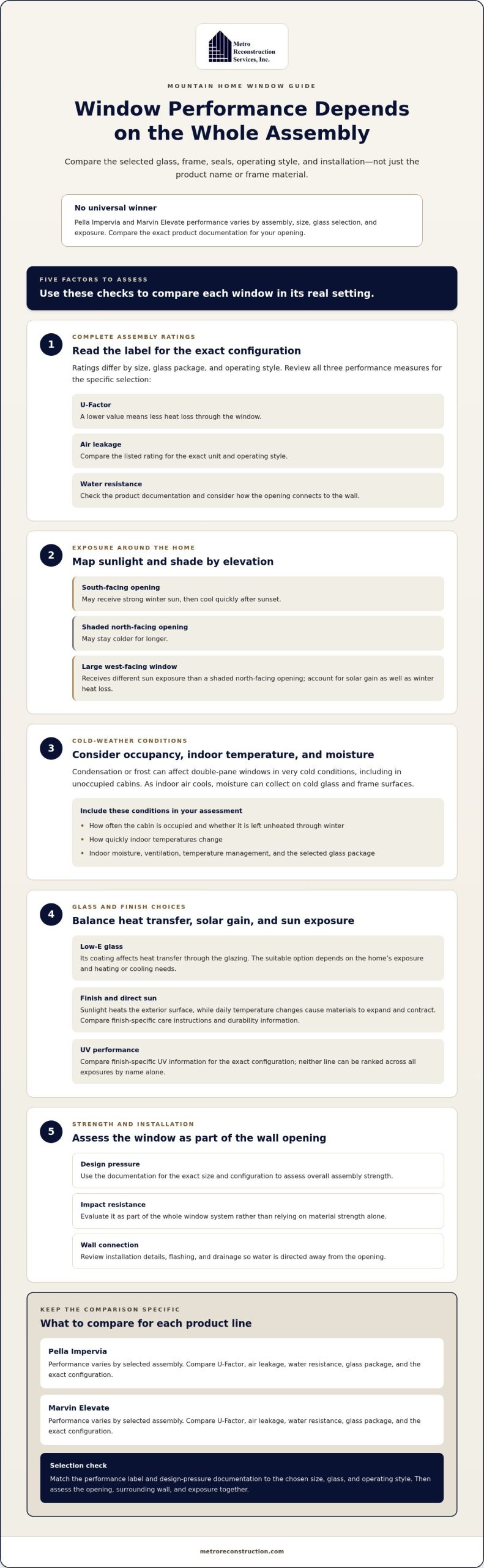
For a mountain home, compare the exact window configuration, not just the frame material. Pella Impervia and Marvin Elevate performance depends on the glass, frame, sash, seals, and installation. A low U-Factor means less heat loss through the window, but the full opening matters too. Air leakage and water resistance also affect comfort and durability.
What are the U-Factor, air leakage, and water resistance ratings for Pella Impervia and Marvin Elevate? Neither line has one universal rating for every size and configuration. Compare the performance label for each specific selection, including its glass and operating style.
Low-E glass has a coating that affects heat transfer through the glazing. The right option depends on the home’s exposure and heating or cooling needs. For example, a large west-facing window receives different sun exposure than a shaded north-facing opening. Consider solar gain as well as winter heat loss when comparing glass options.
| Window line | Thermal comparison | What to compare |
|---|---|---|
| Pella Impervia | Performance varies by selected assembly. | U-Factor, air leakage, water resistance, and glass package. |
| Marvin Elevate | Performance varies by selected assembly. | U-Factor, air leakage, water resistance, and glass package. |
How do maintenance needs and repairability compare for Pella Impervia and Marvin Elevate? Maintenance depends on the selected materials, finish, hardware, and exposure. Include seals, moving parts, and frame surfaces in routine upkeep, because damage to one component can affect the whole opening.
What warranty coverage do Pella Impervia and Marvin Elevate offer? Each line’s written warranty sets out its terms, exclusions, and covered components. Compare the warranty documents for the specific window and installation.
Which window options meet energy codes and ENERGY STAR requirements in mountain regions? Eligibility depends on the selected glass, the complete window’s performance, and the requirements for the project location. Compare product documentation with local criteria and applicable ENERGY STAR standards.
What are the installed prices of Pella Impervia versus Marvin Elevate windows? The final configuration depends on unit dimensions, selected glazing, and installation scope. Those details make each project specification different.
Are local installers available for Pella Impervia and Marvin Elevate in mountain communities? Availability varies by community and product line. Installation should integrate the window with flashing, drainage, and the surrounding wall to direct water away from the opening.
Design pressure helps assess a window assembly’s overall strength. Compare documentation for the exact size and configuration, then review installation details as well. The finish, frame, glass, and wall connection all contribute to how the opening performs within the building envelope. Evaluate the specifications as a complete system, not as isolated features. This gives you a practical basis for selecting windows suited to your home’s exposure and requirements.
Ratings apply to the selected assembly, including its glass package and operating style, so one set of figures won’t apply to either line across the board. Check the performance label for the exact selection and all three ratings.
Neither product line is eligible in every case. Choose a complete window assembly with documented performance that meets the criteria for the project location.
Cold- and hot-weather temperature limits
Compare Pella Impervia and Marvin Elevate based on their specified assemblies and exposure, not a single temperature cutoff. The available comparison does not establish a winner for temperature limits. For a mountain cabin, start by considering how often it’s occupied, how quickly indoor temperatures change, and how much direct sun each elevation receives.
Very cold conditions can cause condensation or frost on double-pane windows, including in unoccupied cabins. As indoor air cools, moisture can collect on cold glass and frame surfaces. A cabin left unheated through winter may behave differently from a home kept at a steady indoor temperature. The glass package, indoor moisture, ventilation, and temperature management all affect the outcome.
Before selecting Marvin or Pella windows, map the exposures around the house. A south-facing window may get strong winter sun, then cool quickly after sunset. A shaded north-facing opening may stay colder for longer. These differences affect glass temperatures and comfort, even when openings use the same product line and finish.
When reviewing hot-weather performance, consider direct sun exposure and the frame’s finish. Sunlight heats the exterior surface, while daily temperature changes cause materials to expand and contract. A dark finish on a sun-exposed elevation may reach a different surface temperature than a light finish on a shaded wall. Compare finish-specific care instructions and durability information rather than assuming both colors age the same way.
Which window line is more resistant to UV exposure, temperature swings, and fading at high altitude? Neither can be ranked across all three factors by name alone. UV performance depends on the selected finish, while temperature response also depends on the complete assembly and exposure. Compare finish-specific UV data and assembly documentation for the exact configuration.
- For an intermittently occupied cabin: consider how cold indoor conditions and condensation may affect the glass.
- For a sunny elevation: compare finish documentation and the selected glazing before approving a color.
- For a replacement: assess the opening, surrounding wall, and exposure together.
Fiberglass is one material used in this category, but its presence alone doesn’t establish a window’s service temperature or resistance to fading. Ultrex is a material term associated with Pella Impervia comparisons, but the decision still depends on the selected assembly and finish documentation. A wood interior, where selected, changes the interior surface material, not the conditions on the exterior.
Use a simple review sequence: identify each window’s orientation, note whether the home stays heated, and compare the exact glass and finish specifications. Treat an upgrade as a complete assembly decision, not just a color or material choice. This helps match durability needs to the mountain home’s actual conditions.
Glass packages and Low-E options
For a mountain home, compare the glass package selected for each specific window, not just the product line. Low-E glass has a thin coating that changes how heat moves through glazing. The effect depends on the coating and window configuration. Start your Pella Impervia vs. Marvin Elevate for mountains comparison with the glass specifications for each opening, including pane arrangement and coating options.
Room orientation helps show which glass characteristics matter. A north-facing bedroom and a west-facing living room receive different sunlight. The west-facing opening may get stronger afternoon sun, while the north-facing opening gets less direct exposure. Compare available Low-E options for each elevation rather than assuming one package suits every room.
For a Pella Impervia vs. Marvin Elevate for mountains comparison, review documentation for the precise size and operating style. Don’t assume either line always uses the same panes, coatings, or performance. Fixed and operable windows may have different configurations. Match each selection to its exposure and intended use before specifying the order.
- Identify orientation: note whether each opening faces north, south, east, or west.
- Record use: distinguish regularly occupied rooms from seasonal spaces.
- Compare packages: match glass specifications to each exact window configuration.
Frames and glazing form one assembly, but serve different purposes. A composite frame, exterior finish, and interior color are parts of the window specification; color alone doesn’t identify its Low-E coating. Aluminum may be used in window construction, but its presence doesn’t determine the glass package. Compare frame and glazing information separately, then confirm they suit the same opening.
Ask how the selected glass affects visible light, solar heat, and winter heat loss. These are separate performance considerations. A coating that limits solar gain can also change how much daylight comes through. For example, a sunny great room and a shaded bedroom may have different priorities. A room-by-room schedule helps match each opening’s exposure to its intended use.
Use product documentation to compare Low-E and pane configurations for both lines. Record each room’s orientation, shading, occupancy, and desired indoor conditions. Then compare the corresponding glass options with that schedule. This keeps the decision specific to your home rather than a general product-line description, and gives you a clear basis for discussing the selected glazing alongside the frame and operating style.
A window professional at Metro Reconstruction Services, Inc. noted that lower-elevation or milder climates are often fine without triple-pane windows. For a mountain cabin that may not be occupied often during freezing weather, another window professional suggested considering triple-pane windows to help avoid condensation. These recommendations address different circumstances, so consider how often the home will be occupied when weighing glass options. For a rarely occupied high-altitude cabin, include condensation avoidance in the discussion. Discuss the choice with a professional at Metro Reconstruction Services, Inc. in the context of the home and its intended use, rather than assuming triple-pane glazing is necessary for every project.
Impact resistance
Impact resistance can refer to several different stresses, so define the concern before comparing window collections. A mountain home may face windborne debris, hail, accidental contact, or strong wind pressure. These conditions don’t test the same parts of a window. Glass may be vulnerable to direct impact, while the frame, sash, and hardware help keep the unit assembled and operating.
How do Pella Impervia and Marvin Elevate windows handle high winds and heavy snow? Performance depends on the exact unit size, configuration, glazing, and installation, so neither line can be ranked without those specifications. Wind pressure acts on the window assembly, while snow loads primarily concern the roof and supporting structure.
Separate the hazards around your site. A home near exposed slopes, for example, may need to account for wind exposure, while an opening beneath trees may face falling branches. Hail risk is also different from pressure resistance. A product description that refers generally to strength doesn’t establish performance against every type of impact. Match the stated test or rating to the specific hazard you want to address.
Review the glass specification and frame details together. The fiberglass exterior, sash construction, and operating hardware each serve a different role in the assembled window. Fiberglass windows aren’t automatically impact-rated because of their frame material. Likewise, evaluate any selected reinforced or laminated glass as part of the complete configuration, not as proof of performance for the entire opening.
- Describe the exposure: identify wind, hail, falling branches, or other likely impact sources.
- Identify each opening: record its size, operating style, and location on the home.
- Compare the documentation: match any stated test or rating to the hazard in question.
- Review installation: consider how the window is secured within the surrounding wall.
Custom openings need particular care because unusual dimensions can change the specified assembly. For a large window facing an exposed view, review the glass and frame information for that exact size. Don’t assume a rating for one configuration applies to every unit in the same collection. A sound decision depends on evidence for the specified product and hazard, not a general material comparison.
Interior hardware matters for operable units too. Locks and latches help keep the sash closed, but they don’t establish resistance to debris impact. Keep those functions distinct when weighing options. For fixed glazing, focus on the glass specification and the frame’s connection to the rough opening.
Use the same method for both lines: define the exposure, identify the exact configuration, then compare relevant product documentation and installation details. This keeps the decision grounded in the mountain home’s actual conditions.
How do Pella Impervia and Marvin Elevate compare in frame materials and construction?
Pella Impervia uses fiberglass construction, while Marvin Elevate combines a fiberglass exterior with a wood interior. That difference affects the material at each surface, but doesn’t establish which complete window is stronger. For a mountain home, compare the assembled frame, sash, glass, joints, and attachment details instead of judging one material in isolation.
Fiberglass can be up to eight times stronger than vinyl in some instances. That comparison describes a material relationship, not a rating for either window line. It also doesn’t mean all fiberglass windows perform identically. Window size, construction, glass, hardware, and installation affect how forces move through the complete unit.
Marvin Elevate’s wood interior gives the room a different frame surface than an all-fiberglass interior. That may matter when matching window finishes to interior trim or other woodwork. Evaluate its fiberglass exterior and the Impervia frame based on their specified finishes and care requirements. Material choice helps define the window, but finish and assembly details also shape long-term performance.
Look closely at corners, sash connections, operating hardware, and the frame-to-wall interface. A large fixed window, for example, has different construction demands from a smaller operable window. An operable unit adds hinges or other moving hardware, while a fixed unit has no opening sash. The configuration matters as much as the broad material category.
- Identify the frame makeup: distinguish the full-fiberglass construction from fiberglass exterior and wood interior.
- Compare the exact configuration: note whether each opening is fixed or operable.
- Review the assembly: consider frame, sash, glass, hardware, and wall attachment together.
- Match finishes: account for exterior exposure and interior trim preferences.
Design pressure helps assess a window assembly’s overall strength. Use the value for the exact size and configuration rather than treating fiberglass as a stand-alone strength rating. This matters on exposed mountain elevations, where the opening’s dimensions and support conditions affect how pressure reaches the surrounding wall.
Construction also involves moisture management. The frame must meet the rough opening with a sound sill, flashing, and drainage path. If water collects at the frame-to-wall junction, material strength alone won’t prevent moisture damage to nearby components. Consider the window as part of the building envelope, alongside exterior cladding and the wall’s water-control layers.
Choose by matching each line’s documented assembly, finish, operating style, and interior material to the opening. Fiberglass strength can inform the comparison, but it can’t replace design-pressure data or a careful review of the complete installation.
A window professional advised evaluating the strength of the complete window assembly rather than relying only on the raw material’s strength. This keeps the comparison focused on how the frame, sash, glass, hardware, and installation work together under the conditions at the opening.
Metro Reconstruction Services: Stucco Restoration
Metro Reconstruction Services, Inc. can help when window decisions bring cracking, separation, or moisture damage in the surrounding stucco to light. A replacement window alone won’t address deterioration in adjacent cladding or masonry; those parts of the exterior envelope need attention too. Stucco Restoration can address damaged stucco, while Masonry Work may suit related masonry concerns.
Consider an evaluation if you notice staining near a window, loose stucco at the opening, or cracks extending beyond the frame. Visible damage may point to a weakness in the surrounding wall assembly, so identifying its extent helps guide repairs. Metro Reconstruction Services, Inc. also provides stucco installation and stucco replacement for projects that need those services.
For help assessing stucco or masonry concerns around your windows, contact Metro Reconstruction Services, Inc.
Plan the Window Opening as Part of the Exterior
Choosing between Pella Impervia and Marvin Elevate for mountain conditions is also an opportunity to plan how each window connects with the surrounding wall. Before work begins, consider the rough opening, flashing, stucco or masonry condition, and drainage path together. This helps align the window project with the needs of the complete exterior envelope.
Metro Reconstruction Services, Inc. offers window installation and replacement, along with Stucco Restoration, stucco installation, and Masonry Work. If the wall around an opening shows cracking, separation, or moisture staining, addressing the surrounding material as part of the project can help avoid treating only the visible symptom. The appropriate work depends on the condition of the opening and adjacent finishes.
Bring your window plans and any visible exterior concerns into the next conversation. Contact Metro Reconstruction Services, Inc. to discuss your mountain-home project, and take the next step with a clear view of the window and the wall around it.
Frequently Asked Questions
What are the U-factor, air leakage, and water resistance ratings for Pella Impervia and Marvin Elevate?
Neither line has one universal rating. Compare the performance label for the exact size and configuration, including the glass package and operating style.
How do maintenance needs and repairability compare for Pella Impervia and Marvin Elevate?
Maintenance depends on the selected materials, finish, hardware, and exposure. Include seals, moving parts, and frame surfaces in routine upkeep, because damage to one component can affect the opening.