
Could the “new window break-in period” mean your home is temporarily more vulnerable? The phrase can sound like a warning, but it is not an official technical standard or a set period when a window is easier to breach. It usually refers to installation materials curing or new hardware becoming smoother with regular use. That adjustment is different from burglary resistance.
It’s reasonable to check that new windows close and lock properly, especially because installation details affect how the frame, sash, and surrounding wall work together. Security depends on the complete window assembly and its fit, not on one lock or a waiting period. This guide explains what the phrase means, what to inspect after installation, and how prevention measures differ from detection tools such as sensors. You’ll also learn how glass, frames, hardware, and installation contribute to security, so you can assess each layer without expecting any one feature to guarantee protection.
Key Takeaways
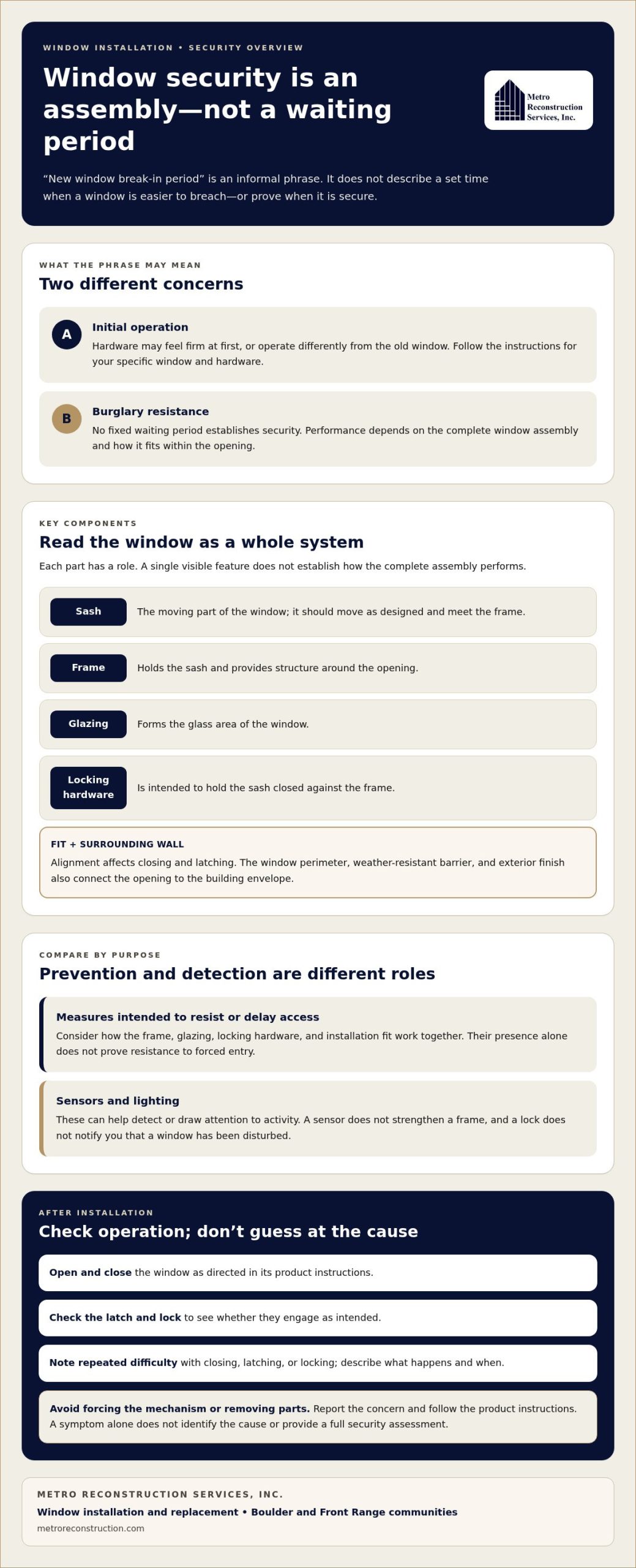
- The “new window break-in period” isn’t a formal vulnerability window; the phrase may refer to initial operation or concerns about burglary resistance.
- Assess security as a system: the frame, glazing, locks, and fit within the surrounding wall all contribute to window performance.
- Compare measures by their purpose. Some are intended to delay access, while sensors and lighting can help detect or draw attention to activity.
- After installation, check that each window opens, closes, and latches as expected, following the product instructions and without removing parts.
- For window installation in Boulder and Front Range communities, contact Metro Reconstruction or call 303.543.9549.
What Does a New Window Break-In Period Actually Mean?
The phrase “new window break-in period” can refer to two different concerns: initial adjustment after installation or a period when a window might be easier to force open. They aren’t the same. In ordinary use, “break-in” may describe hardware that feels stiff at first and becomes easier to operate with regular use. It doesn’t establish that the window is secure or temporarily vulnerable.
A new window break-in period is an informal way to describe initial adjustment in operation, not a set number of days when a window gains or lacks burglary resistance. There is no universal waiting period that proves a window is secure. Security depends on whether the hardware works, whether the window is fitted properly, and how the frame, glazing, sash, and locking parts work as an assembly.
Does a new window need time before it is secure?
No fixed amount of time can establish that a window is secure. Follow the instructions supplied for your specific window and hardware, since operation and adjustment can vary by design. Some hardware may feel firm at first, but don’t assume every new window needs a break-in period or that stiffness will resolve on its own.
A window that won’t close fully, latch, or lock as intended has an operation issue worth reporting. That observation alone doesn’t establish the cause or provide a full security assessment. Review the complete assembly and how it is fitted rather than relying on how many days have passed since installation. For a general overview of approaches, see Window security measures.
Why homeowners may notice changes after replacement
Replacement can change how a window feels in everyday use. You may notice that a handle turns differently, a sash moves with more resistance, or the locking parts meet at a different point than on the old window. These changes can reflect differences in design and hardware. Compare the window’s operation with its product instructions instead of assuming all windows adjust in the same way.
Fit matters. If a sash isn’t aligned with its frame, it may be harder to close fully or the lock may not engage as intended. Document and report the issue rather than removing parts or forcing the mechanism. The window is also part of your home’s complete exterior envelope, so the surrounding wall and installation fit contribute to its performance. Accurate installation matters.
After installation, operate the window as directed and note any repeated difficulty with closing, latching, or locking. Describe what happens and when; avoid diagnosing a hidden defect from the symptom alone. Metro Reconstruction provides window installation and replacement for Boulder and Front Range homeowners. Contact Metro Reconstruction or call 303.543.9549 to discuss your window project.
How New Window Security Depends on the Window and Its Installation
A window is more than a pane of glass set into a hole in the wall. It is one part of your home’s exterior envelope, alongside the frame, wall materials, and water-control layers. Each component has a different role. If one doesn’t fit or function as intended, the performance of the whole opening may be affected.
No single security feature can establish how well the complete window assembly performs. A lock may engage, for example, but that alone doesn’t assess the frame, glazing, or the way the window is secured within the opening. Considering the whole assembly gives you a more useful basis for understanding security than focusing on one visible feature.
Which window components affect security?
The sash is the moving part of the window; the frame holds it in place and provides structure around the opening. Glazing forms the glass area, while the locking hardware is intended to hold the sash closed against the frame. These components work together during normal operation, though their presence alone doesn’t prove resistance to forced entry.
Some measures are designed to physically resist or delay access, while sensors are intended to detect an event and signal it. These roles are different, not interchangeable. A sensor doesn’t strengthen a frame, and a lock doesn’t notify you that a window has been disturbed. When comparing options, consider what each measure is meant to do and how it fits the full window system.
Why installation fit and the surrounding wall matter
Accurate fit supports normal window operation: the sash should move as designed, meet the frame, and allow the lock to engage. If the opening or frame is out of alignment, closing and latching may be affected. That doesn’t establish why the problem occurred or how resistant the window is to entry, but it is a practical reason to review the installation.
The window also meets exterior materials that manage water and protect the wall. The weather-resistant barrier behind cladding, the window perimeter, and the surrounding finish need to work as connected parts of the building envelope. Gaps or poor transitions can affect moisture management, while fit issues can affect operation. Considering the opening as part of the wall helps avoid treating visible symptoms as isolated problems.
Temperature changes can cause building materials to expand and contract, so installation should account for the relationship between the frame and surrounding construction. The new window break-in period doesn’t replace that assessment: time passing cannot correct a fit concern or establish security. For homeowners in Boulder and Front Range communities, careful installation supports proper operation and the durability of the surrounding exterior system. Contact Metro Reconstruction or call 303.543.9549.
Comparing Window Security Measures Holistically
Window security measures serve different purposes. A lock or suitable physical barrier is intended to make access more difficult, while sensors and lighting can help alert you to activity or make it more visible. Glazing, film, and added hardware also vary by window and installation. Treat them as layers with separate roles, not interchangeable products. No single measure makes a home break-in-proof.
Physical protection versus detection
A functioning lock helps hold a sash closed; other physical measures may be intended to resist or delay access. An alarm or glass-break sensor serves a different purpose: it detects a signal or event and may notify you, depending on the system. Lighting can improve visibility around an entry point, but it doesn’t physically strengthen the window. These layers can complement one another, but they can’t guarantee prevention.
| Measure | Purpose | Practical limit and installation consideration |
|---|---|---|
| Window locks and added hardware | Hold the window closed or add a physical layer. | Must fit the window and allow normal opening and closing. |
| Security film | Provides an added layer at the glass. | Performance and compatibility depend on the specific film and glazing; it isn’t a replacement for sound frames or locks. |
| Glazing | Forms the glass portion of the assembly; some glazing is designed with security in mind. | Properties vary by product. Consider the glazing alongside its frame and hardware. |
| Sensors and alarms | Detect activity or signal an alert. | Detection doesn’t physically prevent entry; function depends on the system and its setup. |
| Exterior lighting | Improves visibility around a window. | Lighting doesn’t strengthen the window or replace a working lock. |
Check compatibility before adding film or hardware
Security film and additional hardware should suit the existing window type and installation. A product that doesn’t fit the glazing or frame may interfere with operation rather than improve the overall system. Follow the product instructions and preserve the window’s intended opening function, including any required emergency exit function. Don’t assume one film or hardware option works with every window.
Consider the layers together: a sensor can report activity, while a lock and suitable glazing serve different physical roles. A mismatch can leave a gap in your plan, and no combination guarantees a break-in cannot occur. The phrase “new window break-in period” doesn’t tell you which security measure is appropriate. Check each measure’s purpose, compatibility, and effect on normal operation. For window installation in Boulder and the Front Range, contact Metro Reconstruction or call 303.543.9549.
A Practical Checklist for Checking New Windows After Installation
A simple walk-through can help you spot an operating concern after installation without taking the window apart. Use the instructions supplied for your specific window, since opening styles and locking mechanisms differ. This is a visual and functional check, not a technical security assessment or a reason to adjust the frame yourself.
- Identify each window. Note its room and location so you can describe a concern clearly. If several windows were installed, check them one at a time rather than assuming they all operate the same way.
- Look over visible surfaces. From inside, check for visible damage to the frame, sash, glass, or surrounding finish. Notice visible gaps or movement that seem to interfere with normal operation. Don’t remove trim or glazing to inspect concealed areas.
- Open and close it as directed. Follow the product instructions and move the sash through its normal range. Notice whether it travels as expected or catches, binds, or feels unusually difficult to operate. Don’t force it through resistance.
- Check the latch and lock. With the window positioned as instructed, operate the latch or lock normally. Observe whether it engages as intended. Don’t add hardware or change an adjustment to make it work.
- Record anything repeatable. Write down which window is affected and what happens, such as “the sash stops before closing” or “the lock doesn’t engage during normal operation.” A clear description is more useful than guessing at the cause.
What to do if the window does not close or lock correctly
If the sash won’t close or latch as the instructions describe, stop rather than forcing it. Take a photo of visible conditions if useful, and note when the issue occurs. Avoid removing parts or making unapproved changes to the frame, lock, or hardware. A symptom can point to an operation concern, but it doesn’t identify the underlying cause by itself.
Window operation also depends on fit within the opening and how the surrounding wall was completed. Metro Reconstruction provides window installation services, with attention to both the window and the home’s exterior system. If a newly installed window isn’t operating as expected, contact Metro Reconstruction or call 303.543.9549 to discuss the concern.
Don’t treat the new window break-in period as a reason to wait out a problem with closing or locking. Follow the product instructions, keep your observations, and report an operating concern so it can be assessed accurately. If a window is intended to serve as an emergency exit, don’t add a device or make a change that could interfere with its intended opening function.
How Metro Reconstruction Approaches New Window Installation in Boulder
Metro Reconstruction Services, Inc. is a family-owned construction firm serving Boulder and Front Range communities. Its window work considers more than the new unit itself. A window needs to fit its opening and connect properly with the surrounding wall, because those details affect operation and how the home’s exterior envelope manages water and weather.
This broader view matters when you’re considering replacement or new installation. A window that opens and latches as intended is one part of the assessment; the perimeter, adjoining finish, and visible condition of the surrounding wall also help show whether the project involves more than the window alone. Understanding the conditions at the opening helps define the work instead of treating every concern as a hardware adjustment.
Why assess the complete exterior envelope?
A window opening meets several parts of the wall. The frame sits within the opening, while exterior finishes and the weather-resistant barrier help protect the structure from water intrusion. If a perimeter detail or nearby material is damaged, replacing the window by itself may not address that condition. A careful review considers visible concerns around the opening as well as how the window fits and operates.
For homeowners across the area, local construction knowledge matters because each home has its own combination of wall materials, finishes, and prior work. Metro Reconstruction serves Boulder and nearby communities, including Parker, Morrison, Longmont, Niwot, Evergreen, Cherry Creek, Cherry Hills Village, Golden, Genesee, Littleton, Broomfield, Denver, Silverthorne, Breckenridge, Vail, and Larkspur. Learn more about Metro Reconstruction as a Boulder construction company.
Discuss your window project with Metro Reconstruction
If you’re planning window replacement or have questions about installation, share what you’ve observed and what you want the project to address. Clear details, such as which window is involved and whether the concern relates to operation or the surrounding finish, can help focus the conversation. A window’s security cannot be judged by the installation date or one feature alone, and new windows or installation by themselves cannot guarantee that a home won’t be broken into.
The phrase “new window break-in period” can create uncertainty, but a waiting period isn’t a substitute for proper fit, functioning hardware, or attention to the wall around the opening. Metro Reconstruction can discuss your window project in relation to your home’s exterior envelope. Contact Metro Reconstruction or call 303.543.9549.
Make Your Next Window Decision With Confidence
As you plan your next steps, note what matters most for your home, such as reliable operation, the condition of the surrounding wall, or the scope of a replacement project. Those details provide a practical starting point for discussing the work and identifying what deserves attention.
Metro Reconstruction is a family-owned construction firm with more than four decades of experience. If you’re ready to discuss your priorities and plan a window project, contact our team or call 303.543.9549.
A well-considered next step can help you move ahead with greater clarity and care for your home.
Frequently Asked Questions
Is there a standard break-in period for new windows?
No. “New window break-in period” isn’t a defined number of days. People may mean an initial change in operation or worry about burglary exposure after installation. Use the instructions for the specific window, since they explain its intended operation and care. If the concern is security, don’t treat a certain amount of time or a working lock as proof of protection; neither guarantees the home is secure.
Can window security film prevent a break-in?
No film should be relied on to guarantee that a window can’t be entered. Before considering a film, identify the glazing from the product paperwork and compare it with the film manufacturer’s compatibility and intended-use guidance. Keep the product information with your window records, including any stated limits. This helps you assess whether the film suits that particular glass without assuming all films perform alike.
Do glass-break sensors stop someone from entering through a window?
No. A glass-break sensor is a detection device, not a physical barrier. Its purpose and coverage depend on the selected security system, so read the system’s instructions to understand what it detects and how to test it. An alert depends on the system’s setup and operation; a sensor doesn’t ensure anyone receives or responds to a signal.
Can I add a different lock to a newly installed window?
Don’t drill into a new frame or replace hardware based only on appearance. Window designs differ, and an added lock may interfere with the sash, finish, or seal if it isn’t suited to that unit. Check the manufacturer’s instructions first. If you’re reporting a problem, note the window location and, if available, the hardware information from the installation documents so you can describe the concern accurately.
Does a window that will not latch correctly mean it is easy to break into?
Not necessarily. A latch that doesn’t engage is a reason to document the problem, not enough information to judge how easily the window could be forced. For example, note whether the difficulty occurs every time or only at a certain point in the sash’s movement. That description can help guide an assessment without assigning a cause or making a security claim from one symptom.
Can security bars affect emergency exit from a bedroom window?
Yes. Bars or another added barrier may restrict the opening needed to leave through a bedroom window. Before choosing or installing one, verify the requirements that apply to your property with the local building department and review the barrier’s operating instructions. Requirements can differ by location and building conditions, so don’t rely on a general rule of thumb to determine whether a particular installation is appropriate.
For window installation or replacement in Boulder and Front Range communities, contact Metro Reconstruction Services, Inc. or call 303.543.9549.