
What if the damp spot in your basement isn’t coming through the foundation at all? Water can travel from the roof, siding, windows, or ground before appearing near a foundation wall, so the visible stain may not show where the problem began. For foundation water intrusion repair Boulder homeowners need, identifying the source is the first step toward choosing a lasting repair.
Recurring dampness can raise concerns about hidden damage, but moisture alone doesn’t confirm a structural problem. In the Boulder area, expansive clay soil can swell when wet and shrink when dry, placing pressure on foundations. Drainage problems and openings elsewhere in the building envelope can also let water reach the foundation. Conditions vary by property, so the cause needs to be assessed rather than assumed.
This article covers signs of foundation water intrusion, likely local causes, and what a careful inspection should examine, including how water moves around the complete exterior system. You’ll also learn how to distinguish temporary water control from repairs that address the underlying source, and what information to share when contacting a local contractor.
Key Takeaways
- Dampness, staining, odors, efflorescence, or cracks can signal a moisture concern, but no single sign identifies its source.
- Water near a foundation may come from surface drainage, roof-to-wall transitions, exterior openings, or the foundation itself.
- Record when and where moisture appears, along with drainage patterns and recent changes, to help a contractor assess the likely water path.
- Effective foundation water intrusion repair Boulder homeowners consider should address the water source, not only the visible damage.
- Metro Reconstruction Services, Inc. is a family-owned Boulder firm with more than four decades of experience in foundation repair and moisture mitigation.
Foundation Water Intrusion in Boulder: What the Signs Can Tell You
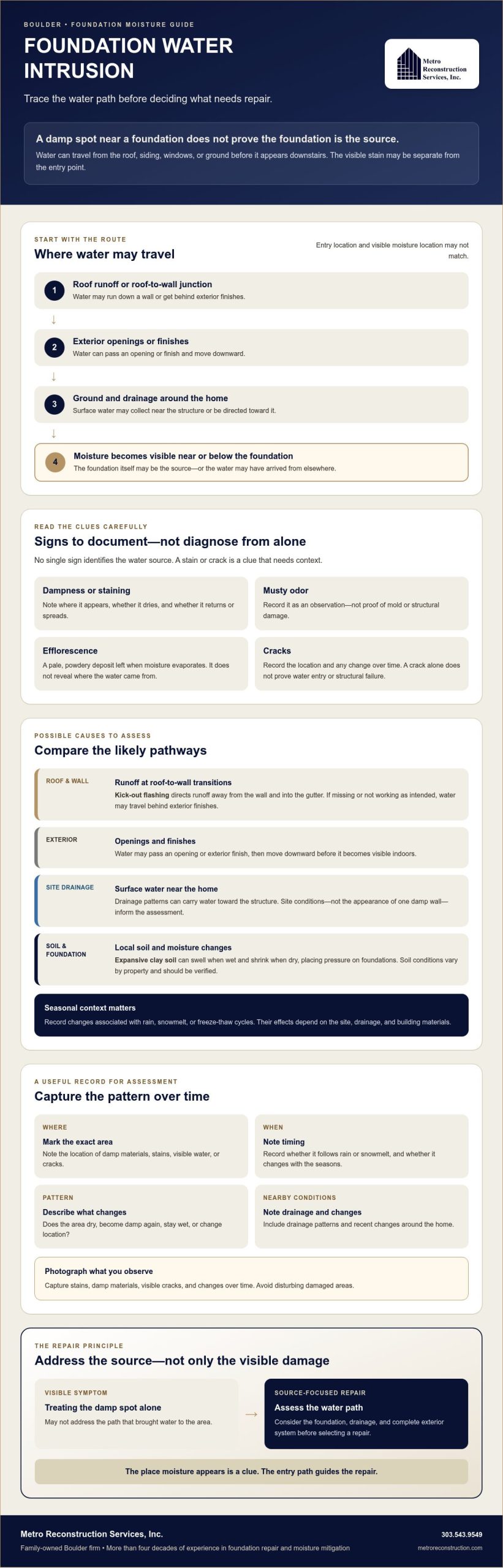
Dampness, staining, or a musty odor can be concerning, but none identifies the source on its own. Water may enter at a foundation wall or travel from another part of the home before appearing downstairs. That distinction matters: a durable repair depends on understanding the route water takes, not just treating the spot where it shows up.
Foundation water intrusion is moisture entering or collecting in areas at or below a home’s foundation; finding its entry path helps determine whether the source is the foundation, drainage, or another part of the building envelope. A stain or crack is a clue to document, not a diagnosis. Background information on basement waterproofing techniques can explain general approaches, but it can’t identify what is happening at your property.
Which foundation water intrusion signs should you document?
Record where water appears and when, such as after rain or snowmelt. Note whether the area dries and becomes damp again, stays wet, or changes location. Visible water may indicate an active entry path, while recurring dampness can point to ongoing moisture even when there is no pooling.
Efflorescence, a pale, powdery deposit left behind when moisture evaporates, can indicate that water has moved through a material. It doesn’t reveal where the water came from. Cracks also need context: note their location and whether they change over time. A crack alone doesn’t prove water entry or structural failure.
Could water near the foundation come from another part of the home?
Yes. Roof drainage can send water down a wall if runoff isn’t directed away from the house. At a roof-to-wall junction, kick-out flashing is a metal piece that directs runoff away from the wall and into the gutter. If that detail is missing or not working as intended, water may travel behind exterior finishes before appearing indoors.
Wall openings, exterior finishes, and foundation areas work together as parts of the building envelope. Water can get past an opening or finish and move downward, so the damp area inside may not be directly behind the entry point. Don’t assume the foundation is the source until the route has been assessed. Effective foundation water intrusion repair Boulder starts by distinguishing the source from the place where moisture appears.
If you’ve noticed recurring moisture, share your observations with Metro Reconstruction. Contact the team through the contact page or call 303.543.9549.
Why Boulder Foundation Water Intrusion Happens: Soil, Drainage, and the Building Envelope
Water reaching a foundation doesn’t always begin there. Roof runoff, surface water, or moisture behind exterior finishes can collect near the home or move downward if it isn’t directed away. The point where water enters and the place where it becomes visible may be separate locations.
When water is directed away from the home, the foundation is less exposed to excess moisture; when drainage paths carry it toward the structure, the risk of water intrusion can increase. The right response depends on site conditions, not just the appearance of a damp wall.
How can expansive clay soil and seasonal moisture affect a foundation?
Some Boulder-area properties may have expansive clay soil, which swells when wet and shrinks when dry. These repeated changes in soil volume can place pressure on foundations, but they aren’t a diagnosis for every home. Soil conditions vary by property and should be verified before being treated as the cause of cracking or water entry.
Seasonal moisture changes, snowmelt, and freeze-thaw cycles are also worth noting. Their effects depend on the site, drainage, and building materials. If cracking or moisture changes with the seasons, record when and where it happens, then have those observations considered alongside the soil and drainage. The University of Minnesota Extension explains several common causes of basement moisture, including water around the structure and openings where it can enter.
How does the complete building envelope affect foundation moisture?
Water can move from the roof toward exterior walls, then down toward the foundation if gutters, flashing, or drainage paths don’t carry it away. It may also pass behind siding or other exterior finishes before reaching an interior wall or lower-level space. An assessment should consider the connected system instead of assuming the foundation is the only possible source.
Building paper and a weather-resistant barrier are layers behind exterior finishes that help manage water and protect the materials beneath them. If these layers or the finish details are damaged or incomplete, water may get behind the cladding. Their condition and connections to nearby openings and the foundation should be considered together.
For a wider look at exterior concerns, see the Boulder exterior home repair guide. If you’re considering foundation water intrusion repair Boulder homeowners can discuss with a local contractor, describe what you’ve noticed and ask how the likely water path will be assessed. Contact Metro Reconstruction or call 303.543.9549.
Is Foundation Water Intrusion Always a Foundation Failure? Compare the Possible Sources
No. Water near a foundation doesn’t, by itself, prove that the foundation has failed. Runoff may collect beside the house, water can travel down from a roof-to-wall transition, or moisture may pass through an exterior opening before appearing indoors. The damp area is evidence to investigate, not a diagnosis.
Timing and location can help narrow the possibilities, but they aren’t definitive tests. A qualified inspection should consider how water moves around the home and check relevant exterior and interior areas before recommending a repair.
| Observed clue | Possible source | What an inspection should check |
|---|---|---|
| Water appears near a foundation wall after rain or snowmelt | Surface runoff or a foundation-area entry point | Where water collects, how the ground directs it, and the condition of the nearby foundation area |
| Moisture is below a roof-to-wall junction | Roof runoff or a detail that isn’t directing water away | Gutters, downspouts, and roof-to-wall flashing, including kick-out flashing |
| Dampness appears near a window, door, or exterior wall opening | Water entering around the opening or behind exterior finishes | Opening edges, nearby finishes, and the route water could take toward the lower wall |
| Moisture repeatedly appears at a basement wall or floor joint | Water entering through or near the foundation, among other possibilities | Moisture patterns, the adjacent foundation area, and drainage conditions outside |
What clues help separate surface water from foundation seepage?
Note whether moisture appears during or after precipitation, where it shows up, and whether nearby gutters, downspouts, or ground conditions seem connected. Repeated observations can help a contractor compare the timing and pattern with conditions around the home. Treat these as clues, not proof. Don’t open walls, excavate, or attempt structural repairs as a diagnostic step.
Foundation drainage solutions should match the verified water path and site conditions. A drainage change may be relevant if runoff collects beside the home. If water appears near an exterior opening or foundation area, another response may be needed. Choosing a fix before establishing the source can leave the underlying pathway unaddressed.
When should a professional assess possible structural movement?
Arrange a professional assessment if water intrusion occurs alongside cracks that are changing, uneven surfaces, or recurring movement. A crack’s appearance alone can’t establish its cause or severity; its location and changes over time need to be considered in context. Learn more in the Boulder foundation repair services guide.
For foundation water intrusion repair Boulder homeowners should seek an evaluation that connects observed moisture to its likely source before repairs are selected. Contact Metro Reconstruction or call 303.543.9549 to discuss what you’ve observed.
How to Prepare for Foundation Water Intrusion Repair in Boulder
A clear record can help a contractor understand when moisture appears and where it may be coming from. For foundation water intrusion repair Boulder homeowners should be ready to discuss symptoms inside and conditions outside, without assuming they already know the cause.
What should you record before a foundation repair assessment?
Use this checklist to organize useful observations before the assessment:
- 1. Track timing. Note the date and location of moisture, along with recent rain, snowmelt, or other seasonal conditions.
- 2. Take dated photographs. Photograph visible water, stains, damp materials, and cracks from consistent angles when possible. Record changes over time, but don’t disturb damaged areas.
- 3. Note surrounding conditions. Identify nearby downspouts, visible drainage paths, exterior cracks, and the interior locations where moisture appears.
- 4. Describe recent changes. Include changes around the home, such as a new pattern of dampness or a change in where water appears.
- 5. Keep conclusions open. Share what you saw and when. These observations can guide an assessment, but they don’t confirm the source on their own.
What should a durable repair recommendation explain?
A useful recommendation should connect the proposed work to the evidence. Ask the contractor to explain the suspected source, which observations support that conclusion, and what the work is intended to address. If the water path hasn’t been established, ask what further assessment is needed before selecting a repair.
Ask how the proposed work relates to moisture management across the exterior envelope, including roof drainage, exterior walls, openings, and foundation areas that may affect the water path. This helps clarify whether the proposal addresses the source and related building components, rather than only the visible damage.
Confirm which local code requirements apply to your property with the contractor or relevant building authority, since requirements can depend on location and scope of work. Don’t rely on a general statement to determine what applies to your home. You can also review Metro Reconstruction’s construction and restoration services.
Bring your notes and questions to the conversation. To discuss your observations with Metro Reconstruction, contact the team or call 303.543.9549.
Metro Reconstruction’s Approach to Foundation Water Intrusion Repair in Boulder
Once you’ve documented where and when moisture appears, discuss the likely source before settling on a repair. Metro Reconstruction is a family-owned construction firm based in Boulder, with more than four decades of industry experience. Its foundation repair and moisture mitigation services may be relevant when an assessment indicates those issues are involved.
What can Boulder property owners expect when discussing the problem with Metro?
Share where water appears, how often it returns, and whether you’ve noticed a connection to rain, snowmelt, or other seasonal conditions. Include dated photos and notes about nearby drainage, visible cracks, or exterior changes. These details can help frame the discussion, but they don’t establish the cause on their own.
Before repair recommendations are made, the source should be investigated. A forensic diagnostic phase is an investigation to identify how and where water is entering, so a proposed response can address the cause rather than only the visible symptom. Ask what the assessment will examine and how its findings will inform the scope of work.
Because water can move across connected parts of a home, ask how proposed work relates to moisture management across the exterior envelope, including the foundation and any relevant exterior components. Metro serves Front Range and Mountain communities, including Parker, Morrison, Boulder, Longmont, Niwot, Evergreen, Cherry Creek, Cherry Hills Village, Golden, Genesee, Littleton, Broomfield, Denver, Silverthorn, Breckenridge, Vail, and Larkspur. You can learn more about the company through its Boulder construction company information.
How can you take the next step?
Prepare a concise description of what you’ve observed and ask what kind of assessment may be appropriate. A useful conversation should clarify which observations support the suspected source, what remains uncertain, and how recommended work would address the identified water path. Avoid assuming that every damp area calls for the same repair.
For foundation water intrusion repair Boulder homeowners can discuss with a local construction firm, contact Metro Reconstruction about foundation water intrusion or call 303.543.9549. Share where and when moisture appears, and ask about the next steps for assessing the problem. Understanding the source comes first.
Start With the Source to Protect Your Home
Dampness, staining, and cracks are clues, not diagnoses. Water near a foundation doesn’t automatically mean the foundation has failed. Tracking when and where moisture appears, then assessing drainage and the connected exterior envelope, can help identify the water path before a repair is chosen.
That distinction matters. Foundation water intrusion repair Boulder homeowners consider should address the verified source, whether it involves the foundation or another part of the home. A repair focused only on visible damage may leave the underlying moisture path unchanged.
Metro Reconstruction is a family-owned construction firm based in Boulder with more than four decades of industry experience. Its services include foundation repair and moisture mitigation. If you’re seeing recurring water intrusion, share what you’ve observed and ask about an appropriate assessment.
Contact Metro Reconstruction about foundation water intrusion or call 303.543.9549. A clear understanding of the cause is a practical first step toward protecting your home.
Frequently Asked Questions
Can foundation water intrusion happen without a foundation crack?
Yes. Water can enter around a foundation-floor joint, through gaps or openings, or travel behind exterior finishes before appearing inside. Runoff that collects near the home can also contribute to moisture around foundation areas. A visible crack may be one clue, but it isn’t required for water intrusion to occur. Assess the entry path before choosing a repair, since the visible damp area may be away from the source.
Is water in a basement always a foundation problem?
No. Water in a basement may come from the foundation, but it can also travel from roof drainage, a wall opening, or an exterior finish that lets moisture behind it. For example, water entering higher on a wall may move downward before becoming visible. Note where and when the water appears, along with nearby drainage features. A professional assessment can consider the whole exterior envelope instead of assuming the foundation is the source.
How do I know whether foundation water intrusion needs professional repair?
Consider a professional assessment if moisture returns, visible water persists, or water intrusion occurs alongside cracks that are changing, uneven surfaces, or recurring movement. These signs don’t prove structural failure, but they deserve attention together. Record the location and timing, take photographs, and note changes after rain or snowmelt. For foundation water intrusion repair Boulder homeowners should seek a recommendation based on the likely water path, not only the visible damage. If severe intrusion or storm runoff causes sudden indoor flooding, emergency disaster recovery providers such as Fire Industry Restoration Experts can assist with immediate water extraction and drying while the underlying source is resolved.
Can expansive clay soil contribute to foundation water problems in Boulder?
It can contribute on properties where expansive clay soil is present. This soil swells when wet and shrinks when dry, and those changes can exert pressure on foundations. Soil conditions vary by property, so don’t assume clay is the cause of a crack or leak without verification. An assessment should consider site-specific soil and moisture conditions alongside drainage, observed movement, and where water appears.
What should a foundation water intrusion inspection include?
A careful inspection should consider where and when moisture appears, nearby drainage patterns, roof runoff, exterior wall openings and finishes, and accessible foundation areas. The goal is to understand the likely water path and distinguish the entry point from where water becomes visible. Share dated photographs and notes about weather or seasonal conditions. Ask which observations support the suspected source and what remains uncertain before discussing repair options.
Are foundation drainage solutions the same for every Boulder home?
No. Foundation drainage solutions should match the verified water path and conditions at the specific property. A home where runoff collects beside a wall may need a different response from one where water appears near an exterior opening or foundation joint. Soil, grading, and drainage conditions should be assessed rather than assumed. Ask the contractor to explain how the recommendation addresses the identified source and related parts of the building envelope.
Who should I contact about foundation water intrusion repair in Boulder?
Contact a qualified local contractor who can discuss the likely source before recommending a repair. Metro Reconstruction Services, Inc. is a family-owned construction firm based in Boulder, with more than four decades of industry experience and services that include foundation repair and moisture mitigation. Share where and when water appears and whether it recurs. You can contact Metro Reconstruction about foundation water intrusion or call 303.543.9549.