
What if a foundation crack reflects soil movement or moisture pressure rather than a surface issue? If you’re searching for foundation specialists near me, you need a clear explanation of what’s happening before planning repairs. In Colorado, expansive clay soil can swell when wet and shrink when dry. Drainage and changing moisture conditions can also affect the ground around a foundation, so visible damage is only one part of the picture.
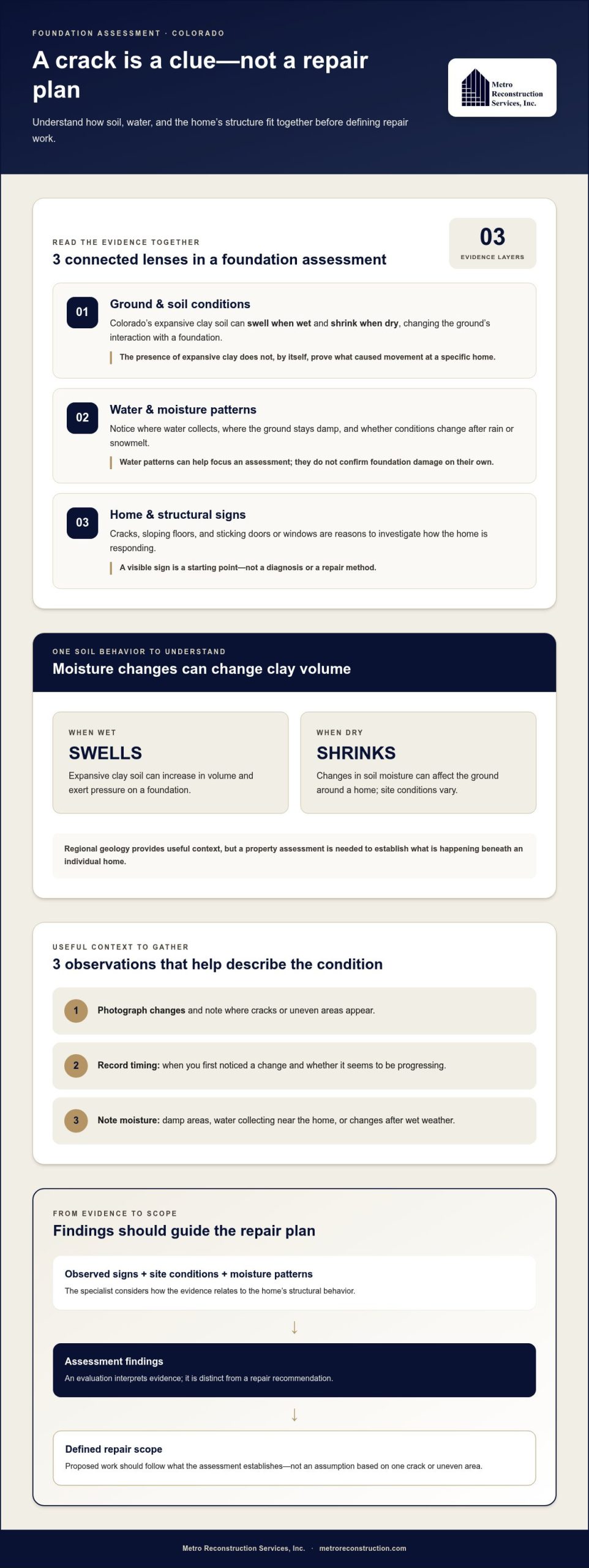
A useful evaluation connects signs of movement with site conditions and the home’s structure. That connection helps shape a repair plan around the cause, not just the crack. This guide explains what a foundation specialist may assess, how Colorado soil and moisture conditions can affect a diagnosis, and how findings inform a defined repair scope. You’ll also learn what information to gather and what to expect as a structural repair project moves from evaluation to planning.
Key Takeaways
- When comparing foundation specialists near me, look for an evaluation that investigates possible causes instead of treating a visible crack as a diagnosis.
- Colorado’s expansive clay soil swells when wet and shrinks when dry, but conditions must be assessed at each property.
- Similar cracks or signs of movement can have different causes. Findings should guide a repair scope suited to your home.
- Photograph visible changes and note moisture patterns before an assessment to give the specialist useful context.
- Metro Reconstruction is a family-owned Boulder firm with more than four decades of experience in foundation repair, stabilization, and moisture mitigation.
Foundation Specialists Near Me: What a Colorado Evaluation Should Establish
A foundation specialist evaluates structural concerns at the base of a home and helps determine what work may address them. If you’re searching for foundation specialists near me, start by finding out what the visible signs mean in the context of your property. A crack, sloping floor, or sticking door is a reason to investigate, not a repair method by itself.
Similar symptoms can have different causes. Soil movement, water flow around the home, drainage patterns, and the way structural components respond may all be relevant. An evaluation considers how these factors relate, rather than treating one visible mark as the full explanation.
Which signs make a foundation assessment relevant?
Look for changes in walls, floors, doors, and windows. Note where cracks appear, whether they seem to be changing, and when you first noticed them. These observations help describe the condition, but they don’t establish its cause.
- Photograph cracks or uneven areas and note their locations.
- Record when you first noticed a change and whether it appears to be progressing.
- Note damp areas, water collecting near the home, or changes after wet weather.
Moisture patterns near a foundation matter because water can affect surrounding soil and may point to drainage concerns. Expansive clay soil swells when wet and shrinks when dry, but that behavior does not automatically explain every crack or sign of movement. A general overview of Clay Soil explains how clay responds to moisture. A property assessment is still needed to establish what is happening at your home.
What should a specialist learn before proposing work?
An evaluation begins with the home’s history and the changes you’ve observed. Useful context includes when symptoms began, whether they have changed, and where moisture appears around the structure. The specialist considers these details alongside site conditions and the home’s structural behavior to distinguish visible symptoms from possible underlying causes.
An evaluation gathers and interprets evidence; a repair recommendation sets out work based on what that evidence shows. The distinction matters. A repair scope should follow the findings, not assumptions drawn from a single crack or uneven area. If the cause is misunderstood, addressing only the visible symptom may leave the underlying concern unresolved.
Metro Reconstruction provides foundation repair, stabilization, and moisture mitigation. If you’re seeing changes in your home, contact Metro Reconstruction to discuss your concerns, or call 303.543.9549.
Colorado Soil and Moisture Conditions That Can Affect Foundations
Soil and water conditions can influence how the ground supports a home, but they don’t explain every foundation concern by default. Expansive clay soil is one factor to consider in Colorado. Whether it contributes to a particular property’s condition depends on what an assessment establishes about the site and structure.
The Colorado Geological Survey’s overview of Expansive Soil and Rock in Colorado describes expansive soils as a state geologic hazard. This regional information explains why soil may be considered during an assessment, but it cannot determine what is happening beneath an individual home.
How expansive clay soil may relate to foundation movement
Changes in the moisture content of expansive clay soil can cause it to change volume and exert pressure on a foundation. The effect may vary across a site, depending on local ground and water conditions. The presence of this soil type is a possible contributing condition, not proof that it caused movement at a specific property.
An assessment connects site observations with the condition of the home. A slope, exposed soil, or an area that stays damp may offer useful context, but none confirms the cause on its own. Local geology can inform the questions a specialist asks; the property’s actual conditions must guide the diagnosis.
Why water management belongs in a structural assessment
Water patterns around a home can show how the site responds to rain, snowmelt, or other sources of moisture. For example, note an area that remains damp while nearby ground dries. That observation does not prove the foundation has been affected, but it can help focus attention on how water movement, soil, and the structure relate.
Changing moisture conditions can alter the ground around a foundation, which is why water patterns belong in a structural assessment. Foundation drainage solutions are methods and systems designed to keep a building’s foundation dry and stable. Whether drainage work belongs in a repair plan depends on the assessment findings. The site conditions should be understood before selecting a system.
Metro Reconstruction provides foundation repair, stabilization, and moisture mitigation. To discuss foundation or moisture concerns at your property, contact Metro Reconstruction or call 303.543.9549.
How a Foundation Specialist Connects Symptoms to Repair Scope
A visible symptom is the start of an investigation, not an instruction to use a particular repair. A foundation specialist considers how signs relate to the home’s structure and site conditions, then uses the findings to define appropriate work. This process helps you understand why a proposed scope addresses the concern observed at your property.
Separate visible symptoms from underlying causes
A crack is something you can see; its cause needs assessment. Similar cracks may relate to different conditions, and one sign does not confirm a specific failure. An evaluation may consider the crack’s location and pattern alongside soil conditions, moisture around the home, and how other parts of the structure behave. Background on Colorado Foundation Problems also describes factors associated with foundation concerns in the state, including expansive soils and freeze-thaw cycles.
| Observed condition | What it may suggest | What the evaluation needs to establish |
|---|---|---|
| Crack in a foundation wall | Movement, material stress, or another condition | Its location, pattern, and relationship to other site or structural observations |
| Uneven floor or area | A change in support or movement in part of the structure | Whether the change is localized and how it relates to the rest of the home |
| Door or window that has become harder to operate | Possible movement affecting the opening or nearby structure | Whether the change aligns with other signs and when it began |
| Moisture near the foundation | Water movement that may affect surrounding conditions | Where moisture appears and whether it connects to observed structural changes |
Match repair planning to the findings
The table helps organize observations, but it can’t diagnose a particular home. A specialist considers the combination of signs, their location, the property’s history, and relevant site conditions. Two houses with similar-looking cracks may need different evaluations and scopes of work. If you’re searching for foundation specialists near me, look for an explanation of how observations inform the next step, rather than a recommendation based on one symptom alone.
Diagnosis should guide repair selection, because the right scope depends on the structural concern the evaluation identifies. Once the findings clarify what needs attention, the proposed work can define its intended scope and relationship to that concern. Metro Reconstruction provides foundation stabilization; planning for your home should reflect its assessment findings, not assumptions about a repair method.
If you have concerns about foundation movement, contact Metro Reconstruction to discuss your property. You can also call 303.543.9549.
What to Expect During a Local Foundation Repair Project
A well-organized foundation repair project follows the evidence from assessment through completed work. You should understand what was observed, what the repair scope is intended to address, and how the work will be coordinated. Project details depend on the home’s conditions and the agreed scope, so planning should follow the findings rather than assume a standard solution or timeline.
The process generally moves through these stages:
- Discuss your concerns. Share the changes you’ve noticed and relevant history about the property.
- Evaluate site and structural conditions. The assessment considers the home and conditions that may relate to the concerns.
- Define the repair scope. Findings inform the proposed work and the areas it addresses.
- Coordinate the work. The project plan accounts for the defined scope and conditions at the property.
- Review completed repairs. Discuss the work performed in relation to the agreed scope and raise any remaining questions.
Prepare useful information for the evaluation
Before an assessment, gather observations that help establish the home’s recent history. Note where you see cracks, uneven areas, or changes in doors and windows, and when you first noticed them. If a change seems to be progressing, record what you’ve observed without trying to diagnose its cause.
Also note moisture patterns or changes around the property, such as areas that remain damp or water collecting near the foundation. Photos can show where a condition appears and how it changes over time. These details provide context for an evaluation; they don’t replace an assessment of the property.
Understand the scope and project coordination
Once the findings are understood, the proposed scope should describe the structural concern the work is intended to address. Before work begins, make sure you understand which areas are included and how the planned work relates to the evaluation. A clear scope gives you and the project team a shared reference as work is coordinated.
Site access, the location of the work, and the defined scope can all shape coordination. Metro Reconstruction manages defined structural repair projects, organizing work around assessment findings and the agreed plan. The sequence and timing can vary with project conditions, so avoid assuming a standard duration before the scope and site needs are understood. Metro’s foundation repair services connect assessment and repair planning within its broader construction work.
For homeowners searching for foundation specialists near me, clear communication about findings and scope makes the process easier to follow. To discuss foundation concerns and next steps, contact Metro Reconstruction or call 303.543.9549.
Working With Metro Reconstruction on Foundation Repair
Metro Reconstruction Services, Inc. is a family-owned construction firm based in Boulder, with more than four decades of industry experience. Its work includes foundation repair, foundation stabilization, and moisture mitigation across Front Range and Mountain communities. Local experience can inform an evaluation, but each home still needs a property-specific assessment. Its structural history, site conditions, and moisture patterns all matter when defining repair work.
A local perspective across the Front Range and Mountain communities
Colorado properties don’t all face the same ground or water conditions. Soil type, slope, drainage, weather exposure, and construction details can vary from one site to another, even within the same community. A careful assessment considers those factors alongside visible changes, using regional experience without assuming every property has the same underlying cause.
Metro Reconstruction Services, Inc. serves homeowners in Parker, Morrison, Boulder, Longmont, Niwot, Evergreen, Cherry Creek, Cherry Hills Village, Golden, Genesee, Littleton, Broomfield, Denver, Silverthorn, Breckenridge, Vail, and Larkspur. Across these communities, the foundation is part of the home’s broader exterior system. Water movement around the structure can relate to grading, roof runoff, and other parts of the building envelope, while structural movement may appear in more than one area. Considering these relationships helps keep an evaluation focused on the underlying concern rather than an isolated symptom.
Metro’s reconstruction experience supports a coordinated view of property preservation. The purpose is not to prescribe one repair for every home, but to understand the observed condition and define work in line with the findings. That distinction helps you see how foundation repair and moisture mitigation fit into care of the property as a whole.
Start a conversation about your foundation concerns
If you’ve noticed a crack, a change in a floor or opening, or a moisture pattern near the foundation, bring those observations to the discussion. Photos and notes about when changes appeared can help describe what you’ve seen. You don’t need to determine the cause yourself. The next step is to discuss the concern and establish what the property assessment needs to examine.
When you’re looking for foundation specialists near me, consider whether the process connects observed changes to site conditions and a clearly defined scope. Metro’s cause-focused approach starts by understanding the structural concern, then planning repair work around the findings. Initial accuracy matters because it keeps decisions grounded in the home’s actual conditions.
Share your observations with Metro Reconstruction Services, Inc. to discuss your property’s foundation concerns. Contact Metro Reconstruction Services, Inc. or call 303.543.9549.
Take the Next Step With Clarity
You don’t have to diagnose a crack or change in your home before seeking guidance. Start by describing what you’ve noticed and what an assessment can help establish. If you’re searching for foundation specialists near me, focus on how observations at your property will inform decisions about any repair work.
Metro Reconstruction can discuss your foundation concerns and the changes you’ve observed. Contact Metro Reconstruction or call 303.543.9549 to start the conversation. Clear information about your home can help guide the next step.
Frequently Asked Questions
How do I know whether I need a foundation specialist?
Consider an assessment if changes start affecting how you use your home, such as doors repeatedly failing to latch or floors feeling newly uneven. Note which rooms are affected and whether the change is isolated or appears in more than one area. If you’re searching for foundation specialists near me, have the condition assessed before deciding what work, if any, is appropriate.
Are foundation cracks always a sign of a structural problem?
No. A crack may be in a surface finish rather than the foundation itself, and its appearance alone can’t determine the cause. Take a clear photo with a nearby reference point, such as a doorframe, and record the date. If you can see the same crack from both sides of a wall, mention that during an assessment. Don’t assume a cause based only on its width or direction.
Can expansive clay soil affect a home’s foundation?
Yes, it can be a contributing factor, though soil conditions can vary across a single property. The material beneath one part of a home may differ from conditions elsewhere, and nearby water patterns can add useful context. Existing site records, if you have them, may help explain what is known about the property. Their relevance depends on how they relate to the home’s observed condition.
What happens during a foundation evaluation?
The evaluation should help clarify which observations are confirmed, which remain uncertain, and what action is appropriate. Make the discussion more useful by identifying the rooms or exterior areas you’re concerned about and noting any earlier repair or renovation records. Before moving ahead, understand how the findings relate to the proposed next step instead of treating one observation as a final diagnosis.
How long does foundation repair take?
There’s no single duration that applies to every project. The time required depends on the defined work and how the site can be accessed and coordinated. A useful schedule discussion considers the work sequence, areas that need access, and project-specific coordination. Once the scope is clear, discuss the expected sequence and how you’ll be informed if site conditions affect the plan.
Can foundation repair address moisture concerns too?
It can if the assessment connects moisture conditions with the foundation concern and includes related work in the project scope. Dampness may also come from another part of the home’s exterior system, so the source matters when planning repairs. Note where moisture appears and whether it follows rain or snowmelt. To discuss your observations with Metro Reconstruction, contact the team or call 303.543.9549.