
A crack can look alarming without proving that your foundation is still moving. With foundation settlement vs sinking, the key question is whether downward movement is uneven and continuing, not simply whether a crack exists.
It’s sensible to take new cracks, sloping floors, or doors that suddenly stick seriously. In Colorado’s Front Range and mountain communities, local soil conditions and seasonal moisture changes provide useful context when assessing movement.
This article explains how structural assessments distinguish normal settling from active movement, including the roles of soil support, moisture, and seasonal changes. You’ll learn how crack patterns, floor levels, and shifting doors or windows fit together, and why repeatable measurements and a history of changes help show whether a condition is stable or progressing.
Key Takeaways
- Distinguish downward settlement from upward heave by looking at the direction of movement and the conditions affecting the soil below the foundation.
- Read cracks alongside changes in floors, doors, and windows; one isolated symptom doesn’t establish active foundation movement.
- Look for several changes occurring in the same area, since connected signs can reveal a movement pattern more clearly than a single crack.
- Consider drainage, soil moisture, and seasonal conditions when assessing whether foundation movement may be changing over time.
- Track how symptoms change over time; repeatable measurements can help distinguish a stable condition from progressive movement.
How do structural engineers distinguish between normal home settling and active foundation failure?
Foundation settlement and foundation sinking both describe downward movement of a building’s support. Foundation heave is upward movement, often when soil expands beneath the foundation. The distinction in foundation settlement vs sinking is whether downward movement is uneven, continuing, and straining connected parts of the home.
Settlement and Heave Warning Signs
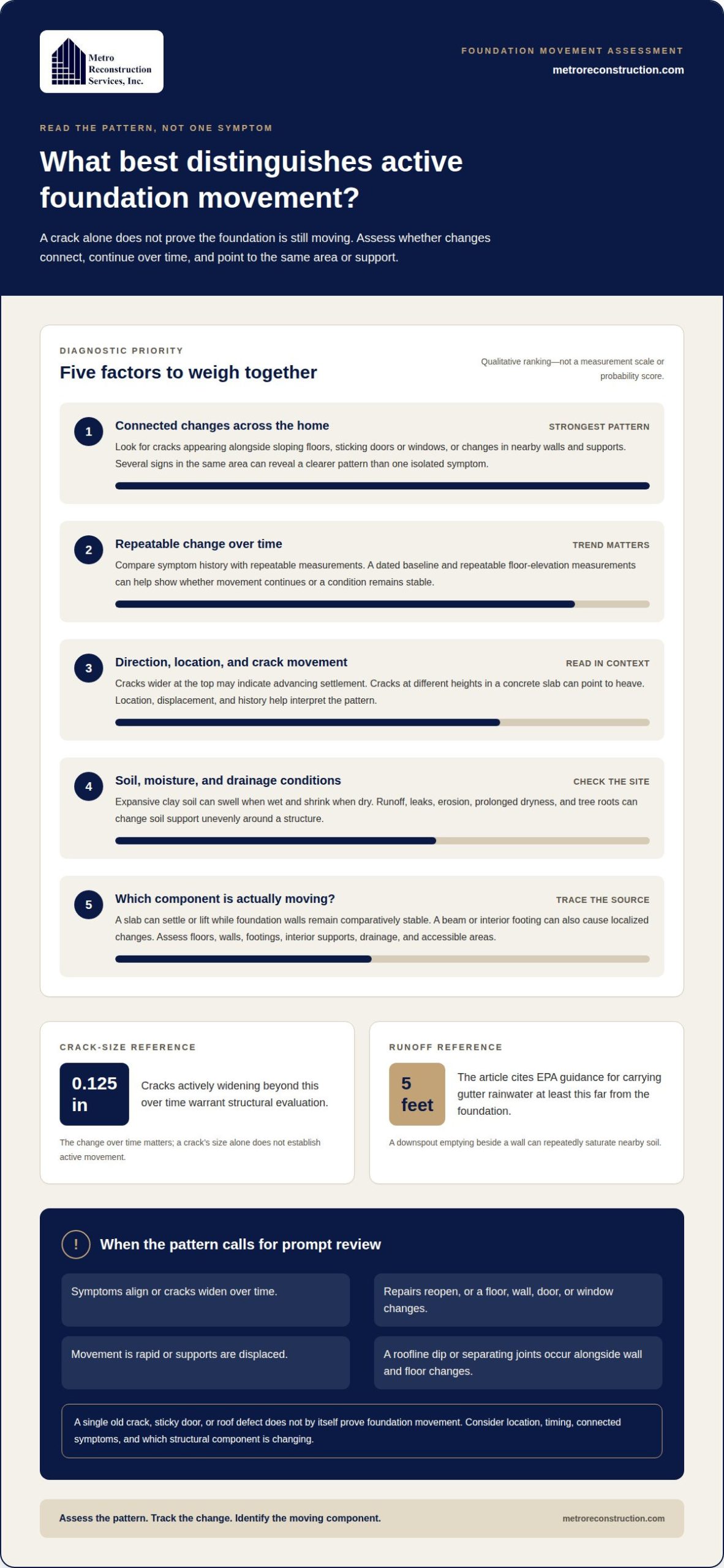
Settlement occurs when soil or fill supports a building unevenly; heave pushes the foundation upward. The direction matters because similar cracks can reflect different kinds of movement. Cracks wider at the top may indicate advancing settlement, while cracks at different heights in a concrete slab can point to heave. A sloping floor or dragging door adds useful context.
Assess the pattern, not one crack alone. Large, jagged wall cracks near a 45-degree angle can signal movement, but location, displacement, and history matter. Differential settlement can cause random or patterned cracking, according to the U.S. Bureau of Mines. Cracks actively widening beyond 0.125 inches over time warrant structural evaluation.
Diagnosing Active Foundation Movement
An assessment compares the history of symptoms with repeatable measurements and examines the home’s supports. To distinguish foundation settlement vs sinking from other structural problems, consider whether cracks, floor changes, and sticking doors or windows appear together. An assessment may include floor elevations, walls, footings, interior supports, drainage, and accessible areas to identify where movement may originate.
One old crack or sticky door does not establish settlement. Wood framing, a beam, or an interior footing can cause localized changes even when exterior foundation walls aren’t the main issue. A structural evaluation is appropriate when symptoms align, cracks widen, repairs reopen, or a floor, wall, door, or window changes. Rapid movement or displaced supports warrants prompt professional review.
Roof effects can broaden an assessment. When part of a structure moves, framing connections may shift and stress nearby materials. A new roofline dip, separating joints, or recurring roof damage alongside wall and floor changes deserves attention as a connected pattern. Roof damage alone doesn’t prove foundation movement; location and timing help clarify whether structural movement may be involved.
Concrete slab floors can move independently of foundation walls. A slab may settle or lift while the walls remain comparatively stable, so a floor crack doesn’t automatically mean the whole foundation is sinking. Compare the crack’s edges for differences in height and note nearby changes in walls or supports. Identify the moving component before selecting a repair.
If active movement goes unaddressed, connected cracks and alignment problems can progress. As support changes, loads may shift to nearby construction and strain components that weren’t carrying them before. A dated baseline and repeatable elevation measurements help show whether movement continues. The observed cause and soil conditions guide decisions about stabilization and longer-term repair.
Environmental and moisture-related causes
Water can change the support beneath a structure by washing soil away, saturating it, or changing its volume. Expansive clay soil swells when wet and shrinks when dry, so repeated moisture changes can create uneven support. Loose sand and compressible soils can also shift under a building’s load. The effect depends on soil conditions, drainage paths, and how the foundation transfers weight.
Settlement may follow soil shrinkage, erosion, plumbing leaks, or poor drainage. Excess water can weaken or wash away supporting soil, while prolonged dryness can shrink clay and reduce support beneath one area. Tree roots can draw moisture from nearby soil. When a leak or runoff problem affects one section, the support there may differ from conditions beneath the rest of the structure.
Roof runoff is one moisture source you can trace to its destination. According to the U.S. Environmental Protection Agency, drain gutters should carry rainwater at least 5 feet away from the foundation. A downspout that empties beside a wall can repeatedly saturate nearby soil. Blocked drainage paths, poor grading, or a plumbing leak can concentrate water and alter support locally.
Construction conditions can shape how soil responds to a building’s load. Insufficient compaction may leave weak areas or voids beneath a footing, which can compress over time. A foundation that does not suit the site’s soil conditions and structural loads can also contribute to settlement. If framing changes or an addition shifts loads, previously stable parts may face different demands.
Can settlement or sinking be prevented or slowed? Managing runoff, keeping drainage paths clear, and addressing leaks can limit avoidable moisture changes around the foundation. These steps help control water exposure but cannot correct every soil or construction condition. The cause matters: moisture control addresses water-related stress, while a support problem may require a different stabilization approach.
Does homeowners insurance cover foundation settlement or sinking? Coverage depends on the policy wording and documented cause of movement. Review the policy alongside inspection findings, because the word “settlement” alone does not identify what caused the condition. Evidence about when movement began and whether a leak or another event contributed can help clarify how the policy applies.
For example, a downspout draining beside one corner and a plumbing leak near another create different moisture patterns. Mapping water sources against the affected area helps connect site conditions to observed movement. An assessment should consider roof drainage, grading, plumbing, and soil together, since correcting only one source may leave another contributor in place.
Recognizing connected signs of settlement
Signs of foundation settlement are more informative when their locations relate to the building’s structure. For example, separation near a chimney and changes in nearby framing may suggest a different load path from an isolated finish flaw.
Common Signs of Foundation Settlement
A change along an interior beam line can point to an issue with a column, footing, beam, or joist. That distinction matters because the exterior foundation may not be the source. For instance, if the floor change is concentrated beneath a beam while exterior walls remain aligned, an inspection should consider the interior support system.
A chimney can move differently from a house if it rests on a footing separate from the main foundation. Separation at the chimney-to-house connection may therefore indicate movement localized to its support, rather than a whole-house pattern. The location of the connection helps narrow what an inspection should examine.
Warning Signs of Foundation Damage
Changes following an addition or framing alteration deserve attention because these projects can shift loads onto parts of the structure that previously carried less weight. A homeowner might notice distress near a newly altered opening or beneath a changed beam. The timing and location can help distinguish load-related effects from unrelated surface damage.
Damaged sills or beams can also change how loads transfer through a building. A visible defect in one component may affect connected framing, even if the foundation wall appears unchanged. An inspection should consider the affected component and its connections, rather than assuming every interior change originates at the perimeter footing.
Signs of a Sinking Home
A sinking section may show that support differs across the structure, but the affected area can be localized. For example, a chimney with a separate footing may shift independently, while an interior support issue can affect the floor above it. These examples show why one visible sign does not establish that the entire house is sinking.
Consider how construction changes relate to the affected location. If an addition changed the load near one side of a house, symptoms in that area may warrant inspection of the new and existing connections. If the change is far from the altered work, the relationship is less direct, and other causes deserve consideration.
Connected signs are useful when they map to a plausible structural relationship: a support, the framing it carries, and the area above. A homeowner can describe those locations during an inspection without assuming the cause. The assessment can then distinguish movement in a footing from damage to a beam, sill, joist, or separate chimney support.
Drywall cracks associated with settlement
Drywall cracks can record strain as parts of a house move differently. Their direction and location, along with their relationship to nearby doors, windows, and masonry, help show whether structural movement may be involved.
Drywall and Wall Crack Clues
Settlement-related drywall cracks often appear as vertical lines or stair-step patterns, while horizontal wall cracks can accompany heave. Their shape alone cannot identify the cause, so note whether a crack begins near a corner, crosses a ceiling, or appears beside a window. Cracks may be more noticeable on upper levels, where movement can transfer through connected framing.
Angular distortion exceeding a ratio of 1/300 is associated with drywall and exterior stucco cracking. This describes a relationship between structural distortion and a building’s span, not a crack-width measurement. The position and progression of each crack still matter. A finish crack along a drywall joint or old patch can occur without footing movement, so compare it with other changes.
Stair-Step Cracks in Masonry
Stair-step cracks follow mortar joints between masonry units and can form when sections move unevenly. They matter because a changing pattern may point to strain across a wall rather than damage limited to one finish. Note whether a crack runs from a window corner, continues through several joints, or shows visible displacement between adjacent blocks.
Compare both sides of a masonry crack and the nearby surfaces. A crack that widens, shifts, or returns after patching deserves attention alongside interior drywall changes. One line in mortar does not prove settlement; its direction, location, and history provide context. For example, a stair-step crack near a window alongside a new interior crack forms a more useful pattern.
Doors and windows provide alignment clues because their frames sit within the same structure. A door that begins dragging at the top or a window that no longer closes smoothly may coincide with nearby wall cracks. Check whether changes affect one opening or several along the same side. Hardware, paint, or seasonal movement can also affect operation, so an opening’s behavior is just one piece of evidence.
Crack location can help connect interior signs with exterior conditions. For example, drywall damage at a room corner near an exterior masonry crack may indicate related strain, especially if both change over time. Nearby ground conditions and drainage can influence support, but a visible crack cannot reveal those conditions by itself. An inspection considers the complete pattern, including floor alignment and the position of affected openings.
Record each crack’s room, surface, direction, and date, then compare the same locations over time. Include nearby doors and windows, such as a bedroom door that recently began sticking beside a wall crack. This record can help distinguish a stable finish defect from a changing pattern. If connected cracks continue to develop, a structural assessment can identify whether movement is affecting the building.
Distinguishing settlement from cosmetic or seasonal changes
A door that sticks in winter or a hairline crack does not, by itself, prove foundation movement. Compare the location, timing, and progression of each change with other signs before deciding whether the cause may be cosmetic, seasonal, or structural.
Seasonal humidity can make wood framing swell or shrink, changing the fit of a door without shifting the foundation. Paint buildup, loose hardware, or a door rubbing at one point can cause similar symptoms. If the sticking changes with indoor humidity and no nearby floor or wall changes appear, the opening alone is weak evidence of settlement.
Wood framing can also shrink, deflect, or deteriorate while the foundation remains stable. A drywall joint crack near a beam, for example, may relate to framing movement rather than footings. Consider the location and pattern: damage confined to one finish or room differs from changes crossing connected walls, floors, and openings.
Seasonal ground conditions can cause real foundation movement, not just cosmetic changes. In colder climates, frozen soil can expand and push a foundation upward; expansive clay soil can swell when wet and shrink when dry. These cycles may create recurring symptoms, so note whether cracks or alignment changes return after wet, dry, or freezing periods.
Evenly distributed settlement may leave a structure sound, while uneven movement can strain connected components. The distinction depends on measured movement, whether symptoms are progressing, and whether multiple areas show related changes. A dated baseline and repeated measurements at the same locations are more useful than relying on the home’s age or a single visual inspection.
For example, a door that sticks each winter but works normally again as indoor conditions change may reflect seasonal framing behavior. A door that stays misaligned while a nearby crack widens suggests a different pattern. Likewise, a hairline finish crack along a drywall joint differs from a growing crack accompanied by a sloping floor. The combination and history guide the assessment.
Some settlement can occur within a few years after construction. Settlement from inadequate soil preparation may appear within 1-3 years after construction, so a relatively new home is not automatically free from movement problems. However, construction date alone cannot establish the cause; changes in cracks, floor levels, and openings provide more useful evidence over time.
Helical piers, steel supports screwed into the ground to bear a foundation’s load, are one possible stabilization method when the foundation load, bearing conditions, and access suit the method. Their presence as a possible repair option does not mean every crack requires piers. First, distinguish active structural movement from seasonal framing or finish changes, then match any repair to the diagnosed cause. If cracks are confined to EIFS (exterior insulation and finish system), an exterior wall finish, rather than the structure, contact Metro Reconstruction Services, Inc. about EIFS problems.
Metro Reconstruction Services
Metro Reconstruction Services, Inc. can help when foundation-related movement damages exterior stucco or masonry. Stucco Restoration, stucco replacement, and Masonry Work address those exterior components, but finish repairs should follow assessment of the underlying movement. Repairing a crack before the structure is stable may leave its cause unresolved.
If an inspection indicates that exterior finishes need attention after movement has been addressed, Metro Reconstruction Services, Inc. can help you plan the appropriate restoration work. The focus is on understanding how visible damage relates to the building’s exterior, rather than treating a surface crack as proof of a foundation problem.
For a next step, contact Metro Reconstruction Services, Inc. about the exterior damage you’re seeing, or call 303.543.9549.
Choose a Clear Next Step
A careful foundation settlement vs. sinking assessment helps you decide what deserves attention first. If you’re unsure whether a visible crack reflects structural movement or an exterior finish issue, focus your next conversation on its location, history, and any related changes. That context can help clarify whether the concern involves the building’s structure or surfaces such as stucco and masonry.
Metro Reconstruction Services can discuss exterior damage and restoration needs in relation to your property. Describe what you’ve observed and where it appears; that is a practical starting point for determining whether its restoration services fit the issue.
For a next step, contact Metro Reconstruction Services to discuss the signs affecting your home. With a clearer understanding of the issue, you can move forward with greater confidence.
Frequently Asked Questions
How Much Foundation Sinking Is Acceptable?
Uniform settlement of less than 1.0 inch across a building’s footprint is described as acceptable when it causes no structural strain. The pattern matters as much as the total: one corner dropping while the rest stays level can strain walls and framing. A measured amount alone can’t establish safety. Engineers also consider the building’s condition, movement history, and whether connected components show distress.
How Serious Is This Problem?
Foundation movement can be serious when it is progressing, uneven, or affecting structural supports. A stable condition with no new movement differs from a changing one that displaces masonry or shifts a support. Severity depends on the location and extent of movement, the structure’s load paths, and observed damage. A visual crack alone cannot determine whether the foundation remains dependable.
Is it possible to level a foundation without installing deep underpinning piers?
Sometimes, but the appropriate method depends on what moved and why. Compaction grouting, which injects grout into soil to fill voids and increase soil density, can improve support, while underpinning extends support toward a deeper, more stable layer. These approaches address different conditions and aren’t interchangeable. Slab piers, supports installed beneath settling concrete floors, are intended for those floors, not foundation walls or heave. Stabilizing movement and raising a surface to level are also distinct goals.
What Are Foundation Problems?
Foundation problems are conditions that affect how the foundation supports and transfers a building’s weight. They can involve downward settlement, upward heave, cracks, or changes in support beneath a footing. A cracked finish or uneven slab may have a different source, so the affected component matters. For example, a floor slab can move separately from the foundation walls and require a different diagnosis.
What Happens If You Ignore It?
If active movement continues, connected cracks and alignment changes can progress, transferring strain to nearby construction. A shifted support may affect the floor or framing it carries, while displaced masonry can lose dependable bearing. Delay also makes it harder to distinguish longstanding damage from new changes. Recording a dated baseline and arranging an assessment when symptoms progress can help clarify whether the condition is changing.
Why Do Foundations Fail?
Foundations can lose support when soil conditions change or the ground cannot carry the structure’s load. Poor soil preparation may leave weak areas that compress; erosion, plumbing leaks, and drainage problems can also alter support. Expansive clay soil changes volume with moisture, while freezing soil can push upward. A design that doesn’t account for site conditions and building loads can add stress to the foundation.
What causes normal foundation settlement versus excessive foundation sinking?
Some movement can occur as soil beneath a newly built home adjusts under its weight. Excessive or uneven sinking is more concerning when support differs across the structure or movement continues. Inadequate soil compaction, erosion, changing moisture, and a mismatch between foundation design and site conditions can contribute. Engineers distinguish these patterns through measurements, symptom history, and inspection of the structure’s supports.
How much foundation settlement is normal, and what settlement limits are considered unsafe?
Uniform settlement under 1.0 inch across the building footprint is described as acceptable when it causes no structural strain. Differential settlement exceeding 0.5 inches over a twenty-foot span calls for close monitoring. These measurements are not standalone safety verdicts: the location, rate of change, and effect on walls, floors, and supports also matter. A structural assessment weighs the measurements against observed damage.