
A long warranty can still leave the cause of foundation movement outside its coverage. A foundation repair warranty, explained clearly, is a written promise tied to specified work for a stated period; limited-term coverage typically lasts 1 to 5 years, while extended warranties typically last 10 to 25 years. The exclusions and upkeep conditions matter as much as the duration.
For homeowners in Boulder, Denver, and nearby Colorado communities, understanding the written terms of a foundation repair warranty helps clarify what protection applies to their property. This guide explains how coverage, maintenance conditions, transfer rules, and the difference between a contractor’s warranty and structural warranty insurance affect the protection the document provides.
Key Takeaways
- Read the written coverage terms closely: the repair method, covered outcomes, duration, and exclusions define what the warranty protects.
- Follow any stated upkeep and inspection conditions, since missed maintenance may affect eligibility for coverage.
- Review transfer deadlines, paperwork, and conditions before a home sale to understand whether coverage can pass to a new owner.
- Distinguish a contractor’s written warranty from structural warranty insurance; they are different forms of protection.
- Keep the repair contract and service records together so the work and its warranty terms are easier to document.
What maintenance requirements might void my foundation warranty?
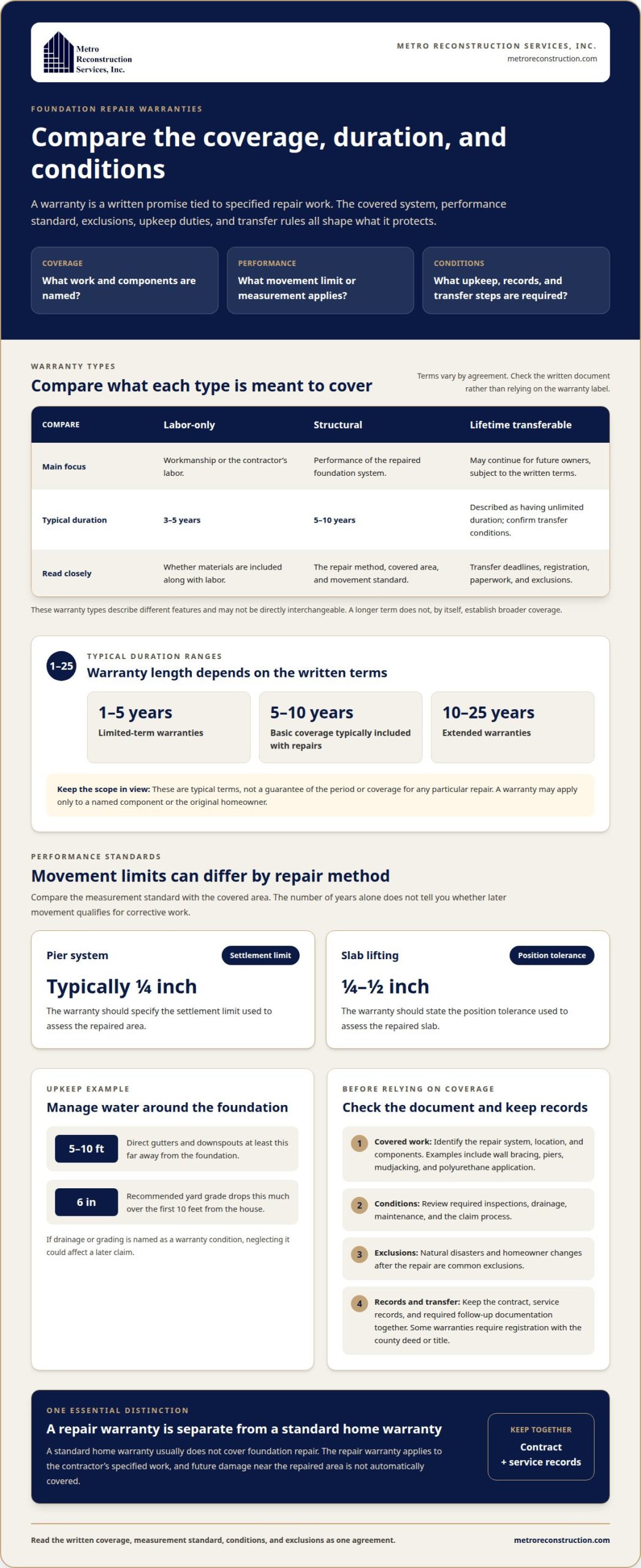
Warranty coverage can depend on the homeowner’s upkeep, not just the original repair. A contractor’s written warranty defines covered work, duration, and conditions; missed maintenance requirements may invalidate coverage. The National Foundation Repair Association says homeowners should follow maintenance requirements included as a condition of coverage. Keep the contract and service records together to document the repair and any required follow-up.
Water management is a practical example of upkeep that can affect foundation performance. Gutters and downspouts should direct water at least 5-10 feet away from the foundation. The recommended yard grade drops 6 inches over the first 10 feet from the house. These measures help limit water collecting beside the foundation, where changing soil moisture can contribute to movement. If the warranty names drainage or grading as a condition, neglecting it could affect a later claim.
- Review the warranty for stated inspection, drainage, and maintenance conditions.
- Keep receipts or records for required service and inspections.
- Document visible changes, such as new cracking or water collecting near the foundation.
What state laws regulate foundation repair warranties in the United States? Requirements depend on the state where the property is located, and the warranty terms also define the promised coverage. Read the written agreement for its covered work, conditions, exclusions, and claim process. This overview does not identify a particular state statute.
Do foundation repair warranties cover labor, materials, and future damage? Coverage depends on the written terms: a labor-only warranty typically lasts 3-5 years, while a structural foundation repair warranty typically lasts 5-10 years. The agreement should make clear whether it covers workmanship, materials, or both, and what happens if the repaired area moves again. Future damage is not automatically covered simply because it appears near the original repair.
Some warranties cover only the contractor’s labor, while structural coverage addresses the performance of the repaired foundation system. The repair method matters: a pier-system warranty may define a settlement limit, while slab-lifting coverage may set a position tolerance. These standards determine whether later movement qualifies for corrective work. Read the measurement standard alongside the covered area, rather than relying on a broad warranty label.
A standard home warranty usually does not cover foundation repair, since foundation damage develops over time. A repair warranty is separate and applies to the contractor’s specified work. Natural disasters and homeowner changes made after the repair are common exclusions. Transferability also comes with conditions: some warranties require registration with the county deed or title, so coverage may not automatically pass to a future owner.
What Is a Foundation Repair Warranty, and What Should You Look For?
A foundation repair warranty is a contractor’s written promise about specified repair work and its performance for a stated period. Before relying on it, compare the covered work, time limit, movement standard, and transfer conditions.
Common Warranty Types
Common types include labor-only, structural, limited-term, and lifetime transferable warranties. They differ in what they protect, not just how long they last. A labor warranty focuses on workmanship, while structural coverage addresses the repaired foundation system. A lifetime transferable warranty may continue for future owners, subject to its written terms. The Foundation Repair Network advises homeowners to pay close attention to warranty or guarantee terms.
Coverage should identify the repair method and work included. Foundation warranties may address wall bracing, piers, mudjacking, or polyurethane application. A warranty that refers broadly to “foundation work” may be harder to interpret than one that names the installed system and covered area. Look for clear language describing the remedy if the specified work does not perform as promised.
Warranty Duration
Warranty duration ranges from a limited term to the building’s entire lifespan. Limited-term warranties typically last 1-5 years; basic coverage of 5-10 years is typically included with repairs. Extended warranties typically last 10-25 years. These ranges describe common terms, not a guarantee that every repair receives the same period.
Duration matters only alongside the warranty’s scope and conditions. For example, a longer term may still cover only the original homeowner or a named repair component. Some lifetime transferable warranties are described as having unlimited duration, but transfer rules and exclusions still shape their practical value. Treat “lifetime” as a label to interpret through the contract, not as a substitute for reading its terms.
Read the measurement standard as carefully as the number of years. A pier-system warranty should specify a settlement limit, typically 1/4 inch. Slab-lifting warranties typically specify a position tolerance of 1/4 to 1/2 inch. Those figures define the movement threshold used to assess whether the repaired area meets the stated performance requirement.
Check these details in the written document:
- Covered work: Identify the installed repair system, location, and components.
- Performance standard: Find any movement limit or measurement method.
- Duration and owner: Note when coverage begins and whether it transfers.
- Claim conditions: Review maintenance duties, exclusions, and required records.
Minor crack-injection or limited-waterproofing repairs usually carry 2-5-year warranties unless included in a broader repair package. That distinction matters: a warranty for a localized repair does not necessarily cover later movement elsewhere in the foundation. Match each promise to the specific work described.
Does a transferable warranty actually increase my home’s resale value?
Some foundation repair warranties transfer to a new homeowner, but transfer is not automatic. The written terms determine the deadline, required paperwork, and whether coverage continues after the sale.
Warranty Transfer After a Sale
A warranty transfer changes who may claim its remaining coverage after ownership changes. Some agreements require both the previous owner and new owner to sign a transfer form before the sale. Others require registration with the county deed or title. A transfer may also require the contractor to receive notice and a fee within 90 days, so timing can affect whether the next owner receives coverage.
Transfer rules can make a lifetime warranty useful only when its conditions are met. For example, if an agreement requires deed registration, a signed transfer form alone may not complete the process. The seller and buyer should account for every stated requirement during the transaction, rather than assume coverage passes with the property. Keep the original repair contract and transfer documents with the home’s records.
Transferability and Home Resale
A transferable warranty can support resale discussions by giving a buyer access to remaining repair coverage. It has been described as providing 1-2% of the sale price in buyer negotiation leverage and appraisal confidence. That figure is not an automatic increase in market value; the warranty’s remaining term, scope, and transfer conditions shape its relevance to a buyer.
A buyer needs to understand what the warranty actually covers. A transferable document with narrow coverage or little time remaining may offer less practical value than a clear warranty covering the installed structural repair. The transfer does not expand the original promise. If the agreement excludes a cause of movement or limits coverage to a specific area, those restrictions remain after the sale.
Transfer procedures vary by agreement, so the written steps matter. Before closing, organize the repair contract, service history, and warranty paperwork. Confirm that required signatures and registrations are completed within the stated time limit. Some terms require the contractor to receive a transfer fee within 90 days, while others require county deed or title registration. Missing a deadline can leave the buyer without the intended coverage.
Inspection requirements can also affect the handoff. Some warranty terms may require an inspection or other documentation before transfer, and any inspection fees depend on the applicable arrangement. Review whether the inspection must happen before the sale or within a stated period afterward. A clear record helps distinguish existing settlement from movement observed after the new owner takes possession.
- Identify the transfer deadline and required notice.
- Determine whether both owners must sign a form before closing.
- Record any county deed or title registration requirement.
- Keep inspection and repair records with the transferred warranty.
Transferability can strengthen a resale conversation when the warranty remains active and the buyer understands its limits. It does not replace a review of the repair history, covered work, exclusions, or remaining duration.
Warranty insurance versus contractor-backed warranties
A contractor’s warranty is a contractual promise about specified repair work. It is not the same as structural warranty insurance. A foundation repair warranty explained in plain language helps you identify who made the promise and which document governs coverage. The distinction matters because a contractor’s written commitment and an insurance policy are separate forms of protection.
Read the agreement rather than relying on the word “backed.” A contractor-backed warranty names the business responsible for the covered work. An insurance document describes insured protection and its policy conditions. Neither label alone explains whether a particular crack, settlement, or repair method qualifies for coverage.
Before selecting a contractor, examine how the warranty connects to the repair plan. For example, a pier installation should be described in terms that match the written coverage. Clear wording helps distinguish a workmanship claim from one involving structural movement. It also identifies which documents may matter if you report a problem later.
Use these questions to assess the written warranty and contract:
- Covered work: Does the document name the repair method and location?
- Performance standard: Does it define how movement or repair failure is measured?
- Claim process: Does it explain how to submit a claim and which records to include?
- Exclusions: Does it identify events or later changes outside coverage?
- Responsibility: Does it name the party responsible for responding to a covered claim?
The contractor’s stability matters because a contractor-backed promise depends on the named business being available to address claims. Review the contract for the legal business name, warranty term, and claim contact details. Keep the signed agreement, repair description, photographs, and service records together. These records link the original work to a later claim and clarify what was installed.
For example, if a homeowner reports renewed movement near a repaired wall, the claim record should identify the repair area and date. The contractor’s warranty can then be compared with its stated performance standard and exclusions. Insurance coverage follows its own policy language, so the two forms of protection are not interchangeable.
Ask to have the foundation repair warranty explained in writing, with the covered work, claim steps, exclusions, and responsible party clearly stated. Those details provide a practical basis for understanding what happens if the installed repair does not meet its stated standard.
Foundation repair warranty exclusions
Exclusions define damage a warranty does not cover, even when it appears near completed repairs. Natural disasters and homeowner changes made after the repair are common exclusions. These limits matter because similar-looking cracks can have different causes. A warranty claim depends on whether the damage relates to covered work or an excluded event.
Consider a repaired area that shows new movement after a natural disaster. The warranty may exclude damage caused by that event, even if the affected area is close to the original repair. The key distinction is cause, not proximity. The agreement explains how excluded events affect the repair promise, so broad phrases deserve careful reading.
Homeowner changes after the work can also affect coverage. For example, later alterations near the repaired foundation may change the conditions around it. If the warranty excludes damage tied to homeowner changes, the connection between the alteration and reported damage becomes important. The exclusion does not automatically mean every later problem is excluded; the written terms and cause of damage define the boundary.
Scope exclusions create another important distinction. A warranty may cover a named repair area or installed system without covering every foundation component. If movement appears in a different part of the house, that issue may fall outside the original promise. Compare the location and type of reported damage with the repair description, rather than treating the warranty as coverage for the whole structure.
Read exclusions alongside the coverage and claim terms. A sentence about excluded causes may limit a broader promise elsewhere in the agreement. For example, a document may cover specified structural work while excluding damage from later homeowner changes. Understanding both statements helps prevent the assumption that all future movement qualifies for corrective work.
When damage appears, preserve records that help establish its origin. Keep the original contract, repair description, dated photographs, and records of later work. Note where new cracking or movement occurs and whether it corresponds to the repaired location. These details help distinguish a change in the original repair from a separate condition or an event named in the exclusions.
Before signing, look for exclusions addressing natural disasters, homeowner alterations, maintenance duties, and areas beyond the installed repair. Identify the specific event or condition named in each clause. If the language refers generally to “other damage,” use the surrounding terms to determine which work and causes it describes. Clear boundaries make the warranty easier to interpret when a claim arises.
- Match cause to clause: Compare the reported damage with the exclusion’s stated event or condition.
- Match location to scope: Check whether the affected area is part of the documented repair.
- Keep a record: Preserve contracts, photographs, and later alteration records together.
The practical takeaway is simple: an exclusion is not merely fine print. It defines where the repair promise ends, so read each clause alongside the covered work and the actual cause of damage.
Metro Reconstruction Services
Metro Reconstruction Services, Inc. can help when foundation concerns appear alongside damage to exterior finishes. Cracking in stucco or masonry, for example, may call for a separate assessment of those materials; finish repairs should not be confused with foundation warranty coverage.
For exterior finish issues, Metro Reconstruction Services, Inc. provides Stucco Restoration, stucco installation and replacement, and Masonry Work. Understanding the warranty’s limits can help you distinguish covered structural work from related damage to your home’s exterior.
If you have questions about exterior damage or restoration, contact Metro Reconstruction Services, Inc.
Make Your Next Property Decision With Clarity
With your foundation repair warranty explained clearly, you can treat it as part of a broader property record, not a substitute for understanding the building’s condition. Connect decisions about future work to documented observations, so changes in one area do not obscure the origins of another issue. This distinction helps you plan carefully and preserve a useful history for future owners.
When a structural concern appears alongside visible exterior damage, consider how the building’s parts relate before deciding what needs attention. A crack, moisture mark, or finish failure can have different origins, and an accurate assessment helps guide the next step. Clear records can support those decisions over time.
For guidance on exterior restoration needs, contact Metro Reconstruction Services, Inc. at 303.543.9549. A thoughtful next step starts with understanding what you’re seeing and why.
Frequently Asked Questions
What happens if my foundation repair company goes out of business?
If the company closes, its ability to respond to a claim may be affected. A separate insurance policy may provide another avenue only if the repair is covered under that policy. Start by identifying the business named on your signed agreement and any insurer named in separate paperwork. Keep those documents accessible, since a warranty label alone does not establish who can handle a claim after a closure.
What’s the difference between a lifetime warranty and a transferable lifetime warranty?
A lifetime warranty describes the coverage period; “transferable” describes whether an eligible future owner may receive that coverage. The terms address different conditions. For instance, a document might describe lifetime coverage but limit who can make a claim. Read the owner-eligibility language alongside the coverage description, and preserve the original document so later owners can understand the rights the warranty actually grants.
Can I transfer my foundation warranty more than once?
Only the warranty’s wording can establish whether coverage may pass through multiple sales. A document that allows one transfer does not necessarily address later ownership changes. If the home may change hands again, look for language about successive owners, not just the first buyer. Keep each completed transfer record with the original agreement to create a clear ownership history for anyone reviewing the warranty.
What Should You Ask a Contractor About Warranty Before Hiring?
Ask how the final repair description will match the warranty and what information is used to assess a reported problem. You can also ask who receives the claim, what observations or records are useful, and how the contractor distinguishes a repair concern from a separate condition. Request the answers in the written agreement. Clear documentation connects the promised protection to the work actually performed.
What does a foundation repair warranty typically cover?
A warranty covers only the work and performance its agreement describes. To understand its practical scope, compare the final repair record with the warranty after the work is complete. For example, confirm that the document identifies the actual repaired area rather than relying on a general project description. This helps clarify whether a later concern relates to the documented work or another part of the home.
What foundation repair warranty exclusions are common?
Exclusions vary by agreement, so read each one in context rather than treating a list as universal. If a reported problem has more than one possible cause, the key question is how the warranty connects that cause to its covered work. Keep dated records of property changes and observations of new symptoms. This context can help explain the sequence of events when a claim is reviewed.
How long do foundation repair warranties last?
The written warranty sets the applicable term. Pay attention to when coverage begins, what event starts it, and the stated expiration point. For example, the start date might be tied to completion of the work rather than the date you first notice a problem. Recording those dates in your property file makes it easier to determine whether a concern arose during the stated coverage period.
What maintenance or inspection requirements can void a foundation warranty?
The agreement defines which maintenance or inspection duties apply and how noncompliance affects coverage. A useful record includes the date, work performed, and any related service documentation. If an inspection produces written observations, keep them with the property records. This creates a timeline to help distinguish completed upkeep from later changes, without relying on memory when a warranty question arises.