
A crack’s appearance shows where to look; its movement over time can offer more useful evidence. Foundation crack monitoring Boulder homeowners can do at home starts with a clear, consistent record, not a guess based on memory.
It’s reasonable to wonder whether a visible crack is changing or simply looks different in changing light. In Boulder, moisture shifts can also affect expansive clay soil, which swells when wet and shrinks when dry. That context makes careful observation useful, but it doesn’t reveal the cause on its own.
This guide explains how to document a crack’s location and appearance, compare observations over time, and recognize changes that may warrant a professional evaluation. You’ll also learn what DIY monitoring can and can’t tell you, and how a documented history can support a more informed assessment. The next step depends on more than the surface mark: the underlying structural cause matters.
Key Takeaways
- Foundation crack monitoring Boulder homeowners can do records changes over time, but it can’t identify a crack’s cause or structural significance.
- Build a useful record by noting the crack’s location, taking dated photos, measuring consistently, and logging relevant moisture or drainage observations.
- Photos, ruler-based records, and crack gauges capture different details; consistent placement is essential when comparing observations.
- Changes in a crack or nearby conditions may help you decide whether a professional foundation evaluation is appropriate.
- For guidance on foundation repair, contact Metro Reconstruction Services, Inc. or call 303.543.9549.
Foundation Crack Monitoring in Boulder: What Tracking Can Tell You
Foundation crack monitoring is the repeated, consistent documentation of a crack’s appearance over time. It gives you a record to compare, rather than relying on memory or a single glance. In practical terms, you note where the crack is, photograph it from the same position, add the date, and record visible changes or nearby conditions.
That record can help show whether the crack appears stable or has changed. It cannot explain why a change occurred or establish whether the foundation’s structural performance is affected. A visible crack is an observation, not a confirmed foundation diagnosis. That distinction matters: the cause may involve the foundation, surrounding soil, moisture, or other building conditions, and monitoring alone cannot determine which factor is responsible.
What does foundation crack monitoring involve?
Use consistent reference points so later observations are comparable. Photograph the same area from a similar distance and angle, include a ruler for scale, and write down the date. Note any visible change in the crack’s length or opening, as well as changes around it, such as nearby water staining or damage to adjacent finishes.
One observation provides a snapshot, not a trend. A difference between two records may be meaningful, or it may reflect a changed camera angle or measurement position. Consistency makes your notes more useful, but it does not turn them into a structural assessment. The broader practice of structural health monitoring also centers on tracking changes over time; for a homeowner, crack records are a limited form of observation, not a substitute for evaluation.
Why does Boulder soil and moisture context matter?
Some properties in the Boulder area may have expansive clay soil, which swells as it takes on moisture and shrinks as it dries. Those changes can affect the ground around a foundation. However, soil and water conditions vary by property, so a crack cannot be attributed to expansive soil based on location alone.
Drainage patterns, grading, and the building’s condition also differ from one home to another. For your log, note relevant observations such as water collecting near the foundation or changes in drainage, without assuming they explain the crack. A professional evaluation can consider these conditions together with the foundation and the home’s complete outer system.
If you’re concerned about a crack or want to discuss foundation repair, contact Metro Reconstruction or call 303.543.9549. Foundation crack monitoring Boulder homeowners complete can provide useful history, while an evaluation helps determine what that history means.
How to Document a Foundation Crack Consistently
A useful crack record is simple enough to maintain and consistent enough to compare. Before changing the area, take clear photos and note what you can see. Don’t fill, cover, or otherwise alter the crack before documenting its appearance; doing so can remove details that may help explain its history.
Set up a repeatable crack record
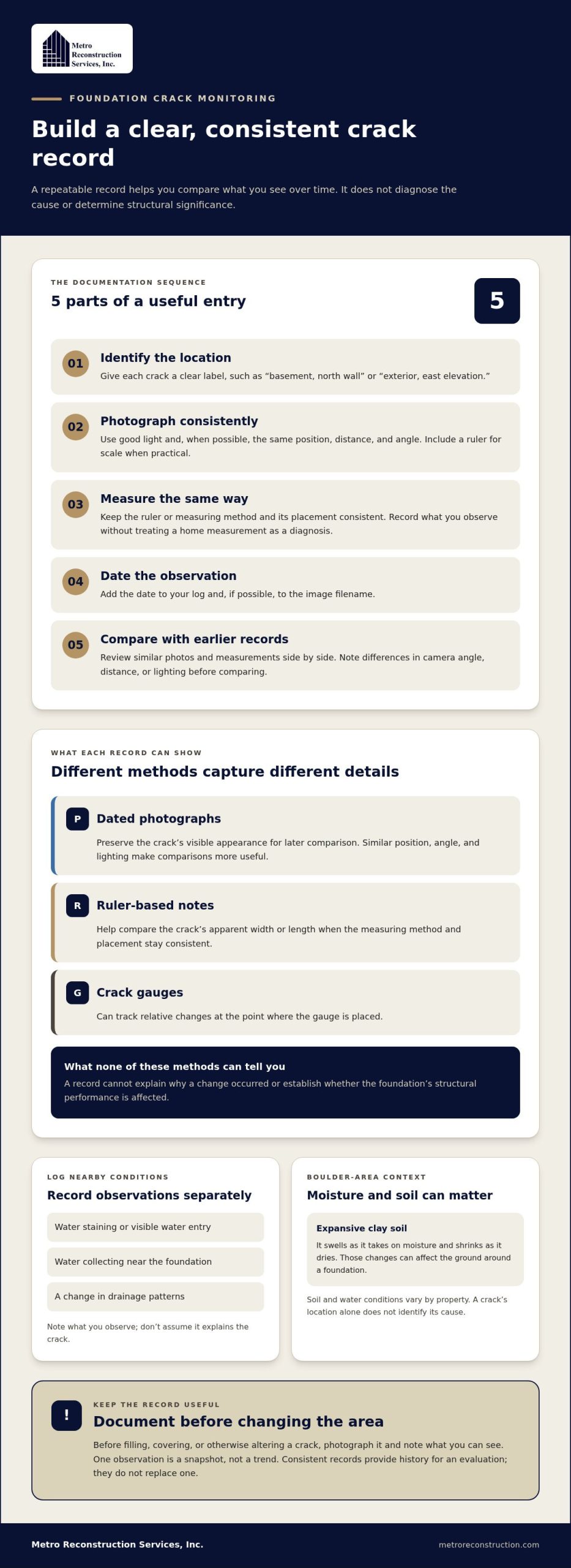
Give each crack a location label, such as “basement, north wall” or “exterior, east elevation.” Record the date, then photograph the crack in good light from a repeatable position. Include a ruler or another scale in the frame when practical. Note what is visible, such as the crack’s apparent length or opening, without guessing at its cause.
Use this sequence for each entry:
- Identify: Assign the crack a clear location label.
- Photograph: Take a well-lit image from the same position and angle when possible.
- Measure: Use the same ruler or measuring method and placement each time. Record what you observe; don’t treat a home measurement as a structural diagnosis.
- Date: Add the observation date to the log and, if possible, the image filename.
- Compare: Review the new record alongside earlier entries, using similar photos and measurements.
A notebook or digital document can hold the record. Include the location label, date, images, measurement notes, and separate observations about moisture or drainage, such as visible water entry or a change in where water collects. Keeping these details together creates a clearer history to share if you seek an evaluation.
Compare observations without overreading them
Compare images taken from similar positions, rather than relying on memory. If a photo differs in angle, distance, or lighting, note that limitation before drawing a comparison. Consistent photographs are more useful than memory because they let you review visible details side by side.
Record nearby conditions as observations, not explanations. For example, note water staining near the crack or a change in drainage separately from any change you see in the crack itself. A single measurement or apparent difference can’t establish why the crack looks different or confirm structural movement. The record supports a more informed evaluation; it doesn’t replace one.
If your notes raise concerns, contact Metro Reconstruction about foundation repair or call 303.543.9549. Consistent foundation crack monitoring Boulder homeowners document can help provide useful context for that conversation.
Foundation Crack Monitoring Methods: What Each Can and Cannot Show
Different tools record different details. Dated photographs preserve the crack’s visible appearance, a ruler-based record helps compare its apparent width or length, and a purpose-made crack gauge can track relative changes at the point where it is placed. None explains why a change occurred. A foundation crack monitoring Boulder log is most useful when you treat its readings as observations, not a diagnosis.
Photographs, measurements, and crack gauges
- Dated photographs: Show the crack’s appearance and surrounding area at a particular time. They’re useful for visual comparison, but differences in angle, distance, or lighting can make changes hard to judge.
- Ruler-based records: Let you note an apparent measurement for comparison. Results depend on placing the ruler at the same spot and reading it consistently; a measurement by itself doesn’t establish structural significance.
- Purpose-made crack gauges: Provide a reference for observing relative change at the installed location. They show what happens at that point, not the condition of the whole foundation, and correct, consistent placement matters.
Use the same reference point each time you photograph or measure, and keep the date with each record. A gauge reading or a difference between images can help identify a change worth discussing, but monitoring tools can’t identify its cause or confirm whether the foundation has a structural problem.
When observation needs a broader structural evaluation
The crack’s location and pattern matter alongside any apparent change. So do related conditions, such as other visible building changes or signs of water entry. Looking at one mark in isolation can miss how foundation conditions, drainage, and moisture interact around the home.
If your observations raise concern, a professional evaluation can consider the crack in context, including relevant moisture and drainage conditions. Metro Reconstruction’s foundation repair team can help you discuss next steps. Call 303.543.9549 or contact us online.
A Boulder Homeowner’s Step-by-Step Crack Monitoring Plan
A useful plan turns scattered observations into a record you can review and share. Keep the focus on what you can see: document the crack, compare records made in a consistent way, note related conditions, and decide whether you need a professional evaluation. Your notes can add context, but they can’t confirm the cause of a crack.
- Document the starting condition. Label the crack by its location, such as “basement, north wall,” then take a clear photo and record what you observe. Don’t fill, cover, or attempt a structural repair before you’ve documented the area.
- Compare records consistently. Use similar photo angles and the same measurement position. Note visible differences without treating a single changed reading as proof of foundation movement.
- Record surrounding conditions. Note visible water entry, water collecting near the foundation, or a change in grading or drainage. Keep these observations separate from your description of the crack.
- Observe other parts of the home. Record changes in how doors or windows operate, or other visible changes near the affected area. These details may help provide context, but they don’t prove that the foundation is moving.
- Decide whether to seek an evaluation. If the crack’s appearance changes or you’re unsure how to interpret your observations, professional input can help assess the crack alongside the home’s structural and moisture conditions.
Organize observations around the whole building
Foundation conditions don’t exist in isolation. A water entry point, drainage concern, or change in a nearby door’s operation belongs in your notes because it describes the home around the crack. Changing moisture or drainage is context to record, not proof of what caused the crack. Avoid digging, filling, or making structural changes based on a log entry.
For local project context, see Metro Reconstruction’s Boulder construction services overview. It can help you understand the range of construction work considered in the area, while a foundation evaluation addresses the conditions at your home.
Recognize when to request professional input
You don’t need to establish a movement trend before asking for an evaluation. If your observations change, several conditions appear together, or uncertainty remains, a professional can consider the crack’s location and pattern alongside related structural and moisture conditions. That broader view helps distinguish a surface observation from an issue that may call for foundation repair.
From Crack Monitoring to Foundation Evaluation in Boulder
A dated record can make a foundation evaluation more focused. It gives you and the evaluator a history to review, rather than relying only on how the crack looks on one day. A clear record is the practical value of foundation crack monitoring Boulder homeowners can do themselves, but interpreting what the observations mean requires looking beyond the surface.
What to bring to a foundation evaluation
Gather the information that helps describe both the crack and the conditions around it. Bring:
- Dated photographs taken from consistent positions
- Notes identifying the crack’s location and any measurements made consistently
- Observations about water entry, moisture, drainage, or grading near the affected area
- Notes on related visible changes, such as a nearby door or window operating differently
Separate what you observed from what you suspect. For example, write “water collected near the wall after rain” rather than concluding that the water caused the crack. This distinction helps keep the record factual and gives an evaluator useful context without treating an assumption as a diagnosis.
How underlying causes guide durable next steps
Repair planning should follow an assessment of the crack and relevant contributing conditions. A crack may be one visible sign among several, so the evaluation may also consider moisture, drainage, and the foundation’s condition together. Where water management is a factor, appropriate foundation drainage solutions may form part of a longer-term plan. The right response depends on the property; a particular repair method shouldn’t be chosen from a photograph or monitoring record alone.
Metro Reconstruction provides foundation repair work with attention to underlying structural conditions, rather than treating a crack as an isolated surface mark. You can also review the company’s construction services overview for information about its broader work in Boulder and Front Range communities.
If your record shows changes, or you remain uncertain about what you’re seeing, a professional evaluation can help clarify the next step. Contact Metro Reconstruction to discuss foundation repair, or call 303.543.9549. There’s no need to interpret the evidence alone.
Turn Your Crack Record Into a Clear Next Step
Consistent foundation crack monitoring Boulder homeowners can do creates a useful history, but photos and measurements can’t explain the crack’s cause or confirm its structural significance. Record what you observe, note related moisture or drainage conditions, and seek a professional evaluation if the crack changes or you remain unsure.
A dated record can help frame an evaluation, where the crack is considered alongside the foundation and other conditions that may contribute to movement. Metro Reconstruction is a family-owned construction firm with over four decades of experience, providing specialized foundation repair and structural mitigation services across Boulder and Front Range communities.
If you have concerns about a crack, take the next step at your pace. Contact Metro Reconstruction about foundation concerns or call 303.543.9549. Careful documentation and an informed evaluation can help you move forward with greater clarity.
Frequently Asked Questions
How do I monitor a foundation crack in Boulder?
Photograph the crack from a consistent position, date each image, and record its location and visible appearance. If you measure it, use the same points and method for each entry. Keep notes about nearby moisture or drainage separate from crack observations. A foundation crack monitoring Boulder log can help you compare what you see over time, but it can’t diagnose the cause or determine whether structural repair is needed.
Can I monitor a foundation crack with photographs alone?
Yes, photographs can provide a useful visual record if you keep the lighting, angle, distance, and scale consistent. They may make clear differences easier to compare, though subtle changes can be hard to judge from images alone. Add the date and a short description to each photo. If you also take measurements, repeat them at the same points and treat both types of records as observations, not a diagnosis.
What does a foundation crack gauge show?
A crack gauge records changes at the location where it’s placed, giving you a reference for comparing observations over time. Consistent placement and repeat readings help make the record more useful, but a gauge can’t explain why a change may be happening or identify the right repair. Pair its readings with dated photographs and notes about relevant moisture conditions, then share the record during a professional evaluation if you have concerns.
Do foundation cracks always mean structural damage?
No. A visible crack alone doesn’t establish its cause or structural significance. Its location, pattern, changes over time, and related building or moisture conditions all provide context. Monitoring can document what you observe, but it can’t confirm that a crack is harmless or serious. If your records show a change, you notice related conditions, or you’re unsure what the observations mean, seek a professional foundation evaluation.
Can expansive clay soil affect foundation cracks in Boulder?
It can be a contributing factor. Expansive clay soil swells when wet and shrinks when dry, which can place pressure on foundations. However, soil and drainage conditions vary by property, and a crack by itself can’t show that soil movement caused it. Record moisture and drainage observations alongside visible crack changes, but avoid treating them as proof of cause. An evaluation can consider these conditions together.
When should I ask for a foundation crack evaluation?
Consider an evaluation if your records show an apparent change, you notice related building or moisture concerns, or you’re uncertain how to interpret what you see. Bring dated photographs, location notes, and any consistent measurements, and distinguish observations from assumptions about the cause. Metro Reconstruction provides specialized foundation repair and structural mitigation services in Boulder and Front Range communities. Contact Metro Reconstruction about foundation concerns or call 303.543.9549.
How often should I check a foundation crack?
There isn’t one monitoring interval that suits every crack or property, so a fixed schedule shouldn’t be treated as a diagnosis. Choose an approach you can follow consistently, and date each observation so you can compare records made under similar conditions. If you see changes or remain concerned, seek a professional evaluation rather than waiting for a particular number of readings. A log documents observations; it doesn’t replace assessment of the underlying cause.