
The Marshall Fire destroyed nearly 1,100 homes, proving that wildfire safety isn’t just about the roof, but the complete outer system of your property. For homeowners living in the Wildland-Urban Interface, choosing fire resistant decking Boulder residents can rely on is now a matter of both structural integrity and legal necessity. As of July 1, 2026, new enforcement of Wildfire Resiliency Code requirements means that deck construction or replacement must adhere to strict ignition-resistant standards. It’s natural to feel a sense of uncertainty when faced with these complex building mandates.
We believe your outdoor living space should offer both aesthetic beauty and a reliable shield against environmental stressors. This guide will help you navigate the nuances of the 2024 International Wildland Urban Interface Code so you can select materials that effectively resist ember ignition. We’ll examine the transition from traditional wood framing to non-combustible steel substructures and high-performance composite surfaces. Because these choices impact the long-term preservation of your home, understanding the home hardening process is the first step toward achieving lasting peace of mind.
Key Takeaways
- Learn why identifying your specific Wildfire Risk Zone is the critical first step in ensuring your deck complies with the 2026 building codes.
- Discover which materials for fire resistant decking Boulder residents use to provide the most reliable protection against ember ignition.
- Understand the hidden vulnerabilities at the connection point between your deck and your home, as this is where wind-blown embers are most likely to collect.
- Identify the proactive maintenance habits and vegetation management strategies that help protect your home’s complete outer system from wildfire threats.
- Start your home hardening project with a professional evaluation by calling 303.543.9549 or visiting our contact page.
Understanding Boulder’s WUI Regulations and Wildfire Risk Zones
The Wildland Urban Interface, or WUI, represents the geographical area where human development meets undeveloped wildlands. In Boulder, this interface isn’t just a line on a map; it’s a zone where environmental stressors like wind-blown embers pose a constant threat to residential structures. Understanding these boundaries is essential because they dictate the specific materials required for fire-mitigation and prevention services. When we evaluate a property, we look at how the deck interacts with the rest of the building’s complete outer system to identify potential vulnerabilities before they lead to structural failure.
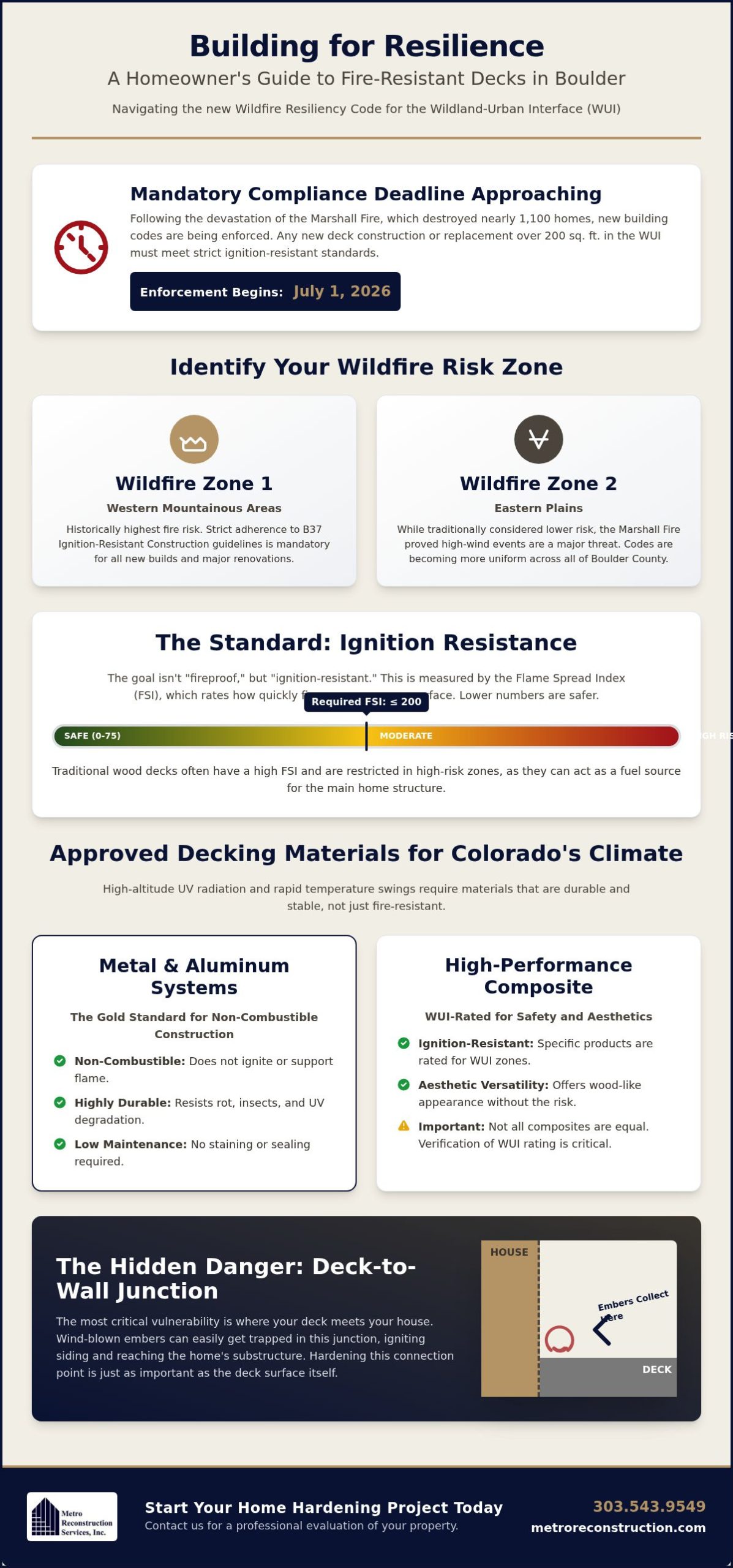
Boulder County categorizes risk into two primary areas. Wildfire Zone 1 covers the western, mountainous portion of the county where the fire risk is historically highest. Here, the B37 Ignition-Resistant Construction guidelines are strictly enforced. Wildfire Zone 2 covers the eastern plains. While Zone 2 has traditionally had fewer restrictions, the 2021 Marshall Fire demonstrated that high-wind fire events don’t respect these boundaries. Consequently, the enforcement of codes for fire resistant decking Boulder homeowners must follow has become more uniform to ensure the safety of the entire community.
What Defines an Ignition-Resistant Deck?
While many people search for a fireproof solution, it’s more accurate to discuss Fireproofing as a set of standards that delay or resist ignition. An ignition-resistant deck is built with materials designed to withstand heat and embers without becoming a fuel source. This resistance is measured by the Flame Spread Index, which ranks how quickly fire moves across a surface. In high-risk areas, your deck surface must have a flame spread index no higher than 200, and in some cases, as low as 75. Traditional wood decks are frequently restricted because they don’t meet these specific safety ratings, which leaves the main structure vulnerable to fire spread.
Permit Requirements for Boulder Homeowners
As of July 1, 2026, any new deck construction or addition over 200 square feet in the WUI triggers the updated Wildfire Resiliency Code. You’ll likely need a Wildfire Mitigation Plan before work begins. This plan evaluates your property’s surroundings to ensure your home hardening efforts aren’t undermined by nearby vegetation. If you’re unsure if your project requires a permit, we recommend a professional evaluation. You can reach our team at 303.543.9549 or through our contact page to discuss your specific site conditions and compliance needs.
Evaluating Ignition-Resistant Decking Materials for Colorado
Boulder’s high altitude presents a unique challenge for building materials that many standard products can’t handle. The intense UV radiation at 5,000 feet and above can break down the chemical bonds in standard decking, making them more brittle and potentially more flammable over time. When selecting fire resistant decking Boulder residents need to consider not just the initial fire rating, but how that material will perform after a decade of exposure to the Colorado sun. Additionally, the Front Range experiences rapid temperature shifts that cause materials to expand and contract significantly. If a decking system lacks thermal stability, the resulting gaps can allow wind-blown embers to reach the vulnerable sub-structure, compromising the building’s total outer system.
Metal and Aluminum Decking Systems
Aluminum is often considered the gold standard for non-combustible construction because it does not ignite or support a flame. In mountain environments, its resistance to rot and insect damage provides long-term value that offsets the initial investment. While some homeowners worry about the industrial look of metal, modern systems offer textured finishes that blend well with mountain-modern architecture. It’s a reliable, low-maintenance choice for those prioritizing the long-term preservation of their property. Choosing a metal system ensures that the deck remains a defensive barrier rather than a fuel source during a wildfire event.
High-Performance Composite Decking
Not all composite materials are created equal. While many offer low maintenance, only specific high-performance composites are rated for use in Boulder’s WUI zones. These materials are engineered with fire-retardant additives that help them resist radiant heat and direct flame contact. However, it’s vital to check the flame-spread rating; a Class A rating is the benchmark for safety. Because these materials can expand in the summer heat, precise installation is required to maintain the structural integrity of the deck-to-wall junction. For a detailed look at which materials fit your specific property, our fire mitigation and prevention services can provide a forensic evaluation of your current structure.
Ignition-Resistant Natural Wood Options
For those who prefer natural aesthetics, ignition-resistant wood is a possible choice, but it comes with specific limitations. Fire-retardant-treated (FRT) lumber must be specifically labeled for exterior use to ensure the protective chemicals don’t leach out during heavy snowmelt or rain. Another alternative is Heavy Timber construction, which uses thick beams that are harder to ignite than thin planks. While beautiful, these systems require diligent maintenance to prevent the wood from drying out. If you have questions about which fire resistant decking Boulder codes allow for your specific zone, you can reach our team at 303.543.9549 or through our contact page for professional guidance.
Beyond the Surface: Hardening the Deck-to-Wall Junction
The connection between your deck and your home is often the most vulnerable point of the entire structure. While high-quality fire resistant decking Boulder residents choose can protect the walking surface, wind-blown embers frequently accumulate in the corners where the deck meets the siding. These embers act much like drifting snow, settling into gaps and smoldering for hours. This can eventually ignite the wall even if the deck boards themselves remain intact. We take a forensic approach to this problem, evaluating the complete outer system of your property to ensure that every transition point is hardened against heat and flame.
Integrating your deck with a non-combustible exterior, such as stucco or masonry work, provides a superior level of protection. By creating a continuous barrier of ignition-resistant materials, we eliminate the specific gaps where fire typically finds a foothold. This holistic strategy is a hallmark of our fire mitigation and prevention services, moving beyond surface-level fixes to address the underlying structural origins of fire vulnerability. We don’t just build decks; we preserve the integrity of your home’s envelope.
Protecting the Ledger and Flashing
The ledger board serves as the structural anchor for your deck, making its protection vital for both safety and longevity. We emphasize the use of non-combustible metal flashing at this connection point to divert water and prevent the accumulation of organic debris. Proper drainage is essential because moisture leads to rot, and rotted wood is significantly more flammable than sound timber. We believe that the framing beneath the boards matters just as much as the visible surface. A fire-resistant deck built on a combustible, poorly flashed frame is a compromise that leaves your investment at risk.
Under-Deck Protection and Mesh Systems
Vulnerability isn’t limited to the top of the deck; the area beneath the structure is equally critical. Boulder’s WUI codes require decks less than 4 feet above the ground to be enclosed to prevent ember intrusion. We use corrosion-resistant mesh with openings no larger than 1/8 inch to block embers from blowing into the crawlspace while still allowing for necessary ventilation. The ground surface must be cleared of all vegetation and replaced with non-combustible materials like rock or gravel rather than mulch. These skirting details ensure your project meets the strict 2026 wildfire resiliency requirements. If you’re concerned about your deck’s junction points, contact us at 303.543.9549 or visit our contact page for a professional evaluation.
Long-Term Maintenance and Fire Mitigation Strategies
The effectiveness of fire resistant decking Boulder homeowners invest in depends heavily on a commitment to proactive maintenance. Even the highest-rated materials can’t protect a structure if they’re undermined by neglect or the accumulation of environmental debris. We view maintenance as a critical component of the building’s complete outer system. Annual inspections are necessary to identify issues like rotten fascia or loose boards that could accelerate the spread of a fire. Professional diagnostics allow us to look past surface appearances to find the underlying structural origins of potential failure before they become critical during a wildfire event.
The “First Five Feet” rule is a foundational principle of home hardening that every property owner should follow. This strategy involves managing all vegetation and combustible materials within a five-foot radius of your deck structure. Replacing wood mulch with rock and removing overhanging branches significantly reduces the radiant heat your deck must withstand during a fire. Cleaning your ignition-resistant materials is also vital, but you must use methods that don’t strip away protective coatings or damage the material’s surface integrity. Using a gentle touch preserves the long-term value of your investment while keeping the fire-safety ratings intact.
Seasonal Fire Prep for Your Outdoor Living Space
Embers often find a home in the small gaps between deck boards where pine needles and dry leaves accumulate. These debris traps can smolder and ignite the sub-structure even if the surface boards are fire-rated. During high-risk periods, it’s also wise to move combustible patio furniture and cushions away from the house. We frequently see woodpecker damage across the Front Range; these holes aren’t just an eyesore, but they create direct entry points for embers to reach the dry, untreated interior of your home’s framing. Patching these holes is a small step that provides a significant defensive advantage.
The Relationship Between Moisture and Fire Risk
There’s a direct link between moisture intrusion and increased fire vulnerability. When water seeps into the ledger or joists, it leads to structural decay and rot. Rotted wood is more porous and ignites more easily than healthy timber, turning a structural problem into a serious fire hazard. If your deck shows signs of aging or water damage, professional restoration services are essential to restore its integrity. Superficial fixes like painting over rot only hide the danger without addressing the core issue. To ensure your home is fully prepared for the next wildfire season, contact us for a comprehensive evaluation at 303.543.9549 or visit our contact page.
Professional Deck Reconstruction: The Metro Reconstruction Methodology
With over 40 years of experience serving the Front Range, we have developed a methodology that prioritizes structural integrity over superficial aesthetics. We don’t view a project as a simple surface replacement; instead, we treat every deck as a critical component of your home’s complete outer system. This holistic perspective allows us to identify the underlying structural origins of potential failure before they lead to a catastrophe. When installing fire resistant decking Boulder homeowners can trust, our family-owned team applies a forensic diagnostic process to ensure that the new structure provides a reliable shield against environmental stressors for decades to come.
Our commitment to precision is a foundational promise that has defined our firm for four decades. We understand that the hidden mechanics of a structure are what truly determine its safety during a wildfire event. By focusing on the relationship between different technical components, we ensure that your deck doesn’t just look great but functions as a defensive barrier. This quiet confidence comes from a deep expertise in local conditions, allowing us to offer grounded and reassuring solutions that protect your family’s most significant investment without the high-pressure tactics common in the industry.
A Consultative Approach to Home Hardening
We believe in an educational partnership rather than a traditional sales relationship. Our consultative approach moves beyond surface-level fixes to explain the difficult truth of a structural failure, guiding you through the technical complexities of home hardening. Because we specialize in stucco restoration, masonry work, and window replacement, we are uniquely qualified to coordinate your decking with your home’s entire exterior envelope. This ensures that the transition points between different materials are seamless and fully hardened against wind-blown embers. We pride ourselves on identifying the root causes of decay, ensuring that your new fire resistant decking Boulder system is built on a foundation of accuracy and long-term value.
Start Your Fire Mitigation Project Today
Navigating the Boulder building department requires a level of local expertise that only comes from years of successful projects. We offer fixed-price reconstruction projects to provide our neighbors with clarity and peace of mind throughout the building process. By choosing a partner who understands the nuances of Wildfire Resiliency Codes, you ensure that your project is code-compliant and built to a premium, engineering-led standard. You can learn more about our fire mitigation and prevention services to see how we help homeowners prepare for the upcoming season. To begin your forensic evaluation, call our team at 303.543.9549 or reach out through our contact page today.
Securing Your Home’s Future with Ignition-Resistant Systems
Building a deck in Boulder today requires more than just picking a color; it’s about integrating a defensive layer into your home’s complete outer system. We’ve explored how local WUI regulations and the specific choice of materials work together to resist wind-blown embers. By addressing vulnerable points like the deck-to-wall junction, you can transform a potential fuel source into a resilient barrier that protects your entire property. Professional diagnostics ensure that every transition point is hardened against environmental stressors, providing a long-term solution rather than a temporary fix.
Choosing fire resistant decking Boulder homeowners can depend on starts with identifying the underlying structural origins of fire risk. Our family-owned team has been protecting the Front Range since 1982, bringing over 40 years of local construction expertise to every project. We specialize in WUI-compliant home hardening and precise structural restoration to ensure your property meets the strictest safety standards. Protect your property with the experts in Boulder fire mitigation. Contact Metro Reconstruction Services today or call us at 303.543.9549 for a professional evaluation. Taking these proactive steps today ensures your outdoor living space remains a safe and beautiful retreat for years to come.
Frequently Asked Questions
Is composite decking fireproof in a Boulder wildfire?
No material is entirely fireproof, but high-performance composites are classified as ignition-resistant. These materials are engineered to resist catching fire from wind-blown embers or radiant heat. In Boulder, these products must meet specific flame spread ratings to be code-compliant. While standard composites might melt or ignite under extreme heat, fire-rated versions provide a critical defensive layer for your home’s complete outer system.
What are the WUI deck requirements for Boulder County?
Boulder County requirements mandate the use of non-combustible or ignition-resistant materials for both the deck surface and the framing. As of 2026, many new projects in high-risk zones require a Class A non-combustible substructure, such as steel framing. Additionally, decks less than 4 feet above the ground must be enclosed with mesh to prevent embers from accumulating in the crawlspace beneath the structure.
Does fire-resistant decking cost significantly more than traditional wood?
The initial investment for fire resistant decking Boulder residents choose is higher than traditional lumber, but the long-term value is superior. Building to wildfire standards is estimated to add approximately 2.7% to construction costs when incorporated into a project. This investment offsets the high price of future replacements and provides peace of mind. These materials also offer better resistance to rot and UV damage, reducing annual maintenance expenses.
Can I just paint my existing deck with fire-retardant paint to meet code?
Topical paints and coatings are generally not accepted as a primary method to meet modern building codes for new construction or major replacements. These treatments can leach out over time due to Colorado’s heavy snow and intense sun exposure. They don’t address the underlying structural origins of fire risk in the framing. A permanent, material-based solution is required to ensure reliable, long-term protection for your property’s exterior envelope.
What is the best material for a deck in Wildfire Zone 1?
Non-combustible aluminum or steel systems are often considered the safest options for properties in Wildfire Zone 1. These materials provide the highest level of protection because they cannot ignite or support a flame. If you prefer a wood aesthetic, fire-rated composites or heavy timber with specific ignition-resistant properties are viable alternatives. The best choice depends on your home’s architecture and your goals for long-term maintenance and structural preservation.
How often should I have my deck inspected for fire safety in Colorado?
We recommend a professional evaluation of your deck system at least once a year, preferably before the peak of wildfire season. Inspections should focus on identifying accumulated debris in gaps, signs of wood rot, or woodpecker damage that could create entry points for embers. Since moisture intrusion can make wood more flammable, checking the ledger and flashing for structural decay is a critical part of maintaining safety.
Do I need a permit to replace my deck boards in Boulder?
Yes, most deck board replacements in the Wildland-Urban Interface require a permit from the local building department. This ensures that the new materials meet current ignition-resistant standards. Because codes have evolved significantly since the Marshall Fire, even minor repairs often trigger a requirement to bring the structure up to modern safety levels. Consulting with a local expert helps ensure your project is fully compliant with the 2026 wildfire resiliency requirements.
What is ember-resistant mesh and do I really need it?
Ember-resistant mesh is a screen with openings no larger than 1/8 inch used to enclose the area under low-profile decks. It is a mandatory requirement for decks less than 4 feet above the ground in many Boulder jurisdictions. This mesh prevents wind-blown embers from blowing underneath the structure and igniting stored items or dry vegetation. It is a simple but effective component of a complete, professional home-hardening strategy.
If you have more questions about fire resistant decking Boulder requirements or need a forensic evaluation of your current structure, our team is here to help. You can reach Metro Reconstruction Services, Inc. at 303.543.9549 or visit our contact page to schedule your consultation today.