
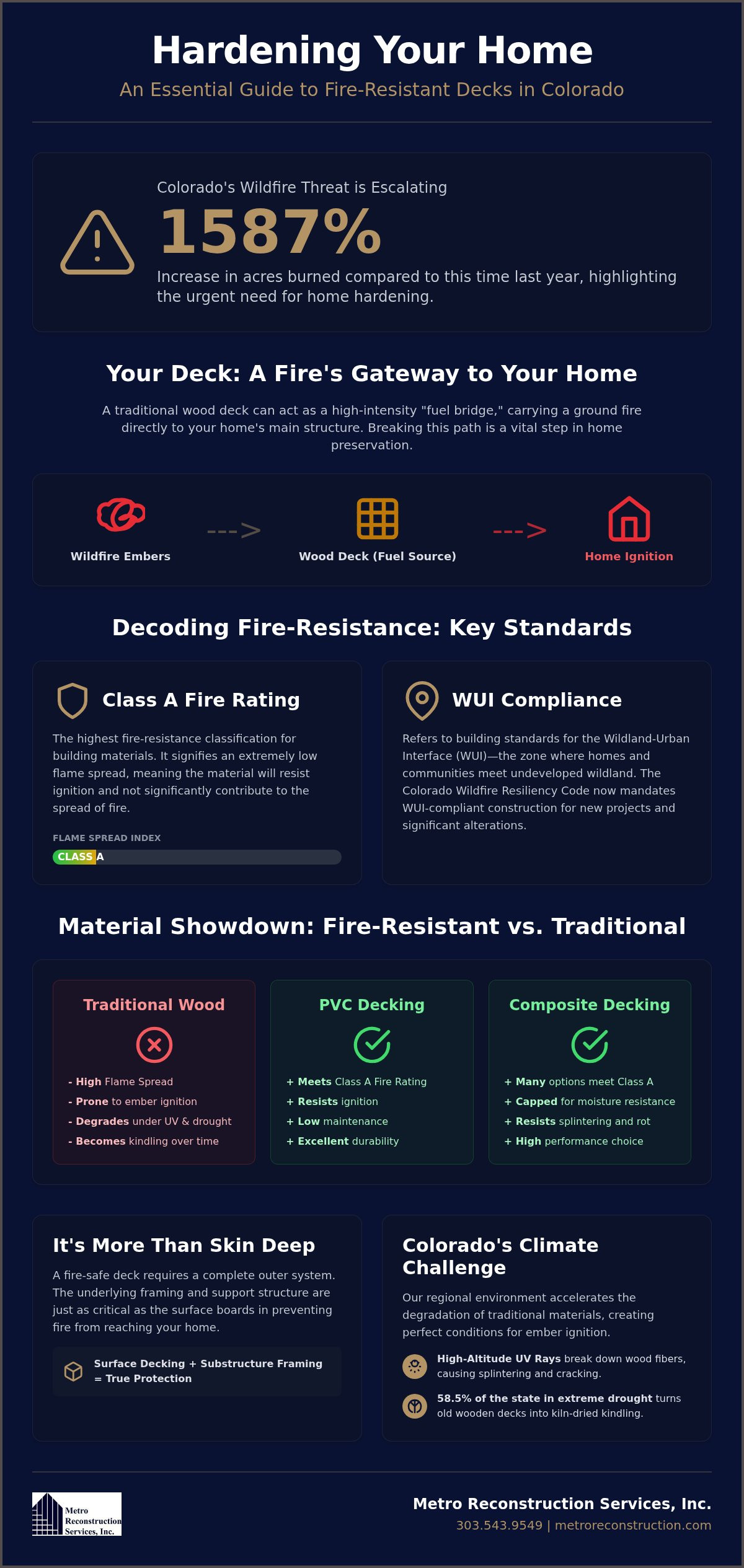
As of July 2026, Colorado has seen a staggering 1587% increase in acres burned compared to this time last year, a statistic that underscores the rising intensity of our regional wildfire seasons. For homeowners in Boulder and Denver, the threat is no longer theoretical; it’s a structural challenge that requires a forensic approach to home hardening. With the Colorado Wildfire Resiliency Code now in full effect as of July 1, 2026, the decision to replace your deck with fire resistant materials has become a vital step in protecting your property’s long-term value and safety.
We recognize the frustration of dealing with shifting insurance mandates and the confusion surrounding technical fire ratings. You deserve an outdoor living space that offers both elegance and an uncompromising level of protection against environmental stressors. This guide will show you how to identify the most effective ignition-resistant materials and structural strategies to safeguard your home. We’ll explore how modern building systems and Class A fire-rated components integrate into your home’s complete outer system to provide the security your family needs.
Key Takeaways
- Understand how a deck acts as a bridge for fire and why breaking that path is vital for home preservation.
- Identify the highest-rated PVC and composite options when you replace your deck with fire resistant materials to meet new safety codes.
- Learn the difference between Class A ratings and WUI compliance to ensure your investment meets local insurance requirements.
- Discover why the underlying framing is just as important as the surface boards in creating a fire-safe outdoor space.
- Start your project by calling 303.543.9549 or visiting our contact page for a specialized fire mitigation inspection.
The Necessity of Fire-Resistant Decking in Colorado’s Front Range
The 2026 wildfire season has already proven to be one of the most volatile on record, with over 250,000 acres burned across the state. In the Front Range, where suburban homes meet rugged foothills, a traditional wood deck often serves as the primary point of failure during a wildfire. Because these structures are physically attached to the residence, they act as a high-intensity fuel bridge that carries ground fires directly to the home’s exterior siding and interior spaces. Recent Colorado fires have demonstrated that even if a house is built with fire-resistant walls, an attached wooden deck can ignite and lead to total home loss. It is a structural vulnerability that requires immediate attention.
Understanding Home Hardening
Home hardening is a proactive strategy that addresses the vulnerabilities of a building’s complete outer system through technical precision and material science. Many homeowners in Boulder and Niwot are finding that local building codes now require these specific protections for any significant alterations. The deck is particularly susceptible because it has a large horizontal surface area where wind-driven embers can land and smolder. When you decide to replace your deck with fire resistant materials, you’re effectively removing a significant fuel source from the Wildland-Urban Interface (WUI) surrounding your property. This transition is no longer just a recommendation; it’s a foundational requirement of the Colorado Wildfire Resiliency Code that went into effect on July 1, 2026. Specialized fire mitigation and prevention services are now essential for maintaining property value and insurance eligibility in these high-risk zones.
Local Climate Stressors
Our regional environment presents unique challenges that accelerate the degradation of standard building materials. High-altitude UV rays in Colorado break down the lignin in natural wood, which causes it to splinter and crack over time. These small fissures, combined with our extreme drought conditions, create the perfect environment for ember ignition. When 58.5% of the state is in extreme drought, old wooden decks become essentially kiln-dried kindling. Wind patterns in the Front Range can carry embers for miles, and once these sparks find a gap in a dry, weathered deck, the resulting fire can consume a structure with terrifying speed. It’s a structural reality that demands a specialized, forensic solution rather than a superficial fix. Protecting your home begins with a thorough diagnostic evaluation of your exterior systems.
To discuss your property preservation needs, contact Metro Reconstruction at 303.543.9549 or visit our contact page for a professional consultation.
Understanding Fire-Resistance Ratings: Class A vs. WUI Compliance
Choosing to replace your deck with fire resistant materials is a decision that relies heavily on understanding two critical industry standards: Class A ratings and Wildland-Urban Interface (WUI) compliance. These aren’t just technical labels. They represent a material’s ability to withstand extreme thermal stress during a fire event. A Class A rating is the highest fire-resistance classification available for building products. It indicates that the material has a low flame spread and does not significantly contribute to the spread of fire. When we evaluate a structure’s complete outer system, we prioritize these ratings to ensure the home remains resilient against ember storms.
The Flame Spread Index Explained
The Flame Spread Index is a measure of how quickly fire moves across a surface. This numerical value is derived from standardized testing where materials are exposed to controlled flame conditions. A lower index number indicates a safer material that slows the progression of fire rather than fueling it. For homeowners in the Front Range, selecting a material with a Class A rating means the deck surface will resist ignition far longer than traditional pressure-treated lumber. This extra time can be the difference between a minor exterior scorch and total structural loss. You can find more detailed design strategies in FEMA’s Builder’s Guide to Construction in Wildfire Zones, which highlights how material performance impacts overall home survivability.
WUI Regulations in Boulder and Beyond
WUI compliance refers to building standards specifically designed for the Wildland-Urban Interface. As of July 1, 2026, the Colorado Wildfire Resiliency Code mandates these standards for new construction and significant alterations in high-risk zones. The City of Boulder previously adopted the 2024 International Wildland-Urban Interface Code in May 2025, setting a high bar for local property preservation. These regulations ensure that every component of a deck, from the surface boards to the hidden joists, contributes to the home’s overall resistance to ignition.
It is vital to distinguish between non-combustible and ignition-resistant materials. Non-combustible materials, such as steel or masonry, will not ignite or burn when subjected to fire. Ignition-resistant materials, including certain advanced PVC and high-performance composites, are designed to resist catching fire and slow the spread of flames. Both play a role in home hardening, but their application depends on your specific WUI zone classification. These ratings are now a primary focus for insurance companies, who often require proof of home hardening to maintain coverage in the Front Range. We provide specialized fire mitigation inspections to help homeowners navigate these complex requirements and ensure their deck replacement meets every necessary safety standard.
To ensure your project meets the latest safety standards, contact Metro Reconstruction at 303.543.9549 or visit our contact page for a professional consultation.
Top Fire-Resistant Material Options for Your Deck Replacement
Selecting the right material is a critical diagnostic step in property preservation. When you choose to replace your deck with fire resistant materials, the specific chemical composition of the boards determines how the structure will react under extreme thermal stress. We focus on identifying materials that don’t just look good but provide a verifiable layer of protection for your home’s complete outer system. While many marketing claims suggest all modern decking is safe, the technical reality is that performance varies significantly between material categories.
Advanced PVC vs. Traditional Composite
Advanced PVC has emerged as a leader in ignition resistance because it contains no organic wood fillers. Traditional composites often rely on a mixture of plastic and wood fibers. While these are durable, the organic components can still smolder or melt if they’re subjected to intense heat for prolonged periods. In contrast, 100% PVC materials are engineered to be self-extinguishing. They offer a sophisticated, wood-like aesthetic that mimics the grain patterns of hardwoods like Ipe or Mahogany without the inherent combustion risks. These systems also require minimal maintenance, as they resist the moisture absorption that leads to the splintering and cracking seen in natural timber. It’s a reliable choice for those who value both substance and style.
Aluminum Decking Solutions
For homeowners seeking the absolute gold standard in safety, aluminum decking provides a completely non-combustible solution. This material is increasingly popular in mountain communities like Vail and Breckenridge, where the threat of wind-driven embers is a constant reality. Unlike wood or even some high-end composites, aluminum won’t ignite. A common concern is whether metal decking becomes too hot in the Colorado sun. In reality, aluminum is an excellent thermal conductor. It actually dissipates heat more efficiently than wood or composite, which means it often feels cooler to the touch during our peak summer months. It is a premium, engineering-led solution that offers total peace of mind during wildfire season.
For ground-level transitions, natural stone and concrete pavers remain excellent choices. These materials provide a permanent, non-flammable barrier that integrates seamlessly with your landscaping. By utilizing a mix of these specialized building systems, we can create a holistic defense for your home’s exterior. Our team at Metro Reconstruction focuses on the technical accuracy of every installation to ensure long-term reliability. To discuss which material is right for your home hardening project, call us at 303.543.9549 or visit our contact page.
The Complete Outer System: Framing and Defensible Space
A holistic approach distinguishes property preservation from simple cosmetic upgrades. If you replace your deck with fire resistant materials but leave the underlying timber framing exposed, you’ve only addressed a fraction of the structural risk. We view the deck as an integral part of the building’s complete outer system. This means the transition points where the deck meets your home’s walls are just as important as the boards themselves. Integrating your new deck with stucco and masonry repairs creates a continuous fire barrier that prevents flames from finding a path into the wall assembly.
The first five feet surrounding your home, known as Zone 0, is the most critical area for wildfire defense. When you replace your deck with fire resistant materials, you must consider the skeleton as much as the skin. Because this zone includes the deck structure, every component within this perimeter must be evaluated for its combustion potential. Hardening this space often involves replacing flammable landscaping with non-combustible alternatives, and you can explore Block Paving Driveways to see how professional paving solutions create a robust fire break. A forensic analysis of recent fire patterns shows that many homes are lost not because the roof ignited, but because embers collected under the deck and ignited the wooden support posts. Precision in these early stages is a foundational promise of our work.
Steel Deck Framing
Steel framing offers a decisive advantage over traditional pressure-treated wood. While wood joists can twist and weaken over time, light-gauge steel remains dimensionally stable. This is particularly important in the Front Range, where our expansive soils often cause significant movement in deck footings. Steel provides a non-combustible skeleton that won’t contribute fuel to a fire, ensuring the structure remains standing even under intense heat. It’s a premium, engineering-led solution for long-term reliability. Steel doesn’t burn.
Enclosing the Under-Deck Area
Protecting the space beneath the deck is a vital step in home hardening. Because wind-driven embers can easily find their way into open cavities, enclosing this area with fire-resistant skirting or non-combustible mesh is essential. This prevents the accumulation of dry leaves and pine needles that act as kindling. We strongly advise homeowners to never store firewood or flammable materials under their decks. This practice creates a high-intensity fuel source directly beneath your home’s structural supports. Identifying these underlying structural origins of risk is what sets a forensic expert apart from a standard contractor.
To ensure your home is protected from the ground up, schedule a professional fire mitigation inspection with our expert team. You can reach us at 303.543.9549 or through our contact page to discuss your project.
Partnering with Metro Reconstruction for Your Fire-Safe Deck
Our approach to property preservation is rooted in technical accuracy and a deep understanding of the Colorado Front Range environment. With over 40 years of experience, we’ve developed a forensic methodology that looks past superficial fixes to address the actual mechanics of structural safety. We don’t just see a deck as a standalone feature; we view it as a critical component of your home’s complete outer system. Because we understand the interaction between environmental stressors and building components, we can offer engineering-led solutions that standard contractors often overlook. This holistic perspective ensures that every project we undertake provides long-term reliability and the peace of mind you deserve during wildfire season.
When you decide to replace your deck with fire resistant materials, you’re entering a partnership with a firm that values integrity and precision. We take full responsibility for the project management process, guiding you from the initial diagnostic phase through the final local code inspection. This comprehensive oversight eliminates the confusion often associated with WUI regulations and insurance requirements, allowing you to focus on the enjoyment of your new outdoor space. Choosing to replace your deck with fire resistant materials is a significant investment in your property’s longevity, and it requires a partner who treats your home with protective care; for insights into other high-end home upgrades, Lux Renovations LLC provides a sophisticated guide to interior remodeling investments.
Custom Design-Build Solutions
We believe that safety and aesthetics shouldn’t be mutually exclusive. Our design-build services are tailored to blend high-performance materials with your home’s unique architectural style. Whether we are utilizing advanced PVC or non-combustible aluminum, our commitment to using only the highest quality materials ensures a premium result. We meticulously plan every detail, from the structural steel framing to the fire-resistant skirting, to create a seamless and beautiful fire barrier. This meticulous attention to detail ensures that your new deck increases your home’s value while providing a robust defense against ignition.
Get Started with a Professional Evaluation
The first step in hardening your home is a specialized fire mitigation inspection. During this evaluation, we identify specific risks related to your property’s landscape, building materials, and structural orientation. This is not a high-pressure sales meeting, but a professional consultation designed to educate you on the best path forward for your investment. We provide the difficult truths about structural vulnerabilities so you can make informed decisions about your property’s future. Our goal is to be a dedicated partner in your home’s preservation, offering solutions that stand the test of time and climate.
Start your home hardening project today by contacting Metro Reconstruction. Call us at 303.543.9549 or visit our contact page to discuss your needs with a seasoned expert.
Strengthening Your Home Against Wildfire Risks
Transitioning to a hardened exterior is a foundational step in preserving your property against the unique climate stressors of the Front Range. A truly resilient structure requires more than just surface-level changes; it demands a forensic focus on the building’s complete outer system. When you choose to replace your deck with fire resistant materials, you aren’t just updating an aesthetic feature. You’re installing a critical defense that breaks the fuel path to your home and protects your investment from the volatility of our region’s fire seasons.
Since 1982, Metro Reconstruction has served as a family-owned and operated partner for homeowners facing complex structural challenges. As specialists in Colorado Front Range home hardening, we maintain an A+ rating for structural integrity and craftsmanship. We’re here to provide the technical accuracy and quiet confidence needed to navigate modern building codes and insurance requirements with ease. Our expertise ensures that your home remains a safe haven for decades to come.
Protect your investment and your family. Contact Metro Reconstruction today for a professional fire mitigation evaluation. You can also reach our team directly at 303.543.9549. We look forward to helping you build a safer, more resilient future for your home.
Frequently Asked Questions
Is fire-resistant decking truly fireproof?
No building material is entirely fireproof, but fire-resistant materials are designed to resist ignition and slow the spread of flames. While aluminum is non-combustible, advanced PVC and fire-rated composites are ignition-resistant. These products give homeowners and firefighters more time to save the structure during an ember storm. The goal is to prevent the deck from becoming a fuel bridge that leads directly to your home’s interior.
Will replacing my deck surface lower my home insurance premiums?
Many insurance providers in the Front Range now require home hardening to maintain coverage, and replacing your deck often qualifies for premium credits. Because a deck is a primary vulnerability, upgrading to fire-rated materials significantly reduces the risk of total home loss. You should check with your specific provider for details. We provide the technical documentation and specifications needed to prove compliance with their safety requirements.
Can I install fire-resistant boards over my existing wood frame?
While it’s possible to install new boards on an old frame, leaving a combustible wood structure beneath your new surface compromises the entire system. A wooden frame remains a hidden fuel source that can ignite from below. To truly replace your deck with fire resistant materials, we recommend a holistic approach that includes steel framing. This ensures the entire structure remains stable during a fire event.
Which decking material has the highest fire rating?
Aluminum decking and steel framing are the only truly non-combustible options, holding the highest possible safety classification for outdoor structures. Among synthetic options, advanced PVC collections often achieve a Class A Flame Spread Rating. This rating indicates the material has a very low contribution to fire growth. We evaluate your specific Wildland-Urban Interface zone to recommend the material that provides the best protection for your property.
How much more does fire-resistant decking cost than traditional wood?
Fire-resistant decking involves a higher upfront cost than wood, but it offers superior long-term value through durability and lower maintenance. When you choose to replace your deck with fire resistant materials, you’re also avoiding the recurring costs of staining and sealing. This investment protects your home’s complete outer system while enhancing its marketability. Over the lifespan of the deck, the total cost of ownership is often lower.
What is WUI compliance, and does it apply to my Boulder home?
WUI compliance ensures your home meets the safety standards required for the Wildland-Urban Interface, which includes much of Boulder and Denver. As of July 1, 2026, the Colorado Wildfire Resiliency Code enforces these standards for any significant exterior reconstruction. If your home is in a designated high-risk zone, using approved ignition-resistant materials is now a legal requirement for obtaining building permits and maintaining your insurance policy.
Do fire-resistant materials require special maintenance?
Advanced PVC and aluminum systems actually require significantly less maintenance than traditional cedar or pressure-treated lumber. These systems don’t require annual sanding, staining, or sealing to maintain their integrity or fire-rated properties. Regular cleaning with soap and water is usually sufficient to keep the surface looking new. This ease of care, combined with their resistance to rot and insect damage, makes them a practical choice for the Front Range.
Can a fire-resistant deck improve my home’s resale value?
A fire-hardened deck is a major asset in today’s Colorado housing market, where buyers prioritize safety and insurance eligibility. Potential buyers are increasingly aware of wildfire risks and the rising costs of home protection. A deck built with Class A materials demonstrates that the home has been proactively maintained and hardened against regional threats. This technical accuracy provides buyers with peace of mind and justifies a higher property valuation.