
New siding can add resale value, but the return depends on more than appearance. Exterior remodel ROI Colorado homeowners can expect is shaped by the existing materials, moisture management, and whether the work improves energy performance.
If you’re weighing a siding or window project, it makes sense to ask whether the investment will pay off when you sell. Resale value is only part of the answer: improved comfort, fewer maintenance concerns, and better protection from local weather can matter to your household over time.
This article explains how siding and window upgrades can affect resale value, how to account for energy savings, and why maintenance and installation quality influence long-term returns. It also explains why treating the exterior as a connected system, rather than a set of isolated surfaces, helps you assess which improvements best suit your property.
Key Takeaways
- Compare resale estimates across exterior projects, but treat them as guides rather than guaranteed outcomes.
- Assess window upgrades by both potential resale value and energy savings, since these measure different benefits.
- Consider how siding and window work together to improve the home’s exterior performance.
- Account for Colorado’s climate when weighing durability, maintenance needs, and long-term value.
- Look beyond appearance: moisture management and sound installation can help protect the home’s complete exterior system.
What is the Average Return on Investment for Exterior Home Renovations in Colorado?
Colorado and Mountain region returns vary by project type, location, materials, and installation quality. The figures offer comparison points, not a single average for every home. A garage door replacement averaged a 96.7% return in the Mountain region, while manufactured stone veneer reached 93.8%. These examples show why exterior improvements deserve close attention when weighing resale value.
Outdoor kitchens can support both outdoor living and a home’s aesthetic appeal, but the return depends on design and market fit. Estimates place Front Range outdoor kitchen returns at 71% to 85%. National outdoor kitchen returns average around 60%. A functional layout and materials suited to Colorado’s conditions help an improvement serve daily use as well as resale appeal.
Denver outdoor renovation returns depend on the improvement and the home. Well-designed outdoor living areas may increase a Denver home’s value by 5% to 15%, depending on scope and quality. A wood deck addition recoups 83% of its cost in Denver, compared with a 75.6% national average. These figures are not interchangeable: a deck and a broader outdoor living project are different improvements.
Manufactured stone veneer offers another useful comparison: its reported return is 93.8% in the Mountain region. A finished basement, by contrast, could bring a 70% return, depending on project details and location. These examples show that resale return is only one measure. Exterior work may also address weather exposure or upkeep, while interior improvements serve different needs.
Permits, homeowners association rules, and local building codes can affect an exterior project’s design and scope. Requirements depend on the work and jurisdiction, while HOA rules may govern visible materials or appearance. Identify these constraints before finalizing plans to avoid designing an improvement that conflicts with applicable requirements.
Colorado’s hail, snow, sun, and freeze-thaw cycles affect material selection and long-term performance. Hail can damage exposed surfaces, while snow and moisture make water management essential. Strong sun and temperature changes also stress exterior materials. Durable choices and correct installation can help reduce maintenance needs and protect the improvement’s usefulness and resale appeal.
To estimate a project’s return, compare local sales of similar homes with and without the improvement. Divide the estimated added resale value by the project’s investment to understand the resale portion of the return. Consider energy and maintenance savings separately, since those benefits accrue over time. Compare homes with similar project types, conditions, and neighborhoods to make the estimate more relevant.
Window replacement resale ROI versus energy savings
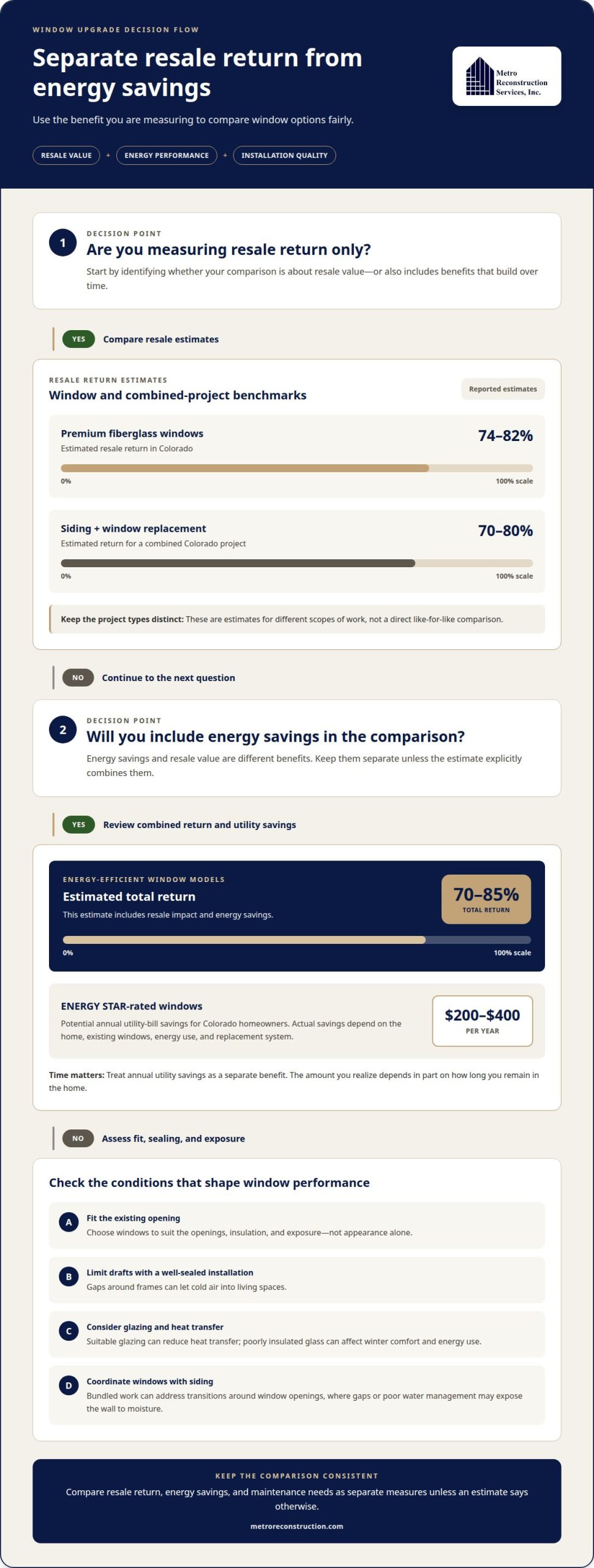
Window replacement has two distinct returns: resale value and reduced energy use. In Colorado, premium fiberglass windows have an estimated resale return of 74% to 82%. Energy-efficient models have an estimated total return of 70% to 85% when resale impact and energy savings are included. These estimates measure different benefits, so compare like with like when planning an investment.
Window performance depends on more than the frame. A well-sealed installation helps limit drafts, while suitable glazing can reduce heat transfer. These details matter during a Colorado winter, when heat loss through older windows can affect comfort and energy use. Choose windows to suit the existing openings, insulation, and exposure, not appearance alone.
Bundling siding and window replacement can address connected parts of the building envelope in one project. The estimated return for combined siding and window replacement in Colorado is 70% to 80%. Coordinated installation can also help address the transitions around window openings, where gaps or poor water management may expose the wall to moisture.
Doors and exterior finishes provide useful resale comparisons. Steel entry door replacement recouped 188% of its cost at resale in the 2024 JLC Cost vs. Value Report. Manufactured stone veneer recouped 153% in that report. Garage door replacement recouped 194%. These figures describe reported resale returns, not a promise for an individual home or project.
What do new windows and exterior doors cost, and what return can you expect? Costs depend on the project scope, materials, and installation; window resale estimates range from 74% to 82% for premium fiberglass. Steel entry doors show a reported 188% resale return, while energy savings can add value beyond resale.
Colorado homeowners can save between $200 and $400 annually on utility bills by upgrading to ENERGY STAR-rated windows. That potential saving depends on the home, existing windows, energy use, and the replacement system. Treat it as a separate annual benefit, rather than adding it directly to resale value without considering how long you’ll remain in the home.
For a practical comparison, separate the figures into resale return, expected energy savings, and maintenance needs. Then assess whether each option suits the home’s siding, window openings, and exposure. Coordinated replacement can support comfort and exterior protection, while premium materials may have a different resale profile from other options.
Energy efficiency and utility savings
Energy savings add a recurring benefit to an exterior upgrade, separate from resale value. For Colorado homeowners, ENERGY STAR-rated windows can reduce utility bills, and a well-sealed installation helps limit drafts. Use the earlier window estimate as a benchmark, but remember that actual savings depend on existing windows, household energy use, and how well replacement units fit the openings.
Start by identifying where heat escapes. Gaps around window frames can let cold air into living spaces, while poorly insulated glass transfers heat. Correct installation closes perimeter gaps and supports the window’s intended performance. A window’s U-Factor also helps compare heat loss: lower values indicate better insulating performance.
Window upgrades work best as part of the full building envelope. If adjoining siding has gaps or water damage, replacing windows alone won’t resolve those conditions. Inspecting the trim, flashing, and weather-resistant barrier can reveal air and moisture pathways. This connects energy performance with the wall’s protection from Colorado winter weather.
Outdoor water use offers another savings opportunity. Replacing grass with artificial turf and drought-tolerant plants can reduce outdoor water use and ongoing maintenance needs by up to 60%. This example shows how changing a home’s outdoor features may lower recurring resource use, though the right approach depends on the property’s needs and conditions.
In Denver, xeriscaping can save homeowners more than $1,200 annually on water bills. That figure relates to water use, not window performance or resale value. Keep these benefits separate when estimating the financial effect of an improvement. A clear comparison distinguishes utility savings from reduced maintenance needs and any later real estate value.
Maintenance affects the long-term value of an energy upgrade. Failed caulking around a window, for example, can allow drafts and moisture intrusion, reducing comfort and potentially damaging adjacent materials. Inspect seals and drainage details to spot issues before they affect the surrounding wall. Durable materials and sound installation support performance over time.
When evaluating an upgrade, record current utility use, the work under consideration, and expected annual savings. Compare those savings with changes in maintenance needs and resale appeal, without counting the same benefit twice. A value report may estimate resale impact, but it won’t measure your household’s future energy use. Keeping these measures separate helps you decide whether added efficiency meets your priorities.
Colorado exterior renovation value
Fiber-cement siding offers a useful benchmark for exterior improvement planning. New fiber-cement siding has an estimated return of 78% to 85% in Colorado. The 2024 JLC report places siding replacement’s resale recovery at about 88%. Different estimates can reflect distinct markets and project assumptions, so compare figures using the same measurement method.
Denver adds a local reference point: fiber-cement siding replacement adds an estimated $18,069 in resale value. That estimate doesn’t determine the value of every home. Existing exterior condition, installation quality, and neighborhood expectations shape how an improvement affects appeal. A relevant comparison considers homes with similar features, rather than applying one citywide estimate to every property.
For exterior remodel ROI in Colorado, include durability and installation details in the calculation. Fiber cement’s long service life depends on correct installation and care. Damaged trim or poorly directed runoff, for example, can allow water behind siding. A sound weather-resistant barrier, flashing, and drainage details help protect wall materials and preserve the finish through exposure.
Evaluate outdoor projects against the home’s layout and how its exterior space functions. A deck that suits the home’s scale and connects indoor and outdoor areas may support buyer appeal. Before assigning value, distinguish the improvement’s resale contribution from personal enjoyment: they serve different purposes and may matter differently to each homeowner.
Denver buyers’ interest in outdoor space can inform project choices, but it doesn’t guarantee a specific premium. A functional patio or deck, for example, may suit a property better than an elaborate feature. Assess access, privacy, and how the area connects to the house. These practical details help determine whether the improvement supports curb appeal and the home’s intended use.
A Colorado exterior remodel ROI estimate should separate resale impact from durability and maintenance benefits. Replacing worn siding may improve appearance while addressing deterioration, but those are distinct outcomes. Keep each benefit in its own category when comparing improvements to avoid counting the same repair or visual change twice.
Use a consistent three-step comparison: identify the work, estimate its resale effect using similar local homes, then assess maintenance and durability separately. Denver sales, for example, may provide a more relevant comparison for a Denver property than statewide averages. This approach makes Colorado exterior remodel ROI easier to evaluate against your home’s condition and priorities.
Long-term maintenance and resale benefits
Return on investment includes more than the resale estimate. Climate exposure, maintenance demands, and the home’s condition at sale also shape value. In Colorado’s mountain communities, snow, sun, and freeze-thaw cycles repeatedly stress exterior materials. A durable finish and well-managed drainage can reduce avoidable wear, while neglected moisture pathways can damage concealed components.
Fiber-cement siding has a lifespan of 50-plus years. That figure makes durability relevant to long-term planning, but the material still depends on sound installation and routine care. For example, damaged caulking or poorly directed roof runoff can allow water behind siding. Addressing the source helps protect the wall assembly instead of simply covering visible damage.
Roof condition can influence a buyer’s decision before they assess other exterior improvements. Many buyers will not purchase a home that needs a roof. In Colorado, hail, strong sun, and freeze-thaw conditions also make roof protection relevant to the value of nearby upgrades. A sound roof and well-maintained siding present a more coherent exterior system.
Class 4 impact-resistant roofing is recommended as a way to protect exterior-upgrade value against hail, sun, and freeze-thaw exposure. This recommendation does not replace careful maintenance. Keeping roof-to-wall transitions clear and directing water away from siding can help limit moisture intrusion. These details support the roof and adjoining exterior materials as a connected system.
Before listing, document completed work and note visible maintenance needs. Records of siding repairs and roof improvements, for example, can help explain the home’s condition to prospective buyers. Clear documentation distinguishes completed repairs from unresolved issues and helps buyers understand what the exterior work addressed.
For an outdoor living area, assess the surface, its connections to the home, and drainage around the structure. A deck with deteriorated boards or water collecting near its attachment can create maintenance concerns, even when it looks appealing. Repairing structural damage and correcting water flow address function as well as appearance. The result should suit how you use the space.
Plan maintenance around the materials and exposure of your property. Inspect siding, sealant, roof edges, and drainage after significant weather, then address damage before it spreads. For help assessing connected exterior improvements, review exterior renovation services and consider how each part affects long-term protection.
Metro Reconstruction Services, Inc.: Exterior Remodels
Metro Reconstruction Services, Inc. can help when your exterior needs more than a cosmetic update. Its Exterior Remodels address the home’s outer system, where siding, stucco, masonry, windows, and water-control details work together. This service is relevant when visible wear, recurring moisture, or aging finishes raise questions about the source of a problem.
An exterior project should start with understanding existing conditions. Cracking stucco, for example, may be a surface issue or point to movement or moisture behind the finish. Identifying the cause before selecting a repair helps focus the work and support long-term protection, rather than applying a temporary visual patch.
Metro Reconstruction Services, Inc. provides exterior remodeling services for projects that require coordinated attention to multiple exterior components. If siding meets a stucco wall or a window opening interrupts the cladding, those transitions need to be considered together. A complete-system view helps maintain drainage and reduce opportunities for water intrusion.
Stucco Restoration can address deteriorated stucco finishes and related concerns. Cracks, loose material, or staining, for instance, can indicate that a finish needs evaluation. Restoration focuses on the existing stucco assembly, and the appropriate scope depends on its condition and the underlying cause of damage.
Masonry Work is another option for exterior areas where brick or stone needs attention. Masonry joints and adjoining finishes affect how water moves across a wall. Coordinating masonry with nearby stucco or siding can help maintain a consistent exterior and protect vulnerable transitions.
For a new finish, Stucco installation offers a way to change or complete an exterior surface. Material selection and installation details should account for wall exposure and moisture management. A three-coat stucco system uses scratch, brown, and finish coats, each contributing to the finished assembly.
When considering an exterior remodel in Colorado, weigh the visible improvement alongside durability, maintenance, and weather protection. Metro Reconstruction Services, Inc. emphasizes initial accuracy and an analytical approach to the complete exterior system. This perspective is useful when components meet or visible damage may have an underlying structural or moisture-related cause.
Contact Metro Reconstruction Services, Inc. to discuss an exterior project. Call 303.543.9549 or contact the team.
Plan an exterior upgrade around lasting performance
A useful estimate of exterior remodel ROI in Colorado starts with your home’s condition and priorities. Decide whether the next improvement should address moisture, aging finishes, energy performance, or resale appeal. Then consider how the roof, windows, siding, stucco, and masonry interact: an isolated repair may not resolve a problem affecting several parts of the building envelope.
Metro Reconstruction Services, Inc. can help assess exterior conditions and determine a suitable project scope. Understanding what is failing and why gives you a clearer basis for planning durable work and protecting your investment.
Discuss the exterior conditions and improvements you’re considering with Metro Reconstruction Services, Inc. Contact the team to discuss your project, or call 303.543.9549. A clear plan can help you move forward with greater confidence.
Frequently Asked Questions
Does new siding add home value?
Yes, new siding can improve resale appeal when it addresses worn, damaged, or mismatched exterior finishes. The effect depends on the home’s condition, neighborhood expectations, and how well the material suits the architecture. Replacing deteriorated siding while correcting failed trim details, for example, can improve appearance and protection. Applying a finish over unresolved moisture damage may conceal the problem without fixing its cause.
Do new windows pay for themselves?
New windows can return value through resale appeal and lower energy use, but those benefits accrue differently. Resale value matters at sale, while utility savings build over time as the windows reduce heat loss. A drafty room beside an older window, for example, may become more comfortable after replacement and proper sealing. Fit, insulation around the frame, and installation quality all influence performance.
What exterior upgrade adds the most value in Colorado?
No single exterior upgrade leads in every Colorado market or for every property. A garage door, entry door, stone veneer, or outdoor feature can appeal differently depending on the home and neighborhood. Compare improvements that address a visible need and suit the property’s style. A well-maintained entry that complements the façade, for example, may strengthen the first impression more than an elaborate feature that feels out of place.
Which exterior projects have the best ROI in 2026?
Available estimates put Colorado patios at an 80% to 100% return, while built-in outdoor fire features are estimated at 50% to 70%. These figures offer benchmarks, not a ranking for every home. A patio’s usefulness depends on access, layout, and how it connects to indoor living areas. For an outdoor feature, consider whether its function suits the property and the lifestyle prospective buyers are likely to value.
Which home improvements have the best ROI?
Among the available estimates, new hardwood floors can recover 106% of their cost, just as kitchen and pantry upgrades using cabinetry from suppliers like DIY Depot often provide strong interior returns. These examples are not exterior projects, so compare them carefully with siding, windows, or other work. The strongest choice for your home depends on its current condition and the benefit you want. A repair that prevents an active exterior problem from worsening may serve a different purpose than an upgrade chosen mainly for appearance or resale.
What is the average ROI for exterior remodeling projects in Colorado?
Exterior remodeling returns vary by project, so a single statewide average can hide important differences. Separate resale value from recurring benefits such as reduced energy use or upkeep. An efficiency improvement, for instance, may provide ongoing household savings, while a visible finish upgrade may influence buyer perception at resale. Keeping those outcomes separate gives you a clearer way to evaluate the project’s contribution.
Which exterior upgrades have the highest resale value in Colorado?
Strong resale candidates include improvements that address visible wear, improve function, or bring the exterior into better condition. The best fit depends on local buyer expectations and the property’s existing features. Restoring damaged stucco, for example, may make more sense than adding a decorative finish when cracking or moisture is the main concern. Prioritize work that suits the home and resolves the underlying issue, not appearance alone.