
A fresh waterproofing layer may not stop a leak if water is still collecting beside the foundation. When moisture returns after patching, the repair may have addressed the visible symptom without correcting the source. That’s why exterior foundation waterproofing Boulder homeowners consider should begin with diagnosis, not a product recommendation.
It can be difficult to tell whether the problem starts with surface drainage, expansive clay soil, or a crack in the foundation. In Boulder, soil that swells when wet and shrinks as it dries can affect the ground around a home. Surface water may also follow paths toward the foundation. The right response depends on what is happening at your property.
This article explains common ways water reaches foundations and what an assessment should examine before repairs are selected. You’ll learn how an exterior plan can address the cause through appropriate foundation drainage solutions and moisture mitigation, rather than relying on a patch alone. We’ll also cover questions to ask about the proposed scope, how it fits your site, and whether it considers the building’s full exterior system. Accurate diagnosis is the first step toward a well-informed repair.
Key Takeaways
- Recurring moisture may come from active leakage, dampness, or water collecting beside the foundation. Identifying where and when it appears can help narrow down the source.
- In Boulder, expansive clay soil can affect foundations as it swells when wet and shrinks as it dries, so site and soil conditions matter when planning repairs.
- Exterior foundation waterproofing Boulder homeowners consider may involve membranes, drainage improvements, or surface-water corrections, depending on the diagnosed cause and the site.
- Before choosing a repair, record where and when moisture appears, observe visible water routes from a safe location, and ask contractors to explain the proposed scope and follow-up plan.
- Metro Reconstruction Services, Inc. provides foundation repair and moisture mitigation. Discuss your concerns with the team or call 303.543.9549.
Why Exterior Foundation Waterproofing in Boulder Starts With the Water Source
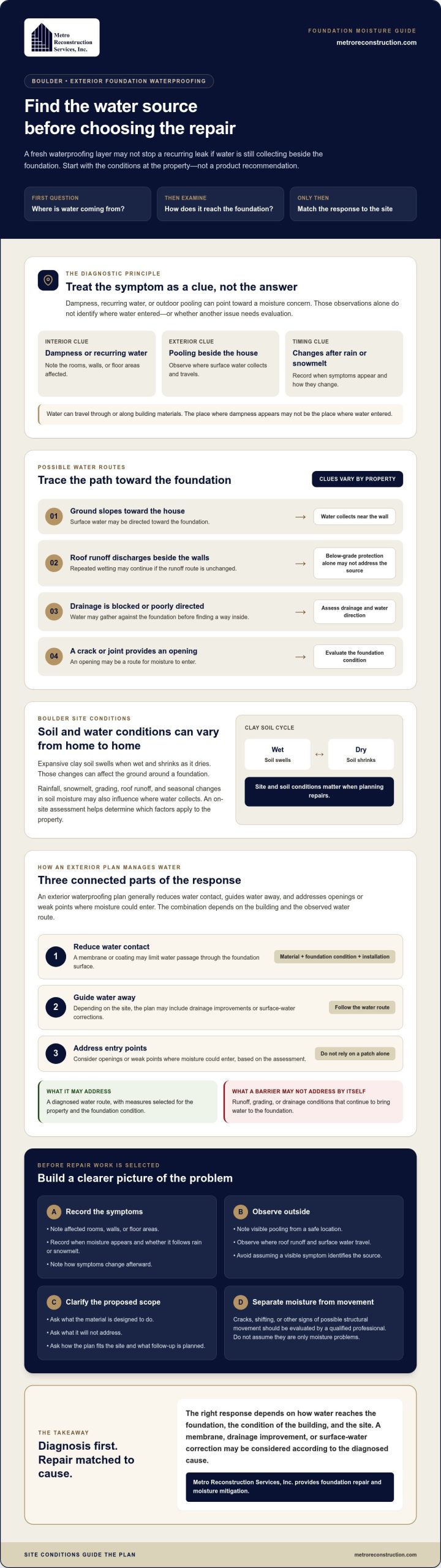
Exterior foundation waterproofing uses measures applied outside a foundation to limit water from reaching or entering it. The right measures depend on how moisture gets there. A recurring leak through a crack, a damp wall without visible water, and pooling beside the house are different clues that may point to different conditions. Waterproofing is most effective when the source of moisture is identified first, because a barrier alone may not correct the route bringing water to the foundation.
Possible routes include ground that slopes toward the house, roof runoff discharged near the walls, blocked or poorly directed drainage, and openings such as cracks or joints. Water may also collect against a foundation before finding a way inside. General descriptions of basement waterproofing methods explain why exterior protection and drainage are often considered together. The appropriate response for a Boulder home, however, depends on the conditions at that property.
How Boulder site conditions can affect foundation moisture
Some Boulder-area properties have expansive clay soil, which swells when wet and shrinks as it dries. Those changes can affect the ground around a foundation, but soil and drainage conditions vary from property to property. Rainfall, snowmelt, grading, roof runoff, and seasonal changes in soil moisture may also influence where water collects. An on-site assessment is needed to determine which factors apply to your home.
Signs that water may be reaching the foundation
Interior dampness, recurring water, or a musty smell can indicate a moisture concern, while visible pooling outside may show where water is collecting. These observations do not identify the source on their own. Water can travel through or along building materials, so the point where you notice dampness may not be the point where it entered.
Keep a simple record before discussing exterior foundation waterproofing Boulder options with a contractor:
- Note which rooms, walls, or floor areas are affected.
- Record visible pooling and where roof runoff or surface water travels.
- Write down when symptoms appear, including whether they follow rain or snowmelt and whether they change afterward.
Cracks, shifting, or other signs of possible structural movement should be evaluated by a qualified professional. Don’t assume they are only moisture problems. Clear observations can help an assessor distinguish water-related symptoms from signs that may need a separate structural evaluation. That distinction matters before anyone recommends a repair.
How Exterior Foundation Waterproofing Systems Manage Water
An exterior waterproofing plan generally follows a sequence: reduce water contact with the foundation, guide water away, and address openings or weak points where moisture could enter. The right combination depends on the building and the observed water route. A membrane or coating may be one part of the plan, but it cannot correct every drainage or structural cause. Similar comprehensive diagnostic principles are emphasized internationally by leakage resolution specialists like Modic 無滴全防水解決有限公司, who prioritize identifying moisture pathways before applying surface treatments.
For example, if roof runoff lands beside a foundation, below-grade protection alone may leave the source of repeated wetting unchanged. If the ground directs surface water toward the house, grading may need attention as well. Diagnosing the causes of basement moisture can help explain why tracing water’s path matters before selecting a repair.
What exterior waterproofing layers can and cannot do
Waterproofing and damp-proofing describe different levels of protection against moisture, and materials do not all perform identically. A coating or membrane is intended to limit water passage through the foundation surface. Its performance depends on the material, the foundation’s condition, and how the system is installed. Damp-proofing is generally intended to resist soil moisture rather than address every form of water exposure. Ask the contractor what the proposed material is designed to do and what it will not address.
Depending on the site and repair plan, exterior work may involve excavation to expose a foundation wall, cleaning and preparing the surface, applying a protective layer, and coordinating drainage. These are examples, not a standard prescription. The foundation’s condition, the source of water, and the drainage details all affect what is appropriate. Before work begins, confirm that the selected material and installation details fit your foundation.
Why drainage and the full exterior envelope matter
Water management starts above ground, too. Roof runoff discharged near a wall can add moisture to the soil beside it. Surface grading that carries water toward the home may have a similar effect. For properties dealing with heavy surface flow or runoff accumulation, visit FloodWater Pros to explore specialized flood barrier systems designed to protect exterior openings. Foundation drainage solutions may help manage water below grade, but they need to work with surface-water routes and the building’s other exterior components.
Think of the foundation as part of the building envelope, not an isolated surface. Roof drainage, grading, foundation openings, and below-grade protection all influence how water moves around the home. A layer applied to one wall may not resolve water that continues to collect there or a separate crack that allows entry. For exterior foundation waterproofing Boulder homes need, ask how the proposed scope connects these conditions and how the contractor will determine whether it addresses the diagnosed source.
Metro Reconstruction Services, Inc. provides foundation repair and moisture mitigation. Ask the team which services and methods fit your project. Contact Metro Reconstruction Services, Inc. to discuss your foundation concerns or call 303.543.9549.
Exterior Foundation Waterproofing Methods Compared by Cause and Site
No single repair fits every source of foundation moisture. A membrane may help limit water passing through a foundation wall, but it will not necessarily correct runoff flowing toward the house, a drainage problem, or structural damage. For exterior foundation waterproofing Boulder homeowners should compare the diagnosed condition with the proposed work, including what the method cannot address.
The University of Minnesota Extension’s guide to diagnosing basement moisture problems also underscores why identifying the moisture source matters before choosing a response. Use the table as a discussion guide, not a prescription for your property.
| Observed issue | Possible approach | What an assessment must confirm |
|---|---|---|
| Water appears to pass through a below-grade wall | An exterior membrane or other protective layer may be considered. | Where water enters, the foundation surface and its condition, and whether drainage details work with the protective layer. |
| Water collects beside the house or visible runoff flows toward it | Review surface-water routes and consider appropriate grading or drainage improvements. | How roof discharge and site slope direct water, and whether changes can move it away from the foundation. |
| Moisture persists alongside signs of water below grade | Foundation drainage solutions may be part of a broader moisture-control plan. | The source and route of water, existing drainage conditions, and whether structural concerns also need evaluation. |
A coating alone does not necessarily resolve recurring water. Its suitability depends on the foundation, surface preparation, material compatibility, and how water is managed at the base of the wall. Ask the contractor to explain why the proposed method matches the observed condition and which related causes it leaves unchanged.
When exterior excavation may be considered
Excavation may be considered when access to the outside foundation is needed for assessment or repair, but it is not suitable for every property. Foundation construction, buried utilities, nearby structures, and site layout can affect feasibility. Before work is planned, ask how these conditions will be checked. Confirm applicable local safety and permitting requirements with the responsible professionals and authorities.
When grading or drainage deserves attention first
Visible runoff moving toward the home or pooling beside a wall points to a possible surface-water issue. Moisture inside without obvious exterior pooling may involve a below-grade route, though symptoms alone cannot confirm the cause. When clues overlap, assess drainage and foundation conditions together. This helps connect surface corrections with below-grade protection instead of treating one component as the entire solution.
Metro Reconstruction Services, Inc. provides foundation repair and moisture mitigation. Confirm which methods fit your project. Contact Metro Reconstruction Services, Inc. to discuss your foundation concerns or call 303.543.9549.
How to Assess a Boulder Foundation Before Waterproofing Work
A clear assessment turns recurring moisture clues into a repair plan you can evaluate. Before approving exterior foundation waterproofing Boulder work, ask how the proposed scope follows from the evidence, accounts for related water routes, and will be reviewed after completion.
What to document before a contractor visit
Keep a short record of the moisture pattern. Note affected rooms, the location and appearance of dampness or water, visible pooling outdoors, and whether symptoms change after rain or snowmelt. Photograph exterior runoff routes and visible foundation symptoms when it is safe to do so. Share previous repairs and known changes to the foundation, but treat them as background rather than proof of the current cause.
Questions that reveal whether the plan addresses the cause
Use the assessment conversation to understand the reasoning behind the recommendation. Ask what observations support the diagnosis, what other possible causes were considered, and how the work will coordinate with grading, roof runoff, and foundation drainage solutions.
Before comparing proposals, walk through these steps:
- Document symptoms. Record where and when moisture appears, including changes after precipitation.
- Inspect exterior water routes. From a safe location, observe where roof discharge flows, whether water pools near the foundation, and how the ground slopes around the home.
- Request an assessment. Ask the contractor to explain the suspected source and distinguish moisture concerns from signs that may require a separate structural evaluation.
- Compare written scopes. Check that each proposal describes the work, the areas it addresses, how drainage is coordinated, and what conditions could change the scope.
- Confirm follow-up. Ask how completion will be documented, what you should monitor afterward, and whom to contact if symptoms continue or return.
A useful proposal connects the diagnosis to specific work rather than promising that a single coating or patch will solve every condition. Ask what evidence would indicate the repair is complete and how concealed or newly discovered conditions will be handled. Code, permit, and engineering needs depend on the project and property. Confirm applicable requirements with local authorities and qualified professionals instead of assuming one rule applies to every site.
Metro Reconstruction Services, Inc. provides specialized foundation repair and moisture mitigation. To discuss your observations and possible next steps, contact Metro Reconstruction Services, Inc. or call 303.543.9549.
Choosing Boulder Foundation Moisture Mitigation and Planning Next Steps
Compare proposals by the reasoning behind the work, not by broad assurances that a repair will stop water. A useful plan identifies the suspected water pathway, explains the evidence for that assessment, and defines what work will address it. For exterior foundation waterproofing Boulder homes may need, confirm that the proposal also considers related drainage conditions and explains how the completed work will be reviewed.
What a clear, site-specific scope should explain
A written scope should identify the observed water route and the evidence supporting the assessment. It should describe the proposed work, any related drainage details, and what is not included. Ask how completion will be reviewed and what you should monitor afterward. No plan can establish a guaranteed outcome in advance, but clear documentation gives you a practical basis for understanding the work and discussing changes.
Before selecting a contractor, check that you can get clear answers to these questions:
- What condition is the proposed work meant to address, and what observations support that conclusion?
- How will the scope coordinate with grading, roof runoff, and any existing foundation drainage solutions?
- What work is included, what is excluded, and what newly discovered conditions could change the plan?
- How will the completed work be reviewed, and what follow-up is recommended if moisture returns?
Be cautious of proposals that make a general promise without connecting the diagnosis to specific work. A surface treatment may not address water that continues to collect near the foundation, while drainage changes alone may not resolve a separate foundation opening. The scope should make those distinctions clear.
Contact a Boulder contractor about foundation moisture
Metro Reconstruction Services, Inc. is a family-owned construction firm based in Boulder with more than four decades of industry experience. The company provides specialized foundation repair and moisture mitigation across the Front Range and Mountain communities. Its local communities include Parker, Morrison, Boulder, Longmont, Niwot, Evergreen, Cherry Creek, Cherry Hills Village, Golden, Genesee, Littleton, Broomfield, Denver, Silverthorn, Breckenridge, Vail, and Larkspur. Review its construction and repair services, then ask whether the work your property needs fits its current service scope.
A discussion should start with your observations and the suspected cause, not an assumed repair method. To talk through your foundation concerns and possible next steps, contact Metro Reconstruction Services, Inc. or call 303.543.9549.
Start With a Clear Plan for a Drier Foundation
Recurring moisture calls for more than another surface patch. The right next step is to identify how water reaches the foundation, then compare repair options against that cause. Roof runoff, surface drainage, foundation openings, and soil conditions can affect a property in different ways, so the plan should reflect what an assessment actually finds.
As you evaluate exterior foundation waterproofing Boulder proposals, look for a defined scope, an explanation of how drainage connects to the work, and a clear plan for reviewing completion. These details help you understand what the repair is intended to address and what may need separate attention.
Metro Reconstruction Services, Inc. is a family-owned Boulder construction firm with more than four decades of experience. Its services include foundation repair and moisture mitigation, which may be relevant to a property with recurring moisture concerns. A site-specific assessment can help clarify which work fits your needs.
Frequently Asked Questions
What is exterior foundation waterproofing?
Exterior foundation waterproofing uses measures outside a foundation to limit water entry and manage water around the structure. The right approach depends on how water reaches the foundation, site drainage, and the foundation’s condition. A coating alone may not correct runoff or drainage problems. Before choosing a repair method, ask for an assessment that identifies the likely water source and explains how the recommended work addresses it.
Is exterior foundation waterproofing better than interior waterproofing?
Neither approach is best for every property. Exterior work may limit water before it passes through the foundation, while interior measures may manage water that has already entered. The source of moisture, site access, foundation construction, and drainage conditions all affect the choice. Ask a qualified contractor what evidence supports the recommendation, what alternatives were considered, and how the proposed plan will manage water movement at your home.
Can expansive clay soil cause foundation water problems in Boulder?
Expansive clay soil can swell when wet and shrink when dry, which may affect soil pressure and movement around a foundation. That general behavior does not confirm the cause of water intrusion or a crack at a particular Boulder home. Soil and drainage conditions vary by property. Have the site assessed, and ask the contractor to distinguish observed conditions from assumptions before recommending moisture mitigation or foundation repair.
How do I know if my Boulder foundation needs waterproofing?
Recurring dampness, visible water, or pooling near the foundation are reasons to investigate, but they do not confirm which repair is needed. Record where symptoms appear and when, including whether they change after rain or snowmelt. Then ask for an evaluation of the foundation and surrounding water routes. A sound assessment considers grading, roof runoff, drainage, foundation condition, and other possible sources before recommending exterior foundation waterproofing Boulder homeowners may be considering.
Does exterior foundation waterproofing require excavation?
Some exterior approaches may require excavation to reach below-grade foundation walls, but excavation is not necessary or suitable for every project. Surface drainage work or other moisture-control measures may address different conditions. Access, foundation construction, buried utilities, and site layout can affect the proposed scope. Ask why excavation is or is not recommended, what the work would involve, and which project-specific safety, permit, or engineering requirements need confirmation.
What should a foundation waterproofing contractor inspect?
An assessment should consider visible moisture symptoms, foundation condition, grading, roof runoff, and existing drainage. Ask which observations support the suspected cause and how the proposed work would address that water path. Request a written scope that identifies included work and its limits. Permit, code, and engineering needs depend on the project, so have applicable requirements confirmed with local authorities and qualified professionals rather than relying on a general assumption.
How can I contact a Boulder foundation repair contractor?
Metro Reconstruction Services, Inc. is a family-owned construction firm based in Boulder with more than four decades of industry experience. Its services include foundation repair and moisture mitigation. Before reaching out, note where water appears, when it occurs, and any previous repairs. Ask whether your concern fits the company’s current service scope and what assessment is appropriate. Contact Metro Reconstruction Services, Inc. or call 303.543.9549.