
A hairline crack near a window frame is rarely just a cosmetic flaw; it is frequently the first visible sign that your home’s complete outer system is under stress. You likely understand the frustration of seeing a previous patch fail or the persistent fear that moisture is quietly compromising the structural health of your walls. In Boulder’s demanding mountain climate, where rapid freeze-thaw cycles and intense UV exposure are constant, these concerns are well-founded. Authentic restoration requires moving past surface-level aesthetics to address the forensic origins of the problem.
This guide explains how to identify, diagnose, and permanently resolve the failures that necessitate stucco repair Boulder. We will examine the relationship between environmental stressors and specialized building systems, ensuring you have the knowledge to protect your property from hidden rot and mold. By the end of this article, you will understand the precise methodology required to restore your home’s curb appeal while securing its long-term integrity. We’ll preview the diagnostic steps that distinguish a professional restoration from a temporary fix, giving you the confidence to make informed decisions about your home’s preservation.
Key Takeaways
- Understand how Boulder’s high-altitude UV exposure and intense freeze-thaw cycles compromise stucco elasticity, turning minor surface cracks into significant structural vulnerabilities.
- Learn why a forensic diagnostic phase is essential for effective stucco repair Boulder, allowing you to move beyond superficial patches to resolve the underlying origins of moisture failure.
- Identify high-risk “danger zones” such as window transitions and rooflines where improper flashing often leads to hidden rot behind the walls.
- Discover the “complete outer system” restoration workflow, which utilizes comprehensive moisture testing to ensure a permanent solution rather than a temporary fix.
- Evaluate the importance of 40+ years of local experience and fixed-price project fees when selecting a specialist for high-stakes property preservation in the Front Range.
Understanding Stucco Damage in the Boulder Climate
High-altitude environments present a specialized set of challenges for external cladding systems. While many homeowners view their exterior as a static shell, it’s actually a dynamic system interacting with intense environmental stressors. To understand why a foundational knowledge of What is Stucco? matters in this context, one must look at the material’s composition and how it responds to the thin, dry air of the Front Range. Boulder’s 300+ days of intense UV exposure effectively bake the exterior, depleting the plasticizers and binders that keep the finish flexible. This loss of elasticity makes the system brittle, ensuring that even minor building movements result in visible damage.
The Freeze-Thaw Cycle and Hairline Cracks
Boulder’s climate is notorious for rapid temperature swings, where a warm afternoon can plummet below freezing in a matter of hours. This cycle is a primary driver behind the need for stucco repair Boulder. When moisture from snowmelt or rain settles into the microscopic pores of the stucco finish, it remains trapped. As temperatures drop, that water expands, exerting immense internal pressure against the cementitious matrix. This physical expansion transforms subtle “spiderweb” cracking into deep fissures that allow further moisture intrusion, eventually leading to delamination where the stucco physically separates from its substrate. It is a progression that begins with a pore and ends with a structural failure.
Hail Damage and Impact Resistance
Front Range storms frequently produce high-velocity hail that does more than leave cosmetic dings. While traditional hard-coat stucco is resilient, large stones can create micro-fractures or “bruises” that compromise the moisture barrier. These breaches are often invisible from the ground but act as entry points for water. Modern acrylic finishes offer improved elasticity and impact resistance, yet even these systems require a forensic eye to ensure the underlying drainage plane remains intact after a major weather event. Immediate inspection is a necessity, as a single breached point can lead to widespread substrate rot if left unaddressed through a wet spring.
Beyond weather, the very ground beneath Boulder homes contributes to exterior failure. The region’s expansive soils undergo volume changes based on moisture content, causing subtle foundation shifts. These movements manifest as diagonal stair-step cracks in the stucco, signaling structural stress rather than simple weathering. Addressing these issues requires a construction company in Boulder that understands the holistic relationship between soil, structure, and skin. We don’t just patch the surface; we analyze why the crack appeared to ensure the stucco repair Boulder provides a permanent resolution for your property.
Forensic Restoration vs. Superficial Stucco Patching
A visible crack in your exterior is rarely the primary problem; it is merely a symptom of a deeper mechanical failure within the building’s complete outer system. Many homeowners are tempted by the convenience of DIY patch kits or general handyman services, yet these superficial fixes often do more harm than good. By sealing a crack without addressing the underlying moisture path, you risk trapping water against the wooden substrate, which accelerates rot and mold growth in the dark, unventilated space behind your walls. Matching the texture and color of your finish is certainly important for aesthetics, but it represents only about 10% of a true restoration project.
Effective stucco repair Boulder requires an analytical approach that prioritizes structural protection over cosmetic speed. Citing the National Park Service’s guidelines for professional stucco restoration highlights that proper repair involves analyzing the original material’s composition and the structural causes of deterioration. If you’re seeing signs of failure, reviewing our restoration services can provide a clearer picture of your home’s actual health.
The Limitations of Handyman Repairs
Most surface-level patches fail within two seasons in Colorado’s volatile climate. This happens because handymen often use incompatible materials, such as silicone caulk or vinyl-based fillers, which have different thermal expansion rates than traditional cementitious stucco. When the temperature swings, these materials pull away from each other, creating new gaps. Beyond the physical failure, improper repairs can lead to significant financial risk. Many insurance companies and product manufacturers will void warranties if they determine that unauthorized or non-compliant repair methods were used on the building envelope.
The Value of Structural Diagnostics
Our methodology relies on technical precision rather than guesswork. We use specialized tools like moisture meters and thermal imaging cameras to see through the finish and evaluate the condition of the lath and sheathing. This data helps us determine if the cracking is caused by active structural movement or if it’s a settled issue from the home’s initial curing phase. Forensic restoration is the search for the root cause of exterior failure. By identifying the origin, we ensure the solution is permanent. This diagnostic phase is the only way to distinguish between a simple settlement crack and a systemic failure of the moisture barrier.
Solving Moisture Intrusion and Flashing Failures
The structural integrity of a home depends entirely on its ability to manage water. In the context of stucco repair Boulder, we focus on identifying “danger zones” where the building envelope is most vulnerable. These areas typically include window perimeters, door headers, and roofline transitions. When water bypasses the outer shell at these intersections, it doesn’t just sit; it migrates through the system, saturating the wood sheathing and framing members. This process is often silent, occurring behind the finished surface until the damage becomes too extensive to ignore.
One of the most common yet overlooked failures involves the absence or improper installation of kick-out flashing. This small metal component is designed to redirect roof runoff away from the vertical stucco wall and into the gutter system. Without it, a concentrated stream of water constantly hammers the wall at the roof-to-wall transition. This leads to rapid saturation and eventual failure of the underlying moisture barrier. Another clear warning sign is efflorescence, which appears as white, salty stains on the stucco surface. These deposits are minerals left behind as moisture evaporates, signaling that water is actively moving through the cementitious material and pulling salts from within the system.
Integrating Windows and Stucco
A window is a significant penetration in the building’s complete outer system. If the flashing around the frame isn’t perfectly integrated with the water-resistive barrier, moisture will find a path inward. This is why window replacement and stucco restoration are often inseparable tasks. To ensure a permanent solution, a proper drainage plane must exist behind the stucco to allow any incidental moisture to escape. For homeowners considering upgrades, High-Performance Window Installation must be performed by specialists who understand how to tie the new unit into the existing stucco system without creating new leak points.
Signs of Hidden Moisture Damage
Homeowners should be vigilant for dark staining or “weeping” at the base of their walls, especially where the stucco meets the foundation. This indicates that the drainage system is overwhelmed or that water is trapped behind the finish. In some cases, a musty odor near exterior walls acts as a reliable diagnostic tool, suggesting that moisture has already breached the interior sheathing and reached the insulation. Early intervention is vital. By addressing these moisture failures before they compromise the structural framing, you avoid the much higher costs associated with extensive rot remediation and structural stabilization.
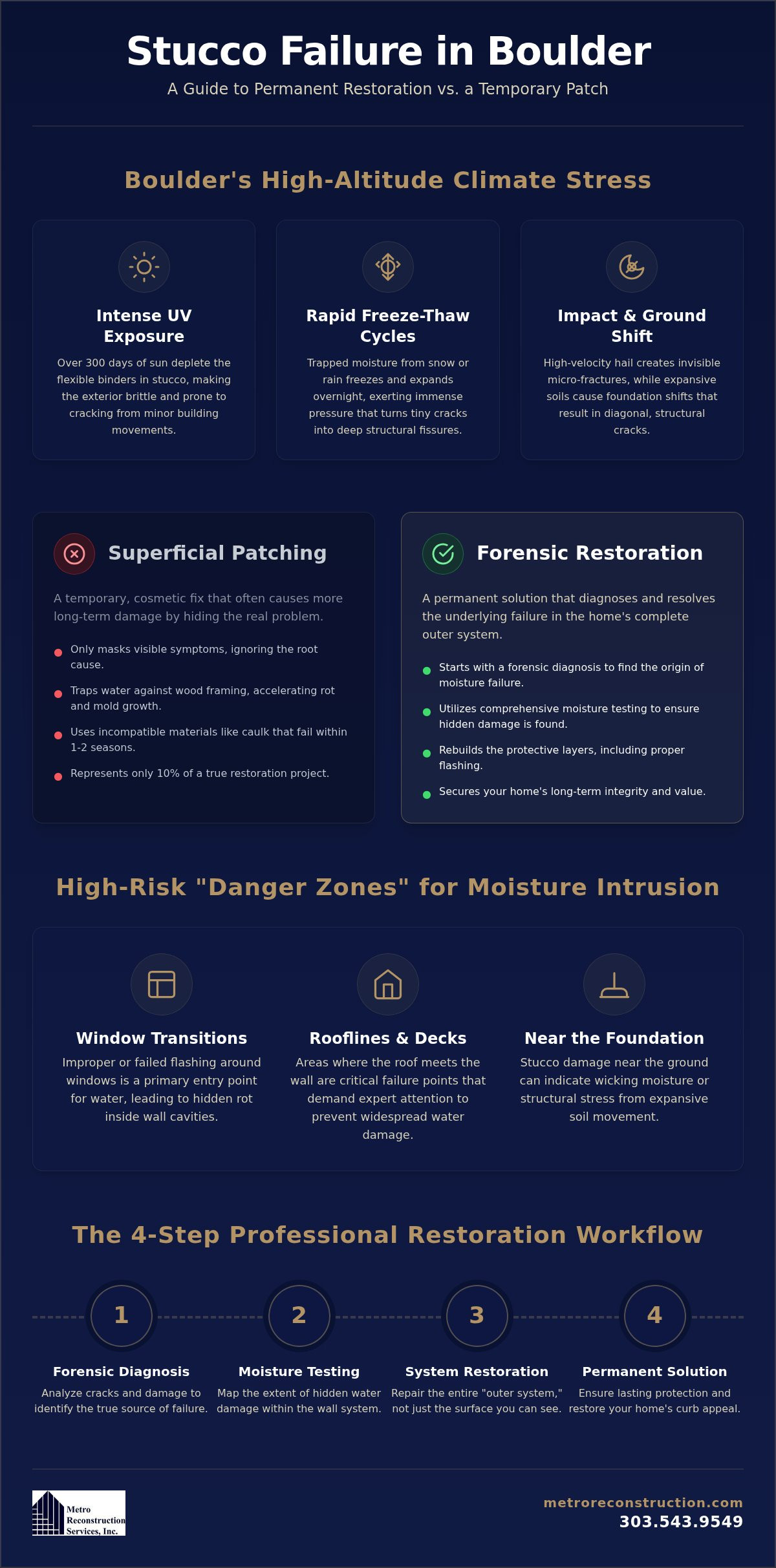
The Professional Stucco Restoration Workflow
A high-quality stucco repair Boulder project follows a sequence defined by technical accuracy rather than speed. We begin with a comprehensive site evaluation that utilizes electronic moisture testing and thermal imaging. This allows us to map the extent of hidden damage before a single tool touches the wall. Once the diagnostic phase is complete, we proceed with the strategic removal of compromised materials. We don’t simply strip the surface; we carefully excise the failed sections to avoid vibrating or damaging the healthy parts of the structure’s complete outer system.
After the substrate is exposed, we address any underlying structural origins of failure. This stage involves the remediation of wood rot or framing damage caused by long-term moisture intrusion. We then re-establish the moisture barrier and lath system, ensuring every overlap and penetration is sealed to modern engineering standards. The final phase is a traditional multi-coat application, moving from a scratch coat to a brown coat before the specialized finish layer is applied. If you require a forensic evaluation of your home’s exterior, you can learn more about our stucco restoration services to start your project correctly.
Texture and Color Matching Techniques
The aesthetic success of a restoration depends on the art of blending new materials with weathered finishes that may be decades old. We avoid the common mistake of simply painting over a repair, which often leads to peeling and masks future moisture issues. Instead, we utilize custom-tinted finishes that replicate the depth and variation of the original surface. Our approach to Stucco and Masonry Repairs focuses on achieving a seamless transition that respects the home’s original architecture while providing a permanent solution to structural decay. Accuracy at this stage ensures the repair is invisible to the naked eye.
Quality Control and Curing Times
Boulder’s semi-arid environment and low humidity present a unique challenge during the curing process. If the cementitious layers dry too quickly, they become brittle and prone to cracking. We implement specific wet-curing protocols to ensure the stucco reaches its full design strength. Before the final finish is applied, we perform pH testing to confirm the alkalinity of the base coats has stabilized. This level of precision prevents chemical reactions that could otherwise cause the finish to delaminate or discolour over time. A final inspection verifies that the entire system is airtight and integrated, providing the peace of mind that only a forensic restoration can offer. To further enhance and protect your home’s new exterior, you can discover Pro Painter USA for professional painting services that deliver high-quality, durable results.
Choosing a Specialist for Boulder Property Preservation
Selecting a contractor for stucco repair Boulder requires evaluating more than just a portfolio of finished photos. In a region where the median single-family home price reached $1,325,000 in May 2026, the stakes for property preservation are exceptionally high. A specialist must demonstrate an analytical understanding of the relationship between high-altitude environmental stressors and the building’s complete outer system. Experience in the Front Range since 1982 provides the necessary context for navigating modern building codes and regional wildfire mitigation requirements. Home hardening is no longer optional in Boulder County; your restoration specialist must understand how stucco systems integrate with non-combustible materials to protect the structure from ignition risks.
Technical precision should extend to the financial structure of the project as well. We advocate for a fixed-price project fee for structural work. This approach ensures that the initial forensic diagnostic phase was sufficiently thorough to account for the true scope of restoration. It protects homeowners from the “discovery” price hikes that often plague projects led by generalists who fail to identify underlying rot or moisture paths during the bidding process. Vetting for moisture mitigation expertise, rather than just masonry skills, is the only way to ensure the repair addresses the source of the failure rather than just the visible crack.
Long-Term Value vs. Initial Cost
Choosing a specialist based on the lowest initial bid often leads to the high cost of “doing it twice.” When a superficial patch fails within two seasons, the subsequent restoration is frequently more expensive due to the advanced state of the trapped moisture damage. Professional restoration protects your home’s resale value by providing documented proof of structural integrity and moisture resolution. True expertise is found in the ability to explain the “why” behind the repair. By understanding the mechanical cause of a failure, you gain the peace of mind that the solution is permanent and your investment is secure.
Partnering with Metro Reconstruction Services
Metro Reconstruction Services operates with a sense of quiet confidence born from over 40 years of solving complex structural failures. We don’t rely on high-pressure sales tactics; instead, we offer grounded, authoritative professionalism that prioritizes the health of your home. We act as a dedicated partner in your property’s preservation, guiding you through technical complexities toward a clear, professional conclusion. As a premier construction company in Boulder, our commitment to initial accuracy acts as a foundational promise for every project. We invite you to experience a methodology where substance always takes precedence over style, ensuring your home remains a resilient sanctuary in the demanding Colorado climate.
Securing the Future of Your Boulder Residence
Your home’s exterior is its primary defense against the high-altitude stressors of the Colorado climate. By moving beyond superficial patches and embracing a forensic diagnostic approach, you address the root causes of failure rather than just masking the symptoms. This methodology ensures that moisture intrusion is permanently resolved, protecting the building’s complete outer system from the long-term risks of rot and structural decay. We’ve seen that true restoration requires a partner who understands the complex relationship between technical building components and environmental pressure.
Metro Reconstruction Services has provided this specialized expertise since 1982. As a family-owned and operated company with over 40 years of regional experience, we bring quiet confidence to every stucco repair Boulder project we undertake. Our commitment to initial accuracy and structural integrity ensures your property remains both beautiful and resilient for decades to come. Protect your home’s structural integrity today. Contact Metro Reconstruction Services for a professional evaluation or call us at 303.543.9549. We look forward to helping you preserve your investment with precision and care.
Frequently Asked Questions
How do I know if a crack in my stucco is serious?
The severity of a crack is determined by its width, pattern, and location. While hairline cracks are often the result of minor thermal expansion, any gap wider than 1/8 inch or a stair-step pattern suggests active structural movement. If you notice dark staining, soft spots, or a musty odor near the crack, it’s a clear sign that moisture has breached the outer shell and is compromising the substrate.
Can you match the existing color and texture of my old stucco?
We specialize in the technical art of matching weathered finishes that have been exposed to Boulder’s intense UV rays for decades. Our process involves analyzing the original aggregate size and pigment depth to create a custom-tinted finish. We don’t simply paint over the repair; we replicate the physical texture to ensure the restored section is virtually indistinguishable from the original architecture.
Is it better to repair or completely replace my stucco exterior?
The choice depends on the health of your home’s complete outer system. Localized failures at window transitions or rooflines are typically resolved through a forensic stucco repair Boulder. However, if we detect widespread delamination or systemic rot behind the walls during our moisture testing, a full stucco replacement may be the only way to ensure the long-term structural integrity of your property.
How long does a professional stucco restoration take in Boulder?
A comprehensive restoration project usually spans one to three weeks, depending on the extent of the hidden damage we uncover. This timeframe accounts for the forensic diagnostic phase, the removal of compromised materials, and the critical curing periods required between cementitious coats. We prioritize the precision of the curing process to ensure the new layers reach their full design strength in our semi-arid climate.
Does homeowners insurance cover stucco repair from hail damage?
Insurance policies often cover sudden, accidental damage caused by hail impact, but they generally exclude long-term wear or maintenance failures. It’s essential to have a professional evaluation to document how a storm breached your moisture barrier. We provide the detailed forensic data required to help you and your insurance provider understand the structural origins of the damage before you proceed with a claim.
Why is my stucco peeling or bubbling near the ground?
This phenomenon, known as delamination, is frequently caused by moisture wicking up from the soil or foundation. If your home lacks a functional weep screed or if the landscaping grade is too high, water becomes trapped behind the finish. This constant saturation weakens the bond between the stucco and the substrate, leading to the visible bubbling and peeling you see at the base of the walls.
Can you repair stucco during the Colorado winter?
Stucco can be successfully repaired in the winter, provided that specialized cold-weather protocols are followed. We utilize heated enclosures and thermal blankets to maintain the necessary temperature for the cement to cure properly. Since freezing temperatures can ruin the chemical bond of wet stucco, we monitor conditions closely to ensure your stucco repair Boulder meets our high standards for durability and strength.
What is the difference between traditional stucco and EIFS?
Traditional stucco is a breathable, cement-based system applied over a metal lath, known for its rugged durability in mountain environments. EIFS, or Exterior Insulation and Finish Systems, uses foam insulation boards covered with a synthetic, acrylic finish. While EIFS provides superior thermal insulation, it requires an expertly engineered drainage plane to prevent moisture from becoming trapped against the structure, which can lead to rapid rot if neglected.