
Cleaning a white deposit may be the easiest part of solving the problem. If you’re seeing efflorescence on stucco or masonry, the residue can be a clue that moisture has moved through the material, carrying dissolved salts to the surface. Wiping it away may improve the appearance, but it won’t explain where the water came from or whether it’s still moving through the wall.
It’s reasonable to wonder whether a white mark is efflorescence, another surface stain, or a sign of a larger moisture concern. Its pattern and texture, and whether it returns, can offer useful clues, but recurring deposits deserve more than repeated cleaning. This guide explains how efflorescence forms, what to observe when assessing moisture, and when a professional stucco or masonry evaluation may help clarify the issue. It also explains why the complete exterior system, including nearby flashing and drainage details, matters when choosing a next step.
Key Takeaways
- Efflorescence appears when moisture carries soluble salts through stucco or masonry and evaporates at the surface.
- A white, chalky deposit can have different causes. Appearance alone can’t confirm efflorescence or identify where moisture entered.
- Photograph the affected area, note nearby exterior details, and track whether the deposit returns before deciding on next steps.
- Recurring deposits call for attention to the moisture pathway and surrounding exterior components, not just the visible residue.
- If you need help assessing stucco or masonry, contact Metro Reconstruction or call 303.543.9549.
What Efflorescence on Stucco or Masonry Looks Like
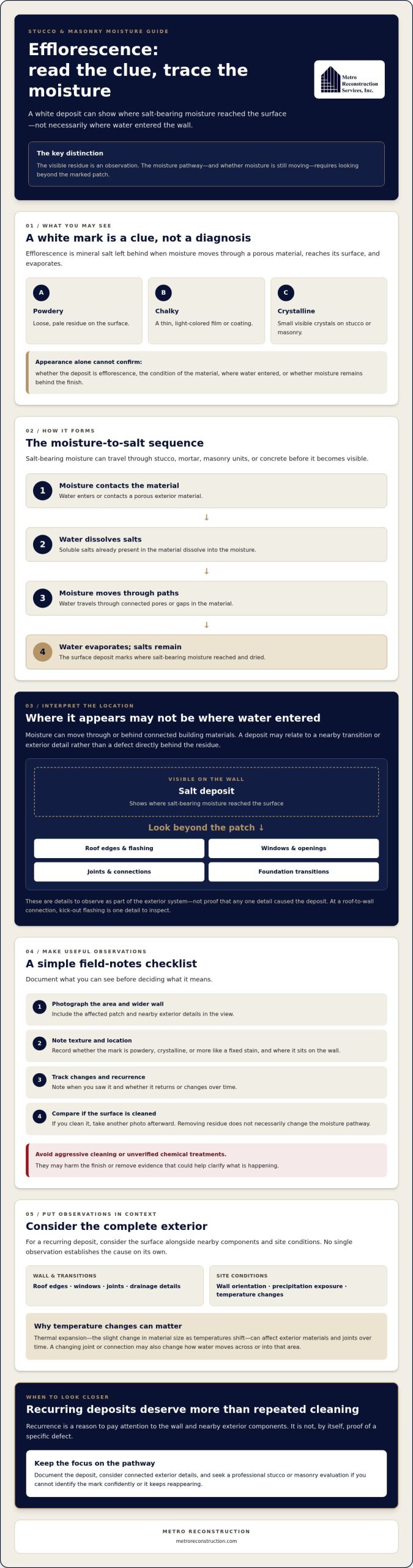
Efflorescence is a visible deposit of mineral salts left behind when moisture moves through a porous material, reaches its surface, and evaporates. On stucco, masonry, or concrete, it may look like white powder, a chalky film, or small crystals. This appearance can point to salt movement, but it can’t confirm the material’s condition or show where moisture entered.
The residue may appear in isolated patches or spread across a larger area. You might notice it near joints, along the lower part of a wall, or around openings and other exterior details. Location and texture are useful observations, not a diagnosis. The linked reference explains salt movement and crystallization, but identifying a deposit on your building also requires considering the surface and surrounding conditions.
How to Recognize Efflorescence on an Exterior Wall
Look at the deposit’s color, texture, and location without treating any one feature as proof. It may be loose and powdery, form a thin pale coating, or appear as visible crystals. Some residue brushes away easily, but removing what you can see doesn’t necessarily change the moisture pathway that brought salts to the surface.
Before disturbing the deposit, take a photo that shows both the affected patch and the wider wall. Note its location and date, then record whether it returns or changes over time. If you clean the surface, take another photo afterward so you can compare the area. Recurrence is a reason to pay attention to the wall and nearby exterior components, not proof of a specific defect.
Efflorescence, Stains, and Other White Deposits
A white mark alone can’t confirm what it is. Stucco and masonry may show other residues or surface changes that look similar, and appearance can vary with the material and its condition. Avoid aggressive cleaning or unverified chemical treatments, which may harm the finish or remove evidence that could help clarify what is happening.
Document whether the mark is powdery, crystalline, or more like a fixed stain, and note whether it returns. If you can’t identify it confidently or it keeps reappearing, consider a professional evaluation of the affected surface and nearby parts of the exterior system. Metro Reconstruction provides stucco restoration and masonry work for property owners in Boulder and Front Range and Mountain communities. Contact Metro Reconstruction to discuss your stucco or masonry concern, or call 303.543.9549.
How Moisture Carries Salts Through Stucco and Masonry
Moisture can move salts through an exterior wall in a simple sequence: water enters or contacts porous materials, dissolves salts already present, travels through connected pores or gaps, then evaporates and leaves the salts behind. Stucco, mortar, masonry units, and concrete can all provide paths for this movement. The causes of efflorescence also depend on the materials involved and the conditions around them.
The visible salt deposit marks where salt-bearing moisture reached a surface and evaporated, not necessarily where water entered the building envelope, how it traveled, or whether moisture is still present behind the finish. That distinction matters: the deposit is an observable clue, while the moisture pathway may involve another part of the wall assembly.
Why the Moisture Source May Be Away from the Deposit
Water can pass through or behind connected building materials before it becomes visible. A deposit on one part of a wall may relate to a nearby roof edge, window opening, joint, or foundation transition rather than a defect directly behind the residue. Consider how these components meet and how water is directed away from the wall. At a roof-to-wall connection, for example, kick-out flashing is one detail to inspect, but its presence alone doesn’t establish the cause.
Note the deposit’s location in relation to nearby transitions and joints. A photo that includes these details can help guide a closer review of the exterior as a connected system, rather than treating the marked patch as an isolated surface problem.
Front Range Conditions to Consider During an Assessment
Conditions vary by property and exposure, so an assessment should consider the wall’s orientation, its exposure to precipitation, and the temperature changes it experiences. These factors need to be considered at the specific site; they don’t establish a cause on their own. Thermal expansion, the slight change in material size as temperatures shift, can also affect exterior materials and joints over time. If a joint or connection changes, the way water moves across or into that area may change as well.
For a recurring deposit, connect the surface observation to nearby roof edges, windows, joints, and drainage details before choosing a repair. Metro Reconstruction provides stucco restoration and masonry work in Boulder and Front Range and Mountain communities. Contact Metro Reconstruction to discuss a stucco or masonry evaluation, or call 303.543.9549.
Does Efflorescence Mean Stucco Is Failing?
No. Efflorescence by itself doesn’t prove that stucco is failing, show that the wall has structural damage, or determine which repair is needed. It can indicate that moisture has moved through a porous material, but it can’t confirm the moisture’s source, how much of the assembly is affected, or whether the stucco needs repair.
A single deposit is one observation, not a complete assessment. Its significance depends on what happens over time and what else is visible nearby. Recurrence, changes to the finish, or signs of moisture around an opening add context and may warrant a closer look at the exterior wall system. They are reasons to investigate, not a diagnosis.
When a White Deposit May Be a Limited Surface Issue
Appearance alone can’t show whether the material below the surface has been affected. A patch that doesn’t return may differ from one that reappears, but even a one-time deposit shouldn’t be called harmless without considering the surrounding conditions. Take clear photos, record the location, and note when you first saw it and whether it changes or returns.
These details help distinguish a temporary surface observation from a recurring pattern. Don’t rely on a quick clean-up as proof that the underlying concern is resolved.
Signs That Call for a Closer Exterior Assessment
Look for more than the deposit itself. Pay attention to whether it returns, whether the stucco finish changes, and whether moisture is visible around nearby windows or other openings. A single patch may be limited, while several observations together can point to a broader moisture concern that deserves evaluation.
- The deposit reappears after the surface has been cleaned.
- The finish nearby looks changed, damaged, or uneven.
- Moisture is visible near a window, joint, or other wall transition.
None of these signs alone confirms the cause or the repair required. Together, they help build a clearer picture of what is happening across the exterior. If an assessment identifies a finish or assembly issue, stucco restoration may be an appropriate next step. Learn about stucco restoration services, or contact Metro Reconstruction to discuss your concerns. Call 303.543.9549.
What to Do When You Find Efflorescence
Start by recording what you see rather than trying to remove every trace right away. A clear record can help show whether the deposit is isolated or recurring and give a professional useful context if you seek an assessment. Include the wall and its surrounding details, since a repair plan should follow an understanding of the moisture pathway and affected materials.
A Homeowner Observation Checklist
Before cleaning, take photos and note the deposit’s location. Include nearby windows, roof-to-wall transitions, joints, and any visible changes to the stucco or masonry finish. If you’ve noticed moisture, record when and where, but don’t assume a single event or feature explains the cause.
- Photograph the deposit and the wider wall area for context.
- Note nearby openings, joints, roof edges, and visible finish changes.
- Record whether the deposit returns after surface cleaning.
- Write down relevant moisture observations without assigning a cause.
Continue to observe the area over time. Recurrence is useful information, but it doesn’t identify the entry point by itself. Avoid scrubbing hard or applying unverified cleaners: an unsuitable method may damage the finish or remove clues that could help with an assessment. Cleaning guidance should suit the specific surface and material. When addressing general exterior grime, professional exterior cleaners like Warrens Power Washing recommend using low-pressure techniques to protect delicate building surfaces from wash-related damage.
Why Cleaning Alone May Not Resolve Recurring Deposits
Removing visible residue changes the surface, not necessarily the way moisture moves through the wall assembly. If moisture continues to carry salts toward the exterior, the deposit may return. That is why recurring residue should prompt attention to the complete exterior envelope, including connected details that may affect how water is directed or managed.
Repair planning is most useful after the moisture pathway and any affected materials have been considered. Depending on what an assessment finds, the next step may involve addressing an exterior detail or considering stucco restoration or masonry work. Cleaning without understanding the conditions behind a repeated deposit can leave the underlying issue unresolved.
For related information about stucco and masonry services, review Metro Reconstruction’s service overview. If deposits keep returning or you’re unsure what the surface shows, contact Metro Reconstruction to discuss an assessment, or call 303.543.9549.
How a Stucco Restoration Assessment Can Address the Root Cause
A useful assessment looks beyond the visible deposit. It considers the stucco finish alongside nearby openings, roof-to-wall details, joints, and other parts of the exterior that affect how water is directed and managed. The goal is to understand how these components relate to the moisture clues, not to assume the spot showing efflorescence is where water entered.
Some parts of a wall assembly, such as building paper or a weather-resistant barrier, sit behind the exterior finish. They may be relevant to understanding the assembly when their presence and condition can be verified, but a surface deposit alone can’t establish what is behind the stucco. A careful review distinguishes what can be observed from what remains unknown.
What a Root-Cause Review Should Consider
Look at the wall as a connected system. An assessment may consider whether the finish has visible changes, how windows and other openings meet the wall, the condition of roof-to-wall transitions and joints, and how nearby details guide water away from the exterior. Each observation adds context; no single feature should be treated as proof of the cause.
Repair decisions should follow a clearer understanding of the moisture source and which materials are affected. Depending on the findings, maintenance, localized work, or stucco restoration may merit consideration. For property owners dealing with localized surface damage, skilled stucco contractors such as Premier Plastering provide comprehensive patching and repair services to restore affected surfaces. Repairing or replacing a finish without addressing a related moisture pathway may leave the central concern unresolved.
When to Contact a Stucco and Masonry Specialist
Consider professional input if deposits keep returning, the finish changes, or other signs of moisture concern you. Share photos and notes about where the deposit appears and what you’ve observed nearby. This information can help frame the discussion, while an evaluation can consider whether the issue is limited to a surface or may involve related exterior components.
Metro Reconstruction provides stucco restoration, masonry work, and moisture mitigation for property owners in Boulder and Front Range and Mountain communities. Explore stucco and masonry restoration services to learn more about the work offered. If you’d like to discuss a recurring deposit or a visible change to your exterior, contact Metro Reconstruction or call 303.543.9549.
Address the Moisture Source for Lasting Clarity
Efflorescence is a visible clue, not a diagnosis of stucco failure. The deposit may form as moisture carries salts to the surface, but its location doesn’t necessarily reveal where water entered. If residue returns, document the pattern and consider the surrounding exterior details before choosing a repair. Cleaning alone may remove what you see without changing the conditions that brought it there.
A careful assessment can help connect the surface evidence to the wall’s complete exterior system and clarify whether maintenance, localized work, or stucco restoration merits consideration. Metro Reconstruction is a family-owned firm with more than four decades of experience, and its relevant services include stucco restoration, masonry work, and moisture mitigation.
If deposits keep returning or changes to your stucco or masonry concern you, contact Metro Reconstruction Services to discuss your concerns or call 303.543.9549. With clear observations and an evaluation of the exterior, you can take a considered next step toward protecting your property.
Frequently Asked Questions
What is efflorescence?
Efflorescence is a visible deposit of mineral salts left behind when moisture moves through porous material, reaches the surface, and evaporates. On stucco or masonry, it may appear as white powder, a chalky film, or crystals. The appearance can offer a clue, but it doesn’t confirm the cause or show where the moisture entered. Note the location and whether the deposit returns, and consider the surrounding wall details.
Is efflorescence a sign of a serious problem?
Not necessarily. A deposit alone doesn’t prove structural failure or establish what repair is needed. It does show that moisture and soluble salts have reached the surface, so it’s useful to consider the surrounding exterior. A one-time observation differs from residue that returns or appears alongside visible finish changes or moisture near an opening. Track what you see and seek an assessment if the pattern concerns you.
Can efflorescence damage stucco?
A surface deposit doesn’t by itself establish that stucco has been damaged. The concern is whether ongoing moisture and salt movement are affecting the finish or materials behind it. Repeated deposits, visible changes to the stucco, or moisture around nearby openings deserve closer attention. Document the location and changes over time rather than assuming either that the wall has failed or that the residue is harmless.
How do you remove efflorescence from stucco?
There isn’t one cleaning method that’s right for every stucco finish. Avoid aggressive scrubbing or unverified chemical cleaners, since an unsuitable approach can damage the surface or hide signs that the deposit is recurring. Record the area before disturbing it, then seek guidance suited to the specific material if you’re unsure how to clean it. If residue returns, investigate moisture movement instead of relying on repeated cleaning alone.
Why does efflorescence keep coming back?
It may return when moisture continues to dissolve salts within porous materials and carry them to an exposed surface, where evaporation leaves residue. Cleaning removes the visible deposit but may not change how water moves through the wall assembly. Track when and where it reappears, and note nearby openings, joints, roof-to-wall details, or visible finish changes. Recurrence is a reason to consider the moisture pathway, not proof of one specific defect.
Does efflorescence mean water is getting behind the stucco?
Not always. A deposit indicates that moisture moved through material to a surface, but it doesn’t identify whether water traveled behind the stucco, entered at that spot, or came from a nearby part of the exterior. Consider the complete wall system, including openings, joints, and roof-to-wall connections. If you also observe recurring residue or visible changes, a closer review can help clarify whether moisture behind the finish may be involved.
When should I have efflorescence professionally assessed?
Consider an assessment if the deposit keeps returning, you see changes to the stucco, or moisture near an opening or joint concerns you. Metro Reconstruction Services, Inc. is a family-owned firm with more than four decades of experience and provides stucco restoration, masonry work, and moisture mitigation. Metro serves Parker, Morrison, Boulder, Longmont, Niwot, Evergreen, Cherry Creek, Cherry Hills Village, Golden, Genesee, Littleton, Broomfield, Denver, Silverthorn, Breckenridge, Vail, and Larkspur. Contact Metro Reconstruction or call 303.543.9549.