
A window can fit its opening and still leave a home exposed to drafts, moisture, or heat transfer if the frame and wall assembly aren’t considered. Custom window replacement in Longmont, CO, should account for the window’s dimensions and how it connects to the building envelope.
You may be weighing whether to replace the window alone or address the existing frame and nearby materials at the same time. The right scope depends on the condition of those components, the fit required, and the performance you want from the new window.
This article explains what a replacement consultation can cover, how to assess window efficiency, and how to compare products and project scopes. You’ll also learn why evaluating the opening and surrounding exterior matters for a durable, well-fitted result in Longmont and nearby communities.
Key Takeaways
- A careful consultation helps determine whether the existing frame can remain or the opening needs broader work.
- Window performance depends on more than the glass; frame materials and installation affect heat transfer and fit.
- Compare window options by material, efficiency information, and how well they suit your home’s needs.
- Look for a contractor who explains the installation scope, relevant experience, and how the window connects to the surrounding exterior.
- Accurate assessment of the opening and building envelope can guide a durable replacement project in Longmont and nearby communities.
Longmont replacement-window consultations and installation
A Longmont consultation should connect window measurements with frame condition, water management, and installation scope. Both the opening and the surrounding wall affect the fit.
Insert and Full-Frame Installation
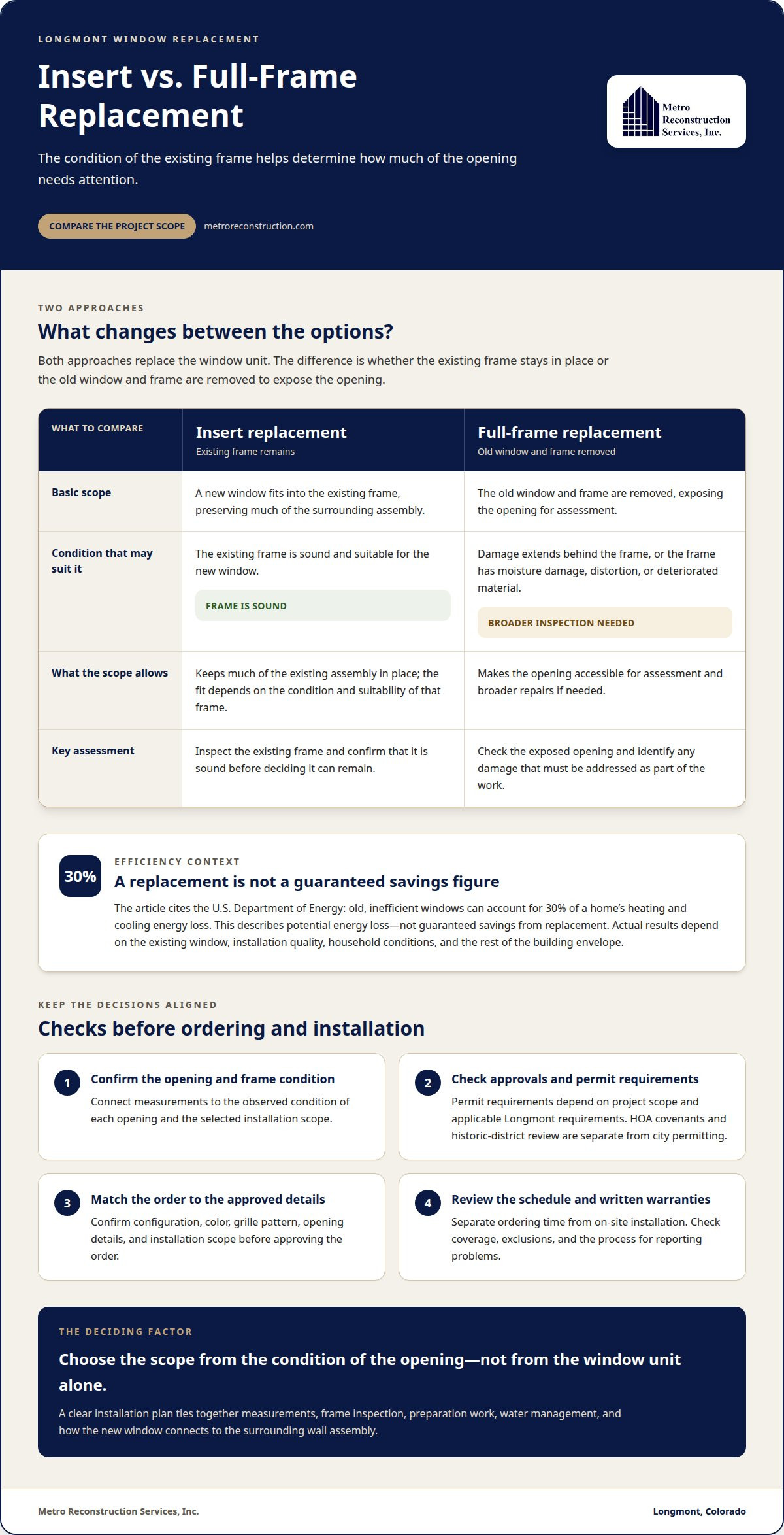
An insert replacement fits a new window into the existing frame, preserving much of the surrounding assembly. A full-frame replacement removes the old window and frame, exposing the opening for assessment. During measurement, examine the frame for moisture damage, distortion, or deteriorated material. If the frame is sound, an insert may suit the opening. If damage extends behind it, full-frame work allows broader repairs.
Permits and Property Approvals
Permit requirements depend on project scope and applicable Longmont requirements. Changing an opening or framing can involve different considerations from replacing a window in the existing opening. Identify applicable permit requirements in the installation plan before work begins.
HOA covenants and historic-district review are separate from city permitting. If either applies to your property, review approval requirements before ordering windows. Frame color, grille pattern, and opening changes can affect the exterior appearance. Resolve these details early to avoid a mismatch between the selected window and property requirements.
Measurement, Ordering, and Installation Timing
Custom work follows a sequence: inspect the opening, measure, confirm the window configuration, order, and install. The schedule depends on the order specifications, manufacturing and delivery, and preparation required at the opening. Accurate measurements matter because an incorrect size can delay fitting or require adjustments. Ask for a schedule that separates ordering time from on-site installation, so you know when the home needs access and preparation.
Reviews, Warranties, and Installation Quality
When reviewing customer feedback, look for specific accounts of measurement, scheduling, installation, and cleanup. Reviews describing how a company handled fit or water-intrusion concerns offer more detail than general praise. No review alone establishes how a particular project will perform.
Window warranties and installation warranties may cover different issues. Read the written terms for coverage, exclusions, and the process for reporting problems. Poor installation can leave gaps, uneven operation, drafts, or pathways for moisture. Accurate measurement, proper fastening, and careful sealing help reduce these risks. The installer should explain how the window integrates with the surrounding wall assembly.
Insert replacement windows fit into existing frames, while full-frame replacement removes the old frame to the studs. Ask the installer to explain which approach suits the observed condition of each opening and what the chosen scope includes. A clear explanation should connect measurements, frame inspection, and preparation work, rather than treating the window unit as the only consideration. Confirm how the work will address damage found during assessment.
Before approving an order, make sure the selected configuration, color, grille pattern, opening details, and installation scope match what was discussed and any applicable property approvals. Ask for a schedule that separates ordering time from on-site installation. Review written warranty terms for coverage, exclusions, and how to report a problem. These checks help you compare proposals and keep measurement, ordering, and installation decisions aligned.
Window energy efficiency and heat transfer
For Longmont, select windows with documented efficiency ratings suited to your home’s exposure and opening. According to the U.S. Department of Energy, old, inefficient windows can account for 30% of a home’s heating and cooling energy loss.
Energy Efficiency and Potential Savings
That 30% figure describes potential energy loss through inefficient windows, not guaranteed savings from replacement. Actual results depend on the existing window, installation quality, household conditions, and the rest of the building envelope. A new unit may still perform poorly if air leaks around its frame or moisture damages the surrounding materials.
Compare the window’s U-Factor, a measure of heat loss. Lower values indicate better insulating performance. Also consider how the glass, frame, and installation work together. For example, a well-rated window installed with gaps can allow drafts and weaken the expected improvement. Sealing the perimeter and addressing the opening are part of the performance decision, not minor finishing details.
Energy-efficient replacements can help reduce heat transfer, but a window rating alone doesn’t establish household savings. Ask for documented product performance information and relate it to the home’s current conditions. ENERGY STAR certification identifies windows that meet energy-star standards. Compare product ratings for the relevant climate zone rather than relying on the label alone.
Energy-Efficient Window Selection
Heat moves through windows by conduction, air leakage, and solar gain. In winter, heat can pass through glass and frames; in warmer conditions, sunlight can add unwanted indoor heat. Frame materials matter, too: thermal bridging occurs when heat bypasses insulation through conductive parts of a frame or nearby wall.
Start with the window’s U-Factor, then review its solar heat gain information and air-leakage performance. These measures describe different aspects of performance, so one rating cannot stand in for all the others. The right balance depends on the opening’s orientation, shading, and the room’s heating or cooling needs.
During selection, match the product to the opening and installation conditions. A sunny south-facing room may need a different balance of insulation and solar control than a shaded north-facing room. ENERGY STAR certification can help narrow options, while product ratings clarify how each unit performs. Include frame fit and perimeter sealing in the decision, because an efficient window needs a properly integrated installation.
Window brands including Alpen, IWT, Marvin, and ProVia
Alpen, IWT, Marvin, and ProVia are window brands homeowners may encounter while comparing replacement options. A brand name alone doesn’t establish how a specific window will perform in your Longmont home. Compare the exact model, frame material, glass configuration, and documented efficiency ratings. These details connect the product choice to the opening and the home’s exterior.
Start with the requirements for each opening. Note its dimensions, operation, exposure, and existing frame condition. Then compare product documentation for models that match those needs. A fixed window, for example, has different operating requirements from a window designed to open. Confirming the configuration keeps the comparison focused on products suited to the installation.
Vinyl and fiberglass are different frame-material categories, so compare their published specifications rather than relying on the material name. Review frame construction, available configurations, maintenance guidance, and compatibility with the existing exterior. For Colorado homes, consider how the selected frame and glass package address heat transfer and fit. Use each product’s documentation to compare performance; don’t assume every model in a material category performs alike.
Vinyl frames vary by design and construction. The term “low-cost vinyl windows” describes inexpensive vinyl frames that are prone to warping and seal failure in high-altitude environments. That warning does not replace a review of a specific product’s documented details. Fiberglass is another category to compare, but its label alone does not establish a window’s efficiency, durability, or suitability for a particular opening.
Use a consistent comparison process for Alpen, IWT, Marvin, and ProVia:
- Match the model and operating style to each opening.
- Compare the U-Factor and other documented performance ratings.
- Review frame material and installation requirements together.
- Check the product’s care instructions and written warranty terms.
For example, if two models fit the same opening, compare their documented ratings and frame details side by side. Then consider how each option integrates with the surrounding wall and exterior finish. This keeps the decision grounded in the specific window, rather than brand reputation or material label. A well-matched product and accurately prepared opening work as one assembly.
Window replacement contractors serving Longmont and nearby areas
Longmont projects may involve glass-only work, complete window replacement, or custom-fit installation. The contractor’s experience should match the work and communities involved.
Contractor Experience and Service Areas
Relevant experience matters most when it relates to the opening and exterior assembly. For a Longmont home, the assessment should address measurement, frame condition, installation scope, and how the window meets nearby materials. For example, replacing a window in an older home may require different preparation than adding a new opening during an exterior remodel.
Service-area details also shape scheduling and project coordination. Longmont, Niwot, Boulder, and Broomfield are nearby communities, while Denver and Golden are farther along the Front Range. A written project scope should identify the property location, installation tasks, and access arrangements. Clear boundaries help prevent confusion about which openings and exterior details the work includes.
Custom Window Services
Custom window work starts with the opening, not an assumption about standard sizes. Measurements, frame condition, operation, and exterior finish all affect the selected configuration. Document each opening separately, such as a fixed picture window in a living room and an operable bedroom window. That record supports accurate ordering and installation planning.
Glass-only service may address a damaged pane, while complete window replacement addresses the window assembly. The distinction matters when a fogged unit has an intact frame, compared with a distorted or deteriorated frame. Identify the issue and affected component first; the appropriate scope follows from that assessment.
For Champion windows, begin by identifying the existing product and its configuration. Labels, operating style, frame dimensions, and the condition of surrounding materials help define the replacement scope. A project involving Champion products still needs measurements for each opening and a clear description of installation work. Product identification keeps the assessment specific rather than reliant on the brand name alone.
Reviews and project descriptions can show whether a contractor handles similar work in Longmont and nearby communities. Focus on concrete details, such as communication about measurements, installation steps, and cleanup. A review describing a particular window project offers more context than a general rating alone. Compare that experience with the work your home needs, whether glass service, frame replacement, or a custom-sized unit.
Before work proceeds, project documentation should name the openings, selected window configurations, and installation responsibilities. For a Longmont home with several window types, a room-by-room schedule can clarify which units are being replaced and how the exterior finish will be handled. A defined scope supports coordination between product selection and installation.
Choosing a replacement window contractor
For a Longmont project, compare the proposed work process, not just the product description. The scope should identify each opening, its measurements, frame condition, and installation method. That detail matters because a window connects to the wall’s insulation, exterior finish, and moisture-control layers. A proposal listing only window units leaves important installation decisions unclear.
Review experience relevant to the home and planned work. Replacing a window in an existing opening differs from changing its size or surrounding framing. A clear project plan explains how the opening will be assessed, how damaged materials will be handled, and how the replacement will meet adjacent surfaces. Specific examples are more useful than general claims of experience.
Use these project details to compare the scope:
- Opening-by-opening measurements and selected window configurations.
- Frame condition and whether the installation keeps or removes it.
- Sealing and connections between the window and surrounding wall.
- Work sequence, site protection, and cleanup responsibilities.
Reviews are most useful when they describe an actual installation. Look for details about measurement accuracy, communication, fit, and how concerns were handled. For example, a review describing a window that operates smoothly after installation gives more context than a general compliment. Consider the project details alongside the work your home needs.
Written documentation should explain product and installation warranty terms separately. Product coverage and workmanship coverage can address different issues, so their limits and exclusions matter. A useful document states how to report a concern and which component the coverage applies to. Keep those terms with the final project records.
Installation quality affects more than appearance. An uneven or poorly sealed window can create drafts, operating problems, and paths for water intrusion. Proper preparation, secure fitting, and perimeter sealing help the assembly function as intended. Coordinate nearby siding or stucco carefully, because exterior finishes meet the window at vulnerable joints.
Finally, compare how each proposed scope handles unexpected conditions. If inspection reveals concealed moisture damage, the project plan should distinguish window installation from repairs to affected materials. Clear documentation of the opening, work sequence, and responsibilities helps prevent missed steps. For a Longmont home, choose a plan that treats the window and adjacent wall as connected parts of one assembly.
That process helps keep the work orderly if a hidden issue changes the scope. Ask how a change will be documented and what work requires approval before proceeding. Energy claims also deserve careful review: the contractor states that double-pane Low-E windows with argon gas fill reduce energy bills by 10-25%. Treat that as a contractor claim, and ask how the proposed products and installation relate to the claim and to your home’s needs.
A broad contractor search can help with comparisons, but listing volume alone does not establish fit or workmanship. The Houzz listing shows 223 replacement window contractors in the Longmont area. The Houzz listing reports 15,990 local projects by window contractors serving Longmont, Colorado. Use those figures as context while examining the proposed scope, project examples, review details, and written coverage. Before choosing, confirm that the contractor’s responsibilities match the work described and that questions about concealed damage, installation, and follow-up have clear answers.
Metro Reconstruction Services: New windows
Metro Reconstruction Services, Inc. provides new windows for homeowners planning a replacement in Longmont. A window’s performance depends on the product, the opening, and the surrounding exterior materials. These parts work together as the building envelope, so the project scope should account for their connections.
For custom window replacement in Longmont, CO, begin by identifying which openings need new windows and what each requires. A room-by-room review can distinguish standard openings from those needing a custom fit. Existing frames and nearby finishes also shape installation planning. Replacement may be appropriate when an aging or damaged window no longer meets the home’s needs.
The exterior around each window matters, too. Windows meet materials such as siding, stucco, and masonry, as well as the wall beneath them. If the work exposes damaged materials, their condition should inform the project plan. Stucco Restoration and Masonry Work may be relevant when these materials surround an opening. Coordinate the window with adjacent finishes rather than treating each component separately.
For another custom window replacement in Longmont, CO, the project’s starting details remain the same:
- Identify the openings and their required dimensions.
- Assess the existing frames and nearby materials.
- Plan how the window will meet the wall and exterior finish.
- Select a configuration suited to the room and its exposure.
Accurate measurements help define the fit, while examining the opening can reveal conditions affecting sealing or moisture management. A replacement window needs to work with the surrounding exterior system, not simply occupy the opening.
Metro Reconstruction Services, Inc. can help when you’re planning new windows or replacing existing units. The project discussion can focus on your Longmont home, the openings involved, and the surrounding materials. Describe whether stucco or masonry is present near the windows to help define the relevant exterior work.
To discuss your window project, contact Metro Reconstruction Services, Inc. or call 303.543.9549.
Frequently Asked Questions
What factors affect custom window replacement in Longmont, CO?
The work involved depends on the windows and openings in your Longmont home. A project may include different configurations, frame conditions, and installation requirements across rooms. For example, a fixed living-room window and an operable bedroom window have different specifications. The scope also depends on whether surrounding materials need attention. Identifying these details helps define the work for each opening.
What window styles and materials are best for Longmont’s climate?
No single style or material is best for every Longmont home. Colorado windows may face temperatures from -20°F to 100°F, so compare each model’s documented performance and suitability for its opening. Consider room use, sun exposure, operation, and exterior conditions. For example, a fixed window and an opening window serve different ventilation needs. Review the specific product details rather than relying on material labels alone.
How do custom window replacement proposals compare, and what should they include?
Compare proposals by matching their stated scope. Each should identify the openings, window configurations, frame material, installation approach, and any work on surrounding finishes. Check whether removal, disposal, trim work, sealing, and cleanup are included or excluded. For example, insert installation differs from full-frame removal. Written product and installation warranty terms also help clarify which parts of the work each proposal covers.