
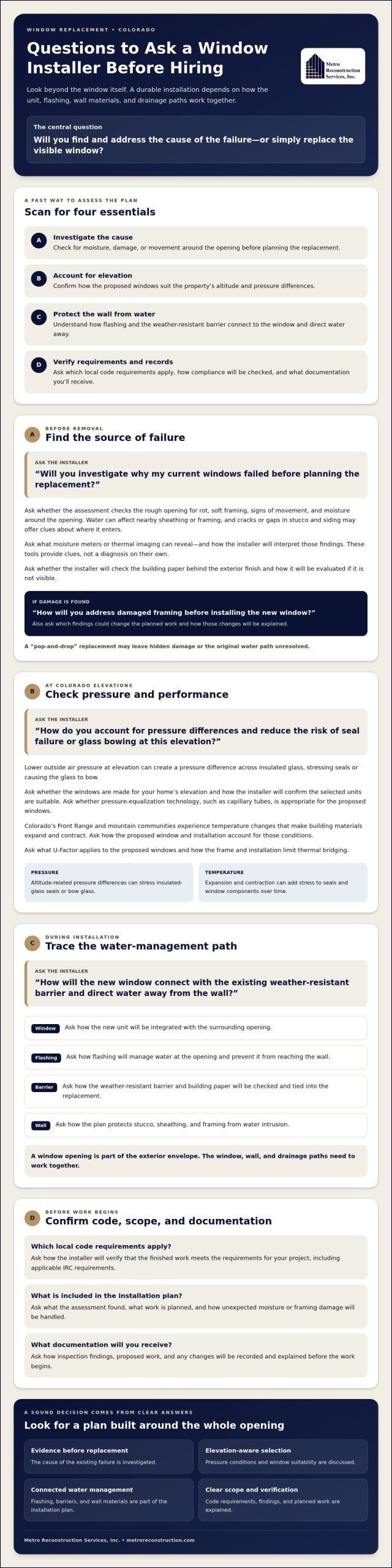
What if a new window still leaves your home vulnerable to leaks and seal failure? In Colorado’s high-altitude communities, pressure changes and temperature swings can stress window seals, while gaps in flashing or the weather-resistant barrier can let water reach the sheathing and damage stucco. That’s why the questions to ask a window installer before hiring should go beyond product selection and scheduling.
You’re right to compare installers carefully. A sound installation depends on more than fitting a window into an opening. The window, flashing, wall materials, and drainage paths must work together as part of the home’s exterior envelope. Ask how the installer will assess moisture issues, account for the property’s elevation, and protect the wall during replacement. Specific, evidence-based answers can help you distinguish a careful plan from a sales pitch.
This checklist will help you assess an installer’s approach to pressure equalization, water management, energy performance, and applicable local code requirements. You’ll also learn what to ask about inspections, installation details, and documentation before work begins. The goal is a durable installation based on an accurate understanding of your home, not a quick fix for a visible symptom.
Key Takeaways
- Use the questions to ask a window installer before hiring to find out whether they’ll investigate why your existing windows failed, not just replace them.
- Ask how the installer accounts for altitude-related pressure changes and whether pressure-equalization technology, such as capillary tubes, is appropriate for the proposed windows.
- Find out how the new windows will connect with the existing weather-resistant barrier and direct water away from the wall to help protect stucco and sheathing.
- Ask which local code requirements apply to your project and how the installer will verify that the finished work meets them.
- Metro Reconstruction Services, Inc. offers window replacement. Call 303.543.9549 to discuss your project.
Investigating the Structural Origin: Questions About the Forensic Diagnostic Phase
A replacement window can’t correct damage caused by a leaking opening, failed flashing, or movement in the surrounding wall. Before approving the work, ask: “Will you investigate why my current windows failed before planning the replacement?” Looking for the underlying cause helps ensure that a new unit doesn’t simply cover an unresolved moisture or structural problem.
Ask what the assessment includes. Moisture meters can help detect damp materials, while thermal imaging can reveal temperature patterns that may point to hidden moisture or air leakage. These tools provide clues, not a diagnosis on their own. The installer should explain what the findings mean and how they may affect the scope of work. A window is one part of the building envelope, the system that separates the home’s interior from outdoor conditions.
Identifying Moisture Intrusion and Structural Shifts
Ask how the installer checks the rough opening for rot, soft framing, or signs of movement. Water can pass around a window and affect nearby sheathing or framing. Cracks or gaps in stucco and siding may also provide clues about where moisture is entering. Ask whether the assessment includes checking the building paper behind the exterior finish, and how the installer will evaluate it if it isn’t visible. The goal is to understand how the window, wall, and drainage paths interact, not just inspect the glass and frame.
The Danger of Superficial Fixes
A “pop-and-drop” installation removes an old unit and places a new one without addressing hidden damage or the path water takes through the wall. If wet or weakened framing remains, or the surrounding barrier and flashing still direct water toward the opening, the new window may face the same conditions. Ask: “If you find damaged framing, how will you address it before installing the new window?” Also ask which findings could change the planned scope and how the installer will discuss those changes with you.
A careful process starts with identifying the problem, then planning the replacement around the home’s exterior system. That sequence can help prevent a cosmetic repair from masking a structural issue and supports moisture control. The questions to ask a window installer before hiring should focus on evidence, clear explanations, and a plan for addressing what the inspection reveals.
Metro Reconstruction Services, Inc. provides window replacement services. The company also offers moisture mitigation and stucco restoration, services that may be relevant when an assessment finds moisture concerns around an opening. Learn more through the company’s contact page or call 303.543.9549.
High-Altitude Engineering: Asking About Pressure-Equalization Technology and U-Factor
At elevation, lower outside air pressure can create a pressure difference across insulated glass, stressing its seals or causing the glass to bow. Ask: “How do you account for pressure differences and reduce the risk of seal failure or glass bowing at this elevation?” The installer should explain how the proposed windows suit your property’s elevation rather than relying on a one-size-fits-all recommendation.
Understanding Pressure-Equalization and Capillary Tubes
Capillary tubes are small openings in windows that allow internal and external pressure to equalize at altitude. Ask whether the proposed windows are manufactured for your home’s elevation and how the installer will confirm that the selected units are suitable. Also ask how the frame and installation limit thermal bridging, where heat passes through the frame or wall instead of the insulation, reducing energy efficiency.
Colorado’s Front Range and mountain communities also experience temperature changes that make building materials expand and contract. This movement can stress seals over time, while rapid temperature changes can add strain to glass and window components. Low-cost vinyl windows may be more prone to warping and seal failure in high-altitude environments such as Silverthorne or Vail. Ask the installer to explain how the proposed window’s materials and design address these conditions.
Evaluating U-Factor and Energy Star Standards
Request the specific U-Factor for each proposed window. U-Factor measures heat loss through a window; a lower value indicates better insulation. In Colorado, the statewide residential window standard effective January 1, 2026, sets a maximum U-Factor of 0.30. Ask the installer to show you the product documentation and explain how the rating relates to your home’s energy performance and indoor comfort. For homeowners also evaluating glare reduction and privacy alongside glass efficiency, resources from specialists such as Sun Guard Tint outline how residential films can further enhance indoor comfort.
Also ask whether the products meet current Energy Star standards for the applicable climate zone, and request documentation rather than relying on a verbal assurance. An Energy Star label and a U-Factor answer related but distinct questions, so ask how each applies to your home. You can review the International Code Council’s IRC flashing requirements, then ask which code version and local requirements govern your project.
These are useful questions to ask a window installer before hiring, especially when comparing proposals for a mountain home. Metro Reconstruction Services, Inc. offers window replacement. Project details can be discussed through the contact page or by calling 303.543.9549.
Protecting the Building Envelope: Questions Regarding Flashing and Moisture Management
A window is not a sealed insert in an otherwise unrelated wall. It connects to the surrounding cladding, flashing, and weather-resistant barrier, which work together to help control water entry. Ask: “How will you integrate the new windows with my existing weather-resistant barrier?” The building envelope is the home’s outer system, including the roof, siding, windows, and other parts that separate indoor spaces from outdoor conditions.
The Role of Weather-Resistant Barriers
Ask the installer to explain the flashing sequence the crew will follow and how it will connect with the existing barrier. Building paper behind stucco or siding helps protect the sheathing from water, while flashing helps direct water away from vulnerable joints. If a roof-to-wall transition near a window sends water toward the wall, ask whether kick-out flashing is present or needed to guide runoff away. Improper flashing can let water reach the sheathing and framing, leading to deterioration and potentially requiring stucco restoration.
Caulking can seal appropriate joints, but it shouldn’t be treated as a substitute for properly integrated flashing and drainage. Metro Reconstruction Services, Inc. offers exterior restoration services, including stucco restoration. Ask the installer to explain what the crew will inspect and how it will handle damage or gaps in the barrier found during the work. The right approach depends on the existing wall construction, so look for an explanation of how the window opening will connect to the surrounding layers rather than a one-size-fits-all answer.
Managing Thermal Expansion and Contraction
Window frames, wall studs, and exterior finishes can respond differently as temperatures change. Ask: “How do you account for thermal expansion in the window frame and its connection to the wall?” If connected materials move at different rates, joints and seals may be strained, creating paths for air or water. The installer should explain how the selected window and installation details accommodate movement without compromising the surrounding assembly.
A thorough assessment considers more than the frame. It examines how the window opening, wall studs, flashing, barrier, and cladding work together, because a failure at one connection can affect the whole wall. These are among the key questions to ask a window installer before hiring, especially if your home has stucco or signs of past moisture intrusion.
Metro Reconstruction Services, Inc. offers window replacement and exterior restoration services. Call 303.543.9549 for more information.
Verifying Professional Standards: IRC Compliance and Local Expertise
A window replacement must account for more than the opening itself. Ask: “Do your installation methods comply with the International Residential Code (IRC), and which local requirements apply to my property?” The IRC provides a recognized baseline for residential construction, but local jurisdictions may adopt different code versions or amendments. The installer should be able to explain how your project’s location affects the requirements and how the work will protect the surrounding wall assembly.
Local Code Requirements and Inspections
Ask whether permits are required for your project, who will confirm that with the local jurisdiction, and who will obtain them if needed. Permit and inspection requirements can vary by location and scope, so seek a specific answer for your home rather than a blanket assurance. Ask how the installer will document the work and respond if an inspection identifies an issue. Clear records can help you show future owners what work was completed, though they can’t guarantee a particular resale outcome.
Colorado’s elevation, temperature changes, and exposure to moisture can place added demands on windows and the surrounding exterior. When comparing installers serving the Front Range and Mountain communities, ask how local conditions inform their installation plans. Metro Reconstruction Services shares information about its regional work on its page for construction services in Boulder. The company’s local communities include Parker, Morrison, Boulder, Longmont, Niwot, Evergreen, Cherry Creek, Cherry Hills Village, Golden, Genesee, Littleton, Broomfield, Denver, Silverthorne, Breckenridge, Vail, and Larkspur.
Liability and Protective Care
Before work begins, ask for current proof of workers’ compensation and general liability insurance, and confirm that the documents apply to the company performing the installation. These are practical checks that help you understand how the contractor addresses coverage for its work and crew. Don’t rely on a verbal assurance; ask to review the documentation.
Also ask how the company handles concerns discovered during or after installation, what its written warranty covers, and how to request follow-up under those terms. Avoid assuming that “standing behind the work” means the same thing from one installer to another. Get the process and coverage in writing.
Experience matters when it’s relevant to regional building conditions. Metro Reconstruction Services is a family-owned construction firm with over four decades of industry expertise. As you compare the questions to ask a window installer before hiring, look for specific, verifiable answers about local codes, permits, insurance, and written warranty terms.
Metro Reconstruction Services provides window replacement in Colorado. Call 303.543.9549 for information.
Finalizing Your Selection: Questions to Ask a Window Installer Before Hiring
A careful selection process ends with more than a choice of window. Ask: “What is your process for final quality control and moisture testing?” The installer should describe how the finished work will be checked, what will be tested, and how findings will be shared. Ask for the results or completion details in writing so you understand what was reviewed and whether follow-up is needed.
The Analytical Approach to Property Preservation
Treat your home as one connected system. A window must work with its frame, flashing, weather-resistant barrier, wall structure, and exterior finish. Before hiring, make sure you’ve asked why the old windows failed, how the replacement accounts for Colorado’s altitude, and how the opening will be protected from water. These questions help you assess whether the installer has a plan for the underlying conditions, not just the visible window.
If the home has a three-coat stucco system, ask how the window work will meet the existing finish and protect the layers behind it. The installer should explain how the stucco will be handled around the opening and how water will be directed away from the wall. The right details depend on your home’s condition and construction, so expect an answer specific to the wall assembly rather than a generic promise.
Look for an installer who can explain the findings, the installation plan, and what can’t be confirmed before work begins. A useful proposal should make clear what work is included, how unexpected damage could affect the scope, and how the finished installation will be reviewed. Metro Reconstruction Services offers window replacement along with stucco restoration and moisture mitigation.
Taking the Next Step with Metro Reconstruction
When discussing your home, describe what you’ve noticed, such as fogged glass, water staining, or damaged stucco. Ask how the team would evaluate the window and surrounding wall before replacement, and what information it needs to discuss possible next steps. This starts with understanding the property’s conditions rather than assuming every failed window has the same cause.
As you compare the questions to ask a window installer before hiring, give clear explanations and a documented quality-control process more weight than pressure to make a quick decision. For window replacement and exterior conditions around your openings, review the company’s services and contact information.
Choose a Window Plan Built for Lasting Protection
The right questions to ask a window installer before hiring help you look beyond the new window itself. First, confirm that the installer will investigate why the old unit failed. Then ask how the proposed windows address high-altitude pressure changes and energy performance, and how the installation will connect with the wall’s flashing and moisture barriers. These details matter because a window must work as part of your home’s exterior system.
Metro Reconstruction Services is a family-owned construction firm with over four decades of industry expertise. Its services include window replacement, stucco restoration, and moisture mitigation. A careful assessment and a clear plan can help you understand the work your home may need.
With thoughtful questions and a documented plan, you can make a more informed decision about protecting your home. To discuss window replacement with Metro Reconstruction Services, Inc., contact the team or call 303.543.9549.
Frequently Asked Questions
Why do windows often fail in high-altitude areas like Boulder?
Lower air pressure at elevation can create a pressure difference across insulated glass, stressing its seals or causing the glass to bow. Temperature swings also make materials expand and contract, which can add stress to seals and frame connections. These conditions can affect homes across the Front Range and Mountain communities, including Boulder, Evergreen, Golden, Breckenridge, and Vail. The window’s design and suitability for the home’s elevation matter.
What is the difference between a standard installer and a forensic window specialist?
A forensic window specialist investigates why the existing window failed before planning a replacement. Rather than focusing only on removing and fitting the unit, the specialist looks for clues such as moisture damage, deteriorated framing, failed flashing, or movement around the opening. The questions to ask a window installer before hiring should reveal whether they’ll examine these underlying conditions and explain how the findings could affect the installation plan.
How does the International Residential Code (IRC) affect my window replacement?
The IRC provides a baseline for residential construction, but the rules that apply depend on your local jurisdiction, adopted code version, and project details. Ask which requirements govern your home and whether permits or inspections apply. Colorado also has a statewide residential window energy standard effective January 1, 2026, setting a maximum U-Factor of 0.30. Confirm applicable requirements with your installer and local building department.
Can I install low-cost vinyl windows in the Colorado mountains?
Whether a window is suitable depends on its specifications, the property’s elevation, and the manufacturer’s guidance. Low-cost vinyl windows may be more vulnerable to warping and seal failure in high-altitude conditions, so don’t choose by frame material or appearance alone. Ask the installer how the proposed unit handles pressure differences and temperature changes, and request product documentation showing its performance ratings and suitability for your location.
What happens if a window is installed without a weather-resistant barrier?
Without an effective weather-resistant barrier connected to the window opening, water can pass behind the exterior finish and reach the sheathing or framing. Damage may remain hidden until staining, soft materials, or stucco deterioration appears. A barrier works with flashing and drainage details, not by itself. Ask how the installer will connect the new window to the existing wall layers and address any damaged materials found during removal.
How do capillary tubes prevent window seal failure?
Capillary tubes are small openings that allow pressure inside an insulated glass unit to balance with outside pressure at altitude. This can reduce pressure-related stress and glass bowing, but it shouldn’t be treated as a guarantee against seal failure. Ask whether the proposed windows are designed for your property’s elevation, how the tubes are specified for the units, and what other factors, such as temperature changes, could affect performance.
What is the forensic diagnostic phase of a window project?
The forensic diagnostic phase is the investigation that looks for the underlying cause of window failure before replacement begins. An installer may use moisture meters or thermal imaging to help locate hidden damage or temperature patterns that need further assessment. The tools are part of the investigation, not a diagnosis on their own. Ask what will be inspected, how the findings will be explained, and whether they may change the work plan.
Is it necessary to repair the stucco around a window during replacement?
Not always. Whether stucco needs repair depends on its condition and how the window opening is built. Cracks, loose areas, staining, or damaged material exposed during removal may indicate a moisture path or deterioration that needs attention. Ask the installer to inspect the stucco and explain how the new window will connect with the flashing and weather-resistant barrier. Addressing damaged areas can help avoid covering an unresolved problem.