
Does a fogged window mean the glass has failed? Not necessarily. Condensation inside the window can collect on the room-facing glass, form on the exterior surface, or appear between the panes. Where the moisture forms is the first clue to what may be causing it and what to do next.
Recurring water on the room-side glass often relates to indoor moisture and a cool surface. Fog that remains between panes may indicate a concern with the sealed insulated glass unit. Exterior condensation forms on the outdoor-facing pane. If moisture keeps returning, dampens the trim, or appears near the frame, the window opening and surrounding wall may also need attention. You can start by identifying where the moisture sits, checking whether it wipes away, and noting when it returns. In Colorado, changing temperatures and strong sun can add stress to windows, but symptoms alone cannot confirm the cause. An accurate assessment starts with the location and pattern of the moisture.
Key Takeaways
- Where condensation inside the window forms is the first clue: room-side moisture, exterior dew, and fog between panes can point to different conditions.
- Cooking, bathing, laundry, and everyday activities add moisture to indoor air. That moisture can condense when it meets cooler glass.
- Check both sides of the glass and note whether the moisture wipes away. This helps guide your next steps but does not confirm a diagnosis on its own.
- Wipe away visible surface moisture, record when and where it returns, and try practical ways to manage indoor moisture.
- A window is only part of the picture. The surrounding exterior walls and moisture-control details also matter when investigating persistent dampness.
What Does Condensation Inside the Window Actually Mean?
Water on a window can raise an immediate question: has the window failed, or is moisture forming on a surface? The location matters more than the word “inside.” Water on the glass facing your room and fog trapped between panes have different possible causes. Appearance alone may not confirm which one is responsible.
Condensation forms when water vapor in the air becomes liquid on a cooler surface. A window can reveal this process because its glass may be colder than the air inside your home. If droplets return regularly, check the sill, frame, and nearby trim as well as the glass. Repeated dampness can affect adjacent finishes, so note the pattern even before the cause is clear.
Room-side moisture versus moisture between panes
Room-side droplets sit on the glass surface facing you. You can usually touch or wipe them away from inside the room. Moisture between panes appears within the sealed insulated glass unit, where the panes are separated by a sealed space. It may look like fog or haze that remains after you wipe both accessible glass surfaces. These are different conditions and should not be treated as interchangeable.
A surface you can wipe shows where water is collecting, but not why it formed. Cloudiness that seems trapped between panes can be a warning sign, but visual inspection alone may not establish the unit’s full condition. Note where the moisture sits and whether it changes or clears. Those observations help guide an accurate assessment.
Why condensation can appear during colder weather
During cold weather, indoor air can carry moisture from ordinary activities while the glass loses heat to the colder conditions outside. When moist indoor air meets sufficiently cool glass, water vapor turns into liquid droplets. The room may still feel warm. The temperature difference between the air and the glass allows moisture to form on the surface.
Condensation forms when water vapor in warmer, moist indoor air meets a cooler surface and turns into liquid water. In Colorado’s cold season, that temperature contrast can make window glass a visible place for moisture to collect. Droplets alone do not prove the window is defective. If water repeatedly gathers at the lower edge, wets the sill, or coincides with damp trim, consider the window opening as well as the glass. A window is part of the home’s exterior envelope, and moisture conditions around it can involve more than one component.
Why Condensation Forms on the Inside of a Window
Indoor moisture comes from several ordinary sources, and their combined effect matters. Cooking releases water vapor, bathing adds moisture to the air, and laundry can contribute as it dries indoors. Occupants also add moisture through breathing. A wet window does not identify which source is responsible, so consider the home’s overall pattern rather than treating one activity as the diagnosis.
The dew point helps explain why droplets appear at one time or place but not another. It is the temperature at which airborne moisture begins to condense. The dew point changes with the amount of moisture in the air, while the glass and frame have their own surface temperatures. In Colorado’s cold season, indoor and outdoor conditions can shift these relationships from day to day.
How indoor humidity meets a cold glass surface
Think of the dew point as a threshold, not a fixed setting for every home. More indoor moisture can raise that threshold, while colder glass can make it easier for the surface temperature to fall below it. This helps explain why droplets may appear after a shower or while cooking, even if the same window was dry earlier. The timing offers a clue, but does not establish the source by itself.
Compare when moisture appears with household activities and weather conditions. Note whether it affects one window or several. A pattern limited to one room may raise different questions from moisture appearing across multiple windows. Avoid treating a single adjustment as a guaranteed fix: indoor moisture, air movement, and surface temperatures interact, and more than one factor may be involved.
How the window and surrounding wall affect surface temperature
Thermal bridging describes heat moving more readily through a component than through the insulation beside it. A frame or part of a wall can therefore have a different surface temperature from the surrounding area. If condensation repeatedly forms along an edge or near the frame, document the pattern. It does not prove that water is entering through the exterior wall or that the window has failed.
U-Factor measures heat loss through a window, so it describes thermal performance, not the cause of visible moisture. A number on a product label cannot, by itself, explain a recurring wet sill or damp wall finish. If the moisture extends beyond the glass or keeps returning in the same location, consider the window and surrounding envelope together.
If recurring moisture is affecting the opening, contact Metro Reconstruction Services, Inc. to discuss the window and its surrounding exterior, or call 303.543.9549.
How to Tell Where the Window Moisture Is Coming From
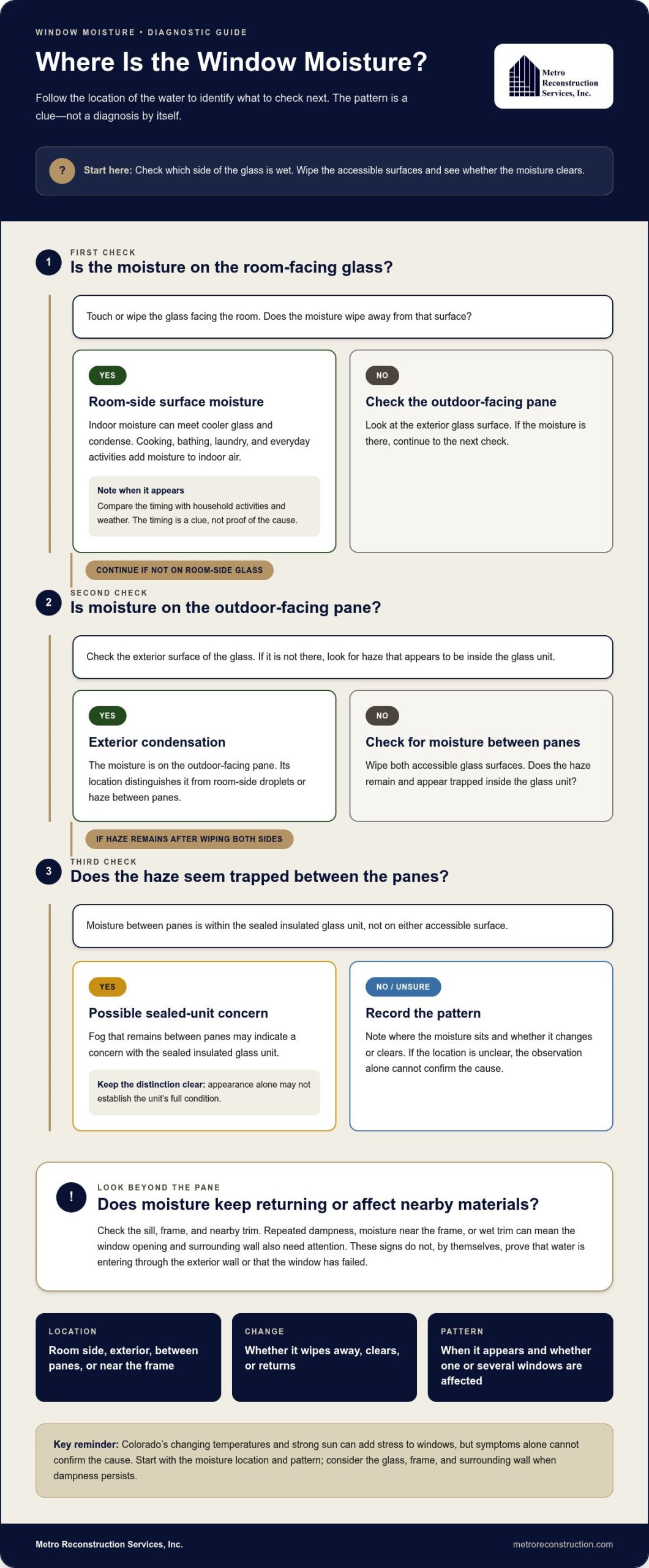
Start by checking which surface is wet. Moisture you can wipe from the room-facing glass differs from water on the exterior or haze that appears to sit inside the glass unit. This first observation helps narrow the next question, but cannot confirm a cause on its own. Check beyond the pane, too. Damp trim, staining, peeling finish, or moisture that returns in the same area deserves closer attention.
The location of the moisture guides the next diagnostic question, while the window opening and nearby finishes provide important context.
Condensation on the room-facing or exterior glass
Room-side droplets are commonly associated with indoor moisture meeting a cool glass surface. Exterior moisture forms on the outdoor-facing glass, so it is distinct from condensation you can touch from inside. Neither location alone proves that a window is performing well or poorly. Note which side is wet, whether the droplets wipe away, and when they appear.
| Where moisture appears | What you can observe | What to consider |
|---|---|---|
| Room-side glass | Droplets or a film wipe away from the glass inside the room. | Indoor moisture and a cool glass surface may be contributing. Check whether water gathers along the sill or dampens the trim. |
| Exterior glass | Dew or droplets are visible on the outdoor-facing surface. | This is outside moisture, not water on the room side. Record when it appears and whether nearby exterior materials are also wet. |
| Between panes | Fog or haze appears to remain within the glass assembly after you wipe both accessible surfaces. | The insulated glass unit may have a seal-related concern. Persistent cloudiness warrants assessment, but appearance alone cannot establish the exact condition. |
If droplets are limited to the room-side glass, compare their pattern with the rest of the opening. Moisture concentrated at the lower edge may run onto the sill. Repeated wetting can affect paint, wood, or other nearby finishes. Staining or dampness extending onto the wall shifts the question from “Why is this glass wet?” to “Is moisture affecting the surrounding assembly?”
Fog or droplets trapped between window panes
Between-pane moisture is within the sealed insulated glass unit, not on a surface you can reach with a cloth. A seal concern is one possible explanation, but cloudy glass alone cannot establish the cause or condition. Persistent haze that remains after you wipe both sides differs from temporary room-side condensation, which clears from the surface when wiped.
Inspect the frame, sill, and visible edges of the wall for recurring dampness or marks. Note whether moisture returns after drying and whether the same location is affected each time. These details help distinguish an isolated glass symptom from a broader pattern involving the window-to-wall connection, flashing, or weather-resistant barrier. If the signs persist, contact Metro Reconstruction about window and exterior-envelope concerns, or call 303.543.9549.
What to Do When You See Condensation Inside a Window
Use a simple sequence to separate observations from assumptions. First identify where the moisture appears and whether it returns. Then check whether nearby materials are affected before deciding what to do.
- Locate the moisture. Identify whether it is on the room-facing glass, outdoors, or apparently within the glass unit. Wipe the accessible surfaces and note whether the moisture clears.
- Document the pattern. Record which window is affected, where the moisture collects, and when you notice it. Note household activities or weather conditions so you can compare what is happening over time.
- Manage indoor moisture where practical. Run kitchen and bathroom exhaust fans during cooking and bathing. These steps can help manage indoor moisture, but they will not address a concern within the sealed glass unit or correct water entering through the exterior.
- Observe what changes. Wipe visible surface moisture from the glass and sill, then note when and where it returns. Air circulation may help distribute indoor air more evenly, though it will not resolve every cause.
- Assess recurring symptoms. If moisture keeps returning, appears trapped between panes, or affects nearby finishes, consider a closer assessment of the window and surrounding exterior.
Simple steps to manage room-side moisture
Use exhaust fans during moisture-producing activities and keep air moving through the room. After wiping the glass and sill, check the same areas again and note any change in the pattern. These steps can help you understand whether indoor conditions may be contributing. Even if the moisture improves, that does not establish that the full window assembly is sound.
When recurring condensation calls for a closer assessment
Persistent fog within the glass unit, returning moisture, or damp and marked finishes are reasons to look beyond routine moisture management. An assessment should consider the window, frame, opening, and surrounding weather-resistant barrier as connected parts of the exterior envelope. The appropriate response depends on the observed conditions.
If the signs persist or nearby finishes are affected, contact Metro Reconstruction to discuss the window and surrounding exterior, or call 303.543.9549.
How Metro Reconstruction Assesses Window Condensation in Colorado Homes
Condensation is a clue, not a complete diagnosis. Metro Reconstruction considers the window as part of your home’s exterior envelope, where the glass, frame, surrounding wall, and moisture-control details interact. Visible water may relate to indoor conditions, the insulated glass unit, or moisture around the opening. The location and pattern help guide the assessment, but condensation alone does not prove that a window has failed or that water is entering through the wall.
Colorado homes experience seasonal temperature changes across the Front Range and mountain communities. When moisture recurs, it is useful to look beyond the glass. Identifying the affected surfaces and nearby finishes helps determine whether the concern centers on the window or also involves the surrounding assembly. Metro Reconstruction serves property owners in Parker, Morrison, Boulder, Longmont, Niwot, Evergreen, Cherry Creek, Cherry Hills Village, Golden, Genesee, Littleton, Broomfield, Denver, Silverthorn, Breckenridge, Vail, and Larkspur.
Why the window opening and exterior wall belong in the assessment
A window depends on more than its glass. The frame, the connection between the window and wall, exterior finishes, and moisture-control layers all play a role in the building envelope. If you notice damp trim, staining, or moisture that returns in the same area, consider those clues alongside the pane. They do not establish a specific defect by themselves, but they can help focus further evaluation.
Metro Reconstruction’s Moisture Mitigation & Waterproofing work includes caulking, exterior wall upgrades, and weather-resistant barriers. These elements matter when assessing moisture management around an opening, but visible condensation alone does not determine the repair scope. Related exterior remodeling and construction services can address building-envelope components when the conditions call for that work.
Discussing window replacement or moisture mitigation
The appropriate project depends on the assessment. If the window itself is the source of the concern, Window & Door Installation & Replacement may be relevant, with energy-efficient windows among the available options. If the evidence points to moisture-control details around the opening, the work may instead involve related exterior measures. Replacing a window is not automatically the right response to surface condensation. Let the findings guide the project scope.
Metro Reconstruction is a family-owned Colorado construction firm with over 40 years of experience and four generations of family ownership. The team takes a whole-envelope perspective, while the conditions at your home determine the next steps. Identify the relevant building components before selecting a repair or replacement approach.
If recurring moisture, trapped fog, or damp finishes have you concerned, contact Metro Reconstruction to discuss your window concern, or call 303.543.9549.
Choose a Clear Next Step for Your Window
Use what you have observed to make a considered decision about your home, rather than treating one window symptom in isolation. A window is part of a larger exterior system, and durable work depends on understanding how its components relate. Keeping that perspective can help you choose an appropriate next step for your property.
Metro Reconstruction can discuss your concern in the context of the window and surrounding building envelope. Contact Metro Reconstruction to discuss your home’s exterior, or call 303.543.9549.
Frequently Asked Questions
Is condensation inside a window always a sign that the window has failed?
No. Condensation inside the window may form on the room-facing glass because of indoor moisture and a cool surface. That does not by itself mean the window has failed. Moisture that appears trapped within the glass unit raises a different concern and may warrant a closer look. Check where the water sits and whether it clears when wiped. If the frame or nearby wall also becomes damp, record that pattern for assessment.
Can condensation between window panes be wiped away?
No, not from the accessible glass surfaces. If you wipe the inside and outside faces but haze remains, the moisture may be within the sealed glass unit. Do not try to open the unit or insert anything between panes. Instead, note whether the cloudiness persists in different conditions and whether it affects visibility. A persistent between-pane pattern can be assessed alongside the window’s frame and condition.
Why did condensation appear after I installed new windows?
New windows do not rule out room-side condensation. Indoor moisture from cooking, bathing, laundry, or occupants can still collect on glass that is cool relative to the room air. Check whether droplets are on the room-facing surface, outside, or apparently between panes, and note when they appear. If moisture is near the frame or trim, include those areas in your observations because the window opening and its connection to the wall may also matter.
Can condensation inside a window damage the surrounding trim?
Repeated surface moisture can keep a sill or nearby trim damp, which may affect finishes over time. Wipe away visible water and look for changes such as staining, peeling paint, or swelling. Those signs do not prove where the moisture originated, but they show that the area deserves attention. If trim remains damp after the glass is dry, document the location and recurrence so the window and adjacent wall can be considered together.
Should I replace a window if I see condensation inside it?
Not based on condensation alone. First identify whether the moisture is on a wipeable surface or appears trapped within the glass unit, then note any recurring dampness at the frame or wall. Replacement may be appropriate when findings point to a window problem, but surface condensation can have other causes. A careful assessment helps determine whether the window, surrounding moisture-control details, or both should guide the next project decision.
Can an exhaust fan help reduce condensation on windows?
Yes. Using a kitchen or bathroom exhaust fan during moisture-producing activities can help remove some indoor moisture. Run the fan while cooking or bathing, then observe whether the frequency or location of room-side droplets changes. Air circulation may also help distribute indoor air around the room. These steps can support moisture management, but they will not correct moisture trapped between panes or water entering through the exterior assembly.
Is condensation on the outside of a window the same as condensation inside?
No. Exterior condensation forms on the outdoor-facing glass, while interior condensation is on the room-facing surface. Record the two separately. If you can safely identify which side is wet, note the time and conditions, then check whether nearby exterior materials or interior finishes are also damp. Exterior droplets alone do not establish whether a window is performing well or poorly, so consider the wider pattern.