
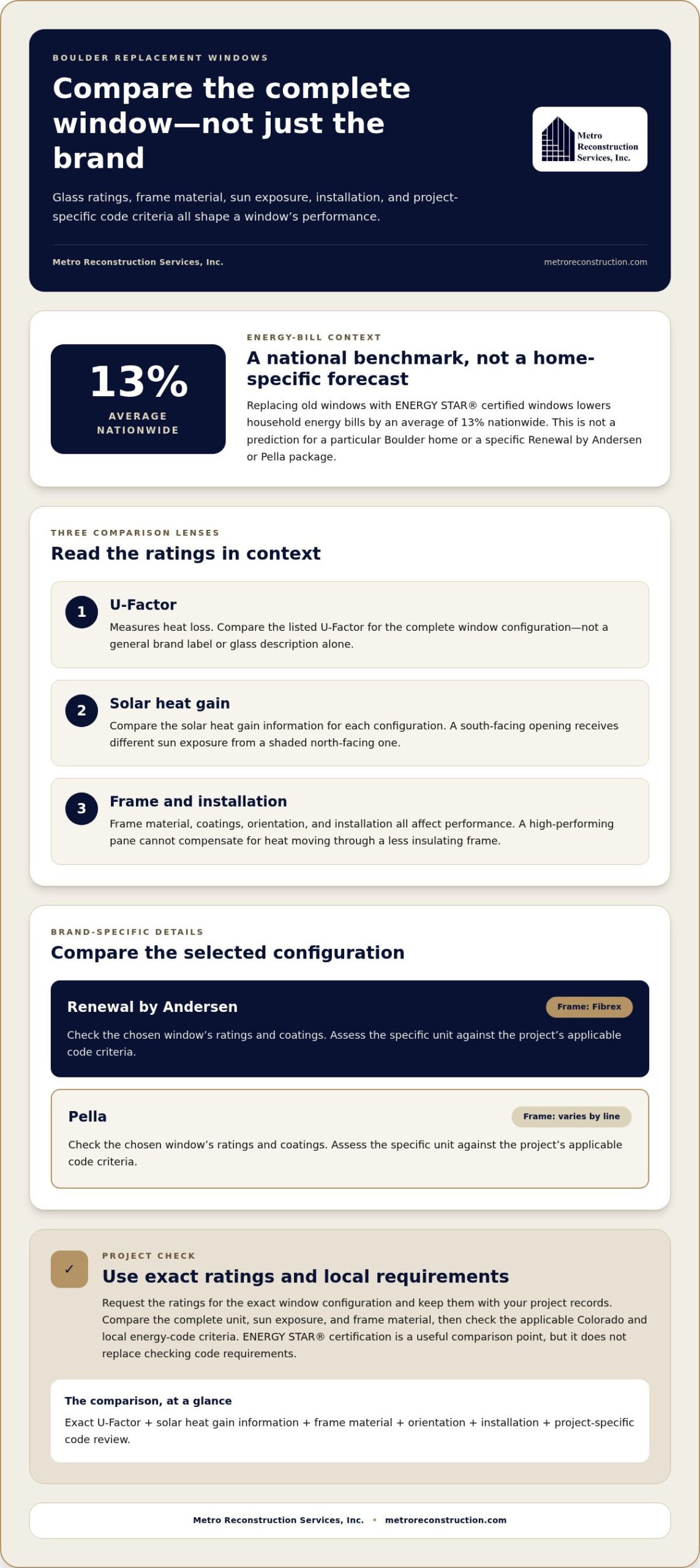
The brand name alone won’t tell you which replacement window is the better fit. In a Renewal by Andersen vs. Pella windows comparison in Boulder, the stronger choice depends on the glass options, warranty terms, and characteristics of your home. Replacing old windows with ENERGY STAR® certified windows lowers household energy bills by an average of 13% nationwide.
When comparing Renewal by Andersen vs Pella windows in Boulder, look beyond appearance. Glass performance can affect comfort and energy use, while warranty terms shape the protection you receive over time. Boulder’s climate makes these details worth weighing, especially when comparing specific window configurations rather than brand names alone.
This guide explains how to compare the two brands’ window options, energy-efficient glass, warranty coverage, and installation scopes. Use the steps to identify which features matter most for your home and compare the complete window system, including the work and written terms that come with it.
Key Takeaways
- Compare glass options by their insulation performance and how well they suit your home’s comfort priorities.
- Look at the full installed quote, including the window configuration and installation scope, rather than judging a brand by the product alone.
- Read warranty terms for glass, components, installation, exclusions, and transferability before choosing.
- Use your preferred appearance, performance needs, and warranty expectations to decide which brand is the better fit for your Boulder home.
Energy efficiency and glass options
For Boulder’s cold, sunny weather, a brand name alone won’t identify the best window. Compare the U-Factor, solar heat gain, and frame material for each specific configuration, including Renewal by Andersen’s Fibrex option and the Pella line you’re considering.
Compare the complete window, not just the glass. Coatings, frame material, window orientation, and installation all affect performance.
Energy-Efficient Glass and Frame Features
Glass coatings can limit unwanted heat transfer while admitting daylight, but the right balance depends on each window’s exposure. A south-facing opening gets different sun than a shaded north-facing one. Compare the listed U-Factor, which measures heat loss, and solar heat gain information for each configuration instead of relying on a general efficiency label.
Frame materials also differ. Renewal by Andersen uses Fibrex, while Pella’s frame material depends on the selected line. Compare frame and glass ratings together: a high-performing pane cannot compensate for heat moving through a less insulating frame.
Energy-Efficiency Glass Packages
Glass packages combine pane construction and coatings, so compare the specific options in each written proposal. Look for the U-Factor and solar heat gain coefficient for the complete window, not just a glass description. These figures help distinguish packages designed to reduce heat loss from those that allow more solar warmth inside.
ENERGY STAR® certified windows lower household energy bills by an average of 13% nationwide. That figure is a national average, not a prediction for a particular Boulder home or a specific Renewal by Andersen or Pella package.
Energy Efficiency and HVAC Use
A window with lower heat loss can reduce the effort needed to maintain indoor temperatures in cold weather. In sunny rooms, glass that admits more solar heat can affect cooling demand. Consider the home’s orientation and room use before choosing coatings: a package suited to a shaded bedroom may not suit a sunlit living room.
HVAC performance also depends on the surrounding wall and installation. Air leakage around an opening can undermine efficient glass, while a poorly insulated frame can contribute to thermal bridging. Evaluate each window as part of the building envelope.
Energy Ratings and Colorado Code Requirements
For Boulder replacement windows, compare the U-Factor and solar heat gain rating of each complete unit, then consider how the project is evaluated under applicable Colorado and local energy-code requirements. No single brand-wide rating establishes code compliance. The selected product and project conditions matter.
Request the ratings for the exact window configuration and keep them with your project records. ENERGY STAR® certification is a useful comparison point, but it does not replace checking the applicable code criteria.
| Option | Frame | Glass comparison | Code review |
|---|---|---|---|
| Renewal by Andersen | Fibrex | Compare selected configuration’s ratings and coatings | Assess the specific unit |
| Pella | Depends on selected line | Compare selected configuration’s ratings and coatings | Assess the specific unit |
Compare exact window ratings, sun exposure, frame material, and project-specific code criteria side by side.
Installed window prices and cost differences
Compare Renewal by Andersen and Pella by reviewing the work described in each proposal, not just the window selection. The written scope should identify the included openings, planned preparation, and how finished areas will be handled.
In Boulder, account for any permit process, historic-district review, or HOA requirements that apply to your property. These can affect the approved window appearance or project sequence, so raise them before finalizing product selections.
Review the financing and promotion terms included with each proposal. Compare eligibility, timing, exclusions, and whether an offer applies to the full project or only specified products. Proposal formats can differ, so check that the listed tasks are clear enough for a direct comparison.
Replacement duration depends on the number and condition of openings, access to work areas, and the amount of finish work involved. A straightforward opening and one with concealed framing damage require different preparation. Ask how the project sequence accounts for those conditions.
Installation and Structural Preparation
Before installation, review how the crew will access each room and protect nearby furnishings. A bedroom with limited access, for example, may need a different work sequence from a ground-floor living room. Confirm how the plan addresses removing existing units and securing each opening during the work.
Existing framing can affect how a replacement fits. An uneven or damaged opening may need extra preparation before the new unit is set. The written scope should explain how changes discovered during removal will be documented and approved.
Full-Service Replacement Installation
Full-service descriptions can include different tasks. Compare whether each proposal covers measuring, removal, disposal, installation, sealing, and interior or exterior finish work. A clear task list shows whether Renewal by Andersen and Pella are proposing the same scope.
Ask how installation will be sequenced across occupied rooms. Grouping work by floor may reduce repeated movement through living spaces, while handling openings individually may suit homes with varied access. The project plan should explain how work areas and daily cleanup will be managed.
Installation records can support future home documentation. Keep product details, approved scope changes, and completion records together. If you sell the property, organized records help explain which windows were installed and what work was completed.
Use a comparison sheet to track each opening, planned preparation, finish work, project sequence, and written terms. This keeps attention on the complete installation and helps you identify differences that matter for your Boulder home.
Choosing a brand based on budget and preferences
For a Renewal by Andersen vs. Pella windows comparison in Boulder, weigh the exact configuration, installation scope, and warranty against your priorities. Neither brand is automatically the better fit for every home.
When reviewing local installer feedback, look for Boulder projects similar to yours. Comments about communication, site preparation, installation, or follow-up are more useful than broad ratings without project context.
Renewal by Andersen
Renewal by Andersen is one option for homeowners comparing windows and installation together. Evaluate its proposal alongside Pella’s using matching opening sizes, glass performance, frame details, and work scope. This side-by-side method reveals practical differences without relying on brand recognition or general satisfaction claims.
Durability also depends on the opening and installation. Fitting a window into uneven framing, for example, may require different preparation than installing it in a sound, square opening.
Boulder-Area Customer Reviews
Reviews can help you assess local installers, but project details matter. Look for Boulder examples describing comparable window replacement, the condition of the openings, and whether the completed work matched the agreed scope.
Separate product feedback from installation feedback. Comments about glass performance concern the window; reports about sealing, cleanup, or communication describe the installation experience.
A second Renewal by Andersen vs. Pella windows comparison for Boulder homeowners should start with proposals covering the same rooms. Record each selected configuration, glass rating, frame material, installation task, and warranty term. Comparing different scopes can make one proposal seem more attractive simply because it includes less work.
Then rank your priorities. A homeowner focused on appearance may weigh frame choices differently from someone prioritizing insulation or warranty conditions. Write down your priorities first, so you judge both brands against the same needs.
If proposals specify different glass packages, compare their documented performance before weighing finish choices. If an opening is damaged, note how each scope addresses preparation. Framing condition can affect the work regardless of manufacturer.
In Boulder, consider the home’s construction and the requirements for the specific project. A contractor familiar with the property can explain how its openings and exterior materials affect the proposed work. Focus on the written scope and the home’s conditions rather than applying guidance intended for another region.
Use a comparison sheet with four categories: product configuration, installation scope, warranty coverage, and appearance. Note how each proposal meets your priorities, then choose the option whose documented features and work plan best suit your home.
Glass, component, and installation warranties
Compare warranty documents for coverage, exclusions, claim steps, and responsibility for repairs. For Renewal by Andersen and Pella, review the written terms for the exact window configuration and installation scope. Don’t assume every product or project has identical protection.
Separate three areas: insulated glass, window components, and installation labor. A glass warranty may address a different issue from coverage for a frame, hardware, or installation defect. The document’s definitions determine which category applies when a problem arises.
For glass, identify the covered condition and required evidence. A visible seal failure, for example, may be treated differently from impact damage. Record the installed unit and retain its warranty paperwork so you can match a claim to the applicable terms.
Read component coverage just as closely. A frame, sash, lock, and operating hardware are distinct parts, so check whether the warranty treats them separately. Composite and traditional frame materials can have different product specifications, but material alone does not establish coverage or its duration.
Installation protection is separate from manufacturer coverage. The installer’s written terms explain how workmanship concerns are handled, while the manufacturer’s warranty addresses covered product defects. A leak at the perimeter could involve the unit, installation, or surrounding wall assembly, and each cause may fall under different terms.
Review Andersen and Pella proposals with a simple document comparison. Match each warranty to the selected product and installation, then note covered parts, exclusions, the claim process, and transfer rules. An energy rating describes product performance, for example, not a promise that every installation issue is covered.
Use these questions as a practical review:
- Does the glass section define seal failure, breakage, or other covered conditions?
- Are frames, hardware, and operating parts addressed separately?
- Does installation coverage identify workmanship issues and responsibility?
- What documentation and claim steps does each warranty require?
- Do exclusions address maintenance, alterations, or damage from outside causes?
Compare the answers for the same window configuration. If Renewal by Andersen’s terms describe a component differently from Pella’s, record that distinction instead of relying on broad phrases such as “limited warranty.” The specific definitions and exclusions are more useful than the label.
After the work, keep the signed proposal, product identifiers, installation records, and warranty documents together. These records connect the windows installed in your Boulder home to the applicable written terms, helping you understand coverage before a concern arises.
For Boulder homes with non-standard openings or settled framing, Metro Reconstruction Services, Inc. recommends using experienced installers familiar with local construction challenges. Ask that the written installation scope identify the work being performed and the party responsible for addressing workmanship concerns, so the terms can be reviewed alongside the product warranty before the project proceeds.
Warranty coverage and transferability
If you may sell your home, check whether the next owner can use any remaining warranty protection. Read the transfer language for the specific Renewal by Andersen or Pella product. Don’t infer transfer rights from phrases such as “limited lifetime warranty”; those words alone don’t establish who qualifies after ownership changes.
Transfer terms can affect how you describe the windows during a sale. A buyer may want to know whether coverage continues, changes, or ends when the property changes hands. Treat that detail as product information, not an assumed benefit of the brand.
Check whether the document addresses each product type in your home. A patio door may have separate terms from a window, even if both were included in one project. Fiberglass or composite construction also doesn’t determine transferability. The written terms do.
Compare timing requirements in both brands’ documents. Note whether a transfer must occur within a stated period, whether notice is required, and whether the next owner receives the same level of protection. These details matter if a sale is planned soon after installation or ownership changes through an estate.
A practical comparison can focus on the next owner’s position:
- Identify which installed products qualify for transfer.
- Note any deadline tied to the ownership change.
- Determine what steps the new owner must complete.
- Compare whether transferred protection differs from the original owner’s terms.
- Check whether a patio door is addressed separately from windows.
If you’re preparing a Boulder home for sale, for example, don’t describe a warranty as transferable until its terms explain how the transfer works. Apply the same approach to both brands, then describe the protection accurately in the home’s records and sale materials.
A flexible warranty may be less useful if its transfer conditions don’t fit your plans. If you expect to stay in the home, focus on the stated term for the original owner. If you may sell, weigh the next owner’s eligibility more heavily. Compare the exact language rather than relying on a broad label.
Before choosing, mark the transfer clause for each proposed product and compare what it means for a future owner. This gives you a clearer basis for deciding how each warranty fits your ownership plans, without assuming similar wording means identical protection.
Metro Reconstruction Services, Inc.: Stucco Restoration
Metro Reconstruction Services, Inc. can help when window work exposes damaged stucco around an opening. Windows, flashing, and exterior finishes work together to manage water, so repairing only the visible surface may leave the underlying moisture path unresolved.
Stucco Restoration addresses deteriorated exterior finishes, while stucco installation or replacement may suit broader finish work around a window opening. Masonry Work is relevant when adjacent masonry also needs attention. The right scope depends on the surrounding exterior’s condition, not the window brand.
If replacement windows leave cracked, loose, or moisture-damaged stucco, consider the opening and surrounding finish as parts of the same building envelope. Contact Metro Reconstruction Services, Inc. to discuss stucco restoration for your Boulder home.
Make Your Window Decision With the Whole Home in Mind
Your Renewal by Andersen vs. Pella window decision in Boulder is one part of a larger investment in your home. Before proceeding, consider how the windows will fit existing openings and connect with surrounding exterior materials. A sound decision accounts for the complete assembly, not just the product name.
If you’re planning related exterior work, Metro Reconstruction Services, Inc. can discuss how stucco and masonry conditions fit into the project. Considering the interfaces around a window helps you plan a coordinated scope rather than treating each visible component in isolation.
For a conversation about your home’s exterior needs, contact Metro Reconstruction Services, Inc. or call 303.543.9549. A clear next step can help you move forward with greater confidence and a plan grounded in your property’s actual conditions.
Frequently Asked Questions
What problems or risks should Boulder homeowners check for in window contracts and installation quotes?
Before signing, check that the contract identifies each opening and exact window configuration, rather than describing the work only as “replacement windows.” For a Boulder home, clarify how concealed rot or out-of-square framing will be handled if discovered after removal, and how scope changes will be documented and approved. Review payment milestones, site protection, debris removal, and responsibility for damage to adjacent finishes. Keep the signed contract and approved changes together.
Which Renewal by Andersen and Pella window lines are best for cold, sunny Boulder weather?
No brand line is automatically best. Compare each exact configuration’s U-Factor, solar heat gain, frame material, and suitability for the window’s sun exposure.
What financing, promotions, and quote options are available from Renewal by Andersen and Pella in Boulder?
Review financing and promotion terms in each proposal, including eligibility, timing, exclusions, and whether an offer covers the full project or only specified products. Compare written quotes by matching openings, preparation, installation, and finish work.
How long does window replacement take, and what is the installation process for each company?
Timing depends on the number and condition of openings, access, and finish work. Compare each company’s written plan for measuring, removal, disposal, installation, sealing, finish work, sequencing, and cleanup.
How do Andersen Fibrex and Pella window frame materials compare for Colorado’s climate?
Renewal by Andersen uses Fibrex, while Pella’s frame material depends on the selected line. Compare the exact frame and complete-window ratings, including U-Factor and solar heat gain, alongside window orientation and installation.