
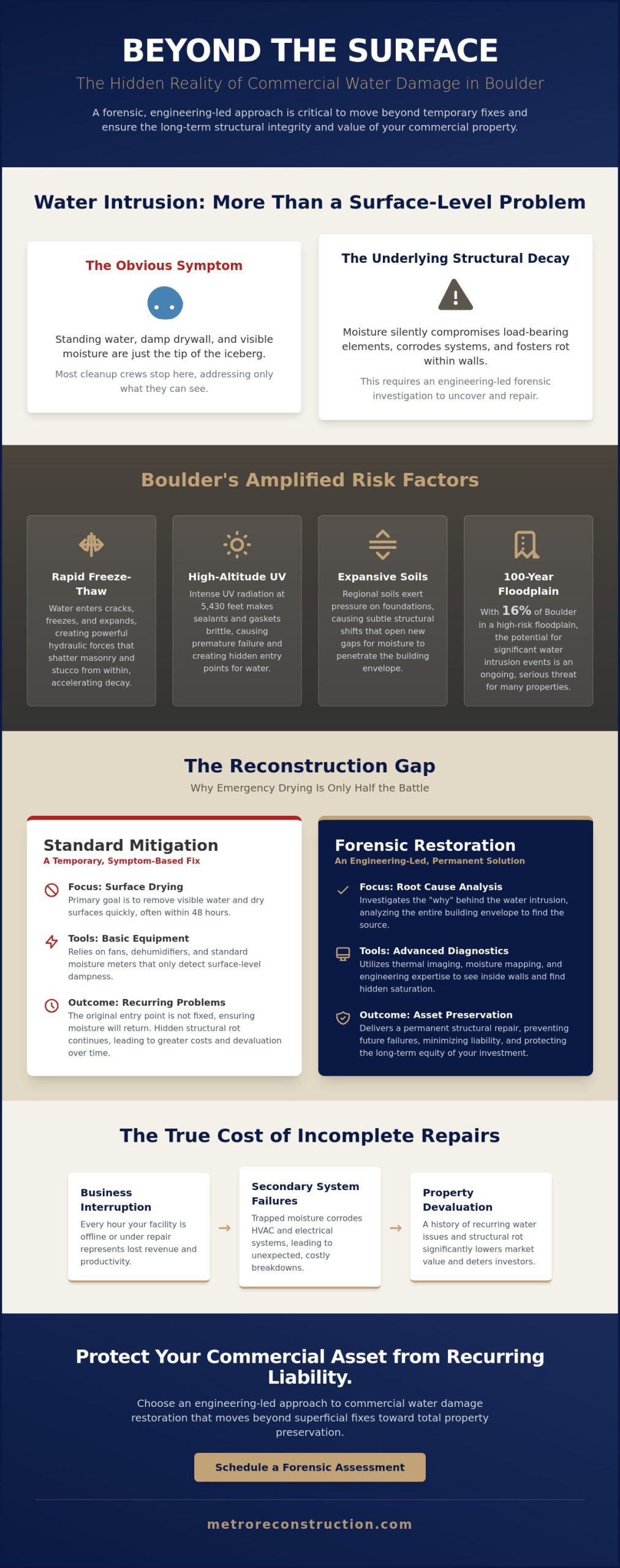
Most commercial property owners view water intrusion as a surface-level cleanup task, yet the reality is that moisture often acts as a silent catalyst for deep-seated structural decay. When 16% of Boulder sits within a high-risk 100-year floodplain, a simple extraction and fan setup isn’t enough to protect a significant investment. You understand that every hour your facility is offline represents mounting business interruption costs, especially since local standards recommend drying materials within 48 hours to mitigate liability. We believe that professional commercial water damage repair Boulder requires more than a quick response; it demands a forensic understanding of how moisture interacts with your building’s complete outer system.
Discover how a forensic, engineering-led approach to commercial water damage restoration ensures the long-term structural integrity of your Boulder property. This article explores how identifying the root cause of intrusion prevents recurring rot and how adhering to the 2024 International Building Code standards keeps your asset resilient. We will walk through the technical diagnostics of stucco restoration and masonry work that move beyond superficial fixes toward total property preservation.
Key Takeaways
- Understand how Boulder’s specific climate stressors, such as rapid temperature shifts and heavy snowmelt, accelerate the degradation of a building’s complete outer system.
- Learn why a forensic approach to commercial water damage repair Boulder is essential for identifying the hidden origins of moisture intrusion rather than just treating surface symptoms.
- Discover the critical distinction between emergency drying and the permanent structural restoration required to maintain the integrity of commercial masonry and stucco.
- Explore how specialized diagnostics can pinpoint failures in window-to-stucco transitions, preventing the long-term structural rot that often follows incomplete repairs.
- Gain insights into how engineering-led reconstruction protects your commercial asset from recurring liability and minimizes future maintenance costs.
The Structural Stakes of Commercial Water Damage in Boulder
Commercial water damage repair Boulder is often misunderstood as a simple race against the clock to remove standing water. While rapid extraction is necessary, it represents only the first step in a much larger, more complex structural preservation process. True restoration focuses on the long-term stability of the asset, ensuring that moisture hasn’t compromised the load-bearing elements or the intricate layers of the building envelope. When moisture penetrates a commercial facility, it initiates a cascade of chemical and physical changes that can lead to permanent degradation if the underlying structural origins aren’t addressed. Precision is not optional. Understanding the causes and effects of water damage is fundamental to recognizing that moisture is a dynamic threat, not a static problem. We view restoration as an engineering challenge rather than a janitorial task.
Environmental Stressors Unique to Boulder County
Boulder’s high-altitude environment places extreme demands on a building’s complete outer system. Intense UV exposure at 5,430 feet causes sealants and gaskets to become brittle and fail prematurely, creating hidden pathways for water to bypass even the most robust flashing systems. This is compounded by the region’s expansive soils, which exert significant pressure on foundations and can cause subtle structural shifting that opens new gaps for moisture intrusion. Perhaps most damaging are the rapid freeze-thaw cycles. When water enters small fissures in masonry or stucco during a sunny afternoon and freezes as temperatures plummet at night, the resulting expansion creates a powerful hydraulic force that shatters internal bonds. This cycle accelerates structural decay far faster than in more temperate climates.
The Financial Impact of Delayed Structural Repair
The true cost of water damage is rarely found in the initial cleanup bill. For commercial property owners, the greatest risk often lies in business interruption costs that accumulate when a building requires repeated, invasive repairs because the root cause was never fixed. Undiagnosed moisture trapped within wall cavities frequently leads to secondary failures in HVAC and electrical systems, as high humidity levels corrode sensitive components and degrade indoor air quality. Beyond the immediate physical damage, “surface-only” drying leaves behind moisture that eventually manifests as structural rot or masonry failure, significantly devaluing the property’s market price. Investors and potential buyers are increasingly wary of assets with a history of water issues, making a thorough forensic restoration a critical step in protecting the long-term equity of your real estate investment.
Forensic Diagnostics: Identifying the Root Cause of Intrusion
Effective commercial water damage repair Boulder begins where traditional mitigation ends. While standard restoration companies often rely solely on moisture meters to confirm dry drywall, a forensic approach requires an exhaustive analysis of the building’s complete outer system. We look beyond the surface to understand why the water entered in the first place. Moisture meters are useful tools, but they only record the presence of water; they don’t explain the mechanical failure of a window seal or the capillary action drawing moisture through a compromised masonry wall. A failure to identify the structural origin of a leak ensures that any drying effort is merely temporary. Without source repair, moisture will inevitably return, leading to the exact conditions described in EPA guidelines on mold prevention, which emphasize that moisture control is the only viable long-term solution.
Our diagnostic process utilizes advanced technology like high-resolution thermal imaging and detailed moisture mapping to visualize what the naked eye cannot see. These tools allow us to track the migration of water through dense structural components, revealing hidden pockets of saturation within wall assemblies. This precision prevents the common trap of recurring insurance claims. When a property owner understands the relationship between environmental stressors and building mechanics, they can move from reactive patches to proactive preservation. If you suspect your facility has hidden vulnerabilities, a professional structural assessment can provide the clarity needed to protect your investment.
Common Failure Points in Commercial Building Envelopes
In multi-story commercial units, window flashing and seal failures are primary culprits for deep-seated water damage. When these transitions fail, water bypasses the exterior finish and flows directly into the structural framing. Similarly, stucco and EIFS systems are prone to delamination when water becomes trapped behind the finish, often due to improper drainage planes or lack of weep screeds. Roof-to-wall transitions, particularly around parapet walls, represent another high-risk zone. Improperly waterproofed parapets allow water to seep downward, compromising the masonry and leading to internal rot that remains invisible until the damage is extensive.
The Forensic Reporting Process
Precision in documentation is a foundational brand promise at Metro Reconstruction Services, Inc. We provide property owners and insurance adjusters with a comprehensive cause-and-effect framework that justifies every necessary structural intervention. This forensic reporting doesn’t just list damages; it explains the underlying structural origins of the failure. By providing a clear, evidence-based narrative of the intrusion, we help facilitate smoother claims processes and ensure that the scope of work covers permanent reconstruction rather than just superficial drying. This level of detail is what separates a Wise Craftsman from a high-pressure restoration franchise.
The Reconstruction Gap: Why Drying Is Only Half the Battle
Many property owners mistakenly believe that once the industrial fans are removed and moisture readings return to acceptable levels, the crisis is over. In reality, the emergency mitigation phase is merely triage. The actual work of commercial water damage repair Boulder transitions from moisture extraction to structural stabilization only after the drying is complete. Drying stabilizes the environment to prevent mold growth, but it cannot reverse the physical degradation of building materials that have already undergone significant swelling, warping, or chemical breakdown. When water infiltrates a commercial asset, it often compromises the building’s complete outer system, requiring a specialized reconstruction approach that moves beyond simple cosmetic fixes.
It’s common to wonder if an in-house maintenance team can handle the resulting repairs. While these teams are invaluable for daily operations, they often lack the forensic diagnostic tools and engineering-led training required to identify latent structural failures. A “patch-and-paint” solution might hide the damage, but it won’t address a sill plate that has lost its load-bearing capacity or a window frame that has shifted due to moisture-induced expansion. Precision matters. If the reconstruction doesn’t restore the original architectural finishes with exactitude, the property’s market value can suffer significant devaluation. A visible patch is a red flag to future inspectors and investors.
Structural Mitigation vs. Surface Restoration
True structural restoration involves a meticulous assessment of load-bearing members such as studs, plates, and masonry units. If moisture has caused these elements to lose their structural integrity, they must be replaced rather than simply dried. This phase also includes the technical requirements for resetting window and door assemblies that may have shifted during the saturation period. Our goal is to ensure the building envelope is more resilient than it was before the intrusion, creating a robust barrier that prevents future ingress and meets the stringent requirements of the 2024 International Building Code.
Specialized Masonry and Stucco Recovery
Water acts as a persistent solvent, specifically attacking the bond between stucco and its underlying substrate. When saturation occurs, the metal lath can begin to corrode and the scratch coat may lose its adhesion, leading to dangerous delamination. Our forensic approach to stucco restoration involves testing the integrity of these bonds to determine if a full replacement is necessary. In masonry systems, we must also manage efflorescence—those white, salty deposits that signal deep-seated moisture—and repair structural cracking that occurs when rapid freeze-thaw cycles expand trapped water within the brick or stone. Addressing these issues correctly prevents the long-term maintenance costs associated with recurring masonry failure.
Case Study: Structural Moisture Mitigation in a Boulder Commercial Facility
A recent project in Boulder County involved a multi-story office complex where tenants reported persistent dampness and localized staining in lower-level suites. While initial assessments by standard restoration companies suggested simple window leaks, our forensic analysis revealed a systemic failure of the building’s complete outer system. The primary culprit was a compromised window-to-stucco transition that allowed moisture to bypass the drainage plane and migrate into the structural framing. This wasn’t just a surface issue; it was a mechanical failure of the integration between disparate building components. Effective commercial water damage repair Boulder must address these intersections with engineering-led precision to prevent recurring decay.
The final result of this intervention was a fully restored asset with a documented history of forensic repair that protected the owner’s investment and maintained the property’s market valuation. By choosing a path of substance over superficial patches, the property owner avoided the cycle of recurring claims and long-term maintenance costs. If your facility is facing complex moisture challenges that require more than a simple cleanup, you can schedule a forensic consultation to ensure your restoration is handled with the precision it deserves.
Phase 1: Emergency Stabilization and Forensic Mapping
We prioritized tenant continuity by coordinating our diagnostic phase to minimize operational disruption. By visualizing the moisture plume through high-resolution thermal imaging, we identified that water wasn’t just pooling at the base of the windows but was migrating horizontally through the wall assembly, affecting several structural bays. Immediate moisture control was established using localized dehumidification to stabilize the environment and prevent the proliferation of mold. This accurate initial mapping ensured that the subsequent scope of work was based on data rather than guesswork, a foundational promise of our diagnostic process.
Phase 2: The Structural Reconstruction Process
The reconstruction phase required a multi-layered approach to structural preservation. Because the intrusion had reached the lower levels, we performed comprehensive waterproofing basement walls to mitigate foundation-level seepage exacerbated by Boulder’s expansive soils. Our team then executed a precision window replacement, integrating new, high-performance flashing systems that created a seamless bond with the restored stucco finish. We utilized specialized sealants and coatings specifically formulated to withstand high-altitude UV exposure and the rapid freeze-thaw cycles typical of the Front Range. This holistic approach ensured the building envelope was more resilient than its original state.
Partnering for Long-Term Property Preservation
Commercial water damage repair Boulder requires a partner who understands the hidden mechanics of a structure rather than one who merely reacts to surface-level symptoms. Metro Reconstruction Services, Inc. brings 40 years of regional expertise to every project, a history that provides the deep technical knowledge necessary to navigate Boulder’s specific building codes and environmental stressors. This longevity is more than just a metric of time; it’s a testament to our commitment to accuracy and the peace of mind that comes from long-term structural solutions. We operate as the Wise Craftsman, a role that values substance over style and meticulous detail over high-pressure marketing tactics. Precision is our standard. This approach ensures that we don’t just fix the damage; we preserve the property’s complete outer system for the decades to come.
Transitioning from a reactive repair mindset to a proactive maintenance strategy is the most effective way to safeguard a commercial asset. Engaging in regular exterior home repair and envelope inspections allows property owners to identify brittle sealants or minor masonry cracks before they facilitate major moisture intrusion. By addressing these vulnerabilities early, you significantly reduce the risk of the costly business interruptions and structural rot discussed in previous sections. We view our clients not just as customers, but as long-term partners in property preservation. Integrity is built into every diagnostic report we produce.
The Value of Fixed-Price Reconstruction
A common pain point in the restoration industry is the uncertainty of final project costs, often referred to as budget creep. Metro Reconstruction Services, Inc. addresses this concern directly by utilizing a fixed-price reconstruction model. This process begins with an exhaustive forensic diagnostic phase, allowing us to develop a comprehensive, upfront scope of work that accounts for all necessary structural interventions. By providing transparency in material selection and engineering requirements from the start, we align our goals with your financial objectives. You receive a definitive path to restoration without the fear of unexpected invoices or mid-project price hikes.
Next Steps for Boulder Property Managers
The path to restoring your facility’s structural integrity begins with a professional forensic walk-through. During this initial assessment, we evaluate the interaction between your building’s environmental stressors and its specialized building systems. This consultative process is designed to educate property managers on the difficult truths of their building’s condition rather than offering a temporary patch. Our personalized project management ensures that every step of the reconstruction is executed with precision and clear communication. To initiate this process and secure your building’s future, you can Request a Forensic Assessment from Metro Reconstruction Services, Inc.
Protecting Your Asset’s Future Through Structural Integrity
Restoring a commercial property after significant water intrusion requires a shift from immediate crisis management to long-term structural preservation. We’ve explored how identifying the underlying mechanics of failure within the building’s complete outer system prevents the recurring rot and liability that surface-level fixes often ignore. By prioritizing forensic diagnostics and precision reconstruction, you ensure that your facility remains a resilient and valuable asset capable of withstanding Boulder’s unique environmental stressors. This engineering-led approach moves beyond temporary patches to offer permanent solutions that maintain your property’s market valuation and operational safety.
Professional commercial water damage repair Boulder is a matter of technical accuracy and protective care. Metro Reconstruction Services, Inc. has been family-owned and operated since 1982, bringing over 40 years of local expertise to every complex structural challenge. We specialize in forensic structural diagnostics to provide the substance and reliability your commercial investment deserves. Secure your commercial investment with a forensic structural assessment today. Our team is ready to partner with you in the meticulous preservation of your building’s integrity.
Frequently Asked Questions
How long does the commercial water damage restoration process typically take?
The timeline for restoration depends on the depth of moisture penetration and the complexity of the structural repairs required. Initial stabilization and drying should begin within 48 hours to comply with local health recommendations and prevent mold growth. Once the environment is stable, the forensic diagnostic and reconstruction phases can take several weeks, depending on whether specialized stucco restoration or window replacement is necessary.
Does commercial water damage repair always require structural reconstruction?
Not every incident requires full reconstruction, but every event demands a forensic assessment to verify structural integrity. If moisture has reached the sill plates, wall studs, or compromised the bond of your masonry work, reconstruction is essential to prevent long-term decay. We evaluate the complete outer system to ensure that temporary drying hasn’t left behind hidden damage that could lead to future failure.
Can you help with insurance claims for commercial water damage in Boulder?
We provide the detailed forensic documentation that insurance adjusters require to process complex commercial claims. By creating a clear cause-and-effect framework, we help demonstrate the necessity of permanent structural repairs over superficial fixes. This professional reporting ensures that the full scope of your commercial water damage repair Boulder is accurately represented to your provider.
What is the difference between drying and forensic moisture mitigation?
Drying is an emergency mitigation step focused on extracting standing water and reducing humidity levels within the building. Forensic moisture mitigation goes further by identifying the mechanical or structural failure, such as a failed window flashing, that allowed the water to enter. Without identifying and repairing the root cause, moisture will inevitably return regardless of how well the space was dried.
How do you prevent mold from returning after a commercial water leak?
Preventing recurring mold requires total moisture control through the repair of the building envelope’s original failure point. We follow industry standards to ensure all materials are dried thoroughly and that the source of the leak is permanently sealed through precision masonry or stucco work. Eliminating the path of ingress is the only way to ensure mold doesn’t find a new foothold in your facility.
Are your reconstruction services fixed-price for commercial clients?
We offer fixed-price reconstruction models once a comprehensive forensic scope of work has been established. This approach provides property managers with budget certainty and eliminates the “budget creep” often associated with open-ended restoration contracts. Our transparency in material selection and engineering requirements ensures that our goals remain aligned with your long-term investment.
Do you handle window and stucco repair as part of the restoration?
Yes, window replacement and stucco restoration are core components of our structural preservation services. Because these elements often represent the primary failure points in a building’s outer system, we handle their installation and integration with precision. We ensure that new windows and restored stucco finishes work together to create a resilient, waterproof barrier against Boulder’s climate.
What should I do immediately after discovering a leak in my commercial building?
You should immediately identify and stop the water source if possible while notifying any affected tenants. It’s critical to begin professional drying within 48 hours to minimize the risk of mold and structural rot. Once the immediate crisis is stabilized, you should schedule a forensic assessment to determine the underlying structural cause and develop a plan for permanent reconstruction.