
Most homeowners believe that waterproofing basement walls is simply about applying a sealant to the interior masonry; however, true structural protection requires managing how moisture interacts with your entire exterior envelope. You’ve likely spent money on “quick fix” paints only to see that familiar white efflorescence return, or perhaps you’re watching Colorado’s expansive soils with growing concern for your foundation’s stability. It’s frustrating to invest in repairs that don’t last, but understanding the physics of groundwater is the first step toward a permanent solution.
This forensic guide will show you how to identify the root causes of leaks and implement high-performance solutions that protect your home’s structural integrity. You’ll gain the confidence to choose between interior and exterior mitigation strategies while learning how these investments secure your foundation. We’ll examine the impact of the 2022 ASTM D8425 standards and explain how professional moisture management can lead to a 30% reduction in your annual energy costs by eliminating the need for constant dehumidification.
Key Takeaways
- Learn how hydrostatic pressure exploits the path of least resistance in foundation walls and why identifying the root cause is essential for stopping recurring dampness.
- Evaluate the strategic differences between interior and exterior waterproofing basement walls to determine which high-performance method best suits your home’s foundation.
- Understand the technical requirements for durable interior mitigation, including mechanical etching for surface preparation and polyurethane injections for structural crack sealing.
- Discover why managing the entire exterior envelope through proper 5% grading and surface drainage is responsible for resolving 90% of moisture intrusion issues.
- See how coordinating specialized masonry work with forensic reconstruction ensures your home remains built right the first time against Colorado’s expansive soils.
Diagnosing Moisture Intrusion: Why Basement Walls Leak
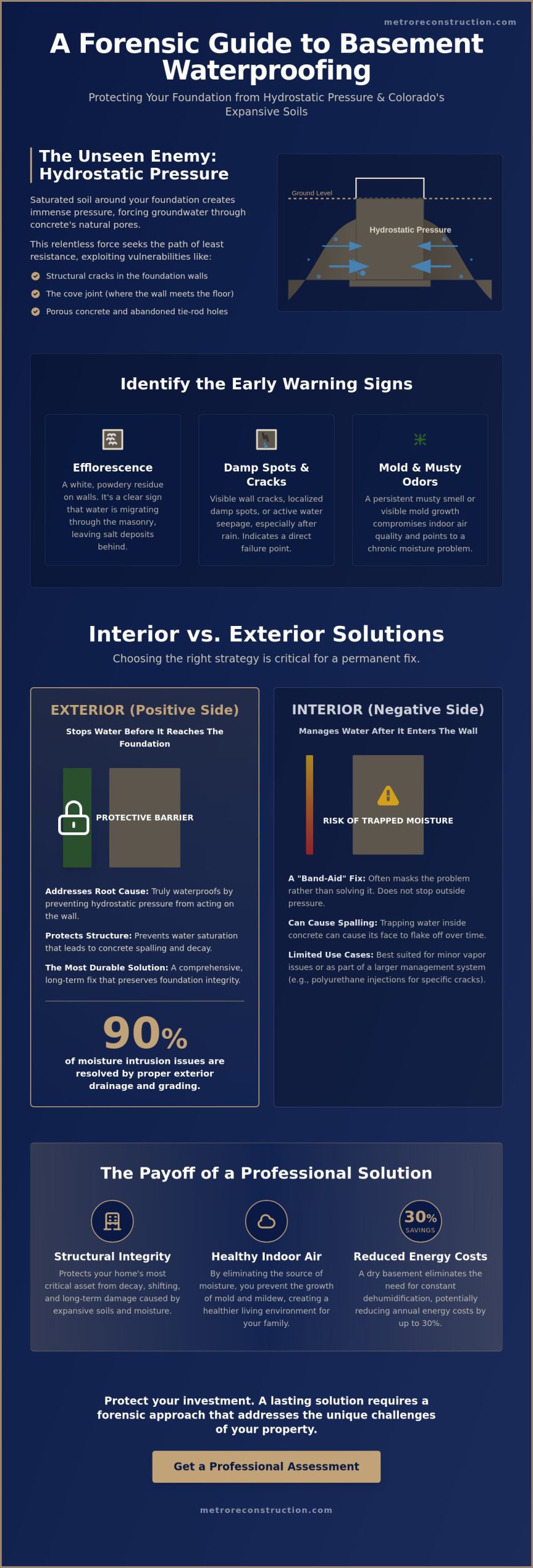
Understanding why your basement feels damp requires a forensic look at the forces acting upon your foundation. The primary driver of water intrusion is hydrostatic pressure, which occurs when groundwater saturates the soil surrounding your home. This accumulated water exerts immense physical force against the masonry, searching for any vulnerability to relieve the pressure. Because concrete is naturally porous, this force drives moisture through the microscopic capillaries of the wall, often resulting in a slow, persistent dampness that defies standard damp proofing methods applied during initial construction. Properly waterproofing basement walls requires more than a surface-level patch; it demands an understanding of the physics of your specific environment.
Water always follows the path of least resistance. In a typical foundation, this includes structural cracks, abandoned tie-rod holes, and the cove joint where the floor meets the wall. It’s vital to distinguish between active seepage and simple surface condensation. If you see water beads on the surface during humid summer months, it might be an HVAC issue related to high interior humidity. However, if the moisture is localized to specific wall sections or floor joints, you’re likely dealing with a failure in your exterior moisture management system. This seepage often indicates that the surrounding soil can no longer drain effectively, forcing liquid water through the masonry itself.
The Role of Colorado’s Expansive Soils
Homeowners in Boulder County face a unique geological challenge: bentonite-rich expansive soils. These clay-heavy soils act like a sponge, expanding significantly when wet and exerting extreme lateral pressure on foundation walls. This movement is compounded by high-altitude freeze-thaw cycles, where ice pushes against masonry with thousands of pounds of force. Many interior sealants fail because they cannot withstand the structural shifting caused by these relentless environmental cycles. A lasting solution must account for this movement rather than just attempting to plug a visible leak.
Identifying Efflorescence and Mold
One common early warning sign of moisture intrusion is a white, powdery residue found on basement walls. Efflorescence is the crystalline salt deposit left after water evaporation. While the powder itself isn’t a structural failure, it indicates that water is actively migrating through the masonry and carrying minerals with it. Over time, this moisture creates a breeding ground for mold behind finished walls. This compromises indoor air quality and creates health risks, making it critical to address the root cause immediately to protect your home’s structural integrity.
Interior vs. Exterior Waterproofing: A Strategic Comparison
Choosing the right strategy for waterproofing basement walls depends on whether you intend to stop water at its source or manage its path once it enters the foundation. In the industry, we distinguish between “Positive Side” and “Negative Side” waterproofing. Positive side solutions are applied to the exterior face of the foundation, creating a barrier that prevents water from ever touching the masonry. Negative side solutions are applied to the interior, attempting to hold back water that has already saturated the concrete. While interior fixes are often more accessible and less disruptive for a finished basement, they don’t address the external hydrostatic pressure that drives moisture through the walls.
Relying on a “band-aid” interior fix, such as heavy-duty waterproof paint, can actually become a structural liability. When you seal the interior without addressing the exterior, you trap moisture within the porous concrete matrix. This trapped water can lead to “spalling,” where the face of the concrete flakes off, eventually compromising the entire exterior envelope. Forensic investigations of moisture problems conducted by groups like Building Science Corporation demonstrate that long-term durability requires a holistic approach rather than a localized patch. A failure to address the root cause can lead to recurring costs and hidden structural decay.
When Interior Mitigation is Appropriate
Interior methods are most effective for managing vapor transmission or minor seepage in unfinished utility spaces. We often utilize high-performance crystalline sealers that penetrate deep into the concrete matrix to block capillaries. These materials are superior to surface coatings because they become a permanent part of the structure. However, these systems have limitations; they cannot stop active structural cracking or the lateral movement caused by expansive soils. If your goal is a fully finished living space, interior-only methods may not provide the necessary security against severe weather events.
The Case for Exterior Structural Mitigation
Stopping water before it makes contact with your foundation is the only permanent solution for comprehensive moisture management. This approach is vital for protecting the structural integrity of stucco exterior walls and complex masonry. While the initial investment for exterior excavation and drainage is higher, the long-term ROI is found in the preservation of your home’s resale value and the prevention of catastrophic foundation failure. If you’re concerned about the longevity of your property, a comprehensive structural assessment can help determine if exterior mitigation is the right path forward for your home.
How to Implement Interior Waterproofing Correctly
When you’re waterproofing basement walls from the inside, the margin for error is remarkably slim. Success depends on a meticulous, step-by-step methodology that goes beyond the surface-level applications found in standard hardware store kits. If you don’t address the microscopic bond between the sealant and the concrete substrate, the system will inevitably fail under the first significant rain event. Professional moisture management requires a forensic approach to ensure the repair is built right the first time.
Forensic Surface Preparation
Concrete is naturally porous, acting much like a dense sponge. Over years of use, it absorbs oils, dust, and old paint that prevent new high-performance sealants from adhering correctly. Forensic preparation involves mechanical etching, using grinders or specialized wire brushes to open the concrete pores. You must also remove every trace of previous DIY “patch” attempts. During this phase, we identify active leaks that require hydraulic cement. This specialized material expands as it cures, allowing it to plug high-pressure points where water is visibly pulsing through the masonry.
Professional Crack Injection Techniques
Surface-level caulking is a temporary fix that fails to address the full depth of a foundation crack. We utilize professional-grade expandable polyurethane resins that are delivered through injection ports drilled directly into the wall. These ports allow the resin to reach the very back of the crack, sealing it against the soil. Epoxy injection restores the structural bond while polyurethane stops active water flow. This dual-action approach ensures that the repair can withstand the lateral pressure exerted by the surrounding earth.
The final stage involves addressing the cove joint, which is the critical junction where the wall meets the floor slab. This area is a frequent point of failure due to the natural expansion and contraction of the home. Once the joints are secure, we apply a high-performance masonry waterproofer in multiple, cross-hatched layers. This technique ensures a uniform thickness and eliminates microscopic pinholes that water could exploit. Research from the Kansas State University guide to dry basements confirms that managing interior vapor is just as vital as stopping liquid seepage to prevent structural rot and maintain a healthy living environment.
Managing the Exterior Envelope: Drainage and Grading
When considering the long-term efficacy of waterproofing basement walls, we must look beyond the concrete itself. High-performance moisture management starts at the surface. Our forensic assessments reveal that poor surface drainage is the root cause of 90% of basement leaks. If water is allowed to pool against the foundation, no amount of interior sealant can indefinitely withstand the resulting hydrostatic pressure. True protection requires a holistic view of the exterior envelope, ensuring that every component works to direct water away from the structure rather than toward it.
The most fundamental defense is proper soil elevation. Maintaining a 5% slope away from the foundation for the first ten feet is essential for natural runoff. This gradient ensures that heavy rainfall or melting snow moves quickly into the yard rather than saturating the backfill zone. Additionally, gutters and downspouts must be clear and functional. A single clogged downspout can dump hundreds of gallons of water into a concentrated area, leading to localized soil saturation and eventual foundation seepage. If your home lacks these basic defenses, even the best masonry is at risk.
The Critical Nature of Exterior Grading
Over time, soil naturally settles, often creating a “trough” next to the foundation. This depression acts as a direct water pipeline to your basement. When correcting these levels, it’s vital to do so without compromising the weep screed of stucco finishes. If soil is piled too high, it blocks the drainage path for moisture that naturally accumulates behind the stucco, leading to rot. We also pay close attention to window wells. Without professional covers and dedicated drainage, these areas act as collection basins that eventually force water through window seals or foundation joints.
Exterior Waterproofing Membranes
For homes facing severe moisture challenges, we implement high-performance exterior membranes. These involve the application of polymer-modified asphalt or rubberized membranes directly to the exterior face of the foundation. To enhance this barrier, we install dimpled drainage boards. These boards create an air gap that relieves hydrostatic pressure and allows water to fall harmlessly to a French drain system. These comprehensive systems are specifically designed to protect foundations from aggressive Colorado soils, which can expand and contract with violent force. If you’ve noticed recurring dampness, contact our team for a forensic inspection to identify your specific drainage vulnerabilities.
Professional Reconstruction and Long-Term Protection
Addressing persistent moisture intrusion is rarely a matter of a single, isolated repair. In complex cases, waterproofing basement walls becomes an exercise in forensic reconstruction, where we must analyze how the foundation interacts with the entire building envelope. A failure in the foundation often correlates with issues in the masonry work and stucco restoration above grade. By coordinating these repairs, we ensure that moisture is managed from the roofline to the footer. Our approach prioritizes transparency through fixed-price project fees, providing you with a clear investment path for comprehensive structural mitigation rather than the uncertainty of hourly “patch” work.
The value of a professional solution is measured in decades, not seasons. According to industry data from March 2026, the global basement waterproofing market has grown to $15 billion as homeowners increasingly recognize that moisture management is a fundamental pillar of home preservation. Investing in a high-performance system doesn’t just protect your square footage; it revitalizes your home’s value. Studies have demonstrated that professional waterproofing can lead to a 30% decrease in annual energy costs by eliminating the need for energy-intensive dehumidifiers. This long-term ROI is why we adhere to the standard of being built right the first time. For property owners managing larger facilities, the same forensic principles apply to commercial water damage repair in Boulder, where moisture left unaddressed can accelerate structural decay and business interruption costs.
Integrating Structural Repairs
Sometimes, waterproofing is only one piece of the puzzle. If Colorado’s expansive soils have caused significant shifting, we may combine moisture management with piering or wall stabilization to ensure the home’s safety. There is also a direct relationship between window replacement and basement moisture. Improper flashing on a new window installation can allow water to bypass even the best wall sealants, trickling down the interior of the wall cavity. We address the root cause rather than visible symptoms, ensuring every component of the exterior envelope is synchronized to repel water.
Your Next Steps for a Dry Basement
A dry, usable basement is the result of a deliberate, engineered plan. We recommend a professional forensic inspection over a standard “sales” estimate, as many contractors ignore the hidden mechanics of structural failure in favor of quick aesthetic fixes. When preparing for a consultation, it’s helpful to document your leak patterns and the timing of water appearance following heavy rains. This data allows our experts to pinpoint vulnerabilities in your specific foundation type. Contact Metro Reconstruction for a comprehensive structural evaluation.
Secure Your Home’s Foundation for the Long Term
Protecting your home from the relentless pressure of Colorado’s expansive soils requires more than a reactionary patch. You now understand that high-performance waterproofing basement walls involves a holistic strategy, ranging from correcting a 5% exterior grade to utilizing professional-grade polyurethane injections for structural cracks. By addressing the root cause instead of just the visible seepage, you ensure your foundation remains stable for decades. It’s about protecting your entire exterior envelope through technical precision and engineering-led solutions.
Metro Reconstruction brings over 40 years of Boulder County expertise to every project, applying a meticulous forensic approach to moisture management. Our family-owned business prides itself on integrity and the quiet confidence that comes from craftsmanship built right the first time. We don’t just offer repairs; we provide the peace of mind that your investment is secure against the elements. You can trust our seasoned experts to identify the difficult truth about your structure and provide a durable, high-performance solution.
Take the first step toward a dry, usable space today. Schedule a Forensic Foundation Inspection with Metro Reconstruction to identify the specific needs of your property. You deserve a partner who values durability and technical precision as much as you do.
Frequently Asked Questions
Is waterproofing basement walls from the inside effective?
Interior mitigation is effective for managing water vapor and minor seepage in unfinished spaces, but it doesn’t stop the external hydrostatic pressure acting on your foundation. These “negative side” solutions allow the concrete to remain saturated, which can lead to long-term masonry degradation. For a permanent solution that protects the structural integrity of your home, managing the exterior envelope is the superior choice.
How much does it cost to waterproof basement walls in Boulder?
According to May 2026 industry data, the average cost to waterproof a 1,000 square foot basement is approximately $13,640, with most projects ranging between $12,447 and $14,833. Interior methods average around $3,000, while more comprehensive exterior solutions typically average $7,000. These costs vary based on the specific method used and the severity of the moisture intrusion.
Can I waterproof my basement walls myself or do I need a pro?
DIY applications are suitable for minor vapor issues using over the counter sealants, but active seepage or structural cracking requires professional forensic intervention. Professionals use high performance materials like expandable polyurethane resins and mechanical etching tools that aren’t available to the general public. Missing the root cause of a leak during a DIY attempt often leads to recurring failures and wasted investment.
What is the best material for waterproofing basement walls?
The best material depends on whether you’re treating the interior or exterior of the foundation. High performance exterior systems often utilize polymer modified asphalt or rubberized membranes, while the 2022 ASTM D8425 standard highlights the effectiveness of sodium bentonite geotextiles for below grade protection. For interior applications, crystalline sealers that penetrate the concrete matrix provide more durability than simple surface paints.
How long does professional basement waterproofing last?
A professionally installed exterior waterproofing system is designed to last the life of the structure when maintained correctly. Interior sealants and crack injections typically offer a reliable service life of 10 years or more, though this can be affected by the movement of Colorado’s expansive soils. Choosing a high performance, engineering led solution ensures the repair is built right the first time.
Does a damp basement always mean I have structural foundation issues?
Dampness doesn’t always signal immediate structural failure, as it can be caused by simple condensation or poor surface drainage. However, persistent moisture is a catalyst for structural decay because it facilitates rebar corrosion and concrete spalling over time. A forensic inspection is the only way to determine if your dampness is a cosmetic nuisance or a symptom of a deeper foundation problem.
What happens if I ignore water seepage in my basement walls?
Ignoring seepage leads to progressive structural damage, toxic mold growth, and significantly higher utility bills. A 2021 case study demonstrated that homes with moisture problems see a 20% increase in energy usage due to the constant need for dehumidifiers. In the Front Range, ignoring moisture also risks catastrophic foundation shifts as expansive soils exert lateral pressure on weakened masonry.
Can waterproofing basement walls stop mold permanently?
Yes, professional waterproofing basement walls stops mold by eliminating the moisture source that spores require to colonize. Mold cannot survive or reproduce without a consistent water supply. By implementing a comprehensive moisture management plan that includes both drainage and high performance barriers, you create an environment where mold can no longer exist.