
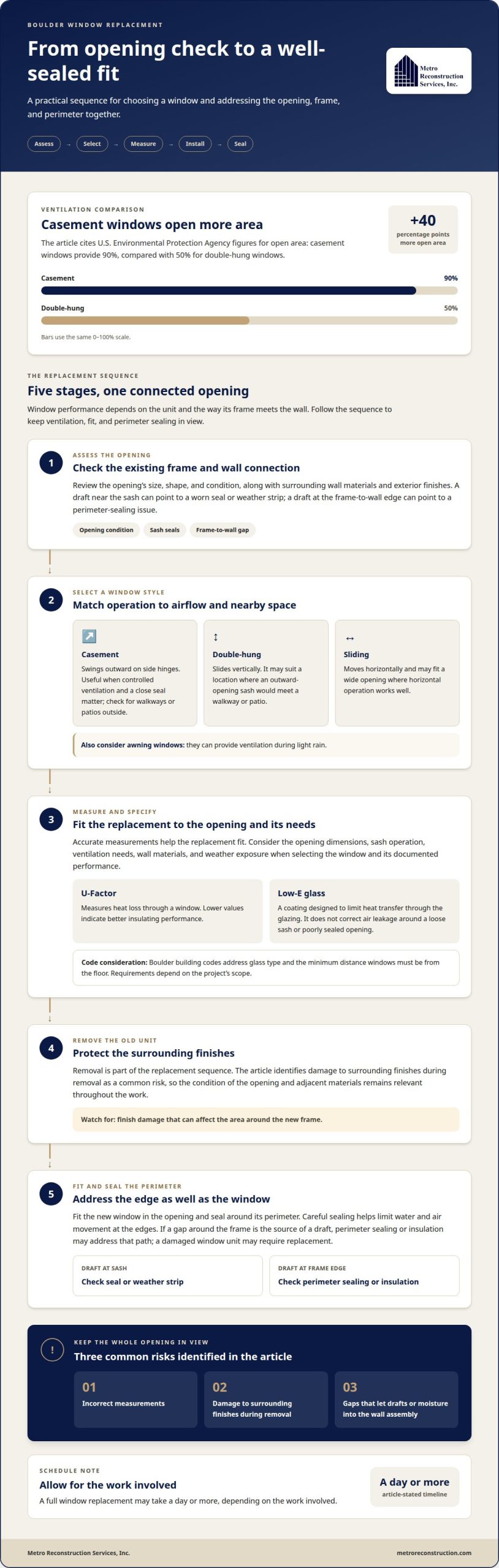
The right replacement window should do more than fit the opening; it should suit how you ventilate your home and help limit drafts. Casement windows are a popular choice in Boulder because they offer ventilation control and a tight seal against gusty winds. According to the U.S. Environmental Protection Agency, casement windows have 90% open area, compared with 50% for double-hung windows. For casement window replacement in Boulder, CO, the best fit also depends on the condition of the existing frame and the way the window connects to the surrounding wall.
Weigh air leakage, energy efficiency, and durability together when considering casement window replacement in Boulder, CO. Worn seals or weather strips can let drafts in, while gaps around a window can undermine the performance of the whole building envelope.
This guide compares window types Boulder homeowners consider, explains how replacement may reduce air leaks, and outlines what to review in estimates and warranties. It also explains why inspecting the opening and surrounding materials matters before work begins, so the project can address underlying issues as well as the visible window.
Key Takeaways
- Compare casement and other window styles by how they ventilate, seal, and suit your home.
- Learn how worn seals, gaps, and installation details can affect drafts and energy performance.
- Understand what an in-home assessment and written estimate can clarify about the replacement work.
- Know which product and labor warranty terms to review before moving forward.
- Recognize when window damage may call for repair and when full replacement is the more practical path.
What are the most popular replacement window types in Boulder?
Casement and awning windows are practical options for Boulder homes, while double-hung and sliding designs suit different openings and ventilation preferences. Casement windows have a 90% open area, compared with 50% for double-hung windows, according to the U.S. Environmental Protection Agency. Awning windows can provide ventilation during light rain, which can be useful when weather shifts.
How do casement windows compare with double-hung and sliding windows? Casement windows swing outward on side hinges; double-hung windows slide vertically, and sliding windows move horizontally. These opening styles affect airflow, access, and the space needed outside the home.
For casement window replacement in Boulder, CO, consider the opening’s size, shape, and condition. Casement windows can suit spaces where controlled ventilation and a close seal matter. A double-hung design may be easier to operate where an outward-opening sash would meet a walkway or patio. A slider may fit a wide opening where horizontal operation works well.
Do Boulder building codes or permits apply to window replacement? Boulder building codes address glass type and the minimum distance windows must be from the floor. Requirements depend on the project’s scope, so the planned opening and glass selection matter.
Window replacement in Boulder, Colorado, involves more than choosing a frame style. The existing opening, wall materials, and connection to exterior finishes all affect how the window fits into the building envelope. In nearby communities, local weather exposure and the home’s construction also shape the decision. UV exposure and occasional high winds make durability an important consideration.
What factors guide casement window selection in Boulder? Consider the opening’s dimensions, how the sash will operate, surrounding wall materials, and ventilation needs. For example, a window beside a patio may need a style that does not swing outward into the space.
Window manufacturing and installation are separate stages: first, the window is made to the selected specifications—which can be configured to exact dimensions through suppliers like Windows Outlet—then it is fitted and sealed in the opening. Residential and commercial projects can differ in opening size, building use, and surrounding materials. Accurate measurements help the replacement fit, and careful sealing helps limit water and air movement around its edges.
Which window replacement companies in Boulder, CO install casement windows? Window and door contractors serving Boulder County handle replacement projects, but this section does not name individual companies. The scope of work can include measurement, removal, installation, and finishing around the opening. For casement window replacement in Boulder, CO, these steps help frame what the project involves.
What is the process and typical timeline for replacing a casement window? The work generally involves measuring the opening, selecting a replacement, removing the old unit, fitting the new window, and sealing the perimeter. A full window replacement may take a day or more, depending on the work involved.
Common risks include incorrect measurements, damage to surrounding finishes during removal, and gaps that let drafts or moisture into the wall assembly. Are rebates, tax credits, or incentives available for replacement windows in Boulder, CO? Availability and eligibility depend on current program rules and the selected window, so do not assume an incentive when planning the project.
Energy efficiency and air-leak reduction
Window performance depends on both the glass and the way the frame meets the wall. In Boulder, assessing these parts together can help identify where heat transfer and drafts begin.
Energy Efficiency and Heat Transfer
A window transfers heat through its glass, frame, and edges, while air leaks move conditioned air through gaps. The U-Factor measures heat loss through a window; lower values indicate better insulating performance. Compare this rating with the frame condition and glass type rather than treating one feature as the full measure of energy efficiency.
Start with the symptoms. A draft near the sash may point to a damaged seal or weather strip, while a gap between the frame and wall can indicate an installation or perimeter-sealing issue. These openings affect comfort and may reduce energy efficiency. Finding where the draft starts helps determine whether sealing, insulation, or a new window addresses the cause.
Low-E Glass and Energy Savings
Low-E glass has a coating designed to limit heat transfer through the glazing. In Boulder, replacing damaged window glass with Low-E glass may help save energy. The right choice depends on the window’s exposure and existing frame, because glass performance alone cannot correct air leakage around a loose sash or poorly sealed opening.
What window materials and glass options are best for Boulder homes? Choose materials and glazing based on the opening, weather exposure, and the window’s documented performance. The National Bureau of Standards identifies tinted, reflective, and insulated glazing units among available options; each changes how the window manages light and heat.
Energy-Efficient Upgrade Options
An upgrade may involve repairing gaps, insulating around the window, replacing worn weather strips, or installing a more efficient window. Each step addresses a different path for heat loss. For example, added perimeter insulation may help where air moves around the frame, while replacing a damaged unit addresses a failed seal within the window assembly.
Are energy-efficient or ENERGY STAR standard casement windows suitable for Boulder’s climate? They can be suitable when their performance ratings match the home’s needs and installation limits air and moisture movement. ENERGY STAR standards are federal energy-efficiency guidelines, so review the window’s ratings and intended application rather than relying on style alone.
During replacement, assess the sash, frame, opening, and surrounding wall before sealing the assembly. If nearby materials have been affected by moisture, installing a new unit without addressing the damage can leave the original problem in place. A sound upgrade considers the whole window-to-wall connection, not just the glass.
In-home consultation and estimate
For window replacement, an in-home assessment and written estimate help define the proposed work and document the scope under consideration.
In-Home Window Consultation
A window assessment examines the unit in its actual setting, including its operation, visible damage, and nearby finishes. For example, a sash that sticks may point to a hardware issue, frame movement, or damage around the opening. These conditions call for different responses, so identifying what is visible helps establish an accurate project scope.
The window connects to the wall, trim, and exterior finish. An assessment can record the opening’s dimensions and note visible gaps, moisture staining, or deterioration around the frame. These observations help distinguish an issue limited to the window from one involving adjacent materials. The Fire Prevention Inspection and exterior home hardening assessments are separate from window replacement planning.
For a useful home improvement discussion, organize observations by opening rather than treating every window as identical. A north-facing casement with a difficult latch may need different attention from a fixed window with staining below its sill. Recording the location and symptom gives the replacement decision a specific starting point.
Window Estimate
A written replacement estimate should describe the window openings included and the proposed work for each. Review whether it identifies the selected window type, removal, installation, perimeter sealing, and finishing around the opening. Clear scope language helps you understand what the project covers before work begins.
Existing conditions can change the work required. A sound frame and intact trim differ from an opening with deteriorated materials or damaged exterior finishes. An estimate should connect its listed tasks to observed conditions, so repairs to surrounding surfaces are not confused with work on the window unit itself.
Window estimates are also useful for comparing project scope, not just product descriptions. Check that each opening is identified and that the installation details address how the replacement meets the wall. If the assessment noted staining, gaps, or difficult operation, the written scope should explain how those observations relate to the planned work.
Keep assessment notes and the estimate together with the window specifications. This gives you a record of which openings were considered and what work was proposed for each. That documentation keeps the discussion focused on the actual condition of the windows and surrounding materials.
In Boulder, damaged window seals or weather strips can let drafts into a home and reduce energy efficiency. If drafts are a concern, note the affected opening and ask whether the proposed work addresses the seal or weather strip. This keeps the discussion focused on the observed condition and clarifies whether the estimate includes that repair or replacement.
Window product and labor warranties
Window warranties describe different responsibilities: product coverage concerns the window itself, while labor coverage concerns installation work. For casement replacement, review both documents and match each term to the window and work described in the estimate.
Product Warranty Coverage
A limited lifetime warranty does not, by its title alone, explain which parts or conditions it covers. Read the written terms for covered components, coverage period, exclusions, and transfer rules. For example, frame coverage and insulated-glass coverage may be treated differently within one product warranty.
Check how the document treats appearance and function. It should clarify whether it covers issues such as frame defects, hardware operation, or a failed glass seal, and describe any limits. Keep the warranty with the product identification and installation records so you can match the window to its coverage later.
Terms matter more than a broad label. A product warranty may define specific remedies, such as repair or replacement, and conditions for making a claim. Read the required claim steps, documentation requirements, and exclusions before accepting the window selection. Do not assume that “lifetime” means every component is covered for the same period or under identical conditions.
Labor and Warranty Support
A labor warranty addresses installation workmanship, separately from a manufacturer’s product warranty. Experienced window specialists such as FrameHouse note that clear workmanship terms ensure any issues with fit or weatherproofing are properly resolved. Review its written coverage, including how it handles issues such as a loose sash, perimeter air leakage, or water intrusion around the frame. The document should identify the responsible party and explain how to submit a service request.
Review the labor terms in writing alongside the product warranty. If the glass has a product defect but the frame-to-wall joint leaks, those concerns involve different parts of the assembly. Clear terms help distinguish a window-component issue from an installation issue, without assuming one warranty covers both.
Maintenance instructions also matter. Follow the window manufacturer’s directions for cleaning glass, operating hardware, and keeping drainage openings clear. For example, paint over moving hardware or sealant across drainage paths can interfere with window operation or water management. Keep maintenance records and dated photos of concerns to document the window’s condition.
Before installation, organize the estimate, product specifications, warranty documents, and completion records together. Confirm that the selected casement window matches the listed product details, then retain instructions for reporting a defect or workmanship concern. This gives you a clear reference if an issue appears after the work is complete.
In Boulder, filling gaps or cracks and insulating windows can help maintain a comfortable indoor temperature.
Window repair and replacement in Boulder
In Boulder, hailstorms and sharp temperature changes can crack or break window glass. The right response depends on the damage, the frame, and the surrounding wall, not just the visible pane.
Small cracks can often be repaired, while large cracks or completely broken double-pane or triple-pane glass usually require replacement. A cracked pane may take a few hours to repair; replacing an entire window may take a day or more. The actual work depends on the damage and the opening.
Start by locating the failure. A crack limited to one pane differs from a window that will not close, has a damaged frame, or leaks around its perimeter. Hail impact and extreme temperature changes can damage glass, while moisture exposure can cause wooden frames to rot over time. Each cause points to a different scope of work.
- Consider repair when damage is small and the frame and surrounding materials remain sound.
- Consider replacement when glass is extensively cracked, a double-pane or triple-pane unit is completely broken, or frame damage affects operation.
- Assess the wall connection when drafts, staining, or deteriorated exterior finishes appear around the opening.
This matters because a window is part of the home’s exterior envelope. Water entering around the frame can affect trim and nearby wall materials; a new pane alone will not correct a failed perimeter seal. During replacement, the condition of the opening and insulation around it can influence how well the assembly limits air and moisture movement.
For casement windows, operation is another practical test. If the sash binds, consider whether the problem comes from the hardware, the frame, or movement at the opening. Replacing a window without addressing a damaged or moisture-affected surrounding area can leave the underlying issue unresolved.
When replacement is needed, the work generally includes removing the existing unit, preparing the opening, fitting the new window, and sealing its edges. The installer should account for the exterior finish as well as the interior frame, since gaps at either side can affect the complete assembly. Replacing an entire window may take a day or more.
Choose the scope based on the evidence: repair a limited pane problem when the rest of the assembly is sound; replace the unit when extensive glass or frame damage makes repair impractical. If the opening also shows moisture damage, include that condition in the replacement plan. Discuss window replacement for your Boulder home with Metro Reconstruction to identify work suited to the observed damage.
Metro Reconstruction Services: New windows
Metro Reconstruction Services, Inc. provides new windows and window installation when damaged units, persistent drafts, or deteriorated frames call for replacement. The work should address the opening and its connection to the surrounding exterior, since gaps or moisture damage can undermine the new window’s performance.
For casement window replacement in Boulder, start by understanding the existing condition and selecting a window suited to the opening. If adjoining stucco or masonry is affected, those materials may also need attention to protect the building envelope. Careful planning aligns the window installation with surrounding surfaces and moisture-management needs.
To discuss replacement windows for your home, contact Metro Reconstruction Services, Inc. or call 303.543.9549.
Plan the next step for your home
A window project is an opportunity to consider how each opening fits into the home’s complete exterior system. Before deciding on replacement, focus on the condition you want addressed and how the window relates to nearby wall finishes. This keeps the next conversation centered on the home’s needs, not just a product choice.
Metro Reconstruction Services, Inc. offers window replacement, Stucco Restoration, Masonry Work, and stucco installation. These related services can matter when a window opening meets stucco or masonry, since the surrounding finish is part of the exterior assembly. The right scope depends on the condition of those materials and the opening.
As you plan casement window replacement in Boulder, CO, make the next step a discussion with Metro Reconstruction about the specific opening and any visible concerns around it. A clear starting point helps shape a practical project plan without assuming every home needs the same work.
Connect with Metro Reconstruction Services, Inc. to discuss your window project and determine a suitable next step.
Frequently Asked Questions
What window design options are offered?
Metro Reconstruction Services provides window and door installation and replacement, including energy-efficient windows and tempered glass options. The right configuration depends on the opening, how you want the window to operate, and the glass requirements for the location. Casement, double-hung, sliding, and awning styles each open differently. Discuss the intended design and glazing with the project team so the selected window suits the home’s layout and use.
When Should You Consider Replacing Your Windows Instead Of Repairing Them?
Consider replacement when damage extends beyond a repairable pane, the frame no longer functions properly, or moisture has caused deterioration. For example, a wooden frame with rot may not provide a sound base for continued repairs. Replacement can also address an aging assembly with persistent air leakage, but identify the cause first. If damage is limited and the frame remains sound, repair may be appropriate instead.