
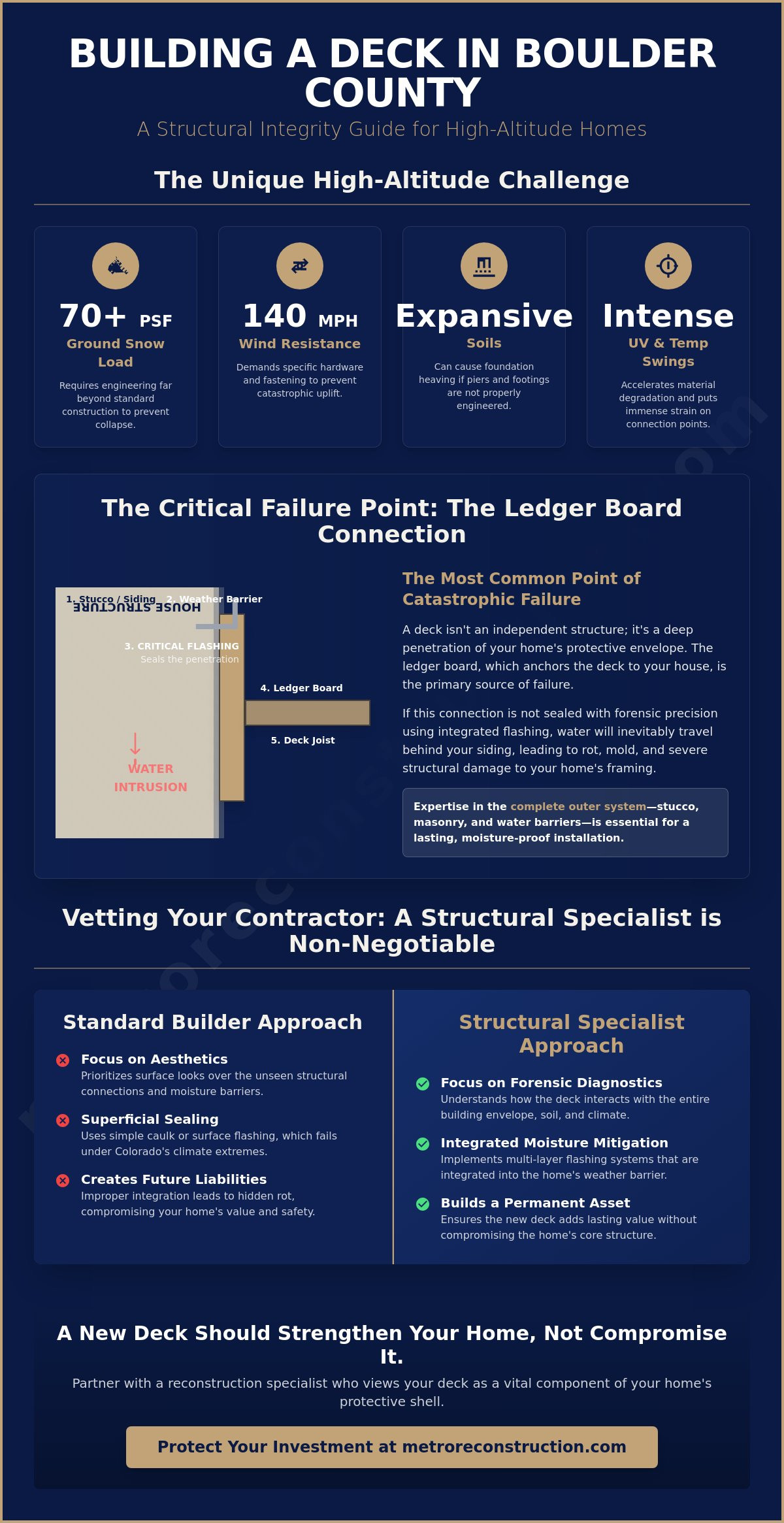
In Boulder County, a deck is far more than a simple outdoor platform; it is a complex structural extension that can compromise your home’s entire moisture barrier if it is improperly integrated. You likely recognize that our local environment is uniquely unforgiving. Between the expansive soils of the Front Range and the heavy snow loads of the foothills, a standard build often fails to provide the long-term security your property requires. Because the interaction between a new ledger board and your existing exterior can create hidden pathways for water intrusion, finding a specialized deck contractor is a matter of essential property preservation.
This guide will teach you how to select a partner who understands these high-altitude demands, from navigating the 2021 International Residential Code to implementing moisture mitigation strategies that protect your stucco or masonry. We will examine the specific engineering requirements for 140 MPH wind zones and the necessity of ignition-resistant materials under local fire safety amendments. By the end of this article, you will have a clear framework for evaluating technical expertise, ensuring your new outdoor space adds lasting value without compromising the structural integrity of your home’s complete outer system.
Key Takeaways
- Understand why Boulder’s expansive soils and extreme wind loads require a deck contractor with a structural engineering mindset rather than a purely cosmetic focus.
- Identify the ledger board as the primary point of structural failure and learn the correct methods for integrating new decking with your home’s stucco exterior.
- Evaluate the long-term durability of ignition-resistant materials and steel framing to meet Boulder County’s specific wildfire safety regulations.
- Navigate the complex local permitting process, including valuation-based fees and the engineering requirements for high-altitude construction.
- Learn why a partner with expertise in stucco restoration and the building’s complete outer system is essential for a seamless, moisture-proof deck installation.
Selecting a Deck Contractor for Boulder’s Unique Structural Demands
Selecting a deck contractor in the Front Range requires a shift in perspective; you aren’t just hiring a carpenter, you’re hiring a structural specialist. While many national brands promote certified installers, these certifications often focus on surface aesthetics rather than the forensic level of detail required for our local geology. Boulder County presents a unique set of stressors that demand a specialized approach. Intense UV radiation at high altitudes accelerates the degradation of standard wood products, while extreme temperature swings cause rapid expansion and contraction across the building’s complete outer system. These forces put immense strain on the connection points between your home and the new structure. Precision is the only path to permanence. A qualified professional must prioritize foundational accuracy before the first pier is poured, ensuring the project remains a long-term asset rather than a liability.
The Reality of Building in Boulder County
Standard deck construction standards often fail to account for the specific environmental demands of the Rockies. In unincorporated Boulder County, framing must be engineered to withstand ground snow loads that can exceed 70 pounds per square foot. This isn’t a suggestion; it’s a structural necessity. Additionally, the expansive soils common in the region can exert thousands of pounds of pressure on pier footings, leading to heaving if foundation stabilization isn’t handled with analytical depth. When wind speeds reach the 140 MPH threshold required by local code, your contractor’s choice of hardware and fasteners becomes the only thing preventing catastrophic uplift. Every bolt and bracket must be part of a calculated system designed for high-wind resistance.
Vetting for Long-Term Structural Integrity
When interviewing a potential deck contractor, look for a deep understanding of mountain topography and forensic diagnostics. Ask specific questions about their approach to pier depth and how they manage the critical transition where the deck meets the house. A volume builder might offer a surface fix that looks attractive today but fails to address the underlying structural origins of future rot or moisture intrusion. True expertise is found in the details of the flashing and the seamless integration with your home’s exterior. It’s the difference between a temporary addition and a permanent structural solution that protects your investment for decades. You need a partner who views your deck as a vital component of the home’s protective shell.
The Critical Intersection of Decking and Your Home’s Outer System
Most homeowners view a deck as an independent structure. In reality, it’s a deep penetration of your home’s protective envelope. The ledger board, which anchors the deck to your house, is the primary connection point and the most common site of catastrophic failure. If a deck contractor fails to seal this interface with forensic precision, water will inevitably find its way behind your siding. This isn’t just a cosmetic issue; it’s a direct threat to your wall framing and sill plate. Precision flashing isn’t a luxury. It’s the baseline for survival in the Colorado climate, where snow melt and heavy rains test the integrity of every joint.
A volume builder might treat the deck as a separate unit, but a seasoned deck contractor understands that every bolt represents a potential leak point. By adopting a forensic approach to moisture mitigation, we can identify potential failures before they manifest as rot. This requires a holistic view of the building’s complete outer system. We focus on the underlying structural origins of moisture intrusion rather than applying superficial patches that only hide the problem temporarily.
Stucco and Masonry Integration
Integrating new decking with existing stucco exterior walls requires more than a simple bead of caulk. It involves carefully cutting back the existing finish to expose the weather-resistive barrier without damaging the underlying substrate. This allows for the installation of integrated metal flashing that directs water away from the framing. Once the deck is secured, professional stucco and masonry repairs are necessary to restore both the aesthetic and functional integrity of the wall. Because different materials expand and contract at varying rates, the transition must be engineered to remain flexible yet watertight through Boulder’s extreme seasonal shifts.
Forensic Moisture Control
True moisture control starts with the installation of high-quality Z-flashing and waterproof membranes at the ledger. We often see decks where the flashing was installed backwards or omitted entirely. This oversight allows snow melt to sit against the house, leading to rot that remains hidden for years. When water bypasses the ledger, it often travels down the interior of the wall, eventually compromising the basement or crawlspace. This type of damage frequently leads to the need for expensive foundation repair services that could have been avoided with initial accuracy. If you’re concerned about the state of your current exterior before starting a new build, a professional assessment of your stucco restoration needs can ensure a solid foundation for your project.
Evaluating Deck Materials for High-Altitude Durability and Fire Resistance
Selecting the right materials for a Boulder County deck involves balancing aesthetic desire with the harsh realities of our high-altitude environment. At 5,000 feet and above, UV radiation is significantly more intense, causing standard stains to fail and wood fibers to break down rapidly. A skilled deck contractor will analyze the orientation of your home to determine the best material for long-term structural preservation. While composite materials are often marketed as maintenance-free, they experience significant thermal expansion in the Colorado sun, which can stress fasteners and structural joints. Tropical hardwoods like Ipe offer incredible density and natural fire resistance, but they require specific oil-based treatments to prevent silvering and checking in our dry climate. Ultimately, your choice dictates the frequency of your exterior home repair cycles.
Steel framing is increasingly the preferred choice for mountain communities. It offers a perfectly level surface that won’t warp, rot, or twist over time, providing a stable foundation for premium decking. Most importantly, it’s non-combustible, which is a critical factor in wildfire-prone areas where traditional wood framing can act as fuel. When you prioritize a forensic-level selection process, you’re not just choosing a color; you’re choosing the longevity of your home’s complete outer system.
Wildfire Safety and WUI Compliance
In many parts of Boulder County, decking materials must comply with local building code amendment R390 for ignition-resistant construction. This means using materials that resist ignition from embers and heat. Non-combustible options like aluminum or specialized fire-rated composites are essential in high-risk zones. Beyond the deck itself, the design should contribute to a defensible space. By using ignition-resistant softwoods or non-combustible framing, you ensure that your outdoor living space doesn’t become a vulnerability during a wildfire event.
Maintenance Realities in Colorado
The extreme temperature swings of the Front Range can cause composite boards to expand and contract by as much as half an inch over a twenty-foot span. This movement can lead to buckling if not properly gapped by your deck contractor. Additionally, dark-colored composites can reflect intense heat onto your home’s exterior. This thermal reflection is a common cause of warped siding and can even lead to premature failure of your glazing, necessitating a window installation service near me to restore efficiency. Investing in high-performance materials may involve a higher initial cost, but the peace of mind and reduced maintenance requirements offer a superior long-term ROI.
Navigating the Engineering and Permitting Process in Boulder County
In Boulder County, the permitting phase acts as a rigorous structural filter designed to ensure your home remains safe under extreme environmental stress. A professional deck contractor understands that this process isn’t merely about administrative compliance; it’s about validating the analytical depth of the project. For any deck larger than 200 square feet or elevated more than 30 inches above grade, the county requires detailed construction drawings and a site plan. Because our region faces wind speeds of 140 MPH and ground snow loads exceeding 70 pounds per square foot, these plans must be designed by a licensed Colorado design professional. This level of oversight ensures that the building’s complete outer system can handle the immense lateral and vertical forces unique to the Front Range.
Understanding the financial and regulatory framework is essential for maintaining project momentum. Boulder County calculates building permit fees on a sliding scale based on the total project valuation. For a project valued between $25,000 and $50,000, for example, the base fee is $442.20 for the first $25,000, with additional costs for each subsequent $1,000. Homeowners should also account for a plan check fee, which is 65% of the building permit fee, and a technology fee that increases for projects over the $25,000 threshold. Precise documentation at the start prevents costly delays during the review phase.
Structural Engineering for Sloped Lots
Mountain builds present specific challenges that generic deck plans cannot address. On sloped lots, calculating lateral loads and wind uplift is critical to prevent structural failure. Site-specific pier designs are a necessity, as foundations must be anchored deep enough to bypass expansive soil layers and resist shifting. If your plans don’t account for the specific topography of your property, they’ll likely fail the initial plan review. We prioritize initial accuracy to ensure every structural component is engineered for the specific demands of your site.
The Inspection Timeline
The path to a safe, compliant deck involves several critical inspection points. Inspectors will typically verify the depth and placement of caissons before concrete is poured, followed by a framing inspection to check hardware and attachment. The final inspection confirms that the project adheres to the 2021 International Residential Code and any local amendments regarding ignition-resistant construction. Following these steps with quiet confidence ensures your investment is protected. If you’re planning a project that involves complex integration with your home’s exterior, partnering with a specialist who understands these forensic requirements is the best way to ensure long-term success.
Why a Reconstruction Specialist is the Right Partner for Your New Deck
Choosing a deck contractor who operates as a volume builder often leads to a project that prioritizes speed over long-term structural integrity. These high-pressure operations focus on rapid turnover, which frequently results in overlooked details at the critical junctions where the deck penetrates the home’s envelope. Metro Reconstruction Services, Inc. operates as a reconstruction specialist, approaching the project as a wise craftsman who understands the underlying structural origins of building failure. Our forensic background means we don’t just see a platform; we see a complex interaction between structural loads and your home’s existing systems. This meticulous attention to detail ensures that your new addition preserves the value of your property rather than introducing new vulnerabilities that could lead to costly repairs later.
Reliability in construction stems from a position of deep expertise and a commitment to precision. We understand that a deck is a permanent structural modification that must withstand Boulder’s unique environmental stressors for decades. By prioritizing substance over style, we ensure that every fastener, pier, and flashing detail is executed with quiet confidence. This commitment to initial accuracy is what distinguishes a specialized partner from a generalist. We frame our role not just as a service provider, but as a dedicated partner in property preservation, protecting your investment through analytical depth and engineering-led solutions.
A Holistic View of Your Home
The primary advantage of our approach lies in our comprehensive understanding of the complete outer system. Because our daily work involves technical services like stucco restoration and masonry work, we possess a deep knowledge of how moisture moves through various building layers. We apply this forensic expertise to every deck build, ensuring that the ledger attachment and flashing are perfectly integrated with your exterior finish. We build for the next 40 years, not just the next season. Our focus remains on the long-term health of your home, preventing the moisture intrusion that often necessitates premature stucco replacement or foundation intervention. We understand how different materials, from tropical hardwoods to steel framing, interact with your home’s existing masonry and siding over time.
Your Partner in Property Preservation
Peace of mind comes from knowing that your project is managed by experts who value transparency and straightforward communication. We begin each project with a thorough diagnostic phase, identifying potential environmental stressors before construction starts. This analytical depth allows us to provide long-term solutions rather than superficial fixes. As your partner in property preservation, we offer personalized project management that guides you through every technical complexity, from complex mountain permitting to final inspection. We would rather explain a difficult structural truth during the planning phase than offer a low-quality patch that fails in five years. Contact Metro Reconstruction Services, Inc. for a structural evaluation of your project to ensure your new build is executed with forensic precision and lasting quality.
Securing Your Home’s Structural Future
Building a deck in the Front Range is a significant investment that requires a holistic understanding of your property’s complete outer system. You now understand that the intersection of the ledger board and your home’s exterior is the most critical point for moisture mitigation, especially when dealing with stucco or masonry. By prioritizing high-altitude materials and navigating the local permitting process with precision, you ensure your addition is both safe and compliant. These steps are essential for long-term property preservation in our demanding climate.
Metro Reconstruction Services, Inc. brings over 40 years of Boulder County expertise to every project. As specialists in structural mitigation and moisture intrusion, we’ve been family-owned and operated since 1982. We focus on identifying underlying structural origins to provide long-term solutions rather than superficial fixes. When you’re ready to move beyond standard builds, choosing a specialized deck contractor ensures your home remains protected against the unique stressors of our regional environment. Schedule a forensic structural evaluation for your Boulder deck project to begin your journey toward a structurally sound outdoor space. Your home deserves the care of a seasoned expert who understands the hidden mechanics of a lasting build.
Frequently Asked Questions
How much does a professional deck build cost in Boulder County?
Pricing for a professional deck installation in 2026 typically ranges between $25 and $80 per square foot depending on material choice and structural complexity. For a standard 200-square-foot build, homeowners often pay between $5,000 and $16,000 for pressure-treated wood, while premium composite or tropical hardwood projects can exceed $25,000. These figures reflect regional labor and material costs but don’t include the specialized engineering often required for Boulder’s mountain terrain.
Do I need a permit for a deck replacement in Boulder?
A building permit is required for any deck that is larger than 200 square feet, attached to the dwelling, or has a floor surface more than 30 inches above the ground. Even for a direct replacement, Boulder County requires a review to ensure the new structure meets the 2021 International Residential Code. Ensuring your deck contractor handles the site plan and construction drawings correctly is vital for passing the multi-step inspection process.
Which decking material is best for high-altitude UV exposure?
High-performance composite and tropical hardwoods like Ipe are the most resilient options for the intense UV radiation found at 5,000 feet and above. While natural cedar is popular, it requires frequent maintenance to prevent the wood fibers from breaking down under Colorado’s sun. Using materials with high UV resistance prevents the thermal reflection that can sometimes damage your home’s complete outer system, including nearby windows and siding.
How do you attach a deck to a home with stucco siding?
Attaching a deck to stucco requires a forensic approach that involves cutting back the stucco finish to properly integrate metal Z-flashing with the home’s weather-resistive barrier. This prevents moisture from becoming trapped behind the ledger board, which is the primary cause of rot. Once the structural connection is secure, professional stucco restoration is necessary to seal the transition and maintain the aesthetic integrity of the wall.
What are the wildfire-resistant decking requirements in Colorado?
Boulder County Building Code amendment R390 requires decks to be built with ignition-resistant or non-combustible materials in designated high-risk zones. This often means using specialized fire-rated composites, aluminum, or steel framing to reduce the risk of ember ignition. A qualified deck contractor will ensure your material selection contributes to the defensible space around your home, meeting all Wildland Urban Interface safety standards.
How deep do deck piers need to be for expansive soils in the Front Range?
Deck piers in the Front Range must typically extend at least 36 inches deep to reach below the frost line, though expansive soils often require deeper, engineered caissons. The specific depth and diameter are determined by a site-specific soil analysis and the total load requirements of the structure. Proper foundation stabilization at this stage is the only way to prevent the heaving and shifting that lead to long-term structural failure.
Can a deck contractor help with foundation stabilization?
A contractor specializing in structural reconstruction can identify and address foundation issues that might be exacerbated by a new deck installation. If the underlying structural origins of a failure involve soil movement or poor drainage, these must be corrected before the new build begins. This holistic approach protects your investment by ensuring the home’s foundation and the new deck function as a single, stable system.
How long does a custom deck construction project typically take?
A custom deck project in Boulder County generally takes between four to eight weeks for the construction phase once the permit has been issued. However, the initial diagnostic, engineering, and permitting phases can add several weeks to the total timeline. Factors like complex mountain topography, material availability, and the thoroughness of the county’s plan review process will influence the final schedule for your project.