
Choosing the cheapest window today often leads to a complex structural failure tomorrow. You’ve likely noticed your energy bills climbing as Colorado’s intense high-altitude UV rays compromise your window seals and threaten the integrity of your surrounding stucco or masonry. It’s a common frustration for homeowners who want to protect their investment but feel overwhelmed by shifting regulations and rising material costs. Understanding the average cost of window replacement Colorado residents face in 2026 requires looking beyond the sticker price to the long-term preservation of your property. Precision is not optional. We’ll show you how to address the strict 2026 energy mandates, such as the required 0.30 U-factor, and secure high-performance windows that serve as a reliable barrier against our rugged climate. This guide breaks down the technical requirements of the latest building codes, explains the specific risks of frame leakage to your complete outer system, and details state-specific financing strategies like the RENU loan to ensure your home remains efficient and structurally sound.
Key Takeaways
- Understand the technical variables that influence the average cost of window replacement Colorado residents face, from the latest 2026 glass technology to specialized frame materials.
- Identify why fiberglass serves as the premier choice for regional durability, offering superior resistance to the thermal expansion and UV degradation common in high-altitude environments.
- Explore long-term financing strategies, such as the Colorado RENU Loan, and learn how to leverage available utility rebates to maximize your return on investment.
- Learn why a forensic approach to installation is vital for protecting your building’s complete outer system from moisture damage and masonry deterioration.
- Discover how to transition from a standard estimate to a technical diagnosis that addresses the hidden structural mechanics of your property.
Calculating the Average Cost of Window Replacement in Colorado for 2026
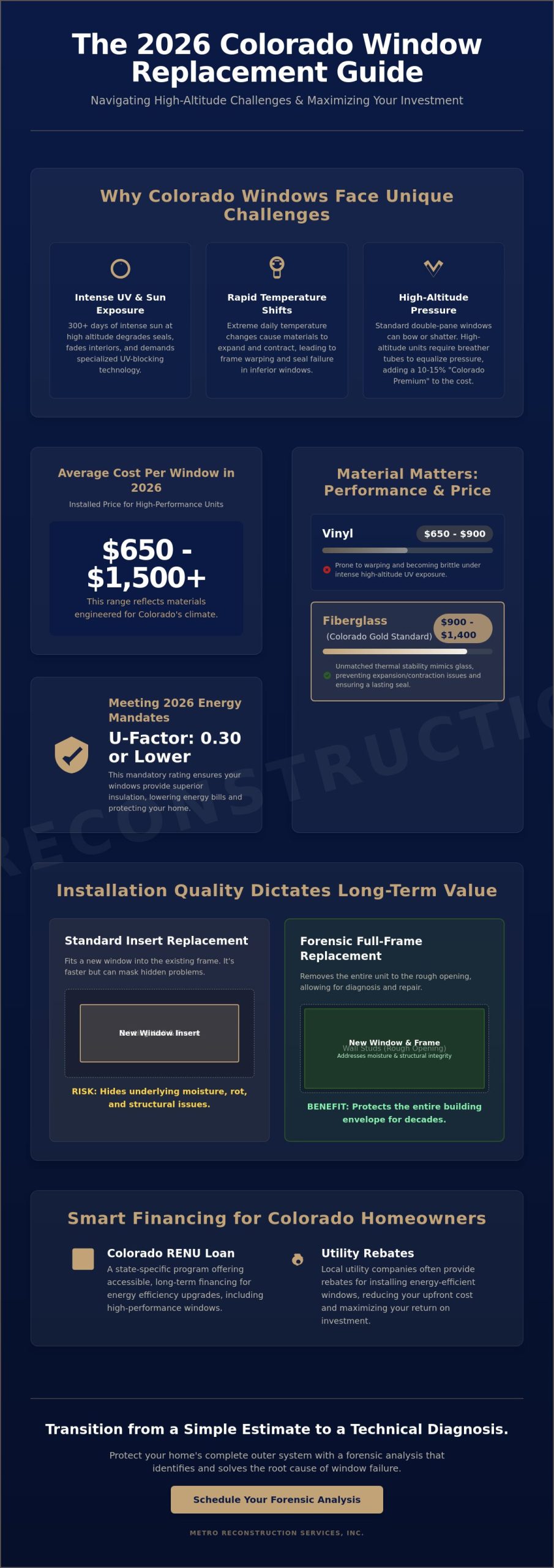
Estimating the average cost of window replacement Colorado residents should budget for in 2026 requires an understanding of regional engineering demands. A baseline range of $650 to $1,500 per unit installed is typical for high-quality replacements. This range isn’t arbitrary; it reflects the necessity of using materials that can withstand 300 days of intense sun and rapid temperature shifts. We see “average” as a moving target because the specific window types and components you select must match the technical profile of your home’s exterior. Whether you choose fiberglass for its thermal stability or wood for its aesthetic value, the investment protects the underlying structural integrity of your property.
Living at altitude introduces environmental stressors that standard national pricing models ignore. Most manufacturers apply a “Colorado Premium” of 10% to 15% to account for specialized engineering. Standard double-pane units manufactured at sea level risk catastrophic failure when transported to 5,000 feet or higher. Without pressure equalization, the glass panes can bow or even shatter. This necessitates the inclusion of capillary tubes or breather tubes to maintain structural stability during the ascent and throughout the life of the unit. The average cost of window replacement Colorado homeowners face is also influenced by the choice between a simple insert and a full-frame reconstruction. While an insert fits into the existing frame, a full-frame replacement involves removing the entire unit down to the rough opening. This forensic approach allows us to identify and remediate the underlying structural origins of previous failures.
Regional Price Variations: Front Range vs. Mountain Towns
Logistics play a significant role in total project costs across the state. While labor markets in Denver and Boulder are competitive, mountain resort communities often face higher rates due to limited local crews and complex delivery routes. Additionally, wildfire-prone zones across the Front Range now frequently mandate tempered or specialized fire-resistant glass. These safety requirements, while necessary for property preservation, add a layer of technical complexity and cost to the installation process. Shipping heavy, fragile units over mountain passes also requires specialized handling that standard estimates often overlook.
The True Cost of High-Altitude Engineering
The intense UV radiation at high altitudes degrades standard window seals faster than in lower elevations. Investing in high-performance glass with superior UV-reflectance isn’t just about comfort; it’s about protecting your interior finishes and maintaining the seal’s longevity. Selecting a high-performance window installation service in Boulder County ensures that the units are specifically calibrated for these conditions. Argon gas fills, while excellent for insulation, require careful management at altitude to prevent seal blowout. Choosing a specialist who understands these hidden mechanics ensures that your windows remain a functional part of your building’s complete outer system for decades.
Material Matters: How Fiberglass, Wood, and Vinyl Impact Your Total Investment
Selecting the right material is the most significant variable when calculating the average cost of window replacement Colorado homeowners will encounter in 2026. While initial price points are a primary concern, the technical performance of the frame material determines whether your investment lasts decades or fails within a few seasons. Standard vinyl windows remain the budget-friendly entry point, typically ranging from $650 to $900 per unit installed. However, these frames often struggle with the intense UV radiation found at our high altitudes. Over time, the material can warp or become brittle, leading to seal failure and air infiltration that compromises your home’s thermal envelope.
Fiberglass has emerged as the “Colorado Gold Standard,” with costs ranging from $900 to $1,400 per installed unit. This material offers unparalleled stability because it is composed of glass fibers and resins that mimic the physical properties of the glass panes themselves. For those seeking premium aesthetics, wood-clad windows offer a classic look with modern exterior protection, though they command a higher price of $1,100 to $1,800 or more. Composite materials represent a middle ground, balancing durability with a more accessible price point. Managing heat gain and heat loss through windows is a critical component of property preservation in our high-desert environment. For homeowners seeking a technical diagnosis of their current frame health, a professional assessment of the complete outer system is the first step toward a lasting solution.
Why Fiberglass Dominates the Front Range Market
Fiberglass is particularly well-suited for the Front Range because its expansion coefficient is nearly identical to that of glass. This means that during a 50-degree temperature swing in a single afternoon, the frame and the glass expand and contract at the same rate. This synchronization prevents the stress on seals that often causes premature failure in vinyl or wood units. Additionally, the inherent strength of fiberglass allows for thinner frames and larger glass panes, enabling homeowners to maximize mountain views without the risk of structural sagging or frame deformation over time.
Glass Packages and U-Factor Requirements for 2026
The 2026 Energy Star standards for the Northern-Central climate zone have raised the bar for thermal efficiency. Meeting the required 0.30 U-factor often necessitates advanced glass packages, such as triple-pane glass in high-country environments where winters are exceptionally harsh. While triple-pane glass increases the average cost of window replacement Colorado residents pay, the reduction in heating costs often justifies the initial outlay. In the sunny Front Range, paying close attention to the Solar Heat Gain Coefficient (SHGC) is equally vital. A lower SHGC helps block the intense solar radiation that can overheat interiors during the summer, further reducing the strain on your cooling systems.
Navigating Colorado-Specific Financing: RENU Loans, Rebates, and ROI
Securing the capital for a comprehensive window project shouldn’t involve high-pressure sales or predatory interest rates. Many homeowners find that the average cost of window replacement Colorado requires is best managed through state-backed initiatives rather than traditional high-interest credit cards. By choosing specialized pathways, you ensure that the financial structure of the project is as sound as the physical installation. These programs are specifically designed to incentivize the high-performance upgrades necessitated by our local climate, allowing you to prioritize structural integrity without draining your immediate savings. For larger projects involving essential exterior home repair, balancing a Home Equity Line of Credit (HELOC) with specialized energy loans can provide the necessary liquidity for a holistic restoration of your building’s outer system.
The Colorado RENU Loan Advantage
The Colorado RENU Loan remains one of the most effective tools for financing energy-efficient upgrades. With interest rates starting at 6.99% APR and terms extending up to 20 years, it offers a level of stability that traditional unsecured loans cannot match. Homeowners can access up to $75,000 to cover the average cost of window replacement Colorado projects demand, provided the windows meet specific energy-efficiency criteria. Our methodology involves providing fixed-price reconstruction fees, which facilitates a smoother approval process with participating RENU lenders. This transparency ensures that the lender understands the technical scope of the work, framing the project as a long-term investment in property preservation rather than a superficial fix.
Stacking Incentives for Maximum Savings
Maximizing your return on investment requires a strategic approach to stacking local, state, and federal incentives. In 2026, federal tax credits allow homeowners to claim 30% of their project costs, up to $600, for windows that meet Energy Star certifications. When combined with Xcel Energy rebates and local utility programs, the net cost of your installation decreases significantly. It’s important to recognize that the Colorado Home Energy Rebate (HEAR) program is currently closed to new applications in the Front Range (Region 1) due to high demand, though it remains active in other counties. We emphasize the necessity of forensic documentation during the installation process. Providing detailed evidence of the new units’ U-factor and air-sealing precision is often a requirement for rebate eligibility, ensuring you receive every dollar of the incentives you’re owed.
The Forensic Perspective: Why Installation Quality Dictates Long-Term Value
A low-cost installation is often the most expensive mistake a homeowner can make. While the average cost of window replacement Colorado residents budget for typically focuses on the price per unit, the technical precision of the labor determines whether that investment actually protects the property. We view a window not as an isolated component but as a critical part of your building’s complete outer system. If the integration between the window frame, the flashing, and the house wrap is flawed, even the most expensive high-performance unit will eventually fail. This failure often manifests as hidden moisture intrusion, which quietly compromises the structural framing long before it becomes visible to the naked eye.
Adopting a forensic approach means we identify and address the underlying structural origins of window failure before the new unit is ever set in place. Many leaks attributed to “bad windows” are actually the result of degraded building paper or improperly layered flashing from the original construction. By correcting these fundamental diagnostics during the replacement process, we ensure the new installation remains watertight for its entire service life. Additionally, professional installation by specialists is the only way to preserve your manufacturer warranty. Most premium window brands will void their coverage if they detect that a failure was caused by improper perimeter sealing or frame distortion during the initial set.
Windows and Stucco: A Critical Structural Interaction
In our regional climate, the relationship between window frames and exterior cladding is particularly sensitive. Many Colorado homes feature stucco or stone veneers that require specialized stucco and masonry repairs during the window replacement process. When a window is replaced without regard for the surrounding material, the seal between the frame and the cladding often breaks. This leads to water being trapped behind the stucco, causing delamination and expensive rot. We focus on integrating new windows into the existing building envelope with surgical precision to maintain a seamless, protective barrier.
Moisture Mitigation at 5,280 Feet
The environmental stressors at a mile high are unique. Colorado’s wind-driven rain and rapid snowmelt cycles demand superior perimeter sealing that can withstand extreme pressure. We utilize specialized sealants that are engineered to remain flexible even in sub-zero temperatures, preventing the cracks that typically form in standard caulking. This level of technical detail is what prevents internal mold growth and foundation-weakening leaks. If you suspect your current windows have already compromised your home’s exterior, you can contact Metro Reconstruction for a comprehensive forensic assessment of your property’s structural health.
Strategic Planning: Securing Your Home’s Outer System with Metro Reconstruction Services, Inc.
Executing a successful project involves more than just selecting a high-performance unit; it requires a comprehensive strategy that addresses the unique demands of the Colorado landscape. While many contractors provide a “free estimate” based on surface-level measurements, we prioritize a technical diagnosis that uncovers the hidden mechanics of your building’s envelope. The average cost of window replacement Colorado homeowners encounter should be viewed as a capital investment in property preservation. By moving beyond temporary patches and focusing on the structural origins of failure, you ensure that your new windows function as a resilient barrier for decades. Our 40 years of family-owned integrity provide the foundation for this meticulous approach, allowing us to offer transparent, fixed-price reconstruction fees that eliminate the uncertainty often associated with complex structural work.
We believe that quiet confidence comes from a position of deep expertise rather than high-pressure sales tactics. When we evaluate a property, we look for the relationship between different technical components, such as how a failing window seal might be contributing to broader moisture intrusion within the wall cavity. This analytical depth allows us to provide long-term solutions that protect your home’s structural integrity. Choosing a seasoned expert means you’ll receive the difficult truth about your property’s health rather than a superficial fix that merely masks underlying decay. This commitment to precision is what distinguishes a professional installation from a standard replacement, securing the peace of mind that your investment is fully protected against the rugged regional environment.
What to Expect During Your Forensic Window Consultation
Our diagnostic process begins with a thorough investigation of the rough opening and the surrounding structural framing. If previous window leaks have allowed water to migrate downward, we provide the necessary documentation for foundation repair services to address any resulting base instability. We also specialize in coordinating your window installation with professional stucco restoration. This ensures that the transition between the new frame and the exterior cladding is watertight and aesthetically seamless, preventing the delamination issues that often plague less rigorous installations. By analyzing the complete outer system, we identify potential stressors before they lead to expensive repairs.
Investing in Peace of Mind
The long-term value of a project done right the first time cannot be overstated in Colorado’s demanding climate. While the average cost of window replacement Colorado residents pay can vary, the cost of remediating a failed installation always exceeds the initial price of a forensic approach. We focus on technical truth and engineering-led solutions to deliver results that stand up to intense UV rays and rapid temperature shifts. If you’re ready to move beyond the “free estimate” and secure a definitive plan for your home’s exterior, we invite you to schedule your forensic window and exterior assessment with Metro Reconstruction Services, Inc. today.
Securing Your Property Through Technical Precision
Navigating the average cost of window replacement Colorado residents face in 2026 requires a shift from viewing windows as individual units to seeing them as critical components of a complete outer system. You now understand that the true value of this investment lies in meeting strict U-factor mandates and utilizing high-altitude engineering to prevent seal failure. By leveraging state-specific financing like the RENU loan and prioritizing forensic installation over superficial fixes, you protect your home’s structural integrity from the destructive effects of moisture and UV degradation.
Our team brings over 40 years of Colorado structural expertise to every project, specializing in high-altitude moisture mitigation that standard contractors often overlook. We provide fixed-price reconstruction project fees to ensure budget certainty, allowing you to focus on quality results rather than hidden costs. It’s time to move beyond the “free estimate” and choose a partner dedicated to technical accuracy and long-term property preservation. Schedule Your Forensic Window Assessment with Metro Reconstruction today to ensure your home remains efficient and sound for decades to come.
Frequently Asked Questions
What is the average cost of window replacement in Colorado for 2026?
Industry data from March 2026 indicates that the average cost of window replacement Colorado homeowners pay is approximately $880.97 per window installed. This figure represents a baseline that varies significantly depending on the frame material and technical glass specifications required for your specific elevation. While basic vinyl units occupy the lower end of the spectrum, high-performance fiberglass windows designed for extreme thermal stability often range between $900 and $1,500 per unit.
Does the Colorado RENU program cover the full cost of window installation?
The Colorado RENU Loan program provides up to $75,000 in financing, which is generally sufficient to cover the full cost of a comprehensive window installation project. This state-backed initiative offers fixed interest rates starting at 6.99% APR with repayment terms extending up to 20 years. It’s an effective tool for homeowners who want to prioritize structural integrity and energy efficiency without the financial strain of high-interest unsecured credit or immediate cash depletion.
Why do windows cost more in Boulder and Denver than the national average?
Front Range costs are driven higher by strict local building codes, including the mandatory 0.30 U-factor requirement that became effective on January 1, 2026. Additionally, Colorado’s unique geography necessitates high-altitude engineering that standard national products lack. Features like capillary tubes for pressure equalization and specialized UV coatings add a regional premium of 10% to 15% but are essential for preventing premature seal failure in our rugged environment.
Can I get a tax credit for energy-efficient windows in Colorado this year?
Homeowners can currently claim a federal tax credit of 30% of their project costs, up to a maximum of $600, for windows that meet ENERGY STAR certification. While the state-level HEAR rebate program is closed to new applications in the Front Range due to high demand, these federal incentives remain available. Utilizing these credits helps offset the average cost of window replacement Colorado residents face while ensuring the home meets modern efficiency standards.
Do I need special windows for high-altitude Colorado homes?
Windows installed at elevations above 5,000 feet must be equipped with breather or capillary tubes to equalize the pressure between the insulated glass panes. Without these specialized components, the pressure difference between the manufacturing facility and your home can cause the glass to bow or the seals to rupture. This specialized engineering is a fundamental requirement for maintaining the long-term structural integrity of any window installation in the Rocky Mountain region.
How long does it take for new windows to pay for themselves in energy savings?
The timeline for a return on investment depends on your previous energy loss, but the primary value of new windows is the preservation of the building’s complete outer system. High-performance units drastically reduce thermal transfer, which lowers monthly utility bills and prevents the expensive structural decay caused by moisture intrusion. We view the payback period not just in energy dollars, but in the avoidance of costly future repairs to your home’s framing and exterior cladding.
What is the best window material for Colorado’s extreme temperature swings?
Fiberglass is the superior choice for Colorado because its expansion and contraction rates almost perfectly match those of the glass panes it holds. When our temperatures shift 50 degrees in a single day, fiberglass frames move in unison with the glass, which prevents the seal stress common in vinyl or wood units. This thermal synchronization ensures the window remains airtight and structurally sound throughout decades of intense UV exposure and rapid weather changes.
Does window replacement involve stucco or siding repair?
A technically sound window installation often requires integrated stucco or masonry work to ensure a seamless and watertight transition. If the surrounding cladding isn’t properly addressed during the replacement, moisture can become trapped behind the exterior finish, leading to delamination and hidden rot. Our forensic approach treats the window and the exterior wall as a single, unified system, which is vital for protecting the underlying structural mechanics of your property.