
What if the subtle draft in your living room is actually a warning sign of a compromised building envelope? While many homeowners wait for visible cracks or shattered glass to take action, the reality is that window failure is often a silent process that slowly degrades your home’s entire outer system. If you’ve found yourself wondering are your windows failing, you’re likely already noticing the early symptoms of a deeper structural issue. You might feel a persistent chill during a Colorado winter or see the unsettling sight of peeling paint and softened wood around your frames.
We understand the uncertainty that comes with rising energy costs and the question of whether a simple repair or a full replacement is necessary. This article, prepared by the technical specialists at Metro Reconstruction Services, Inc., provides a clear path forward by teaching you how to spot the subtle signs of failure before they lead to expensive stucco damage or moisture intrusion. You’ll gain a comprehensive checklist of what to look for and the confidence to decide when it’s time to bring in a professional diagnostic. By looking behind the surface, you can protect your investment and ensure your home remains a secure, efficient sanctuary for years to come.
Key Takeaways
- Learn to distinguish between simple cosmetic wear and the deeper functional failures that threaten your home’s complete outer system.
- Understand why asking “are your windows failing” is often the first step in identifying hidden moisture damage within your exterior stucco.
- Discover how Colorado’s intense UV radiation and extreme temperature shifts accelerate the breakdown of window seals and frame stability.
- Evaluate the long-term value of window replacement by comparing the initial investment against energy savings and structural protection.
- Gain the clarity needed to choose between temporary repairs and a holistic restoration that preserves your property’s long-term health.
Recognizing the Early Warning Signs of Window Failure
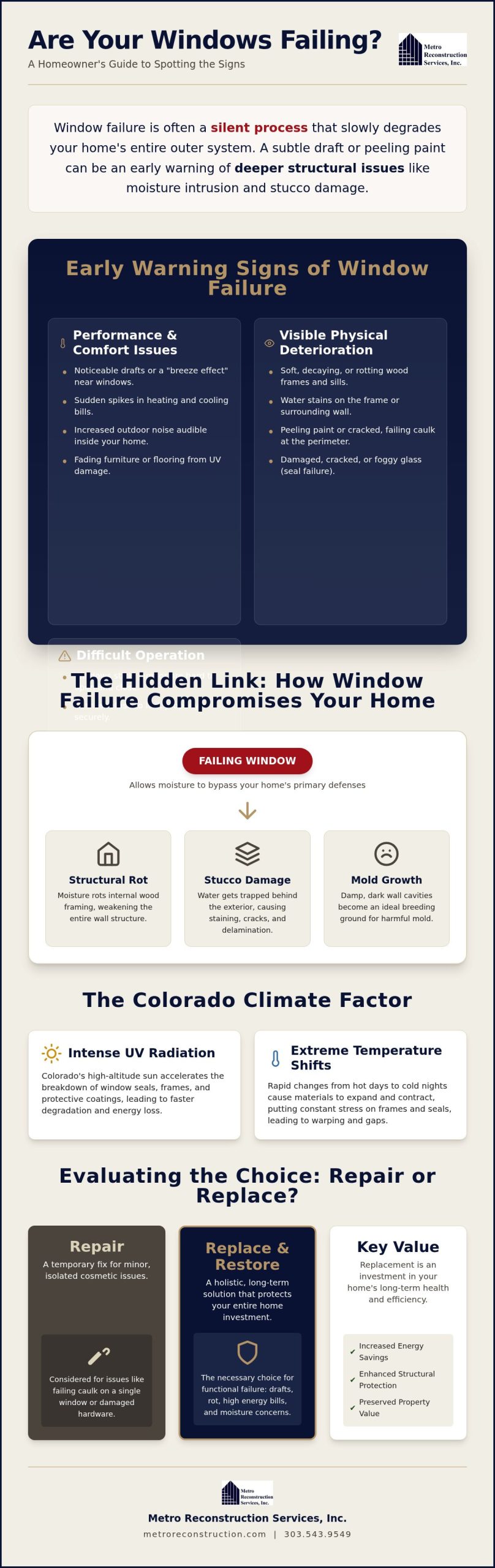
Determining whether a window requires professional attention involves more than a cursory glance at the glass. For many homeowners, the question are your windows failing arises when a room feels colder than it should or when a sash becomes difficult to lift. It’s vital to distinguish between cosmetic wear, such as surface scratches or outdated hardware, and true functional failure. Functional failure occurs when the window can no longer perform its primary duties: maintaining a thermal barrier, shedding water away from the structure, and providing secure operation. When these core functions break down, the window stops being a protective shield and starts becoming a liability for the rest of your home’s exterior.
Difficult operation is a significant red flag that goes beyond mere annoyance. When a window sticks, jams, or refuses to lock properly, it often indicates that the frame has warped or the home’s rough opening has shifted over time. This mechanical resistance puts undue stress on the hardware and the perimeter seals. Similarly, a sudden increase in outdoor noise suggests that the sound-dampening properties of your insulated glazing have been compromised. If the airtight seal is broken, the inert gas that provides insulation has likely escaped, meaning the window’s ability to regulate temperature is effectively gone.
Visible Physical Deterioration
Physical decay is often the most direct evidence of a failing system. We frequently observe soft, rotting wood or water-stained frames that suggest moisture is bypassing the window’s intended drainage path. Peeling paint or failing caulk around the perimeter aren’t just aesthetic concerns; they’re indicators of moisture movement that can lead to significant stucco damage. Cracked glass or damaged frames also present immediate safety risks and negate any energy efficiency the unit once provided. These visible cues are the house’s way of signaling that the building envelope is no longer watertight.
Performance and Comfort Issues
Your monthly utility bills often tell the story that your eyes might miss. Unexplained spikes in heating and cooling costs frequently stem from windows that no longer hold a seal against the elements. You might notice the ‘breeze’ effect, where drafts are palpable even when the units are locked tight. Additionally, if you see your furniture or flooring beginning to fade, it’s a sign that the UV-protective coatings have degraded. In Colorado’s high-altitude environment, this loss of protection accelerates the aging of your entire interior, making are your windows failing a question that impacts your home’s value both inside and out.
If you have noticed these warning signs, protecting your home’s structural integrity starts with accurate diagnostics. Contact Metro Reconstruction Services, Inc. at 303.543.9549 or visit our contact page to schedule a professional evaluation and explore our restoration services.
The Hidden Link: How Window Failure Impacts Your Home’s Structural Integrity
A window is a critical component of your home’s building envelope, serving as a functional bridge between your interior living space and the external stressors of the Colorado climate. When this bridge weakens, the consequences extend far beyond the window frame itself. A window that has lost its structural integrity no longer works in harmony with your walls, creating a vulnerability that allows environmental elements to bypass your home’s primary defenses. When homeowners ask are your windows failing, they often focus on the glass, but the most critical damage usually occurs where the window meets the wall. This intersection is where moisture mitigation becomes a matter of property preservation rather than just a simple home improvement task.
The relationship between a failing window and the surrounding wall is often one of cause and effect. Structural settling can cause a window to shift, breaking the perimeter seals and allowing water to enter the wall cavity. Conversely, a window with failed flashing can allow moisture to rot the internal wood framing, leading to further structural instability. This moisture creates an ideal environment for mold growth, which can spread undetected behind your drywall for years. Understanding the restoration services required to fix these issues involves looking at the building as a complete outer system rather than a collection of isolated parts.
Moisture Intrusion and Stucco Damage
In many Denver homes, a leaking window is the primary cause of extensive stucco failure. When water bypasses the window’s flashing, it becomes trapped behind the stucco layer, where it cannot evaporate. This leads to the appearance of ‘stucco tears’ or dark staining at the bottom corners of the window. Over time, this trapped moisture rots the wooden studs and sheathing that support your home’s weight. Identifying these underlying structural origins is essential because a superficial patch to the stucco will not stop the ongoing rot if the window’s drainage system is the root cause of the failure.
Seal Failure and the Building Envelope
When the ‘thermal bridge’ of a window breaks down, the building envelope is effectively compromised. High-performance window spacers are designed to keep the glass panes separated and the seals intact, but moisture intrusion can cause these components to degrade prematurely. This breakdown allows heat to transfer freely, forcing your HVAC system to work harder and increasing the cost of window replacement when the damage becomes too severe to ignore. Localized repairs often fail to address these systemic issues, which is why a holistic evaluation is the only way to ensure long-term reliability. If you suspect your home’s exterior is at risk, our team can provide a detailed diagnostic to uncover the truth behind the surface.
Addressing these hidden structural links requires a partner who understands the complex mechanics of property preservation. You can reach Metro Reconstruction Services at 303.543.9549 or through our contact page to discuss your home’s specific needs.
Evaluating the Choice: Should You Repair or Replace Your Windows?
Homeowners often find themselves at a crossroads when determining the best path forward for their property’s exterior. Deciding whether to invest in a targeted repair or a full-scale replacement requires an objective analysis of the unit’s current state and its remaining functional lifespan. If you’re asking are your windows failing, the answer often hinges on whether the issue is isolated to a mechanical component or if it has compromised the unit’s structural frame. While a simple hardware fix might resolve a sticking sash, it cannot restore the thermal integrity of a unit that has suffered total seal failure. At Metro Reconstruction Services, Inc., we believe in providing the difficult truth about a window’s condition rather than offering a temporary patch that may lead to more expensive structural challenges later.
The financial aspect of this decision is equally significant when looking at long-term property preservation. High-quality replacement projects in the Denver market typically offer a return on investment of 70% to 80%. Beyond the immediate boost to property value, modern units engineered for our climate can reduce annual heating and cooling costs by 25% to 40%. When you consider that new standards effective in 2026 require residential windows to meet strict ENERGY STAR Northern Climate Zone requirements, the long-term value of an upgrade becomes even clearer. Choosing a high-performance solution today protects your investment against rising energy costs and future regulatory shifts.
When a Professional Repair is Sufficient
There are instances where the building’s complete outer system remains healthy and the issue is strictly localized. If the window frame is solid and there’s no evidence of moisture intrusion, addressing minor hardware malfunctions or broken latches is a sensible choice. Replacing worn weatherstripping can effectively eliminate minor drafts and restore comfort without the need for a full installation. Glass-only replacement may also be a viable budget-friendly option if the failure is limited to a single shattered pane and the original seals are still performing their duty.
Signs that Full Replacement is Necessary
Replacement becomes the only responsible course of action when a unit can no longer protect the home’s framing. Widespread frame rot is a definitive sign of failure, as it indicates that moisture has already begun to compromise the structural support of the opening. If you observe severe seal failure across multiple units, it’s often a symptom of aging materials that can no longer withstand Colorado’s intense UV radiation and rapid temperature swings. Upgrading to advanced materials like fiberglass ensures that your new windows expand and contract at a rate similar to glass, providing a more reliable, long-term seal.
Making the right choice for your home requires a specialist’s eye to identify underlying structural origins. To receive a professional evaluation of your home’s windows and exterior, contact Metro Reconstruction Services, Inc. at 303.543.9549 or visit our contact page. We’re here to help you navigate these technical complexities with confidence.
Taking Action: How to Address Window Issues in the Colorado Climate
Colorado’s climate presents a unique set of challenges that standard, off-the-shelf window products simply aren’t designed to handle. At an elevation of 5,280 feet, Denver homes are exposed to significantly higher levels of UV radiation, which accelerates the chemical breakdown of sealants and frame materials. When you ask are your windows failing, you must consider the atmospheric pressure differences inherent to our high-altitude environment. Without capillary or breather tubes to equalize pressure, insulated glass units can experience seal failure or glass bowing. These regional stressors, combined with rapid temperature fluctuations that cause frames to expand and contract at different rates than the glass, make generic solutions a risky investment for Front Range homeowners.
The Importance of a Professional Diagnostic
A standard sales estimate often overlooks the underlying structural origins of a leak. A forensic diagnostic moves beyond the surface, utilizing specialized tools like moisture meters and thermal imaging to identify water trapped within the wall cavity. While a window salesman focuses on the unit itself, a reconstruction expert evaluates the building’s complete outer system. If you are noticing drafts or sticking frames, the question of are your windows failing should lead to a technical diagnostic rather than a simple cosmetic repair. This analytical depth is necessary to determine if the moisture you see is a result of window failure or a symptom of a larger issue with your exterior stucco.
Choosing a Qualified Local Contractor
Selecting a partner with deep regional expertise is the most effective way to ensure a long-term solution. With over 40 years of experience in Boulder and the Front Range, we understand the critical relationship between windows, flashing, and stucco integration. It’s essential to ask potential contractors how they plan to manage the transition between these technical components to prevent future moisture intrusion. We favor a transparent, straightforward approach, offering fixed-price project fees that provide peace of mind for complex renovations. This commitment to precision ensures that your home remains protected against the demanding Colorado environment.
If you suspect your home’s defenses are compromised, it is time to consult with specialists who look behind the wall. Schedule a forensic evaluation with Metro Reconstruction Services today to protect your property’s structural health. You can reach our team at 303.543.9549 or through our contact page.
The Metro Approach: Holistic Window and Exterior Restoration
At Metro Reconstruction Services, we recognize that a window is never just a standalone component. It is a vital part of your building’s complete outer system. When homeowners ask are your windows failing, they deserve more than a surface-level estimate that ignores the surrounding wall structure. Our methodology is rooted in forensic expertise, which means we prioritize identifying the underlying structural origins of every issue. By focusing on the intersection of windows, stucco, and moisture mitigation, we provide long-term reliability that superficial patches simply cannot match. This commitment to precision ensures that your home remains a secure and efficient sanctuary regardless of the environmental stressors it faces.
We believe that integrity in construction comes from a refusal to offer low-quality patches for complex structural failures. Our team approaches every project with the mindset of a dedicated partner in property preservation. This means we take the time to explain the difficult truth of a structural failure rather than offering a quick fix that will fail in a few seasons. By looking behind the wall, we protect your investment and ensure that the root cause of your window or stucco issue is fully resolved.
Integrating Windows into the Building Envelope
Successful restoration requires a seamless transition between the window unit and the exterior wall. We ensure that flashing and sealants are meticulously installed to create a watertight finish that directs moisture away from the internal framing. Because we specialize in both window installation and masonry work, we can match your existing stucco or stone for a flawless aesthetic appeal. This holistic view prevents the common failure points found in projects where multiple contractors work in isolation. You can learn more about our comprehensive restoration services to see how we protect every layer of your home’s exterior.
Long-Term Protection for Your Investment
Choosing a partner for structural preservation is an investment in your property’s future value. We offer personalized project management for every client, ensuring that the specific technical challenges of your home are addressed with meticulous care. Our deep roots in the Front Range since 1982 give us a unique perspective on how to harden a home against Colorado’s intense sun and rapid temperature shifts. This experience is why we are the preferred construction company in Boulder, CO. We don’t just fix a symptom; we restore the integrity of the whole system, providing you with the peace of mind that comes from a job done correctly the first time.
If you’re concerned that are your windows failing, don’t settle for a temporary fix. Contact Metro Reconstruction Services at 303.543.9549 or visit our contact page to schedule a professional evaluation. We look forward to becoming your dedicated partner in property preservation.
Securing Your Property’s Structural Future
Preserving the health of your home requires an understanding that windows are more than just glass panes; they are critical components of a complex building envelope. When these units lose their integrity, the resulting moisture intrusion can lead to silent decay within your walls and expensive stucco failure. If you have noticed rising energy costs or difficult operation and find yourself asking are your windows failing, the time for a professional diagnostic has arrived. Early action prevents minor leaks from becoming structural failures. This proactive step protects your long-term investment.
Our family-owned company brings over 40 years of local expertise to every project, utilizing a forensic approach to uncover the hidden mechanics of your home’s exterior. We prioritize accuracy and reliability, ensuring that every restoration provides lasting protection against Colorado’s demanding high-altitude climate. Don’t let failing windows compromise your home. Contact Metro Reconstruction Services today or call us at 303.543.9549 for a professional assessment. We are ready to help you restore the peace of mind that comes from a healthy, well-preserved property.
Frequently Asked Questions
How can I tell if my windows are failing if I don’t see any cracks?
You can identify failure through operational resistance or audible changes in your environment. If you find yourself asking are your windows failing despite the glass being intact, check for sticking sashes or increased outdoor noise levels. These symptoms suggest the frame has warped or the airtight seals have degraded, which compromises the unit’s ability to protect your home’s interior.
Is condensation between the glass panes a serious problem?
Condensation between panes is a definitive sign of total seal failure. This moisture indicates that the insulating gas has escaped and the internal desiccant is fully saturated. Once this occurs, the window’s thermal efficiency is permanently lost, and the unit can no longer provide the structural protection or energy savings your home requires.
How long do windows typically last in the Colorado climate?
Windows in the Front Range often face a shorter functional life than the national average due to intense high-altitude UV radiation and rapid temperature shifts. While many units are marketed to last 20 years, the extreme environmental stress in Denver can cause seals and frames to degrade prematurely. Regular diagnostics are essential to monitor the performance of your building’s complete outer system.
Can I just replace the glass or do I need a whole new window?
Replacing just the glass is often a superficial fix that fails to address the underlying structural origins of the problem. If the window frame is rotting, warped, or has failed flashing, new glass won’t restore the building envelope’s integrity. We specialize in full window replacement to ensure a watertight, long-term solution that protects your home’s framing and exterior stucco.
Does failing stucco cause windows to leak, or is it the other way around?
It is often a reciprocal relationship, but window flashing failure is a primary cause of extensive stucco damage. When water bypasses the window’s intended drainage path, it becomes trapped behind the stucco, leading to rot in the internal wooden studs. We evaluate the entire system to identify whether the window or the wall cladding is the root cause of the moisture intrusion.
Why are my energy bills rising even though my windows look fine?
Rising utility costs often stem from invisible seal failure that allows heat to transfer freely through the glass. Your windows may look fine to the naked eye, but if the thermal barrier is compromised, your HVAC system must work harder to maintain a consistent temperature. This is a common indicator that are your windows failing is a question requiring a technical diagnostic.
What is the danger of ignoring a drafty window for too long?
Ignoring a drafty window allows moisture to enter the wall cavity, where it can cause undetected rot and mold growth. This moisture intrusion compromises the structural health of your home and can lead to expensive restoration needs. Addressing drafts early prevents these complex structural challenges from escalating into a total system failure.
Should I replace all my windows at once or can I do it in stages?
While replacing windows in stages is possible for budget management, replacing them as a single project ensures consistent performance and better structural integration. This approach allows for a unified moisture mitigation strategy across the entire building envelope. If you’re unsure where to start, contact Metro Reconstruction Services at 303.543.9549 or through our contact page for an assessment.