
Replacing your historic wood windows to save on energy costs might actually be the most expensive mistake you make this year. You likely value the unique character of your Boulder home, yet the bite of a drafty winter and the sight of visible rot on your sills make it hard to justify keeping them. It’s frustrating to face strict Landmark Alteration Certificate requirements when your utility bills are climbing and moisture is clearly compromising your building’s exterior envelope.
We understand that you want a home that’s both beautiful and high-performing. This guide explains how professional wood window restoration Boulder specialists use to protect your investment while meeting the 2026 ENERGY STAR standards of a 0.22 U-Factor. You’ll discover how a forensic approach to moisture management can eliminate drafts and secure state tax credits worth up to 20% of your rehabilitation costs. We’ll break down the technical differences between a temporary patch and a long-term reconstruction that respects your home’s original character and ensures it’s built right the first time.
Key Takeaways
- Learn why professional wood window restoration Boulder services prioritize forensic stabilization of sashes and frames over simple aesthetic repairs.
- Identify the root causes of window failure by looking beyond surface symptoms to find where moisture is trapped within the frame.
- Compare the long-term value of old-growth wood against modern replacements and debunk common myths about thermal performance in historic homes.
- Find out how to comply with Boulder’s strict landmark regulations while securing tax credits and grants that offset the cost of high-quality restoration.
- Understand why a holistic approach to the exterior envelope by Metro Reconstruction Services, Inc. is the only way to ensure your restoration project is built right the first time.
The Value of Wood Window Restoration in Boulder’s Historic Districts
True wood window restoration Boulder is a process of forensic stabilization that goes far beyond a simple coat of paint or a bead of caulk. It involves the careful analysis and repair of original sashes, sills, and frames to ensure they function as a cohesive part of the home’s exterior envelope. In historic neighborhoods such as Mapleton Hill and Goss-Grove, these windows are not just functional openings; they are essential architectural features that define the building’s soul. Preserving these elements is a commitment to the principles of historic preservation, ensuring that the home’s original design intent remains intact for future generations.
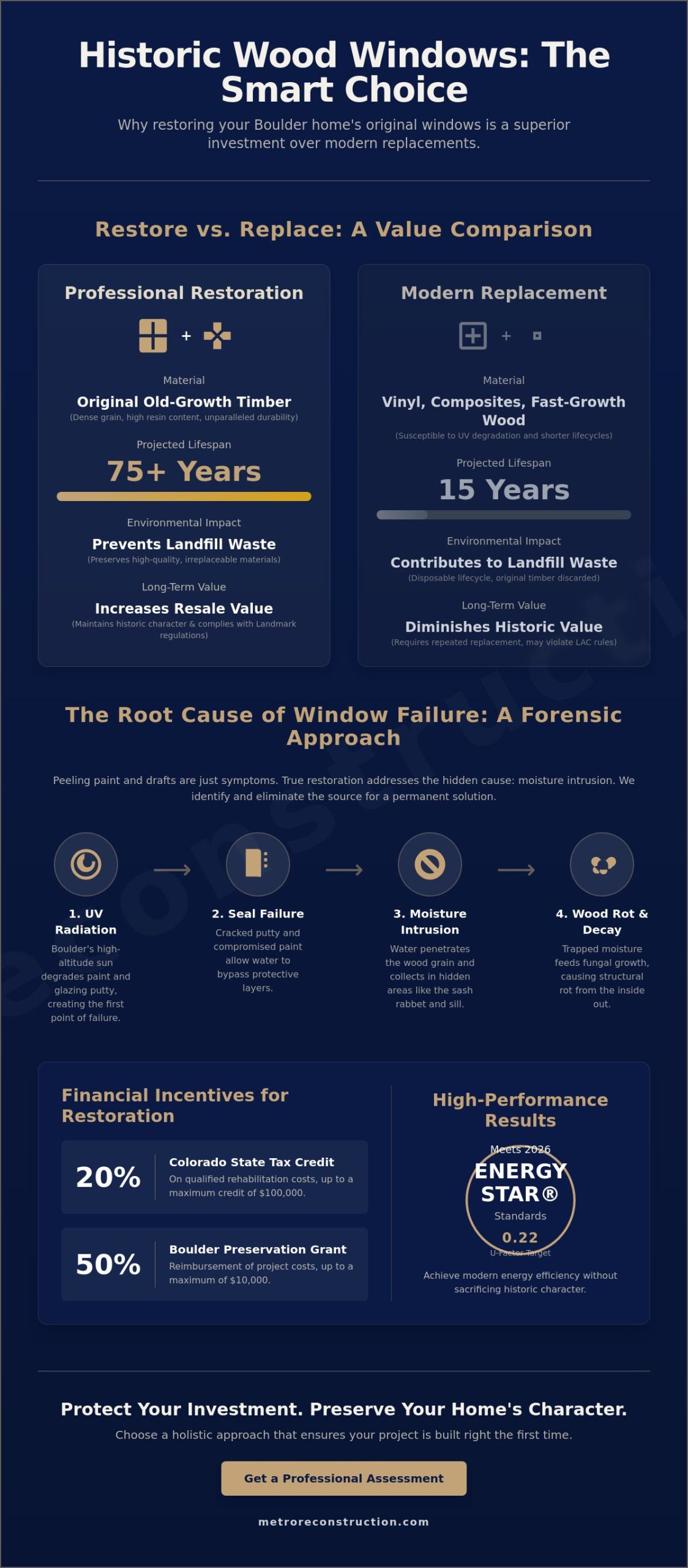
Original windows were typically constructed from old-growth timber, a material harvested from forests that grew slowly over centuries. This results in a tight grain and high resin content that modern, fast-growth lumber simply cannot replicate. While modern replacement windows often rely on a 15-year lifecycle of vinyl or composite materials, a restored wood window can easily exceed a 75-year lifespan. This longevity makes restoration a superior environmental choice, as it prevents high-quality timber from entering landfills while maintaining a material that’s inherently more durable than its disposable counterparts.
Boulder’s Climate: A Unique Challenge for Wood
At an elevation of 5,430 feet, Boulder presents a harsh environment that punishes building materials. High-altitude UV radiation is significantly more intense than at sea level, causing traditional paints and glazing putties to oxidize and fail prematurely. This degradation often leads to moisture intrusion, which is the root cause of most window failures. The Front Range is also famous for rapid temperature swings, sometimes exceeding 40 degrees in a single afternoon. These fluctuations cause constant expansion and contraction in wood joinery, stressing the bonds between components. Without specialized moisture management and high-performance finishes, the dry climate can also cause wood to shrink and check, creating pathways for seasonal moisture to settle and rot the core of the sash.
Economic Impact of Historic Preservation
Investing in your home’s original windows is a sound financial strategy that protects your property’s resale value. Because all exterior changes to landmarked properties require a Landmark Alteration Certificate (LAC), the Boulder Landmarks Board strongly favors restoration over replacement. Homeowners can leverage significant financial incentives to offset costs, including a Colorado state income tax credit equal to 20% of qualified rehabilitation expenses, up to a maximum of $100,000. Additionally, the Boulder Residential Historic Preservation Grant Program offers reimbursements of up to 50% of project costs, capped at $10,000. When you consider these incentives alongside the long-term durability of old-growth wood, the return on investment far outweighs the recurring costs of cheap replacement cycles. We believe every project should be built right the first time, ensuring your home remains a high-performance asset for decades.
Forensic Analysis: Identifying the Root Causes of Window Failure
Successful wood window restoration Boulder requires a shift in perspective. Instead of treating peeling paint or a stuck sash as the primary problem, we view these as symptoms of a deeper failure within the exterior envelope. A forensic approach means looking past the surface to understand why moisture is trapped in the frame and how it’s compromising the structural integrity of the wood. When we identify the root cause, we can implement a solution that prevents the same decay from returning in five years.
The relationship between failing paint, cracked glazing putty, and wood rot is a direct cause-and-effect chain. When UV radiation breaks down the protective paint layer, moisture finds its way into the wood grain. If the glazing putty has pulled away from the glass, rainwater sits in the sash’s rabbet, saturating the end-grain. This creates a hidden reservoir of moisture that feeds fungal growth. Often, a window sill may look sound on the outside, but our analysis frequently reveals that the underlying framing is completely saturated because of a failure in the transition between the window and the siding.
The Role of Moisture Intrusion
Moisture doesn’t just attack from the front. Improper flashing at the window head is a common culprit for internal wall rot that goes unnoticed for years. When water bypasses the head casing, it travels down the side of the window buck, rotting the weights and pulleys from the inside out. We also pay close attention to the wicking effect. Because wood is a bundle of microscopic tubes, end-grain at the bottom of a sash will pull moisture upward if the sill isn’t sloped at the correct angle to shed water. Interior condensation is another factor; in Boulder’s cold winters, warm indoor air hitting a single pane of glass can create enough runoff to damage the interior stool and apron if the window isn’t properly sealed.
Structural Symptoms You Shouldn’t Ignore
Identifying which issues are cosmetic and which are structural is vital for a high-performance restoration. If a window is difficult to open, it might be paint-bound, but it could also indicate that the house has settled or the frame has shifted. Visible daylight around the sash is a clear sign of air infiltration, which directly undermines your energy efficiency. To determine the depth of decay, we use a simple but effective pick test. By pressing a small probe into the wood, we can feel the difference between surface soft spots and deep-seated rot that requires a full epoxy consolidation or a Dutch-man repair. For a detailed look at technical standards, we often refer clients to The Repair of Historic Wooden Windows, which outlines the federal guidelines we exceed in our daily practice.
Understanding these hidden mechanics is the first step toward a home that is truly built right the first time. If you suspect your windows are showing signs of more than just age, it may be time to schedule a forensic assessment to protect your building’s envelope before the next season hits.
Restore vs. Replace: Making the Right Choice for Your Boulder Home
The decision to invest in wood window restoration Boulder homeowners often face comes down to a choice between preserving a high-performance original component or opting for a modern replacement that may only last 15 years. We believe in the “Built Right” factor, which recognizes that the old-growth wood found in Boulder’s historic homes is a non-renewable resource with structural density that modern lumber cannot match. Replacing these units often triggers a cascade of hidden costs. A full-frame replacement frequently requires the removal of original interior trim and can compromise the surrounding siding or stucco, leading to a much larger disruption of the exterior envelope than homeowners initially anticipate.
Performance Comparison
Many people believe the myth that original single-pane windows are inherently inefficient. However, the U.S. Department of Energy indicates that while windows account for significant energy loss, replacing them with modern models only saves an average of 12% on annual energy bills. When we apply high-performance weatherstripping and integrate low-profile storm windows, a restored unit can approach the thermal efficiency of modern double-pane glass without the risk of seal failure. These restored windows also provide superior sound dampening due to the sheer mass of the old-growth timber. While fiberglass or clad-wood products promise low maintenance, they operate on a much shorter lifecycle. A properly restored wood window, maintained on a regular cycle, will continue to function for another century. We follow the National Park Service guidelines on historic window repair to ensure every project meets federal preservation standards.
Decision Matrix for Homeowners
To help you determine the best path forward, we utilize a specific decision matrix based on structural integrity and historical value. We generally follow the 50% rule: if more than 50% of the sash or frame has succumbed to deep-seated decay that cannot be consolidated with epoxy, a high-fidelity replication may be more cost-effective than a restoration. The process of wood window restoration Boulder specialists provide is designed to save as much original material as possible. We also evaluate the presence of original “wavy” or cylinder glass, which is a hallmark of Boulder’s heritage homes and adds significant intangible value to the property. If your long-term plan is to remain in the home for more than 10 years, restoration is almost always the superior financial choice. It protects your investment by addressing the root cause of failure rather than offering a temporary aesthetic patch.
High-Performance Restoration: Protecting the Entire Exterior Envelope
Our philosophy at Metro Reconstruction Services, Inc. is built on the understanding that a window is only as good as the wall it sits in. Many contractors treat wood window restoration Boulder as a purely aesthetic task; however, we approach it as a critical component of a building’s forensic reconstruction. If the interface between the window frame and the surrounding wall is compromised, even the most beautifully restored sash will eventually fail. This is why we often coordinate our efforts with stucco restoration to ensure the entire transition is watertight and the drainage plane is continuous. By addressing the root cause of moisture intrusion at the perimeter, we protect the structural integrity of the home’s framing and prevent the costly cycle of repetitive repairs.
Our methodology focuses heavily on moisture management, particularly at the window sill and sub-sill. These components are the primary defense against water, yet they’re frequently the most neglected. We ensure that every sill is properly sloped to shed water away from the building, utilizing high-performance flashing and back-dams to prevent water from wicking into the rough opening. This technical precision is what allows us to promise a solution that’s built right the first time, giving homeowners peace of mind that their investment is shielded from the elements.
The Restoration Process Step-by-Step
The process begins with the careful extraction of the sashes, a delicate task that requires removing stops and parting beads without splintering historic trim or cracking interior plaster. Once removed, we perform lead paint abatement and strip away decades of accumulated grime to reveal the raw timber. For areas where decay has begun, we use high-performance epoxy consolidation to revitalize softened wood fibers, effectively turning the porous material into a durable, moisture-resistant composite. Finally, we re-glaze the glass using modern sealants that maintain a traditional aesthetic while providing a vastly superior seal against Boulder’s intense wind and temperature fluctuations.
Beyond the Sash: Casing and Masonry Integration
A comprehensive restoration must look into the rough opening. We inspect the hidden framing for signs of historic moisture damage that occurred long before the visible symptoms appeared. In Boulder’s heritage homes, wood windows often interface with masonry or stone sills. These transitions require specialized caulking and sealants that can withstand high-altitude UV radiation and low humidity without losing their elasticity. If your home’s exterior shows signs of failure, contact our team for a comprehensive envelope assessment to ensure every component of your home is working in harmony.
Investing in Longevity: The Metro Reconstruction Approach
Selecting a partner for wood window restoration Boulder requires an expert who understands the complex mechanics of high-altitude construction and the specific vulnerabilities of historic timber. Metro Reconstruction Services, Inc. brings four decades of specialized experience to every project we undertake. We don’t believe in temporary patches or aesthetic shortcuts that fail after a few seasons. Our philosophy is rooted in the belief that every preservation task must be built right the first time. We bridge the gap between 19th-century craftsmanship and modern engineering, ensuring your home remains protected against the unique stresses of the Colorado climate.
Our approach is fundamentally engineering-led. We treat the window as a critical failure point in the building’s defense against moisture. By applying forensic analysis to every sash, sill, and frame, we identify the specific environmental factors causing decay in your neighborhood. This level of technical precision allows us to move beyond simple repairs toward a comprehensive revitalization of your property’s value and performance. It’s about providing a long-term solution that respects the building’s original character while exceeding modern performance expectations.
Expert Project Management for Boulder Residents
We provide a level of transparency that’s rare in the construction industry. Our fixed-price reconstruction fee structure eliminates the uncertainty often associated with historic preservation, giving you peace of mind from the initial contract to the final walkthrough. Our team consists of specialized craftsmen who embody the Wise Craftsman persona; they’re meticulous, detail-oriented, and deeply committed to the integrity of your investment. Because we specifically serve the Front Range and Mountain communities, we understand how the interplay of low humidity and intense sun affects different wood species. We don’t just work on houses; we partner with homeowners to ensure their heritage properties are resilient for another forty years.
Schedule Your Forensic Window Assessment
The first step toward a successful wood window restoration Boulder project is a thorough structural mitigation evaluation. During this initial phase, we don’t just look at the peeling paint. We inspect the entire assembly to identify the root cause of moisture intrusion, whether it’s a failure in the head flashing or a lack of proper slope on the sub-sill. This diagnostic phase is essential because it allows us to develop a preservation plan that addresses hidden mechanical failures before they lead to structural rot. We believe in providing the difficult truth about your building’s condition rather than a cheap, temporary fix. Contact Metro Reconstruction Services, Inc. today to schedule your forensic assessment and take the first step in protecting your home’s architectural legacy.
Securing Your Home’s Architectural Legacy
Preserving your home’s architectural integrity requires shifting from surface-level repairs to a comprehensive understanding of the entire exterior envelope. Successful wood window restoration Boulder projects prioritize forensic moisture management over quick aesthetic fixes to ensure long-term durability. By addressing the root cause of decay and utilizing high-performance stabilization, you protect the high-density, old-growth timber that makes your historic property irreplaceable. This technical approach doesn’t just satisfy landmark requirements; it secures your building’s performance for the next generation.
Metro Reconstruction brings over 40 years of industry expertise to the unique challenges of Boulder County. We’re a family-owned firm dedicated to high-performance craftsmanship and the peace of mind that comes from a holistic approach to the exterior envelope. Whether you’re managing historic district regulations or preparing for new energy standards, our team ensures your home is built right the first time. Request a Forensic Window Assessment from Metro Reconstruction to begin your comprehensive preservation plan. Your home’s legacy is an investment that deserves the technical precision and protective care of a seasoned expert.
Frequently Asked Questions
Is wood window restoration worth it in Boulder compared to replacement?
Restoration is a financially sound investment because it preserves the high-density, old-growth wood that modern replacement units lack. In the City of Boulder, original windows are essential for maintaining property value in historic districts. Homeowners can also access a 20% state income tax credit for qualified rehabilitation costs, making wood window restoration Boulder a more cost-effective choice than a full replacement cycle every 15 years.
How long does a professional wood window restoration typically last?
A professionally restored wood window can exceed a 75-year lifespan if the exterior envelope is properly maintained. Unlike modern vinyl or composite units that often fail within 15 years due to seal degradation, old-growth wood is structurally resilient. When we use high-performance epoxies and modern sealants, we ensure the unit is built right the first time to withstand high-altitude UV exposure and temperature swings.
Can restored wood windows be energy-efficient for Colorado winters?
Restored windows can approach modern thermal standards when integrated with high-performance weatherstripping and low-profile storm windows. While the 2026 ENERGY STAR requirements mandate a 0.22 U-Factor for new units, a restored single-pane window with a storm attachment provides a comparable thermal break. This configuration significantly reduces the 12% average energy loss typically attributed to poorly sealed windows in Colorado homes during the winter months.
Do I need a permit for wood window repair in the City of Boulder?
You must obtain a Landmark Alteration Certificate (LAC) for any exterior changes if your property is individually landmarked or located within a historic district. The City of Boulder’s design guidelines prioritize restoration over replacement to protect the city’s architectural heritage. Minor repairs like simple glass replacement might not require a full permit, but any work affecting the window’s appearance or structural profile requires formal board approval.
What are the signs that my wood windows are beyond restoration?
Windows are generally considered beyond restoration if more than 50% of the sash or frame has succumbed to deep-seated structural rot. If the joinery has completely lost its mechanical integrity and can’t be consolidated with epoxy, a high-fidelity replication is the safer choice. We use a forensic pick test to identify if decay has reached the core framing behind the exterior casing, which indicates a systemic failure.
How do I maintain my restored wood windows in Boulder’s high-UV climate?
Maintaining windows at 5,430 feet requires inspecting the paint film and glazing putty every 3 to 5 years. High-altitude UV radiation causes traditional finishes to oxidize faster than at lower elevations. Keeping the paint bond intact prevents moisture from wicking into the end-grain, which is the primary root cause of fungal growth and subsequent wood failure in the Front Range and surrounding mountain communities.
Does Metro Reconstruction handle historic window replication for missing sashes?
We specialize in the high-fidelity replication of historic sashes that are missing or structurally unsalvageable. Our craftsmen utilize technical precision to match original profiles, muntin widths, and joinery methods used in the late 19th century. This ensures the new component integrates seamlessly into the existing frame and complies with all local historic preservation standards while maintaining the building’s original character and design intent.
What is the typical timeline for a residential window restoration project?
A typical project involving 10 to 15 windows usually spans 4 to 8 weeks from initial extraction to final installation. This timeline allows for careful lead abatement, wood stabilization, and the curing of high-performance finishes. We provide a steady, logical workflow that ensures each unit is restored with the meticulous attention to detail required for long-term durability and protection of your home’s exterior envelope.