
A standard window manufactured at sea level is effectively a pressurized vessel waiting to fail once it reaches the thin air of the Front Range. When you invest in a window replacement for high altitude homes in Boulder, you aren’t just buying glass; you’re commissioning a specialized building system designed to withstand intense atmospheric pressure imbalances. We understand the frustration of seeing expensive panes bow or develop the permanent fog of a failed seal, especially when you’re also battling 40 degree temperature swings in a single afternoon. Our commitment to precision ensures that your installation isn’t just a superficial fix but a long-term solution for property preservation.
You deserve the peace of mind that comes from knowing your windows meet the strict 2026 Colorado standards, including the required U-factor of 0.22 for Northern Climate Zones. This article explores the engineering requirements for high-altitude units, demonstrating how pressure-equalization technology and forensic integration with your home’s exterior cladding prevent structural failure. We will examine the technical components of a leak-proof installation, from capillary tubes to advanced Low-E coatings that defend against extreme UV damage. Initial accuracy is the only way to guarantee a window system that maintains its integrity for decades.
Key Takeaways
- Learn why atmospheric pressure causes standard glass units to bow and how a specialized window replacement for high altitude homes prevents catastrophic seal failure.
- Understand the critical role of capillary tubes in equalizing internal pressure and why this technology is a non-negotiable requirement for mountain elevations.
- Evaluate the coefficient of thermal expansion for different frame materials to ensure your windows remain structurally sound during 40 degree temperature swings.
- Discover a forensic approach to installation that treats the window as a critical component of the building’s complete outer system, including seamless integration with stucco and masonry.
- Identify the specific warranty protections and local expertise required to safeguard your property investment against the unique environmental stressors of Boulder County.
The Science of High-Altitude Window Failure: Pressure and UV Stress
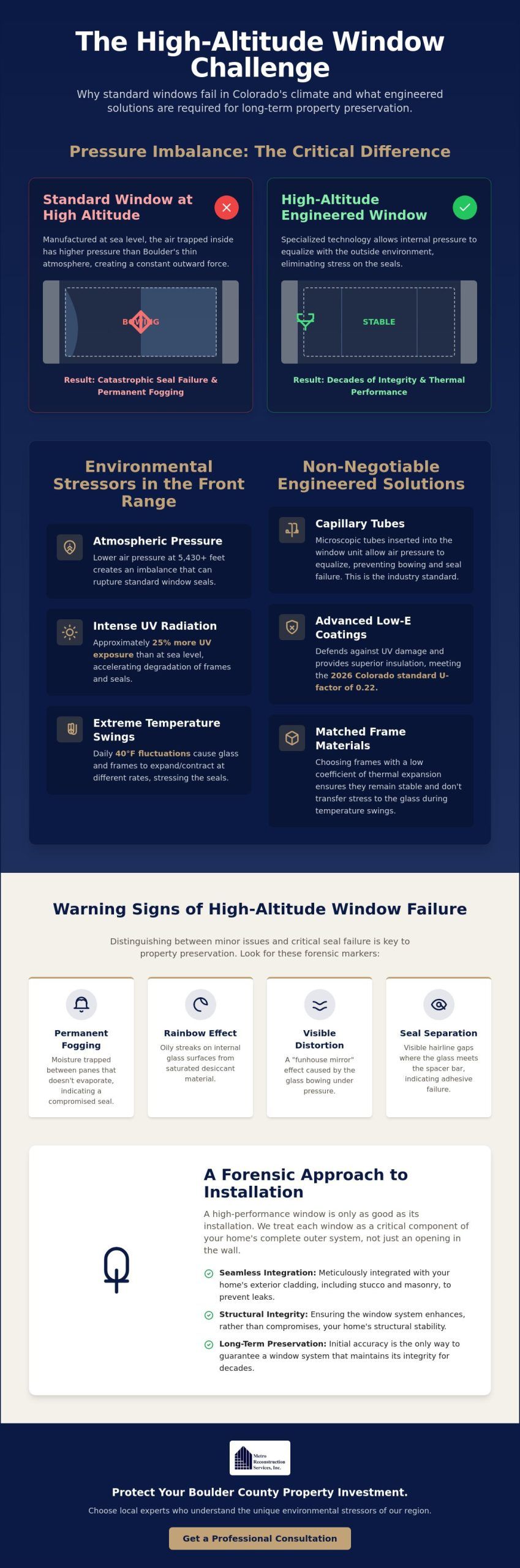
Most homeowners view windows as static objects, but at 5,430 feet, they’re dynamic systems under constant atmospheric strain. A standard window manufactured at sea level arrives in Boulder with a hidden liability. The air trapped between the panes is pressurized for coastal environments, creating a permanent imbalance the moment it reaches the Front Range. This is why a window replacement for high altitude homes requires specific engineering to equalize these forces before they compromise the building’s complete outer system. Without these adjustments, the very technology meant to insulate your home becomes its primary point of failure.
Atmospheric Pressure and IGU Distortion
This pressure differential is the primary cause of premature failure in an Insulated glazing technology unit that lacks altitude adjustments. Because the external atmospheric pressure in Boulder is significantly lower than at sea level, the high-pressure air inside the unit pushes outward. This forces the glass to bulge, a phenomenon known as bowing. Over time, this constant outward force stresses the primary and secondary seals until they eventually rupture. Once the seal is compromised, the window loses its insulating argon gas fill and begins a cycle of breathing where moist air is pulled into the unit. This isn’t just a cosmetic issue; it represents a fundamental failure of the window’s thermal barrier and structural integrity.
Front Range UV Exposure and Thermal Stress
Pressure isn’t the only environmental stressor. At higher elevations, the atmosphere is thinner, providing less protection from solar radiation. Homes in the Front Range experience approximately 25% more UV radiation stress than those at sea level. This intense exposure accelerates the degradation of standard vinyl frames and chemical sealants, leading to brittleness and discoloration. Thermal shock adds another layer of complexity. Boulder’s weather often features rapid shifts, where a window might move from direct sunlight into the deep shade of a sudden mountain storm. These 40 degree temperature swings cause the glass and frame to expand and contract at different rates.
Distinguishing between simple surface condensation and a forensic seal failure is a critical diagnostic step for property preservation. We look for specific markers that indicate the underlying structural origins of the problem:
- Permanent Fogging: Moisture trapped between panes that doesn’t evaporate with the sun’s heat.
- The Rainbow Effect: Oily deposits or mineral streaks on the internal glass surfaces caused by desiccant saturation.
- Visible Distortion: A noticeable curve or “funhouse mirror” effect in the pane when viewed from an angle.
- Seal Separation: Hairline gaps where the glass meets the spacer bar, indicating the failure of the primary adhesive.
If the materials aren’t matched for their coefficient of thermal expansion, the resulting torque can snap a weakened seal. Identifying these factors is essential for any homeowner seeking a long-term window replacement for high altitude homes rather than a superficial patch. Our approach focuses on these hidden mechanics to ensure your investment survives the unique rigors of the Colorado climate.
Essential Technology for Mountain Performance: Capillary Tubes and Low-E
Solving the atmospheric pressure challenge requires a shift from standard manufacturing to altitude-specific engineering. For a successful window replacement for high altitude homes, the inclusion of capillary tubes is the industry standard for maintaining structural integrity. These microscopic metal tubes are inserted through the spacer bar, allowing the air pressure inside the insulated glass unit to equalize with the thinner mountain air outside. Without this bypass, the internal pressure would eventually force a seal rupture or cause the glass to bow until it reaches its breaking point. It’s a proactive measure that addresses the underlying physics of our regional environment.
There is a technical trade-off that homeowners must understand: because capillary tubes create an open path for pressure equalization, they also allow the inert argon gas typically used for insulation to escape over time. While this slightly reduces the window’s initial R-value, it prevents the far more destructive issue of total seal failure. We prioritize the long-term structural integrity of the building’s complete outer system over temporary, high-performance metrics that can’t be sustained at elevation. This focus on reliability ensures that your investment remains a protective barrier for decades rather than just a few seasons.
How Capillary Tubes Equalize Pressure
The mechanics are straightforward yet precise. A small metal tube, often made of stainless steel or brass, provides a controlled vent for the air trapped between the glass panes. These are non-negotiable for any installation above 5,000 feet. To ensure long-term performance, these tubes must be properly positioned and maintained to prevent moisture from migrating into the unit, which would lead to the same fogginess the tubes are meant to prevent. This detail is a foundational brand promise for any project we undertake in the Boulder area.
Selecting the Right Glass Package
Choosing the correct glass involves more than just counting panes. While triple-pane units offer superior insulation, their increased weight can put additional stress on the frame and the home’s surrounding masonry or stucco. In many Boulder projects, a high-performance double-pane unit with spectrally selective Low-E coatings provides the ideal balance. These coatings are essential for energy-efficient window selection, as they reflect the intense mountain UV radiation while managing solar heat gain during our bright winter days. We also emphasize the use of warm-edge spacers, which utilize non-conductive materials to reduce thermal transfer at the glass edge, preventing the common issue of condensation and mold growth at the perimeter of the unit.
Pella replacement windows are frequently favored for high-altitude custom builds because of their robust frame construction and proven performance in regional climates. These systems are engineered to handle the physical demands of high elevations while maintaining the aesthetic standards of premium Boulder properties. We often recommend these systems when integrating new units with existing stucco or stone exteriors. If you’re currently evaluating the condition of your home’s exterior, our team can provide a detailed assessment of your window installation needs to ensure a leak-proof, pressure-equalized result.
Evaluating Frame Materials for Colorado’s Extreme Temperature Swings
The success of a window replacement for high altitude homes depends largely on how the frame material interacts with the surrounding building envelope during Colorado’s intense thermal cycles. While the glass package handles pressure and radiation, the frame must manage the physical movement caused by temperature swings that can exceed 40 degrees in a single day. The most critical technical metric here is the coefficient of thermal expansion. This value determines how much a material grows or shrinks when heated or cooled. If the frame material expands at a significantly different rate than the glass it holds or the wall it’s anchored to, the resulting stress will eventually compromise the building’s complete outer system.
Fiberglass and Wood: The Structural Choice
Fiberglass is often considered the gold standard for mountain environments because its coefficient of thermal expansion is nearly identical to glass. This synchronization means the frame and the glass panes move together as a single unit, which drastically reduces the mechanical stress on the seals. Wood frames also offer exceptional structural stability and natural insulation, which is vital during sub-zero mountain winters. However, the dry Colorado climate requires proactive maintenance to prevent wood from desiccation and cracking. For homeowners seeking a premium, engineering-led solution, these materials provide the necessary rigidity to maintain a leak-proof seal against the home’s primary cladding.
The Limitations of Vinyl at Altitude
Standard vinyl frames present specific challenges in high-altitude applications. Vinyl has a high expansion rate, often expanding up to seven times more than glass when exposed to direct sunlight. At higher elevations where UV intensity is significantly increased, this thermal movement is even more pronounced. This constant shifting can create gaps between the window frame and the exterior stucco or masonry, leading to air infiltration and potential water intrusion. Additionally, intense UV exposure can cause standard vinyl to become brittle over time, leading to hairline cracks in the corners of the sash. While high-quality composite vinyl options exist that incorporate stabilizers for better UV resistance, they must be carefully evaluated against the specific demands of the property’s orientation.
Color retention is another forensic indicator of material quality. Darker frame colors absorb more solar energy, which increases the internal temperature of the material and accelerates thermal expansion. In the thin air of the Front Range, this heat absorption can lead to warping if the material lacks the structural integrity to resist the load. Choosing a frame isn’t just about matching the siding; it’s about ensuring the long-term structural integrity of your home’s protective barrier. We focus on these underlying structural origins to ensure every installation provides the peace of mind that comes from a permanent, high-quality solution.
The Forensic Installation Process: Integrating Windows with Stucco and Masonry
A window is only as resilient as its weakest connection point. Even the most advanced window replacement for high altitude homes will eventually fail if the installation ignores the surrounding wall assembly. We view each opening as a complex intersection between disparate materials, where the frame, the sealant, and the building’s cladding must function as a single, unified barrier. Precision is our foundational promise. By focusing on underlying structural origins rather than superficial patches, we ensure that every transition between the window and the building exterior is hermetically sealed against the unique environmental stressors of the Front Range.
Flashing and Sealant Integrity
High-altitude wind-driven rain requires a sophisticated approach to moisture management. We utilize integrated pan flashing as a primary defense, ensuring that any moisture that bypasses the outer seal is directed safely away from the structural framing. This prevents the hidden rot that often plagues mountain homes with standard installations. Because Boulder experiences extreme temperature fluctuations, we select high-performance sealants that maintain their elasticity at sub-zero temperatures. These materials allow the window frame to expand and contract without tearing the bond, preserving the building’s complete outer system through every season.
Stucco and Masonry Integration
Replacing windows in a home with a stucco or stone exterior requires a forensic understanding of how these materials interact. A common industry failure is the “cut and caulk” method, which often damages the existing drainage plane. Our methodology integrates the new unit with the existing stucco restoration layers to ensure water cannot migrate behind the cladding. We perform detailed diagnostics before the first sash is removed, identifying previous moisture intrusion points that must be corrected to ensure long-term structural integrity.
Maintaining the continuity of the building’s weather-resistive barrier is essential for meeting the 2026 Boulder County building codes. When you choose a window installation service near me, you are hiring more than just a labor crew; you’re partnering with specialists who understand the hidden mechanics of your home’s structure. This holistic approach prevents premature failure and ensures that your new window system performs at its peak efficiency for decades. Request a forensic evaluation of your home’s exterior systems to ensure a leak-proof installation.
Choosing a Partner for High-Altitude Window Replacement in Boulder
Selecting a contractor for a window replacement for high altitude homes in Boulder County requires more than a simple comparison of labor rates. Because our regional climate presents a unique combination of low atmospheric pressure and high UV intensity, the partner you choose must possess a deep understanding of local weather patterns and building physics. A standard installation crew might overlook the critical pressure-equalization requirements discussed earlier, leading to a system that fails long before its expected lifespan. We believe that a successful project begins with the recognition that your windows are a vital component of a complex structural assembly, not just isolated pieces of glass.
The Metro Reconstruction Difference
With over 40 years of experience serving the Front Range and mountain communities, our approach is rooted in the principles of forensic engineering and property preservation. We don’t view ourselves as simple service providers; we’re dedicated partners in maintaining the long-term integrity of your investment. This seasoned perspective allows us to identify underlying structural origins of failure that others might miss, ensuring that every replacement is treated as a comprehensive structural preservation project. Our family-owned firm prioritizes quiet confidence and analytical depth over high-pressure sales tactics, focusing instead on the precision required for high-altitude success.
Evaluating warranties is another area where local expertise is essential. While many manufacturers offer a “Lifetime” warranty, these documents often contain specific exclusions regarding environmental stressors common in Colorado. We help you navigate these complexities by selecting products and installation methods that are specifically rated for elevations above 5,000 feet. Our commitment to initial accuracy means we stand behind our work, providing the peace of mind that comes from a window system designed to survive 40 degree temperature swings and intense solar radiation without compromise.
Starting Your Project
The process begins with a technical consultation that goes beyond surface-level aesthetics. We conduct a thorough diagnostic assessment of your home’s current state, examining how your existing windows interact with the surrounding cladding and drainage planes. This forensic approach allows us to coordinate any necessary exterior home repair with your window upgrades, ensuring the building’s complete outer system is fully restored. We’ll explain the difficult truths about your home’s current performance and offer engineering-led solutions that provide lasting value.
Your home deserves a window system that is as rugged and resilient as the Colorado landscape. If you’re ready to move from a temporary patch to a permanent, high-quality solution, contact Metro Reconstruction for a grounded and professional assessment. We’ll guide you through the technical complexities of a window replacement for high altitude homes, ensuring your property is protected for decades to come.
Securing the Structural Integrity of Your High-Altitude Home
Successful window replacement for high altitude homes requires an analytical approach that treats the window as a critical structural component rather than a standalone fixture. By prioritizing pressure-equalization technology and selecting materials that synchronize with the thermal expansion of glass, you ensure your home survives the Front Range’s 40 degree temperature swings. The final measure of success lies in the forensic integration of these units with your home’s stucco or masonry cladding to prevent hidden moisture intrusion. These steps are essential for any property owner who values long-term structural integrity over a temporary, superficial fix.
At Metro Reconstruction, we’ve spent over 40 years mastering the unique environmental stressors of the Colorado mountains. As a family-owned and operated firm since 1982, we specialize in high-stakes moisture mitigation and precise stucco integration. We don’t offer superficial patches. Instead, we provide the peace of mind that comes from engineering-led solutions designed for property preservation. We understand the hidden mechanics of your home and the necessity of initial accuracy as a foundational promise.
Take the first step toward a more resilient home by choosing a partner who understands the underlying structural origins of high-altitude failure. Schedule a Technical Consultation with Metro Reconstruction today to protect your investment for the long term. Your home is a complete outer system, and it deserves a professional standard of care.
Frequently Asked Questions
Do I really need special windows for a home above 5,000 feet?
Yes, specialized engineering is mandatory for homes at this elevation to ensure long-term performance. Standard insulated glass units are manufactured at lower altitudes and higher atmospheric pressures. When these units are brought to Boulder, the higher internal pressure causes the glass to bulge outward. This physical distortion puts immense strain on the primary seals, which eventually leads to the foggy, failed windows common in our region.
What are capillary tubes and why are they used in high-altitude windows?
Capillary tubes are microscopic metal vents inserted into the window’s spacer bar to allow internal and external air pressures to equalize. They’re a critical feature in a successful window replacement for high altitude homes because they prevent the glass from bowing. While they allow insulating argon gas to escape, this is a necessary trade-off to prevent the catastrophic structural failure of the glass unit itself.
Why do my window seals fail so quickly in Colorado?
Colorado’s environment creates a perfect storm for seal failure through mechanical and chemical stress. The pressure differential at 5,000 feet or higher constantly pulls at the adhesive bonds, while intense UV radiation at high elevations makes those same materials brittle. When you add 40 degree daily temperature swings, the resulting thermal expansion forces the weakened seals to separate, allowing moisture to penetrate the building’s complete outer system.
Can I use triple-pane windows in the mountains?
Triple-pane windows are an excellent asset for mountain climates, provided they’re engineered with pressure-equalization technology. These units offer superior thermal resistance, which is vital for meeting the 2026 Colorado energy standards. However, because they have two internal air spaces instead of one, the project requires precise coordination to ensure each chamber is properly vented and integrated into the home’s structural framing.
Will high-altitude windows prevent my interior furniture from fading?
High-quality window systems significantly reduce interior fading by utilizing spectrally selective Low-E coatings. These microscopically thin metallic layers are designed to reflect the intense UV radiation found at higher altitudes while still allowing visible light to enter. By blocking the specific wavelengths responsible for solar degradation, these windows act as a protective barrier for your flooring, artwork, and interior furnishings.
How much does high-altitude window replacement cost in Boulder?
The investment for a window replacement for high altitude homes in Boulder is influenced by specialized material requirements and forensic labor. Factors such as the choice of fiberglass or wood frames, the complexity of pressure-equalization systems, and the integration with your home’s exterior cladding all play a role. We focus on providing premium, engineering-led solutions that prioritize long-term value and structural integrity rather than the lowest initial price point.
Can you replace windows in a house with a stucco exterior without damaging the walls?
We specialize in replacing windows in stucco and masonry homes without compromising the surrounding wall assembly. Our forensic installation process involves carefully integrating the new window with the existing drainage plane and stucco restoration layers. This holistic approach ensures that the transition between the frame and the wall remains leak-proof, preventing the hidden structural rot that often results from superficial installation methods.