
What if the recurring rot on your deck boards isn’t a maintenance failure, but a symptom of a structural disconnect between your outdoor living space and your home’s building envelope? In the demanding climate of Boulder County, effective deck repair requires a forensic eye that looks beyond the surface. You’ve likely spent hours staining and sealing, only to find the same soft spots returning or the ledger board pulling away from the house. It’s frustrating to invest in your home’s exterior while still harboring a quiet fear about the structural integrity of your deck during a summer gathering.
We understand that true peace of mind comes from long-term solutions, not superficial patches. This article provides a comprehensive checklist to help you identify underlying failures caused by Colorado’s expansive soils and the strict 2021 International Residential Code requirements that took effect for Boulder County permits in 2025. We’ll explore how to diagnose structural origins of decay and ensure your deck is integrated safely with your home’s complete outer system. By the end, you’ll have a clear path toward a restoration that prioritizes precision and protects your property’s value for years to come.
Key Takeaways
- Identify how high-altitude UV radiation and extreme thermal expansion compromise structural integrity, necessitating a forensic approach to deck repair.
- Learn to inspect critical failure points like the ledger board and internal joists to detect rot that often eludes superficial maintenance.
- Master the “sway test” to accurately differentiate between minor cosmetic issues and hazardous structural lateral movement.
- Discover why a professional forensic inspection is vital for maintaining the security of your home’s complete outer system and building envelope.
- Understand the value of integrated property preservation to resolve underlying structural failures rather than settling for temporary surface fixes.
Understanding Deck Failure in Colorado’s Demanding Climate
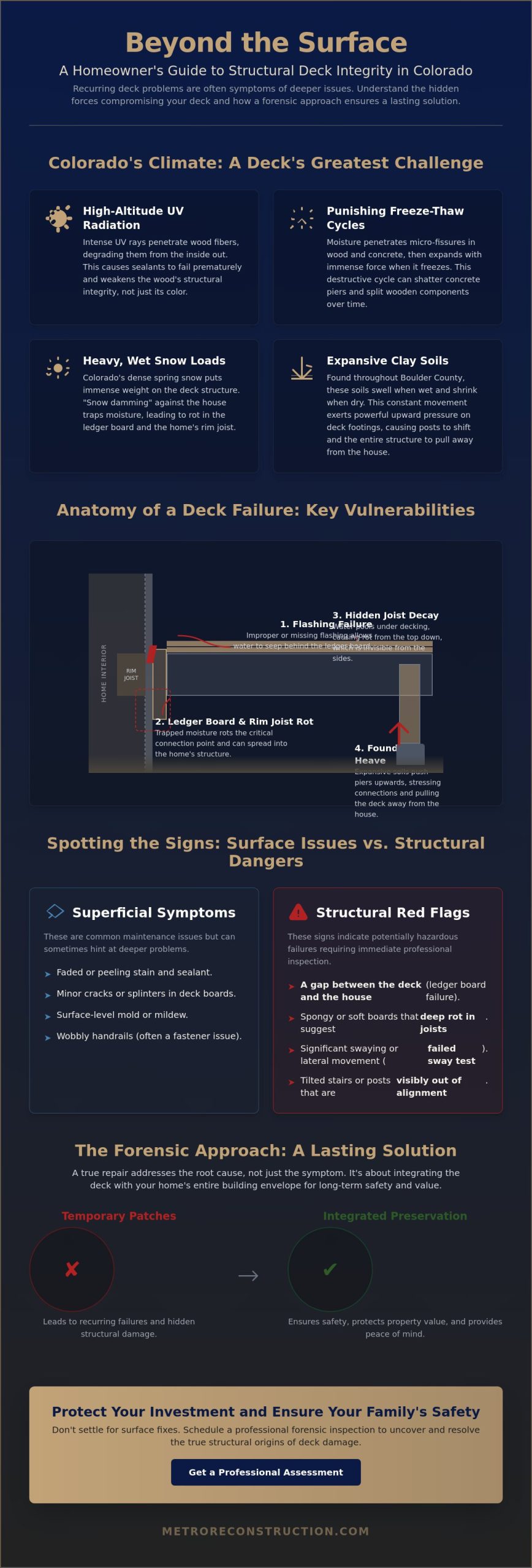
Structural deck repair represents more than a simple aesthetic refresh; it’s a critical restoration of a building’s load-bearing integrity and moisture protection systems. In Boulder County, the environment acts as a constant stressor on these components. High-altitude UV radiation is particularly aggressive, penetrating deep into wood fibers and causing rapid lignin degradation. This process doesn’t just fade the color; it compromises the cellular structure of the timber, making traditional sealants fail prematurely. Understanding the history of Wood preservation techniques helps homeowners realize why standard over-the-counter stains often fall short in the thin air of the Front Range.
The local climate also introduces a punishing freeze-thaw cycle. Moisture seeps into micro-fissures in concrete deck piers during the day, only to expand with immense force as temperatures drop at night. Over several seasons, this cycle can shatter unreinforced concrete or cause piers to heave. When combined with the region’s expansive bentonite soils, which swell significantly when wet, the result is often a deck that begins to pull away from the primary structure. This physical disconnect creates dangerous gaps and stresses the entire building envelope. Identifying these underlying structural origins is the first step in a professional deck repair plan.
The Impact of Front Range Snow Loads
Heavy spring snow in Colorado is notoriously dense, often weighing significantly more than mid-winter powder. This concentrated weight puts immense stress on joist hangers and ledger bolts, which are the primary connections between your deck and your home. If these connections aren’t perfectly flashed, “snow damming” occurs. This happens when melting snow gets trapped against the siding, forcing moisture into the wall cavity and rotting the rim joist from the inside out. For those considering modern composite decking upgrades, weight capacity calculations are essential. Composite materials are often heavier than natural wood, requiring a structural assessment to ensure the existing framing can handle the increased dead load along with Boulder’s required snow load ratings.
Expansive Soils and Foundation Stability
The clay-heavy soils found throughout Boulder County are highly reactive to moisture. These expansive soils exert vertical pressure on deck supports, often causing stairs to tilt or posts to shift out of alignment. This movement is closely related to the same geological pressures addressed in foundation repair services, as both systems rely on stable ground contact. To achieve long-term structural preservation, deep-drilled piers are often necessary. These piers reach below the active soil layer to more stable strata, preventing the seasonal “lifting” that compromises the deck’s connection to the home’s outer system. Precision in this area ensures your deck repair isn’t just a temporary patch but a lasting engineering solution.
The Anatomy of a Structural Deck Repair: Beyond Surface Esthetics
Effective deck repair requires looking past the surface level of weathered boards to examine the skeletal integrity of the entire structure. The most critical component in this anatomy is the ledger board, which serves as the primary connection between the deck and the house. When this connection fails, it often happens silently, hidden behind the building’s outer finish. For homeowners performing a preliminary walkthrough, using a deck safety checklist is a helpful starting point, but identifying deep-seated structural origins requires a forensic perspective. We focus on the hidden mechanics to ensure the safety of your home’s complete outer system.
Beyond the ledger, joist integrity must be meticulously evaluated. Internal rot often starts at the top edge of the joist where water collects under the decking. This rot can hollow out the timber while leaving the sides looking perfectly sound to the untrained eye. A professional assessment involves probing these hidden areas to ensure the load-bearing capacity remains intact. Precision in these diagnostics ensures that your investment is protected by a system that is structurally integrated with the home, rather than just a cosmetic patch.
Ledger Board Flashing and Moisture Mitigation
A failing ledger often reveals itself through interior drywall staining or localized soft spots in the flooring near the deck exit. These symptoms indicate that water has bypassed the flashing and is now infiltrating the home’s building envelope. In Boulder County, where stucco is a common finish, proper integration is paramount. Successful stucco restoration must involve a precise counter-flashing system that prevents “water-traps.” If the deck was originally installed without this consideration, moisture can sit against the rim joist indefinitely, leading to catastrophic rot within the wall cavity.
Structural Fasteners vs. Common Nails
Many decks built over 15 years ago rely on “builder-grade” galvanized nails. These fasteners were not designed to withstand the corrosive nature of modern ACQ-treated lumber, which contains high levels of copper that aggressively reacts with zinc. Over time, this chemical reaction eats away at the coating, causing the nails to snap under lateral loads. Modern building codes now mandate lateral-load connectors and structural screws that provide superior pull-out resistance and durability. In high-moisture mountain environments, stainless steel fasteners are the gold standard for long-term reliability. If your inspection reveals that moisture has already breached the building envelope, a specialized stucco restoration can address the damage to your home’s substrate before it leads to more costly structural failures.
Identifying Critical Structural Origins of Deck Damage
Diagnosing the need for deck repair requires a shift in focus from surface aesthetics to the hidden mechanics of lateral stability and foundation connectivity. One of the most effective diagnostic tools is the ‘Sway Test.’ By applying rhythmic lateral pressure to the deck’s outer rim, an expert can distinguish between simple loose railing posts and more ominous structural lateral movement. If the entire structure oscillates, it indicates a failure in the bracing system or a detachment at the ledger. This movement isn’t just a nuisance; it’s a precursor to catastrophic failure during high-occupancy gatherings or heavy wind events common in Boulder County.
Another critical origin of failure is post-to-pier disconnection. In many older regional installations, posts were simply rested on concrete blocks rather than being mechanically fastened to deep-drilled piers. Over time, the expansive clay soils can cause the deck to ‘lift’ or the soil to subside, leaving posts dangling or improperly supported. This leads to ‘over-spanning,’ where the horizontal beams are forced to carry loads across distances they weren’t engineered to handle. Following an InterNACHI deck inspection guide can help identify these discrepancies between original construction and modern safety load requirements.
Forensic Signs of Hidden Decay
Fungal decay, specifically brown rot, often consumes the interior of a structural beam while leaving the exterior shell intact. We utilize the ‘pick test’—using a specialized tool to probe the wood’s resistance—to identify these hollowed-out sections. This type of decay is frequently found at the threshold where the deck meets the house. Moisture trapped at this transition point often necessitates integrated stucco and masonry repairs to stop the cycle of infiltration. Additionally, forensic diagnostics can distinguish between water-induced rot and insect infestations, such as carpenter ants or termites, which mimic moisture damage but require entirely different mitigation strategies to protect the home’s complete outer system.
Evaluating Stair and Railing Safety
Stair stringer decay remains a leading cause of deck-related injuries because the connection points are constantly exposed to ground moisture and snow accumulation. When the wood softens at the base, the entire stair carriage can pull away under the weight of a single person. Modern safety standards also demand more than just ‘sturdy’ railings; they require specific balustrade spacing and graspable handrails that meet current 2021 IRC codes. For homeowners upgrading to heavy glass or metal railing systems, the structural requirements change significantly. These premium systems exert different torque forces on the deck’s perimeter, requiring reinforced framing to prevent the railing from acting as a lever that slowly prying the outer joists apart. Precision in these attachments is a foundational promise of a high-quality deck repair project.
The Forensic Inspection: Navigating the Reconstruction Process
A successful reconstruction begins not with a hammer, but with a diagnostic plan. While some might suggest that demolition is the first step, our forensic lens views it as the final stage of a detailed investigation. Jumping straight into removal without understanding the underlying structural origins of a failure often leads to repeating the same mistakes. A professional inspection ensures that every component of the complete outer system is evaluated for its relationship to the deck. This is the difference between a temporary patch that fails in five years and a reconstruction strategy that lasts for decades. Precision in this initial phase is what distinguishes an engineering-led deck repair from a superficial fix.
Navigating the complexities of Boulder County’s building permits requires an understanding of the 2021 International Residential Code (IRC) with local amendments that became effective on March 31, 2025. These regulations aren’t just red tape; they’re safety benchmarks designed to address the specific environmental stressors of the Front Range. When a project involves structural modifications, engineering requirements become a foundational promise of quality. We ensure that every project meets these rigorous standards, providing homeowners with the peace of mind that comes from long-term solutions. If you’re concerned about the hidden mechanics of your deck, a professional structural assessment from Metro Reconstruction Services, Inc. is the most reliable way to secure your home’s longevity.
Analyzing the Building Interface
Our team examines the transition between the deck and critical exterior home repair zones to ensure moisture isn’t being channeled into the house. We utilize high-precision moisture meters to detect hidden intrusion behind stucco or masonry before any visible staining appears. In many cases, this requires the selective removal of siding or stucco to inspect the house’s rim joist. Identifying rot at this juncture is essential, as the rim joist provides the structural substrate for the entire deck attachment. Without this forensic step, a new deck could be fastened to a compromised foundation, leading to future instability.
Engineering for Longevity
Modern outdoor living spaces often include heavy additions like hot tubs or outdoor kitchens, which require a recalculation of load paths to ensure the structure remains sound. In mountain communities, site-specific engineering is mandatory for areas with high wind speeds or heavy ground snow loads. We prioritize the selection of materials that resist Colorado’s intense UV exposure and meet the county’s ignition-resistant construction requirements. These material choices, ranging from specific wood-plastic composites to metal framing systems, are designed to mitigate wildfire risks while providing a durable extension of the home’s living space. This holistic approach ensures your deck repair is integrated safely within the broader building envelope.
Preserving Your Investment with Metro’s Integrated Approach
Choosing a partner for structural restoration is a significant investment in your home’s future safety and market value. At Metro Reconstruction Services, Inc., we view deck repair not as an isolated cosmetic task, but as a critical component of a holistic property preservation plan. Our approach is rooted in four decades of local expertise, allowing us to navigate the unique geological and climatic challenges of Boulder County with quiet confidence. We prioritize the identification of underlying structural origins over superficial fixes, ensuring that every solution we provide is engineered for the long term. To provide our clients with absolute clarity and financial predictability, we utilize fixed-price project fees for complex structural mitigations, eliminating the uncertainty often associated with large-scale restoration work.
As a family-owned firm, our reputation is built on a foundation of integrity and protective care for our clients’ investments. We understand that your home is likely your most significant asset, and our role is to act as a dedicated partner in its preservation. This means we would rather explain the difficult truth of a structural failure than offer a temporary, low-quality patch that will inevitably fail. By focusing on the hidden mechanics of a structure, we deliver results that go beyond surface-level aesthetics, providing the peace of mind that comes from knowing your home’s complete outer system is secure. Precision in deck repair is as much about the forensic investigation as it is about the final installation.
The Metro Reconstruction Services, Inc. Methodology for Deck Restoration
Our process begins with a forensic diagnostic phase that establishes the baseline health of your building’s complete outer system. During the reconstruction phase, we take meticulous care to protect your home’s existing stucco and window systems. We understand that a deck failure often involves moisture intrusion that can compromise these adjacent elements. By utilizing premium, engineering-led hardware and advanced moisture barriers, we create a seamless, waterproof integration between the deck and the house. This level of precision prevents the formation of future water-traps and ensures that your home’s building envelope remains uncompromised by the new installation.
Partnering for Property Preservation
We see ourselves as more than a service provider; Metro Reconstruction Services, Inc. is a dedicated partner in maintaining the structural health of your property. While a low-cost patch might seem appealing in the short term, the long-term ROI of a professional reconstruction is found in the avoidance of recurring minor repairs and the total protection of your home’s substrate. Our commitment to initial accuracy acts as our foundational promise to every homeowner. This meticulous attention to detail ensures your deck remains a safe, integrated part of your home for decades to come. If you suspect your outdoor structure is compromising your home’s integrity, contact Metro Reconstruction Services, Inc. for a specialized structural evaluation of your property.
Securing Your Home’s Complete Outer System
Boulder County homeowners face a distinct set of environmental pressures that require more than a surface-level response. We’ve discussed the necessity of moving beyond aesthetic fixes to address the forensic origins of structural failure. True success in deck repair lies in the seamless integration of your outdoor structure with the home’s complete outer system, ensuring the building envelope remains impenetrable. By prioritizing long-term engineering over temporary patches, you protect both your family’s safety and your property’s enduring market value. It’s about ensuring that every component, from the ledger to the foundation piers, works in harmony.
Metro Reconstruction Services, Inc. brings over 40 years of local expertise to every project, serving as a dedicated partner in property preservation. As specialists in complex moisture mitigation and a family-owned firm since 1982, we’re committed to the difficult truth of structural integrity over low-quality shortcuts. We invite you to Schedule a Forensic Structural Evaluation with Metro Reconstruction Services, Inc. to secure your home’s future. Your property deserves a solution as rugged and reliable as the Colorado landscape itself.
Frequently Asked Questions
How do I know if my deck needs a structural repair or just a new stain?
Structural failure is typically identified by lateral movement, persistent soft spots in load-bearing beams, or gaps appearing at the ledger connection. While staining addresses surface aesthetics, it cannot resolve deep-seated wood fiber degradation or foundation shifting. If your deck sways when you walk or shows signs of rot near the house wall, a comprehensive deck repair is necessary to ensure the safety of your home’s complete outer system.
Can a rotting deck damage my home’s foundation or stucco exterior?
A compromised deck often acts as a conduit for moisture to enter your home’s building envelope. When the ledger board flashing fails, water seeps behind the stucco or masonry, leading to rot in the rim joist and potential mold within the wall cavity. This moisture can also pool at the base of the structure, exacerbating issues with expansive soils that affect your foundation’s stability and the integrity of your stucco restoration.
Is a building permit required for deck repair in Boulder County?
A permit is mandatory in Boulder County for any deck attached to a dwelling, larger than 200 square feet, or positioned more than 30 inches above grade. Since March 31, 2025, all applications must comply with the 2021 International Residential Code (IRC) and local amendments. Navigating these regulations ensures your structure meets modern safety standards for snow loads, which is a foundational promise of our professional reconstruction process.
What are the signs that my deck ledger board is failing?
Visible separation between the deck and the house is the most immediate warning sign of ledger board failure. You might also notice interior drywall staining near the deck exit or soft spots in the flooring inside the house. These forensic markers indicate that water has bypassed the flashing and is actively damaging the home’s structural substrate, requiring a professional intervention to restore the building’s moisture protection system.
How long does a professional structural deck reconstruction typically take?
The timeline for a structural reconstruction generally includes a three to six-week period for obtaining Boulder County permits followed by the active construction phase. Each project’s duration varies based on the extent of the structural failure and the complexity of the moisture mitigation required. We focus on a steady, logical rhythm to ensure every connection is meticulously engineered rather than rushing through superficial fixes that don’t last.
Why is moisture mitigation so important for decks in the Front Range?
Colorado’s extreme temperature swings and heavy spring snow loads create a punishing environment for outdoor structures. Moisture mitigation prevents the freeze-thaw cycle from shattering concrete piers and stops “snow damming” from rotting the house frame. Without a robust moisture barrier, the thin air and intense UV exposure will accelerate the breakdown of even the highest-quality building materials, leading to recurring rot despite frequent staining.
Can Metro Reconstruction repair decks that were improperly installed by previous owners?
We specialize in correcting structural failures caused by substandard original construction or DIY attempts that didn’t meet local codes. Our team conducts a forensic diagnostic to identify where the previous installation failed to integrate with the home’s complete outer system. We then implement long-term solutions that bring the structure into full compliance with current Boulder County safety requirements, ensuring your investment is properly protected.
What is the difference between a handyman repair and a forensic reconstruction?
A handyman typically focuses on superficial board replacement, whereas a forensic reconstruction analyzes the underlying structural origins of damage. We evaluate the load paths, foundation stability, and the building envelope to ensure the deck repair is structurally integrated with the home. This engineering-led approach provides a level of precision and longevity that simple cosmetic patches cannot achieve, offering true peace of mind for homeowners.