
Could a drafty frame be more than just a nuisance in your living room? In the demanding climate of the Front Range, many homeowners overlook the fact that window failure is rarely an isolated incident; it’s often the first visible symptom of a compromise in your building’s complete outer system. You might already feel the bite of rising energy costs during our extreme Colorado winters or struggle to slide a sash during a rapid temperature swing. Identifying the signs you need new windows Boulder home owners frequently notice is the first step toward preserving your property’s long-term structural integrity. Accuracy in diagnosis prevents costly repairs later.
It’s a common concern, but ignoring these subtle indicators can lead to moisture intrusion and hidden rot that a simple coat of paint cannot fix. This guide provides a technical breakdown of the ten critical indicators of window failure, specifically updated for the 2026 ENERGY STAR Version 7.0 standards now required in Colorado. We’ll examine how professional diagnostics differentiate between superficial wear and systemic failure. By understanding these structural origins, you’ll gain the clarity needed to protect your investment and restore the quiet confidence your home should provide. We prioritize substance over superficial fixes.
Key Takeaways
- Understand how high-altitude UV radiation and rapid thermal cycles in the Front Range accelerate the degradation of window seals and finishes.
- Identify the primary signs you need new windows Boulder home owners often encounter, including frame warping and moisture trapped between glass panes.
- Learn to spot forensic indicators of failure, such as cracking in the stucco-to-window transition, which signal a breach in your building’s complete outer system.
- Navigate the 2026 Colorado energy standards and the technical necessity of altitude-adjusted glass components for long-term structural performance.
- Discover why a holistic replacement approach must include an inspection of the surrounding masonry and wall sheathing to prevent hidden structural decay.
The Boulder Environmental Stress Test: Why Local Windows Fail Faster
Boulder’s geography creates a unique laboratory for material fatigue. While most window manufacturers design products for sea-level conditions, our homes sit in a high-desert environment characterized by thin air and intense solar radiation. These factors don’t just age a window; they systematically dismantle the chemical and physical bonds that keep it functional. Recognizing the early signs you need new windows Boulder home owners often see requires looking past the glass to the structural integrity of the frame itself. Precision in identification is the only way to prevent hidden decay.
High-Altitude UV and Material Degradation
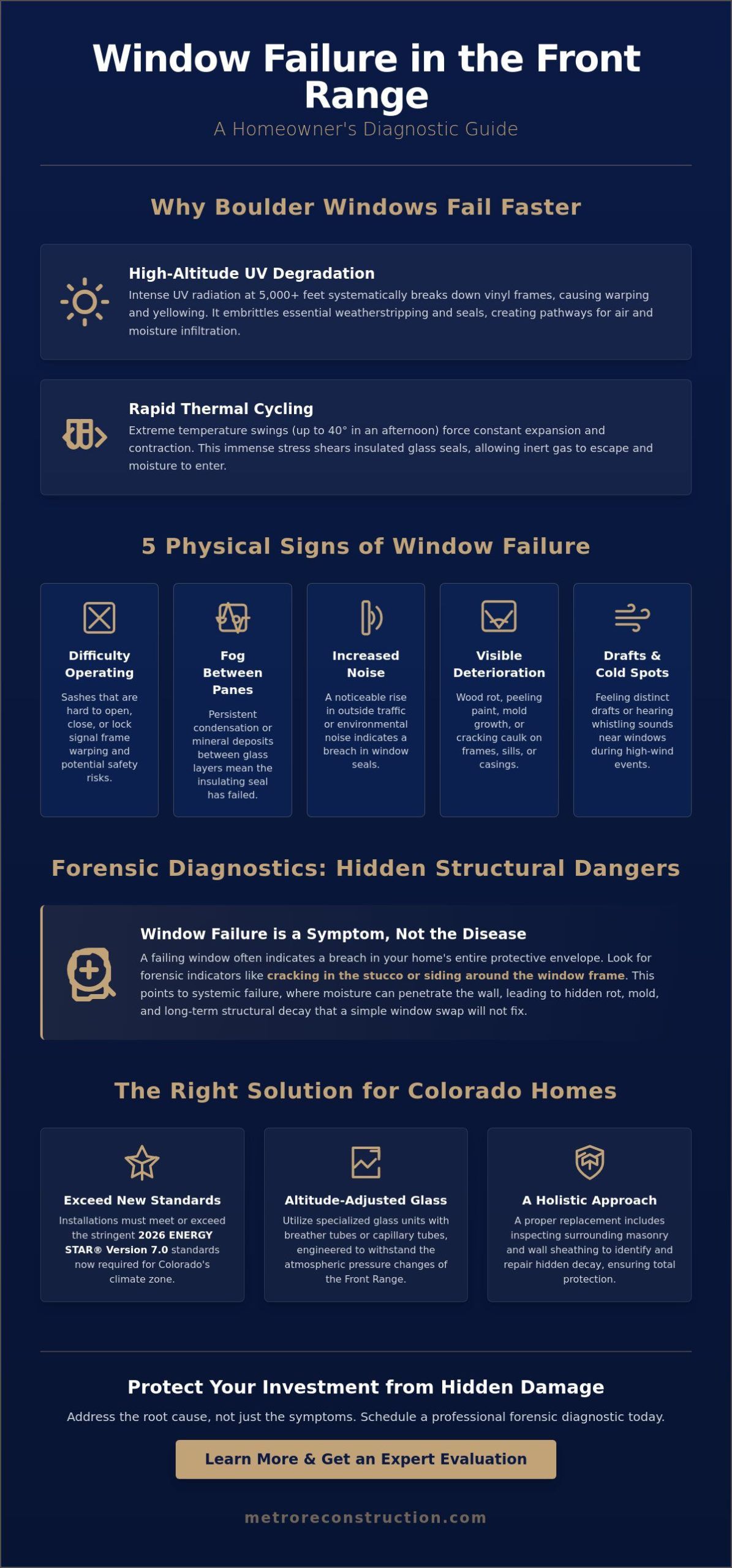
The intense UV exposure at our elevation acts as a catalyst for rapid material degradation. In standard vinyl frames, this radiation frequently leads to yellowing or warping as the PVC loses its structural rigidity and chemical stability. Glazing beads and weatherstripping, which are essential for preventing air infiltration, often become brittle and crack after just a few seasons of exposure to over 300 days of annual sunshine. At 5,000+ feet, the high concentration of ultraviolet photons initiates a photochemical reaction that severs the polymer chains within synthetic seals, leading to permanent embrittlement and subsequent failure. This desiccation of the seal is a primary driver of moisture intrusion during wind-driven rain or heavy spring snow.
Thermal Cycling and Seal Integrity
Temperature swings in the Front Range are notoriously violent. It isn’t uncommon to witness a 40-degree shift in a single afternoon, which forces window components through a constant accordion effect of expansion and contraction. This movement puts immense pressure on the perimeter of modern insulated glass units, eventually causing the primary and secondary seals to shear away from the glass pane. When this bond breaks, the insulating gas escapes and ambient moisture enters the void, leading to the permanent fogging often seen in aging units.
Beyond the climate, Boulder’s expansive soils add another layer of stress to the building’s complete outer system. As the ground shifts, it can pull a home’s rough openings out of square, causing frames to twist and seals to pop under the mechanical tension. If you notice your sashes no longer sit flush or require significant force to lock, these are definitive signs you need new windows Boulder home experts look for during a forensic diagnostic. We believe in addressing the underlying structural origins rather than applying a temporary, superficial fix.
5 Physical and Operational Signs You Need New Windows
While the atmospheric stressors previously discussed provide the underlying cause for window degradation, the physical symptoms are what ultimately compromise your daily comfort and safety. Recognizing the tangible signs you need new windows Boulder home inspections frequently reveal allows for proactive maintenance before secondary damage occurs. These indicators are rarely isolated; usually, one visible symptom points toward a broader failure within the building’s complete outer system. Accuracy in your initial assessment prevents the trap of superficial fixes that fail to address the root of the problem.
Homeowners should monitor for these five primary indicators of systemic failure:
- Mechanical Resistance: Difficulty operating sashes or engaging locks due to frame rack, warping, or hardware fatigue.
- Internal Condensation: Persistent fogging or mineral deposits trapped between the glass panes that cannot be wiped away.
- Acoustic Infiltration: A noticeable increase in traffic noise from local thoroughfares, signaling a breach in the window’s seals.
- Visible Deterioration: Presence of wood rot, peeling paint, or mold growth on the interior casing and sills.
- Thermal Bypassing: Feeling distinct drafts or hearing audible whistling sounds during high-wind events.
Operational Failure and Safety Risks
A window that requires excessive force to open or close is more than a simple annoyance; it represents a critical egress safety concern. In the event of an emergency, every second matters, and a stuck sash can become a dangerous barrier. When frames distort due to the extreme thermal cycling common in the Front Range, the internal hardware is forced to operate under mechanical tension it wasn’t designed to withstand. This eventually leads to stripped gears in crank-out units or snapped balances in double-hung styles. Once the frame has warped beyond its original tolerance, repairing individual components is no longer a viable solution. Professional window installation restores both functionality and peace of mind by ensuring the rough opening is properly analyzed and corrected before the new unit is set.
Moisture Intrusion and Foggy Panes
It’s vital to distinguish between surface condensation, which often results from indoor humidity, and the internal fogging that indicates a blown seal. When the primary seal of an insulated glass unit fails, the desiccants within the spacer bar become saturated and can no longer absorb moisture. This failure effectively destroys the window’s R-value, turning a high-performance unit into a thermal liability. Because these units are factory-sealed, they cannot be effectively repaired in the field. Replacing the unit is the only way to restore the thermal barrier and protect your wall cavity from the rot that follows unmanaged moisture infiltration. We prioritize identifying these structural origins to ensure your investment is protected for the long term.
Forensic Diagnostics: Hidden Signs of Structural Window Failure
Identifying the signs you need new windows Boulder home owners should prioritize involves looking beyond the glass to the surrounding substrate. A window is not an island; it is an integral part of the building’s complete outer system. When the interface between the window frame and the exterior cladding begins to fail, the resulting damage is often hidden within the wall cavity, away from the casual observer’s view. These forensic indicators require a meticulous eye to ensure that the structural integrity of your property remains uncompromised. Accuracy in these early stages prevents extensive secondary decay.
The Stucco and Window Interface
The transition between a window frame and exterior stucco is a frequent point of failure in our regional climate. If you observe hairline cracks or a distinct separation where the frame meets the wall, it suggests that the sealant has reached the end of its service life or that the building is experiencing excessive thermal movement. This breach allows water to bypass the drainage plane, often necessitating comprehensive stucco restoration to address the underlying moisture damage. We often find that “kick-out” flashing failures or improper head flashing installation allow water to migrate behind the window header, rotting the structural sheathing before any interior staining appears. Similarly, the appearance of efflorescence, which is a white, powdery salt deposit, on nearby masonry or peeling paint on brick lintels indicates that moisture is being trapped within the wall system. Soft spots in the wall beneath a window sill are definitive proof that the window’s weatherproofing has been breached.
Energy Loss and Thermal Bridging
Unexplained spikes in energy costs are another diagnostic marker of systemic failure. While many focus on heat transfer through the glass itself, air leakage around the frame perimeter is often the greater culprit in older Boulder homes. Forensic tools like thermal imaging cameras can reveal significant thermal bridging where cold air infiltrates the building envelope, bypassing the window’s intended insulation. Old single-pane units essentially act as thermal holes, but even double-pane units with failed frames can contribute to massive energy loss. If your thermostat remains at a consistent setting yet your utility bills continue to rise, these are clear signs you need new windows Boulder home professionals use to justify a full system replacement. Precision in these diagnostics ensures that you aren’t just buying glass, but restoring your home’s protective shell. We value substance over superficial patches.
Selection Guide: Choosing Windows for the Front Range
Once you’ve identified the signs you need new windows Boulder home owners must pivot from forensic diagnostics to technical selection. Choosing a replacement unit is not merely an aesthetic decision; it’s a structural upgrade to your building’s complete outer system. In our high-altitude environment, the materials and glass technology you select will determine whether your home can withstand the next decade of Front Range weather cycles. We prioritize long-term performance over superficial cost savings.
Material Performance in High Altitudes
Fiberglass represents the premier choice for Boulder’s demanding climate because its thermal expansion coefficient closely mirrors that of the glass itself. This synergy significantly reduces the mechanical stress on perimeter seals during our frequent 40-degree temperature shifts. While standard vinyl frames are prone to the warping and yellowing discussed earlier, fiberglass remains structurally rigid and UV-resistant. For owners of historic Boulder properties, modern wood-clad windows offer a necessary balance of traditional aesthetics and exterior protection. These units utilize heavy-gauge aluminum cladding to shield the structural wood core from intense solar radiation and moisture intrusion. Accuracy in material selection ensures that your new frames won’t fall victim to the same failures as the units they replace.
Glass Technology for the Mile-High City
Standard insulated glass units (IGUs) manufactured at sea level often struggle in the thin air of the Rockies. As the atmospheric pressure drops, the gas trapped between the panes expands, which can cause the glass to bow outward and eventually breach the seal. Capillary tubes are small, hollow tubes integrated into the spacer bar that allow the internal pressure of the insulated glass unit to equalize with the external atmospheric pressure at high elevations, preventing the glass from bowing or imploding.
To meet the 2026 ENERGY STAR Version 7.0 standards, Boulder homes require high-performance Low-E coatings that manage solar heat gain without sacrificing interior light. A U-factor of 0.22 or lower is now the benchmark for the Northern Climate Zone, ensuring your home retains heat during extreme winters. Selecting a window installation service near me that understands these specialized ratings is the only way to guarantee compliance and comfort. Restoring your home’s thermal barrier requires a forensic approach to the entire opening. We invite you to schedule a professional window installation assessment to ensure your selection matches your home’s specific structural needs.
The Metro Reconstruction Approach to Window Replacement
Recognizing the signs you need new windows Boulder home owners encounter is merely the initial step in a complex restoration process. At Metro Reconstruction, we don’t view a window as a standalone component; we treat it as a critical aperture within your building’s complete outer system. Our methodology is rooted in forensic precision, ensuring that the structural origins of any failure are identified and rectified before a new unit is ever installed. This engineering-led approach distinguishes our work from superficial replacements that often mask underlying decay. Accuracy in the diagnostic phase is the only way to ensure the longevity of the restoration.
Beyond the Glass: A Holistic Installation
A successful replacement must address the continuity of the building envelope. During our installation process, we perform a detailed inspection of the rough opening, focusing on the health of the wall sheathing and the integrity of the existing flashing. This level of scrutiny is essential because moisture intrusion often begins at the transition points between different materials. By integrating your window replacement with necessary exterior home repair, we ensure that the new moisture barriers and head flashings function as a unified shield. We advocate for full-frame replacement over simple ‘insert’ windows; full-frame projects allow us to inspect and restore the structural header and sill, providing a level of long-term property preservation that superficial inserts cannot match. We prioritize the hidden mechanics of the structure over easy, low-quality patches.
Partnering for Your Home’s Future
Our 40-year legacy in Boulder and the surrounding mountain communities has been built on a commitment to substance over style. We understand that your home is your most significant investment, and our role is to act as a dedicated partner in its preservation. From the initial structural diagnostic to the final interior trim, our project management team maintains a steady, logical flow that prioritizes technical excellence and transparent communication. You gain the peace of mind that comes from working with a firm that understands the specific environmental stressors of the Front Range.
The signs you need new windows Boulder home professionals identify are often warnings of broader systemic issues. We invite you to move beyond temporary fixes and invest in a permanent solution that protects your home’s structural integrity. Our team remains meticulous and detail-oriented throughout every phase of the project. Schedule a structural window assessment with our seasoned experts today to restore the integrity of your home’s complete outer system. Reliability is our foundational promise.
Preserving Your Home’s Structural Future
Protecting your property from the rigorous environmental stressors of the Front Range requires more than a superficial understanding of aesthetics. We have explored how high-altitude UV radiation and rapid thermal cycling degrade the building’s complete outer system, leading to the specific signs you need new windows Boulder home owners must address to prevent structural decay. By prioritizing technical precision, such as altitude-adjusted glass and forensic installation methods, you ensure that your investment provides long-term reliability rather than a temporary fix. Substance must always precede style in high-performance reconstruction.
Accuracy in your initial diagnostic is a foundational promise at Metro Reconstruction. As a family-owned and operated firm serving the region since 1982, we bring over 40 years of Boulder County expertise to every project. We specialize in structural integrity and moisture mitigation, ensuring that your window replacement is integrated seamlessly with your home’s existing cladding. Schedule a Forensic Window Assessment with Metro Reconstruction Services to secure the peace of mind that comes from professional, engineering-led restoration. Your home is a significant investment; we are here to help you protect its future.
Frequently Asked Questions
How long do windows typically last in the Boulder climate?
In the demanding Front Range environment, residential windows typically maintain their structural integrity for 15 to 20 years. However, standard vinyl units often experience seal failure or frame warping significantly earlier due to the intense high-altitude UV radiation. Factors such as orientation to the sun and the quality of the original building envelope integration will ultimately determine the service life of your units.
Can I just replace the glass if the frame is still in good shape?
Glass-only replacement is a viable solution for isolated physical breakage, but it rarely addresses the underlying causes of systemic failure. If you observe internal fogging or frame distortion, these are definitive signs you need new windows Boulder home experts use to justify a full-frame replacement. Simply swapping the glass won’t restore the perimeter seals or correct mechanical rack in the sash.
What are capillary tubes, and why do I need them in Colorado?
Capillary tubes are small, hollow components integrated into the insulated glass unit to allow for pressure equalization between the internal gas and the external atmosphere. Because Boulder sits at over 5,000 feet, units manufactured at sea level will bow or implode without these tubes. They are technically essential for maintaining seal longevity and preventing glass distortion in high-altitude regions.
Will new windows really lower my Boulder heating bills?
High-performance windows significantly reduce thermal bridging and air infiltration, leading to measurable reductions in seasonal utility costs. Under the 2026 ENERGY STAR Version 7.0 standards, units must achieve a U-factor of 0.22 or less for the Northern Climate Zone. This improved thermal resistance ensures that heat remains within the building envelope during extreme Colorado winters, protecting your investment from rising energy prices.
How do I know if my window leak is causing structural rot?
Identifying hidden structural rot requires a forensic look at the wall sheathing beneath the window sill and the surrounding exterior cladding. If you notice soft spots in the drywall, persistent mold growth, or cracking in the stucco-to-window transition, moisture is likely bypassing the drainage plane. These indicators are common signs you need new windows Boulder home professionals identify when moisture is compromising the building’s complete outer system.
Is it better to replace all windows at once or in phases?
Replacing all windows simultaneously is the preferred method for ensuring consistent structural protection and maximizing labor efficiency. This holistic approach allows our team to address the entire building envelope at once, preventing isolated points of failure between new and old units. While phasing is possible for larger estates, a unified project ensures that all seals and flashing systems age at the same rate.
Does Metro Reconstruction handle the stucco repair around new windows?
Yes, our team specializes in the seamless integration of window installation and stucco restoration. We recognize a window replacement project often reveals existing damage to the exterior cladding or requires modification of the drainage plane. By managing both the window and the surrounding stucco or masonry work, we maintain the integrity of the complete outer system and prevent hidden moisture traps.
What is the best window frame material for high UV exposure?
Fiberglass is the superior choice for high-altitude UV exposure because its thermal expansion rate matches that of the glass panes. Unlike vinyl, which can yellow and warp, fiberglass doesn’t lose its structural rigidity under the intense Colorado sun. This material stability ensures that the perimeter seals remain intact despite the extreme temperature swings common in the Front Range.