
The standard vinyl window sold across most of the United States is fundamentally engineered to fail when installed at 5,430 feet above sea level. It’s a harsh reality for Boulder County homeowners who often see premium products succumb to seal failure and frame warping within just a few seasons. Finding the best replacement windows for Colorado climate requires looking beyond the glass to the root cause of material degradation, specifically the combination of intense UV radiation and extreme 50-degree daily temperature swings.
You shouldn’t have to worry about your furniture fading or your energy bills spiking because of an inadequate exterior envelope. We’re here to ensure your investment is protected by identifying the specific technical specifications, such as capillary tubes and specialized spacers, that allow windows to survive this rugged environment. This guide details the high-performance materials and installation methods necessary to maintain structural integrity for 20 years or more, ensuring your home is built right the first time.
Key Takeaways
- Understand how the “Triple Threat” of UV, altitude, and thermal cycling dictates the selection of the best replacement windows for Colorado climate to prevent premature frame failure.
- Learn why fiberglass frames offer superior long-term durability by mirroring the expansion and contraction rates of glass panes during extreme Front Range temperature swings.
- Discover the technical necessity of capillary tubes and specialized Low-E coatings for maintaining seal integrity and energy efficiency in high-altitude environments.
- Explore why a high-performance window is only as effective as its integration with your home’s exterior envelope and moisture management systems.
- Identify the value of a forensic, engineering-led installation approach that prioritizes addressing root causes to ensure your investment is built right the first time.
The Colorado Climate Challenge: Why Standard Windows Fail in Boulder County
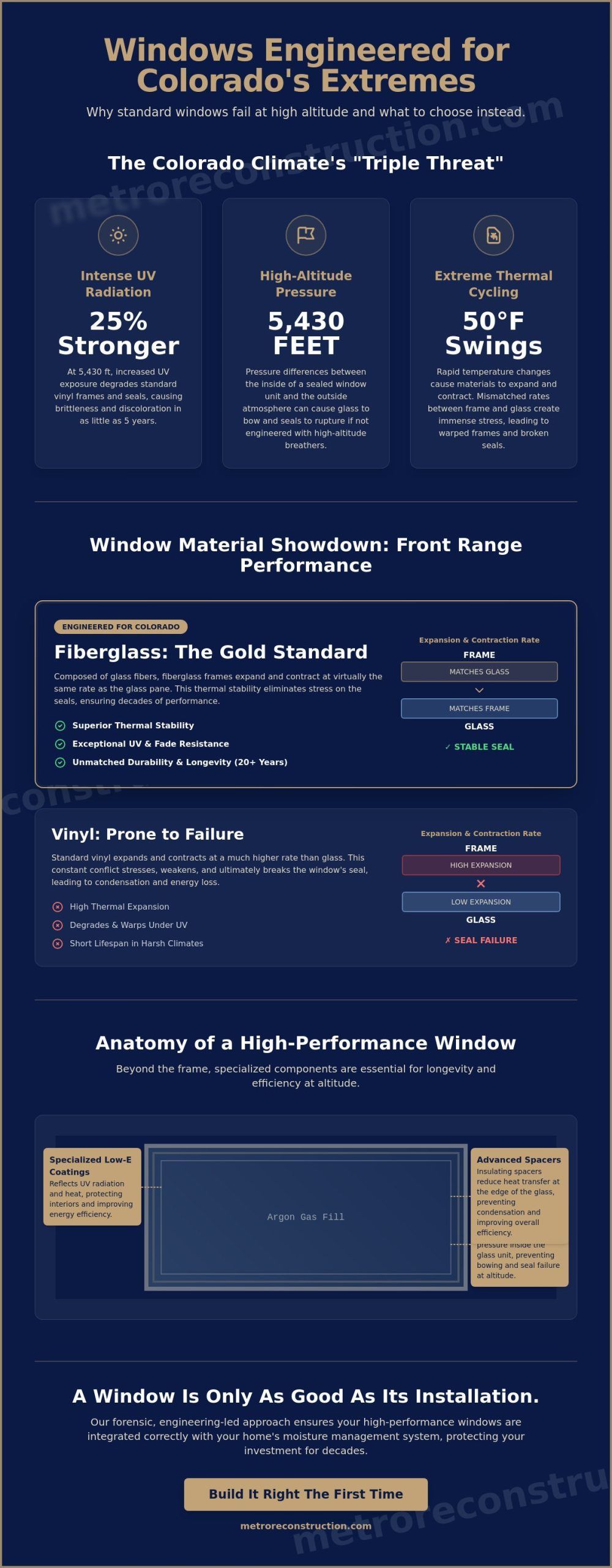
Boulder County presents a unique set of atmospheric demands that most manufacturers simply don’t design for. We call this the “Triple Threat”: intense UV radiation, extreme thermal cycling, and high-altitude pressure. While a window might perform adequately in the Midwest, it often reaches its breaking point within five years on the Front Range. Selecting the best replacement windows for Colorado climate requires an understanding of how these forces interact with the building’s exterior envelope. Standard products often fail because they lack the engineering to handle the specific stressors of a high-desert environment.
UV Exposure and Altitude: The Silent Seal Killers
At Boulder’s average elevation of 5,430 feet, the atmosphere is thinner and provides less protection from solar radiation. UV intensity increases by approximately 4% for every 1,000 feet of elevation gain; this means Boulder homes endure 20% to 25% more punishing UV rays than coastal properties. This radiation acts as a catalyst, breaking down the chemical bonds in standard vinyl polymers and causing sealants to become brittle. When the seals fail in insulated glazing units, the insulating gas escapes, leading to foggy glass and a total loss of thermal efficiency. South-facing windows are particularly vulnerable, often showing signs of frame chalking and discoloration within just 60 months of installation.
Thermal Cycling in the Front Range
Colorado is famous for the “Chinook” wind event, where temperatures can plummet from 60°F to 10°F in a single afternoon. These rapid 50-degree shifts create massive mechanical stress on the entire window assembly. Different materials expand and contract at different rates. If a frame material lacks “memory,” it won’t return to its original shape after these cycles, creating permanent air gaps and structural warping. This leads to thermal bridging, where cold air bypasses the sash, causing interior condensation and potential moisture damage to the surrounding wall.
We focus on identifying the root cause of these failures rather than applying temporary fixes. Off-the-shelf products from lower elevations lack the structural integrity to handle this constant expansion and contraction. High-performance solutions must be engineered to withstand these specific local pressures to protect your long-term investment. The best replacement windows for Colorado climate are those designed with low-expansion materials and high-altitude capillary tubes to balance internal and external pressures.
- UV radiation at 5,000+ feet degrades standard vinyl 25% faster than at sea level.
- Rapid thermal swings of 50°F or more cause seal failure in “budget” window units.
- High-altitude pressure differentials can cause glass bowing in non-vented IGUs.
- Moisture management becomes critical when thermal bridging leads to interior frost and condensation.
Choosing a window based on aesthetics alone is a common mistake that leads to premature replacement. A comprehensive approach involves looking at the entire window unit as a critical component of the home’s moisture management system. By investing in engineering-led solutions, homeowners avoid the cycle of repeated repairs and ensure their exterior envelope remains secure against the elements.
Evaluating Window Materials for the Front Range: Fiberglass vs. Wood Clad vs. Vinyl
Selecting the right frame material is the most critical decision for maintaining the integrity of your home’s exterior envelope. In Boulder County, where temperatures can swing 50 degrees in a single afternoon, material stability isn’t just a preference; it’s a structural requirement. We evaluate window materials based on their ability to withstand intense UV radiation and rapid thermal cycling without compromising the seal.
Why Fiberglass Dominates the Colorado Market
Fiberglass stands as the gold standard for the best replacement windows for Colorado climate because it’s composed primarily of glass fibers and resin. This shared composition means the frame expands and contracts at nearly the exact same rate as the glass panes themselves. This parity prevents the seal failure and seal “creep” that often lead to foggy glass in other materials. Beyond thermal stability, fiberglass handles the heavy snow loads of the Front Range without warping. Its inherent strength allows for slimmer profiles, which maximizes mountain views while maintaining the rigidity needed to resist impact from the large-diameter hail common during spring storms.
The Reality of Wood and Vinyl in High Altitudes
Wood clad windows offer exceptional insulation and a classic aesthetic that fits historic Boulder neighborhoods, but they demand rigorous moisture management. In our semi-arid climate, the exterior wood components can desiccate and shrink, creating microscopic gaps in the flashing system. If homeowners don’t commit to a 3-to-5-year maintenance cycle of staining and sealing, moisture can eventually penetrate the core, leading to localized rot that compromises the entire opening.
Vinyl presents a different set of risks in high-altitude environments. Because vinyl has a high coefficient of thermal expansion, the frames move significantly more than the glass. This leads to the “smiling” effect where the bottom rail bows under heat. During extreme winters, these frames become brittle, and it’s common to see corner welds crack under the stress of rapid contraction. When evaluating Energy Performance Ratings, look closely at the U-factor and Solar Heat Gain Coefficient (SHGC) for Zone 5 and 6. While vinyl can meet these numbers on paper, its real-world performance often degrades within 12 years due to structural fatigue.
- Fiberglass: Lowest maintenance; 30-plus year lifecycle; best for extreme temperature swings.
- Wood Clad: Superior aesthetics; high maintenance; requires expert installation to prevent rot.
- Vinyl: Lowest initial cost; high risk of warping and seal failure within 15 years in Colorado sun.
Investing in fiberglass or high-quality wood cladding represents a higher initial outlay but offers a lifecycle that far exceeds the 10-to-15-year span of budget vinyl. This long-term approach protects your property value and ensures the job is built right the first time. If you’re concerned about the current state of your seals, a professional assessment can identify the root cause of your window failure before it impacts your interior finishes.
Technical Specifications for High-Altitude Performance
Selecting the best replacement windows for Colorado climate requires an understanding of atmospheric physics that goes beyond standard aesthetic choices. In Boulder County, elevations range from 5,430 feet in the city to over 8,000 feet in the foothills. This elevation change creates a pressure differential between the factory where the window was manufactured and your home’s exterior envelope. Without proper technical calibration, a high-performance window can become a structural liability within its first winter.
Capillary Tubes and Pressure Equalization
Most premium windows are manufactured at sea level or low altitudes where atmospheric pressure is significantly higher than in the Front Range. When these sealed units arrive in Colorado, the internal pressure causes the glass to expand outward. To prevent seal failure or glass breakage, manufacturers must install capillary tubes. These small stainless steel tubes, roughly the diameter of a needle, allow the internal and external pressures to equalize during transit and after installation. Glass that appears concave or convex is a direct result of failing to calibrate the internal pressure of the unit to Colorado’s thin mountain air.
While these tubes are essential for structural integrity, they do present a trade-off. Because the unit is technically “open” to the atmosphere, the insulating gas fill will eventually dissipate. For this reason, we prioritize the glass coating technology over the gas fill itself when designing systems for mountain homes. Our focus remains on the root cause of energy loss: the thermal transfer through the glass pane and the frame assembly.
Optimizing for Solar Heat Gain (SHGC) and U-Factor
The U-Factor measures how well a window prevents heat from escaping, which is vital for Boulder’s sub-zero winter nights. Under the 2021 International Energy Conservation Code (IECC) often adopted locally, a U-Factor of 0.22 or lower is frequently the target for high-performance builds. However, the Solar Heat Gain Coefficient (SHGC) requires a more nuanced, surgical approach. We often recommend a “tuned” window package rather than a one-size-fits-all solution for the entire home:
- South-facing elevations: These areas benefit from a moderate SHGC to allow for passive solar heating in the winter, though they require high-performance Low-E coatings to prevent UV damage to interiors.
- North-facing elevations: These windows rarely see direct sun, so we prioritize the lowest possible U-Factor to mitigate the constant thermal pull of the cold exterior.
- Argon vs. Krypton: While Argon is the industry standard, Krypton gas is a denser insulator that performs better in the narrow gaps found in triple-pane units. In high-altitude applications where capillary tubes are used, the long-term ROI of Krypton is often diminished by gradual dissipation.
To address moisture management and perimeter frost, we specify “Warm Edge” spacers. These non-metal spacers separate the glass panes and reduce thermal conductivity at the edge of the unit. This technology reduces the risk of condensation by 70% compared to traditional aluminum spacers, protecting your window sills from rot and mold. Investing in these technical specifications ensures your exterior envelope remains resilient against the extreme temperature swings common to the Front Range.
The Critical Link: Integrating Windows with Your Home’s Exterior Envelope
Even the highest-rated glass package will fail if the transition between the window frame and the wall is compromised. In Boulder County, where homes face diurnal temperature shifts of 40 degrees or more, materials expand and contract at different rates. This mechanical stress tests the integrity of your home’s exterior envelope every single day. Choosing the best replacement windows for Colorado climate is a strategic investment, but that investment is only protected when the installation accounts for moisture management and structural physics.
A window is essentially a functional hole in your home’s protective shell. If the flashing isn’t integrated perfectly with the house wrap or weather-resistive barrier, water will eventually penetrate the wall cavity. These hidden leaks often go undetected for years, quietly causing structural rot and mold growth behind the siding or masonry. We treat every window replacement as a structural preservation task, ensuring the new unit becomes a seamless extension of the wall’s drainage plane.
Window Installation in Stucco and EIFS
Stucco and Exterior Insulation and Finish Systems (EIFS) present unique challenges because they are reservoir claddings that hold moisture. Generic window installers often make the mistake of “breaking the seal” of the stucco without a plan to restore the drainage plane. This leads to water intrusion at the corners, a common failure point that results in expensive repairs. Our team utilizes expert precision when cutting into these surfaces, ensuring that the window-to-wall transition is “Built Right the First Time.” We prioritize a mechanical bond over simple sealants, as surface-applied caulk typically fails within 3 to 5 years in the intense Colorado sun. This level of detail is a core component of professional stucco restoration, ensuring your home remains watertight for decades.
Moisture Mitigation and Forensic Reconstruction
Our approach goes beyond aesthetics to address the root cause of potential building failure. We often identify existing issues like missing head flashing or improperly sloped sill pans during the removal of old units. By identifying these “hidden leaks” early, we prevent the 15% to 20% of structural damage typically found in older Boulder County homes during renovation. Metro Reconstruction views the best replacement windows for Colorado climate as part of a holistic system. We inspect the surrounding masonry and framing to ensure the entire opening is sound before the new unit is set. This forensic mindset provides homeowners with the peace of mind that their property is protected from the inside out. We don’t just replace windows; we revitalize the entire exterior envelope to withstand the harssh Front Range environment.
Protect your home’s structural integrity by choosing a partner who understands the science of moisture management. Contact Metro Reconstruction for a comprehensive exterior envelope assessment.
Selecting and Installing High-Performance Windows with Metro Reconstruction
Choosing the best replacement windows for Colorado climate requires more than just picking a high R-value or a specific frame material. Since 1984, Metro Reconstruction has provided the Front Range and Mountain communities with a level of technical expertise that standard window contractors rarely match. We understand that a window is a critical component of a complex system. Our team brings 40 years of industry experience to every project, focusing on long-term structural health rather than quick cosmetic fixes. We manage each project with a personalized touch, ensuring that every detail aligns with our commitment to high-quality craftsmanship.
Our fixed-price reconstruction fees eliminate the uncertainty often associated with home improvement. You won’t face unexpected surcharges or mid-project price hikes. Instead, we provide a professional, transparent framework that respects your budget and your time. This “Seasoned Expert” approach allows us to identify and solve deep-seated structural problems that others might simply cover up with new trim.
Our Forensic Approach to Window Replacement
We begin every project by evaluating your entire exterior envelope. This forensic analysis is vital because a window can only perform as well as the wall system surrounding it. As a family-owned firm deeply rooted in the local community, we maintain a thorough understanding of Boulder County building codes and the specific stressors of high-altitude environments. Our process is methodical and transparent. First, we conduct a site-specific assessment to identify moisture intrusion or flashing failures. Next, we develop a tailored plan that integrates your new windows seamlessly into your home’s existing drainage plane. We then execute the installation with surgical precision, keeping you informed at every stage of the reconstruction.
Protect Your Investment with Professional Installation
The most sophisticated window on the market will fail if the installation is flawed. Professional installation is the primary driver of window ROI, as it prevents the air leaks and water damage that lead to premature replacement. Our specialized teams prioritize moisture mitigation and structural integrity above all else. We don’t just install products; we engineer solutions that protect your home from the inside out. By addressing the root cause of previous window failures, we ensure your new investment remains durable for decades. We believe in doing the job right the first time, providing the peace of mind that comes from true technical proficiency. Schedule a comprehensive exterior envelope consultation today.
Invest in a High-Performance Exterior for Your Boulder Home
Choosing the best replacement windows for Colorado climate is a decision that impacts your home’s structural integrity for 30 years or more. Standard installations often ignore the specific demands of the Front Range, where 100-mph wind gusts and intense high-altitude UV rays can compromise a building’s exterior envelope within 24 months. Selecting durable materials like fiberglass or wood-clad units is only half the battle. The real value lies in the technical precision of the installation, particularly when integrating new units into complex stucco or masonry surfaces.
Metro Reconstruction has spent 40 years perfecting these forensic details across Boulder County. We don’t just replace glass; we restore the integrity of your home. We prioritize long-term moisture management over quick aesthetic fixes, ensuring every component works together to protect your investment. Our fixed-price project fees eliminate the uncertainty often found in restoration work, providing a transparent path to a revitalized home. We’re ready to help you secure your property against the elements with solutions that are built right the first time.
Request a Professional Window and Exterior Consultation
Frequently Asked Questions
Do I really need capillary tubes for windows in Boulder?
Yes, you need capillary tubes because Boulder sits at an elevation of 5,328 feet, creating a pressure differential that can cause glass to bow or shatter. These small tubes allow the atmosphere between the panes to equalize during transport and after installation. Without them, the physical stress on the seals increases significantly, leading to a failure rate of nearly 50 percent in high-altitude environments.
What is the most durable window material for Colorado weather?
Fiberglass is the most durable material for the best replacement windows for Colorado climate due to its exceptional thermal stability. Because fiberglass consists of glass fibers and resin, it expands and contracts at the same rate as the window panes themselves. This eliminates the stress on seals that occurs with vinyl, which expands up to seven times more than glass in Colorado’s extreme temperature swings.
How much does window replacement actually save on energy bills in the Front Range?
Homeowners in the Mountain region save an average of $366 annually when replacing single-pane windows with ENERGY STAR certified products, according to 2023 Department of Energy reports. These savings result from the elimination of drafts and the reduction of thermal transfer. In a climate where winter temperatures can drop below zero, high-performance windows are a vital investment for long-term energy management and interior comfort.
Can I replace windows without damaging my existing stucco exterior?
It’s possible to replace windows without stucco damage by using a retrofit or jump frame installation that leaves the original perimeter intact. However, if the goal is to address the root cause of leaks, a full-frame replacement is often necessary. This involves carefully cutting back the stucco to integrate new flashing, ensuring the exterior envelope remains watertight against the 18 inches of average annual rainfall in Boulder.
What Low-E coating is best for high-altitude solar exposure?
A triple-silver Low-E coating like LoĒ-366 is the most effective choice for the high-altitude solar exposure found in Boulder County. This specific coating blocks approximately 95 percent of ultraviolet rays, which are significantly more intense at 5,000 feet than at sea level. It protects your interior finishes from fading while reducing solar heat gain during the 300 days of sunshine Colorado experiences every year.
How long should a quality window replacement last in the Colorado mountains?
A quality window replacement should last between 20 and 30 years if it’s engineered for high-altitude conditions and installed correctly. Lower-grade vinyl products often fail within 12 years in the Front Range due to UV degradation and rapid thermal cycling. We focus on high-performance materials that can withstand the 100 mph wind gusts and heavy snow loads common in the foothills of Boulder County.
Is it better to replace all windows at once or in phases?
Replacing all windows at once is the most effective way to ensure the entire exterior envelope is sealed and performing at peak efficiency. This approach also guarantees a uniform aesthetic and allows for a comprehensive moisture management strategy. If you must choose a phased approach, we suggest starting with the west-facing windows to mitigate the intense afternoon sun that drives up cooling costs during July and August.
What are the signs that my current window seals have failed due to altitude?
The primary sign of failed seals is the presence of condensation or a milky film between the panes that can’t be wiped away. You may also see the glass physically bowing inward, a phenomenon known as collapsed glass, which occurs when internal pressure isn’t equalized at high altitudes. These failures compromise the window’s insulating properties and are often the root cause of rising energy costs and localized drafts.