
The visual appeal of a stone facade often masks a critical structural vulnerability that only reveals itself after several Colorado freeze-thaw cycles. You’re likely concerned that a beautiful installation today might lead to delamination or moisture intrusion tomorrow, especially when navigating the complex 2024 International Building Code updates recently adopted in Boulder. It’s a valid anxiety. Selecting the right stone contractors is not just an aesthetic choice; it’s a decision about the fundamental diagnostic health of your home’s exterior. We believe that expert masonry is a forensic science that must account for your property’s entire moisture mitigation and structural system.
We understand the confusion that arises when comparing differing quotes that fail to address the underlying structural origins of potential failure. This article provides a rigorous framework to evaluate stone contractors based on their regional climate expertise and adherence to forensic standards. We’ll examine the technical requirements of stone-to-stucco transitions and the necessity of initial accuracy as a foundational promise for your investment. By the end, you’ll have the tools to hire a partner who prioritizes long-term property preservation over superficial fixes.
Key Takeaways
- Learn why professional stone masonry must be viewed as a protective component of the building’s complete outer system rather than a mere cosmetic finish.
- Discover a professional framework for vetting stone contractors that prioritizes diagnostic assessment of existing moisture and foundation issues over simple price estimates.
- Compare the cost-to-longevity ratios of natural and manufactured stone veneers to ensure your investment withstands the specific environmental stressors of the Front Range.
- Understand how Boulder’s unique environmental factors, such as expansive soils and high-altitude UV exposure, can lead to the premature degradation of masonry sealants.
- Identify the critical differences between surface-level repairs and a forensic approach that addresses the underlying structural origins of masonry failure.
Defining Expert Stone Masonry: Beyond Aesthetic Appeal
Expert stone masonry is often misunderstood as a purely cosmetic endeavor, but in reality, it’s a critical engineering component of your property’s complete outer system. While many stone contractors prioritize the visual “stack” of the stone, a seasoned expert views the installation through the lens of structural protection. A true craftsman understands that stone acts as a heavy, porous shield that must interact perfectly with the underlying drainage plane and the home’s foundation. This level of technical depth is what separates a professional Stonemasonry specialist from a general masonry laborer. A laborer might know how to apply mortar to a stone, but a stonemason understands the thermal expansion coefficients and moisture absorption rates that dictate whether a wall stands for a decade or a century. Precision is the only path to longevity.
Initial accuracy in both material selection and installation technique is the only way to prevent catastrophic structural failure. In Boulder, where temperature swings are frequent and the 2024 International Building Code updates demand higher performance, choosing a stone with the wrong density or failing to account for its weight can lead to sagging lintels or cracked foundations. We approach every project as a forensic exercise. Before we recommend a specific stone or mortar type, we analyze the existing conditions to ensure the new masonry work enhances the building’s integrity rather than compromising it. We don’t just build walls; we preserve investments.
The Role of Stone in the Building’s Envelope
In the demanding Colorado climate, stone serves as the primary weather barrier. It’s the first line of defense against wind-driven rain and heavy snow. However, this beauty comes with immense weight. If stone contractors don’t calculate the specific foundation load-bearing capacity, the resulting settlement can tear the building’s envelope apart. Effective moisture mitigation remains the most critical factor. Without a dedicated drainage system behind the stone, water becomes trapped, leading to rot in the structural framing that remains hidden until it’s too late. Proper engineering ensures the system breathes while keeping the elements out.
Identifying Forensic Indicators of Masonry Failure
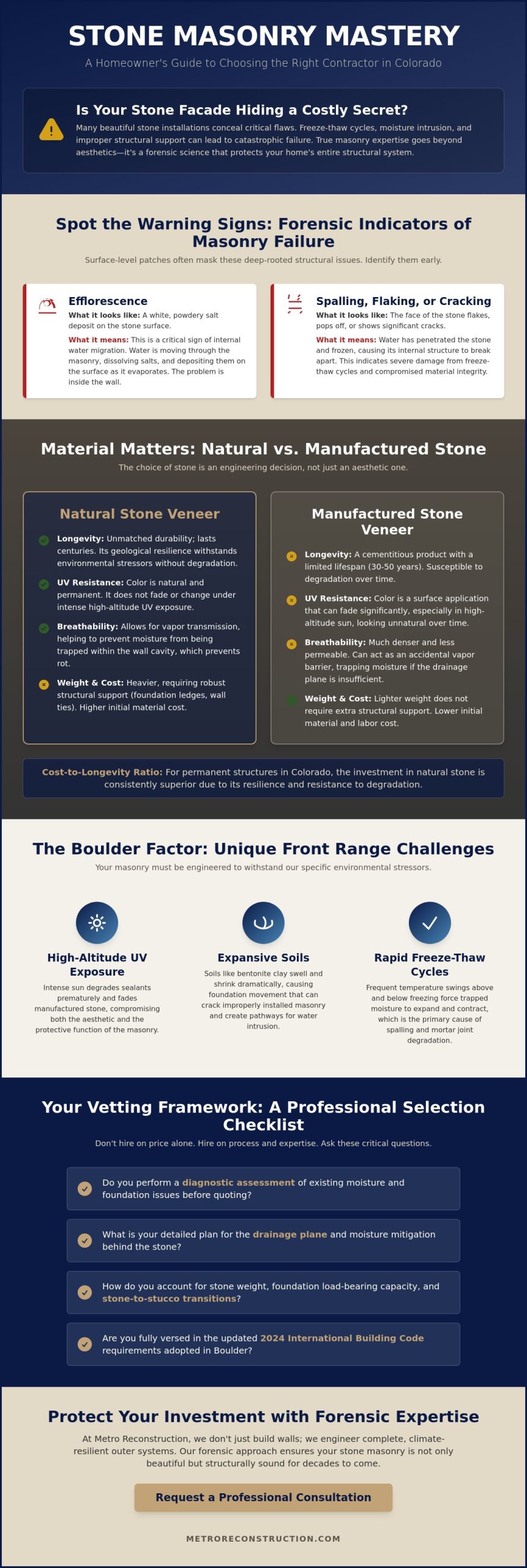
When evaluating an existing structure, we look for specific forensic indicators that signal deeper trouble. Efflorescence, that white powdery salt deposit on the stone surface, isn’t just an eyesore; it’s a symptom of internal water migration. Spalling, where the face of the stone begins to flake or pop off, often indicates that the stone’s internal structure has been compromised by freeze-thaw cycles. Surface-level patches are temporary fixes that often mask these underlying structural origins. We focus on identifying the root cause of the degradation before proposing any restoration plan. Accuracy saves money and prevents future headaches.
Evaluating Stone Systems: Natural vs. Manufactured Veneer
Choosing between natural and manufactured stone is an engineering decision that dictates the long-term stability of your building’s envelope. Full-bed stone offers the greatest longevity but requires extensive structural support due to its significant weight. Natural thin veneer provides the same geological resilience with a reduced load on the framing, making it a versatile choice for many Boulder properties. In contrast, manufactured stone is a cementitious product that often lacks the breathability and UV resistance required for high-altitude environments. Experienced stone contractors understand that the cost-to-longevity ratio typically favors natural materials for permanent structures because they don’t fade or degrade under intense solar exposure.
Technical Comparison of Stone Veneer Systems
Weight remains a primary consideration when evaluating these systems. Natural stone installations require specific foundation ledges or reinforced wall ties to manage the dead load. Permeability also differs greatly between materials. Natural stone allows for a degree of vapor transmission that helps prevent moisture entrapment within the wall cavity. Manufactured stone is much denser and can act as an accidental vapor barrier. This is problematic if the drainage plane is insufficient. During the temperature swings expected in 2026, natural stone expands and contracts with the structure more predictably than concrete-based products, reducing the risk of stress cracks in the mortar joints.
Proper Lath and Scratch Coat Standards
Structural integrity begins behind the stone. Every installation must adhere to strict ASTM-compliant metal lath standards and utilize high-performance weather-resistant barriers to protect the underlying sheathing. When vetting stone contractors, verify they follow OSHA safety standards for masonry regarding wall support and bracing during the construction phase. A common industry shortcut is omitting the weep screed at the base of the wall. Without this critical component, water cannot escape the drainage plane, leading to systemic rot and eventual stone delamination. We prioritize these hidden details because they are the foundation of a healthy exterior.
Transitions between different materials are where most exterior systems fail. Achieving durable stone stucco combinations requires specialized flashing and expansion joints to manage differential movement. If you’re concerned about the state of your current facade, our team provides comprehensive Masonry Work that addresses these technical junctions with forensic precision. Accuracy at the transition point prevents the moisture intrusion that otherwise destroys the building’s complete outer system over time.
Vetting Stone Contractors: A Professional Selection Framework
Selecting a partner for your masonry restoration requires looking past the surface-level aesthetics of a digital portfolio. While high-resolution photos demonstrate a finished product, they rarely reveal the structural integrity of the drainage plane or the precision of the flashing beneath the stone. The selection of stone contractors should be treated with the same analytical rigor as a structural engineering consult. You need a partner who views your home as a complete outer system, ensuring that every component works in harmony to prevent moisture intrusion and premature degradation.
Your vetting process must begin with a verification of specialized credentials and local project history. A qualified specialist will demonstrate a deep understanding of Natural Stone Institute standards, which provide the technical baseline for material durability and installation methods. Beyond certifications, assess their diagnostic process. If a contractor provides a quote without examining the underlying structural origins of existing failure or checking for foundation settlement, they’re offering a superficial fix rather than a long-term solution. Precision in the diagnostic phase is a non-negotiable requirement for a successful outcome.
Transparency in project management acts as the final pillar of professional vetting. Expert stone contractors provide detailed, fixed-price fees that explicitly outline the scope of work, including moisture mitigation and drainage management. This clarity protects your investment from the “hidden costs” that often arise during mid-project discoveries of structural rot. Finally, inspect their past work for joint consistency and stone blending. A master mason ensures that colors and shapes are distributed naturally across the facade, avoiding the “patchy” look that characterizes low-quality labor.
Essential Questions for Masonry Specialists
Ask these specific questions to gauge a contractor’s technical depth before signing a contract:
- How do you manage moisture drainage behind the stone veneer? Listen for mentions of rainscreens, weep screeds, and high-performance weather-resistant barriers.
- What specific mortar mix do you use for Colorado’s freeze-thaw cycles? The mix must account for local thermal expansion to prevent mortar joint degradation.
- Can you provide a forensic analysis of why my existing masonry failed? A specialist should identify the root cause, such as high-altitude UV exposure or expansive soil movement, rather than just suggesting a patch.
Red Flags to Avoid in Masonry Bids
Avoid any bid that uses vague language regarding flashing, weather barriers, or weep systems. These components are essential for the health of your building’s envelope, and their omission is a sign of a “slap-on” approach. Extremely low bids often suggest that the contractor is cutting corners on structural preparation or using inferior secondary sealants that will fail under intense UV exposure. A professional partner would rather explain the difficult truth of a necessary structural repair than offer a low-quality, temporary solution that leads to future delamination.
The Boulder Factor: Masonry Challenges in the Front Range
Boulder’s environment presents a unique set of stressors that demand a specialized response from stone contractors. The Front Range is notorious for its expansive soils, which contain high concentrations of bentonite clay that swells when wet and shrinks when dry. This constant subterranean movement exerts immense pressure on masonry retaining walls and home foundations alike. When these structural elements shift, the rigid stone facade above must either accommodate the movement or succumb to stress fractures. Identifying these underlying structural origins is the first step in our stucco and masonry repairs, ensuring we treat the cause of the damage rather than just the visible crack.
High-altitude UV exposure adds another layer of complexity to property preservation. At Boulder’s elevation, the intensity of solar radiation accelerates the degradation of secondary sealants and caulking. These flexible joints are designed to prevent water ingress at transition points, such as where stone meets window frames or rooflines. When these materials become brittle and fail, moisture penetrates the building’s complete outer system, leading to hidden rot and eventual stone delamination. We prioritize the use of high-grade, UV-stable materials to ensure that these critical junctions remain watertight for years to come. Precision in the diagnostic phase is a non-negotiable requirement.
Managing Freeze-Thaw Stress in Stone Joints
The “freeze-thaw” cycle is a destructive force acting on Front Range masonry. When moisture enters porous stone or mortar joints and then freezes, it expands by approximately 9 percent. This internal pressure can easily shatter natural stone or cause rigid mortar to pop out of the joints. We utilize specialized expansion joints and flexible mortar additives to manage these fluctuating temperatures. Regular stucco maintenance Boulder CO is essential to identify early signs of joint fatigue before water ingress leads to systemic failure. Preventing the initial entry of moisture is the only way to safeguard the structural integrity of the facade.
Structural Integrity and Foundation Stabilization
Foundation movement in Boulder County is a reality that stone contractors must account for during the diagnostic phase. If a stone facade is showing horizontal or stair-step cracking, it’s often a symptom of underlying foundation settlement. Coordinating stone restoration with foundation mitigation is necessary to prevent the repairs from failing immediately. Heavy stone features, like outdoor fireplaces or thick veneer walls, require reinforced footings that extend below the frost line and are designed to resist the lifting forces of expansive soil. If your property shows signs of masonry distress, secure the longevity of your investment by contacting us for specialized Masonry Work today.
The Metro Reconstruction Standard for Stone and Masonry
Selecting a partner for complex structural challenges requires more than a simple estimate; it demands an alliance with experts who understand the hidden mechanics of your property. At Metro Reconstruction, our 40+ years of local expertise in the Front Range informs every decision we make. Unlike typical stone contractors who might focus on the speed of installation, we prioritize identifying the underlying structural origins of any existing failure before the restoration process begins. This commitment to initial accuracy ensures that our solutions address the root cause of degradation rather than merely masking its symptoms. Precision is our foundation.
We approach every project by evaluating the building’s complete outer system. This holistic perspective allows us to understand how different technical components, such as the interaction between stone veneers and window flashings, contribute to the overall health of the structure. By analyzing these relationships, we provide engineering-led solutions that offer long-term reliability. Our fixed-price reconstruction fees reflect this analytical depth, providing you with the peace of mind that comes from a transparent, well-defined scope of work. We believe that professional integrity is demonstrated through straightforward communication and the refusal to offer low-quality, temporary patches.
A Forensic Approach to Property Preservation
Our methodology is rooted in technical diagnostics. We use forensic standards to ensure that your stone work lasts for decades, even in the face of Colorado’s extreme environmental stressors. For many homeowners, integrating stone restoration with high-performance stucco painting is the most effective way to create a unified moisture barrier. This integrated approach prevents the capillary action that often leads to water entrapment behind the facade. Our focus remains on precision and reliability, ensuring that every element of your building’s envelope functions as a protective shield for your investment.
Partnering for Long-Term Structural Health
Proactive maintenance is the most effective strategy for long-term property preservation. Moving beyond superficial fixes allows us to provide solutions that withstand the test of time and climate. We view ourselves as a dedicated partner in your property’s health, offering the quiet confidence that comes from deep industry knowledge. Whether you require a specialized Masonry Work intervention or a complete facade restoration, our team is prepared to guide you through the technical complexities toward a clear, professional conclusion. Contact us to discuss your specialized masonry or reconstruction needs and secure the future of your property’s structural integrity.
Securing the Structural Integrity of Your Facade
Building a durable exterior requires a shift from viewing stone as a cosmetic layer to recognizing it as a critical component of the building’s complete outer system. We’ve explored how specialized stone contractors must account for expansive soils, UV degradation, and the precise management of moisture drainage planes to prevent systemic failure. Selecting a partner who prioritizes diagnostic accuracy over superficial patches is the most effective way to protect your long-term investment. Precision in the initial assessment phase isn’t just a preference; it’s a structural necessity.
With over 40 years of Boulder County expertise, we specialize in moisture mitigation and structural stabilization for complex residential facades. Our fixed-price project fees ensure transparent budgeting, while our forensic methodology guarantees that we address the underlying structural origins of every masonry challenge. Schedule a Forensic Masonry Evaluation with Metro Reconstruction Services today to ensure your property remains a resilient sanctuary against the Colorado elements. We’re here to provide the peace of mind that comes from engineering-led solutions and dedicated craftsmanship.
Frequently Asked Questions
How do I choose the right stone contractors for a historic restoration?
Choose stone contractors who demonstrate experience with historic lime-based mortars and local geological matches. Historic projects require a forensic understanding of how original materials interact with modern moisture barriers. We recommend reviewing a contractor’s history with local preservation standards to ensure they respect the building’s complete outer system. Accuracy in material matching is essential for maintaining both the aesthetic and structural integrity of a heritage property.
What is the difference between decorative stone and structural masonry?
Structural masonry supports the weight of the building’s roof or floors, while decorative stone is a non-load-bearing finish applied to a secondary substrate. Most modern residential applications utilize stone veneer, which serves as a protective weather barrier. Understanding this distinction is vital because decorative stone still requires a specialized drainage plane to prevent moisture entrapment against the structural framing. It’s a technical system, not just a cosmetic layer.
Can stone veneer be installed over existing stucco exterior walls?
Stone veneer shouldn’t be applied directly over finished stucco without first evaluating the underlying lath and weather-resistant barrier. Because stone adds significant dead load, the existing wall system must often be reinforced or stripped to ensure a proper bond to the structural sheathing. Failure to address the transition points often leads to delamination or moisture intrusion behind the new facade. We always prioritize a forensic evaluation of the substrate first.
How much does it cost to repair stone masonry in Boulder County?
Repair costs for masonry vary based on the extent of the structural damage and the specific geological materials required. Factors such as the complexity of the moisture mitigation system and any necessary foundation stabilization will dictate the project’s scope. Qualified stone contractors provide fixed-price reconstruction fees only after a thorough diagnostic evaluation. This approach ensures transparent budgeting and prevents the “hidden costs” often associated with superficial masonry bids.
Why is moisture mitigation so important for stone installations?
Moisture mitigation prevents water from becoming trapped behind the stone, where it causes rot and freeze-thaw damage. In Colorado’s climate, trapped moisture expands during freezing cycles, which leads to stone cracking and mortar joint degradation. A high-performance drainage system allows the building’s outer system to breathe while protecting the interior structural components. Without proper drainage, even the most beautiful stone installation will eventually fail from the inside out.
What are the signs that my stone facade has structural foundation issues?
Signs of structural foundation issues include stair-step cracks in mortar joints, horizontal displacement of stone units, or gaps appearing around window frames. These symptoms often originate from expansive soil movement common in the Front Range. If you notice these forensic indicators, it’s essential to address the underlying structural origins before attempting any surface-level masonry restoration. Patching a crack caused by foundation movement is a temporary fix that won’t last.
How often should stone masonry be inspected for maintenance?
You should inspect your stone masonry at least once a year, preferably in the spring after the final freeze-thaw cycles. Look for efflorescence, spalling, or brittle secondary sealants that may have been damaged by high-altitude UV exposure. Early detection of these issues allows for proactive maintenance, which preserves the long-term value and integrity of your property’s exterior. Regular check-ups prevent minor joint fatigue from turning into a major structural failure.
Does stone installation require a permit in Boulder County?
Most stone installations in Boulder County require a building permit, especially if they involve structural changes or significant exterior alterations. The City of Boulder recently adopted the 2024 International Building Code suite, which includes specific amendments for energy efficiency and ignition-resistant construction. Expert stone contractors should be familiar with these local requirements. You should consult with the local building department to ensure your project complies with the most current regional regulations.