
A single sixteenth of an inch is often the only thing standing between a high-performance window and a structural failure that invites Colorado’s harsh elements into your wall cavity. Many homeowners understandably fear ordering the wrong size, especially since Boulder’s unique climate and the strict 2026 ENERGY STAR standards now require a U-Factor of 0.22 or less. While you might be tempted to handle the tape measure yourself, most find that a professional window measurement service Boulder provides the necessary diagnostic depth to protect their property’s long-term value.
It’s frustrating to face the confusion of rough opening versus unit size when the stakes involve your home’s moisture protection and thermal envelope. We understand that you want more than just a set of numbers; you want the peace of mind that comes from a perfect, airtight fit. This guide will master the technical process of measuring window openings to ensure structural integrity and a foolproof ordering process. You’ll learn how to analyze the building’s complete outer system, giving you the confidence to oversee a professional installation that stands up to the most demanding regional environments.
Key Takeaways
- Learn how window measurement acts as the diagnostic foundation for your building’s complete outer system, preventing future moisture intrusion and structural decay.
- Follow a rigorous step-by-step process to measure width and height at three distinct points, ensuring your new units accommodate any subtle shifting in the rough opening.
- Understand the forensic importance of checking for square, level, and plumb to maintain the long-term structural integrity of your window installation.
- Navigate the complexities of measuring for stucco and masonry exteriors by accounting for the specific requirements of full-frame replacements and stucco flanges.
- Discover how utilizing a professional window measurement service Boulder protects your investment by preventing common errors that can void manufacturer warranties.
The Critical Necessity of Accuracy in Window Measurement
Measurement is far more than a preliminary step in a renovation project; it’s a forensic exercise that serves as the diagnostic foundation for structural preservation. When we approach a home in Boulder, we aren’t just looking at a hole in the wall. We’re analyzing how a new unit will integrate into the building’s complete outer system. This holistic view is necessary because a window doesn’t exist in isolation. It interacts with the surrounding stucco, masonry, or siding to create a continuous barrier against the environment. To perform this audit correctly, a specialist relies on a specific forensic toolkit: a 25-foot steel tape measure for rigid accuracy, a high-grade level, a framing square to detect shifting, and a detailed notepad for recording multi-point data. This level of detail is why many homeowners eventually seek a professional window measurement service Boulder to ensure their investment is protected from the start.
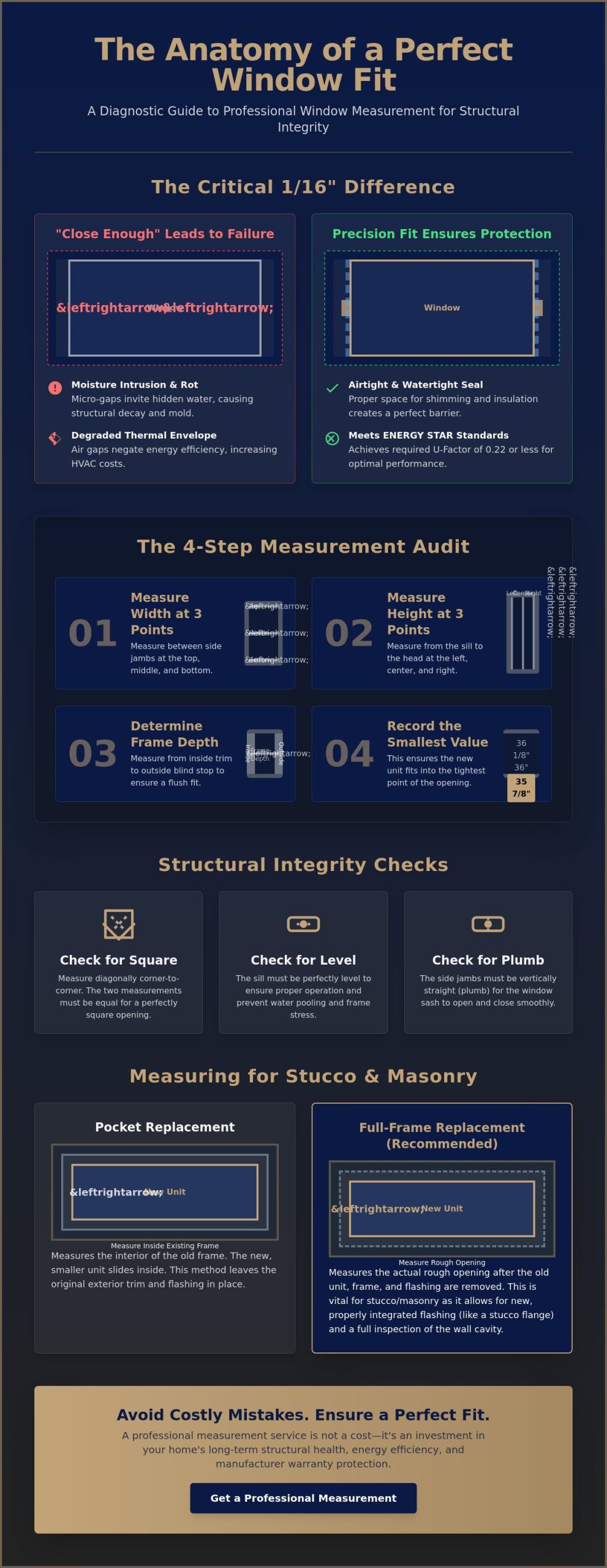
The complexity of the task changes significantly depending on the installation method chosen. A pocket replacement involves measuring the interior of the existing frame, which requires identifying the narrowest points to ensure the new unit slides in without compromising the original trim. Conversely, a full-frame replacement requires measuring the actual rough opening after the old unit and its perimeter flashing are removed. This distinction is vital because a full-frame approach allows for a complete inspection of the underlying studs and the restoration of the building’s moisture management system. Precision here determines whether the new window will perform as an engineered solution or merely a temporary patch.
Why Close Enough Leads to Structural Failure
In the high-altitude climate of Colorado, temperature swings cause materials to expand and contract rapidly. If a window fit is “close enough” rather than exact, these shifts create micro-gaps that invite moisture intrusion. This water often remains hidden behind the facade, leading to rot or mold that compromises the home’s structural integrity. These air gaps also significantly degrade the thermal envelope, forcing HVAC systems to work harder and negating the benefits of high-performance glass. Precision measurement is the primary defense against future masonry damage and systemic structural failure.
Anatomy of a Window Opening
A forensic measurement requires a deep understanding of the head, jambs, and sill. The head is the top horizontal part, the jambs are the vertical sides, and the sill is the bottom horizontal component that must be sloped correctly for drainage. While a homeowner might only see the visible glass, the specialist focuses on the actual structural frame and how it sits within the rough opening. For those understanding window components, it becomes evident that the final unit size must be slightly smaller than the rough opening to allow for shimming and insulation. This delicate balance ensures the window remains plumb and level regardless of seasonal settling.
Step-by-Step: How to Measure for Replacement Windows
Executing a precise measurement requires a disciplined approach that accounts for the natural shifting of a home’s structure over time. Houses move. Measurements must reflect that reality. While a casual DIY approach might involve a single quick measurement, a professional window measurement service Boulder utilizes a multi-point audit to ensure a perfect fit within the building’s complete outer system. This rigorous methodology prevents the frustration of units that are too large for the opening or too small to be properly sealed. To achieve this level of accuracy, follow these four essential steps:
- Step 1: Measure the width between the side jambs at three distinct locations: the top, the middle, and the bottom of the frame.
- Step 2: Measure the height from the highest point of the windowsill to the window head at the left, center, and right sides.
- Step 3: Determine the frame depth by measuring the distance between the inside window trim and the outside blind stop to ensure the new unit won’t protrude incorrectly.
- Step 4: Record the smallest of the three measurements for both width and height; this ensures the replacement unit will fit into the tightest point of the existing opening.
Measuring Width and Height with Precision
Precision begins with the correct placement of your tool. You must place the tape measure firmly against the side jambs rather than the decorative interior trim or the stop beads. For height, always measure from the head down to the sill, which is the lowest part of the window frame itself. Recording the smallest number is the industry standard for structural replacement units because it guarantees the window can be plumbed and leveled within the opening. If the underlying structural origins of your window’s failure seem complex, reaching out to the experts at Metro Reconstruction Services, Inc. can provide the clarity you need before placing an order.
Calculating Depth and Clearance
Depth is a frequently overlooked variable that can compromise the final aesthetics and performance of your installation. You need to measure the available space between the interior trim and the exterior blind stop. Meeting modern energy efficiency standards for windows requires a unit that sits perfectly within the thermal envelope. Most standard double-hung replacements require a minimum depth of 3 1/4 inches to seat properly. If your current frames are shallower, you may need to consider a full-frame replacement instead. Consult our High-Performance Window Installation Service guide for specific unit requirements and to better understand how your measurements impact your choice of window style.
Analyzing Structural Squareness and Frame Integrity
A window frame that has lost its geometric integrity is more than a nuisance; it’s a symptom of underlying structural movement. When we perform a forensic audit, we look beyond simple width and height to evaluate the three pillars of a window opening: square, level, and plumb. A professional window measurement service Boulder identifies these issues before any materials are ordered. This ensures that the replacement unit serves as a long-term solution rather than a superficial fix that will eventually bind or leak. If a frame is significantly distorted, it indicates that the building’s complete outer system has been compromised, requiring a more intensive restorative approach than a standard insert.
Identifying signs of failure is critical during the initial diagnostic phase. We look for sagging headers above the window or diagonal cracks in the surrounding stucco, which often signal that the opening is no longer supporting the weight of the structure correctly. If the frame is not square, a pocket replacement is no longer a viable option. Attempting to force a square unit into a trapezoidal opening creates uneven pressure on the glass and frame, leading to seal failure and operational issues. In these cases, a full-frame replacement is necessary to reset the opening and restore structural integrity to the wall cavity.
The Diagonal Test for Squareness
To check for squareness, measure the diagonals of the window opening from the top-left corner to the bottom-right corner, then repeat the process from the top-right to the bottom-left. These two numbers should be identical. If you detect a difference of more than 1/4 inch, the opening is officially out of square. This variance often points to significant settling in the home’s substructure. If you find substantial deviations during your audit, you should consider professional Foundation Repair Services in Boulder to address the root cause before proceeding with window installation.
Checking for Plumb and Level
Using a 4-foot level is essential for verifying the vertical and horizontal planes of the opening. Plumb refers to the vertical jambs, while level refers to the horizontal head and sill. We also check for bowing in the center of the jambs, as even a plumb frame can have bellied sides that impede the window’s movement. A level sill is particularly important for moisture protection; a sill that slopes toward the interior will trap water and cause the underlying wood to rot. By identifying these issues early, we can plan for the necessary structural corrections that a simple tape measure would miss.
Measuring for Stucco and Masonry Exteriors
Boulder’s architectural landscape is defined by its rugged, high-performance exteriors, yet these same features present significant challenges during a window audit. Measuring a window embedded in stucco or masonry requires more than a simple tape reading; it requires a forensic understanding of how the unit was originally integrated into the wall. A professional window measurement service Boulder looks beyond the visible frame to identify the hidden transition points where the window meets the facade. This holistic view is essential to maintain the integrity of the building’s complete outer system, as any error in calculation can lead to systemic moisture intrusion that remains undetected for years. We treat every measurement as a diagnostic probe into the wall’s health and structural continuity.
Navigating the Stucco Interface
In many Boulder properties, windows are secured with an integrated nailing fin that resides deep beneath the stucco surface. When we measure for a full-frame replacement, we must account for the thickness of this stucco layer and the potential need for facade restoration once the old flange is removed. This process often reveals hidden rot or structural issues that a superficial measurement would ignore. Measuring to the brick mold or the exterior casing is a delicate task that determines how much of the original facade must be disturbed. If your home’s exterior shows signs of cracking or moisture staining around the frame, it is vital to coordinate your project with Professional Stucco Restoration services. This ensures that the new window is not just a replacement unit, but a fully integrated component of a restored moisture barrier.
Masonry and Stone Considerations
Masonry openings in brick or stone facades require a different diagnostic approach because these materials are rigid and unforgiving. We focus on measuring the daylight opening, which is the visible space between the masonry, while simultaneously calculating the rough opening located behind the facade. In high-altitude climates like ours, masonry materials and window frames expand and contract at different rates. Consequently, we must leave precise room for high-performance sealant joints that can absorb this movement without failing. To ensure accuracy in masonry, we follow these forensic steps:
- Measure the width and height at three points within the stone or brick return.
- Check the depth of the masonry pocket to ensure the new frame doesn’t protrude beyond the facade.
- Analyze the sill’s pitch to confirm it directs water away from the stone interface.
A measurement that is too tight leaves no room for these critical joints, while one that is too loose creates a structural weakness that compromises energy efficiency. For a precise and reliable fit in these complex materials, partner with a specialist who understands the hidden mechanics of masonry and stone exteriors.
Transitioning from Measurement to Professional Installation
The transition from gathering data to executing a physical installation is the most critical phase of any property preservation project. At Metro Reconstruction Services, Inc., we view initial accuracy not as an optional target but as a foundational brand promise that dictates the success of the entire building system. While a DIY approach might seem cost-effective initially, the inherent risks of measurement errors often lead to significant financial consequences. Most manufacturers maintain strict guidelines; an incorrectly measured unit that results in poor operation or moisture intrusion will almost certainly void your warranty. By utilizing a professional window measurement service Boulder, you transfer that risk to specialists who understand the hidden mechanics of your home’s structure.
Our process involves a final verification through forensic diagnostics before any custom units are ordered. This step is essential because it allows us to reconcile the measurements with the actual structural health of the wall cavity. If we detect sagging headers or compromised masonry, we address those underlying issues first. This analytical depth ensures that your new windows provide long-term protection rather than acting as a temporary, superficial patch over a deeper structural failure. We ensure the window performs as a dedicated partner in your home’s thermal envelope, maintaining efficiency throughout our extreme local temperature swings.
The Value of a Forensic Audit
With 40 years of experience in Boulder County, we’ve refined a methodology that prioritizes the identification of underlying structural origins. A simple window replacement can’t fix a settling foundation or a failing stucco moisture barrier. Our Seasoned Expert approach, combined with a professional window measurement service Boulder, focuses on long-term restoration. We provide engineered solutions that respect your investment. This quiet confidence comes from decades of solving the region’s most complex structural challenges.
Next Steps for Your Boulder Home
If you’ve begun taking your own notes, organize them by room and include any observations regarding frame squareness or exterior cracks. This preparation streamlines the professional consultation and helps us identify potential challenges early. The ultimate goal is the peace of mind that comes from a guaranteed fit and a perfect structural seal. When you’re ready to secure your home’s thermal envelope, Contact Metro Reconstruction Services, Inc. for a precision window assessment to ensure absolute accuracy.
Securing Your Home’s Structural Future
True precision in window measurement represents the first line of defense for your property’s long-term health. We’ve explored how identifying the underlying structural origins of frame distortion and navigating the intricacies of masonry interfaces are essential steps for a successful installation. A simple tape measure cannot replace a diagnostic mindset that views each opening as a critical component of the building’s complete outer system. Accuracy at this early stage prevents the systemic moisture failures that often lead to costly restorations later.
For homeowners facing complex stucco or structural settling challenges, utilizing a professional window measurement service Boulder ensures that every custom unit is backed by forensic accuracy. Metro Reconstruction Services, Inc. brings 40 years of local expertise and specialized knowledge in structural integration to every project. As a family-owned company, we prioritize integrity and precision over high-pressure sales tactics. We understand that your home is a significant investment that requires meticulous, engineering-led care.
Don’t leave your home’s thermal envelope to chance. You deserve the peace of mind that comes from a guaranteed fit and a robust structural seal. Schedule a Professional Forensic Window Audit with Metro Reconstruction Services, Inc. today to protect your investment. We’re here to help you navigate these technical complexities with confidence.
Frequently Asked Questions
What is the difference between a rough opening and a window size?
The rough opening is the structural gap between the wall studs, while the window size refers to the actual dimensions of the manufactured unit. A window must always be slightly smaller than the rough opening to allow for precise plumbing, leveling, and the application of high-quality insulation. This small gap ensures the unit doesn’t bind as the home naturally shifts over time.
Do I measure from the inside or the outside of the window?
Measurement location depends entirely on the installation method, but for most pocket replacements, you measure from the interior. For full-frame replacements, a specialist will measure both the interior and the exterior to analyze how the unit integrates with the building’s complete outer system. This dual-sided approach ensures the new unit sits perfectly within the existing thermal envelope and moisture barrier.
What should I do if my window frame isn’t square?
If your frame is out of square by more than 1/4 inch, you should opt for a full-frame replacement rather than a simple pocket insert. A distorted opening indicates structural settling that a standard replacement window cannot accommodate without binding or leaking. Utilizing a professional window measurement service Boulder helps identify these issues early, allowing for structural corrections before the new units are ordered.
How do I measure for a window if I have a stucco exterior?
Measuring for stucco requires identifying the depth of the window’s nailing fin which is often buried beneath the exterior facade. You must measure the width and height of the existing frame while accounting for the stucco return that overlaps the unit. Because stucco is a rigid material, these measurements must be exact to prevent cracking the facade during the removal of the old window.
Can I replace a window myself if I have the right measurements?
While DIY installation is possible, it carries significant risks regarding structural integrity and manufacturer warranties. Most window brands will void your warranty if the unit isn’t installed according to strict precision standards, as even a minor measurement error can lead to hidden moisture intrusion. Professional installers understand the forensic requirements needed to protect your property’s long-term value in Colorado’s demanding climate.
What are the most common mistakes when measuring for replacement windows?
The most frequent errors include measuring the decorative interior trim instead of the actual window jambs and only taking a single measurement for width or height. Professionals always take measurements at three distinct points to detect bowing or sagging in the frame. Ignoring the depth of the opening is another common mistake that results in windows protruding awkwardly from the wall.
How much clearance should I leave between the window frame and the rough opening?
Industry standards typically require a total clearance of 1/2 inch in width and height, resulting in a 1/4 inch gap on all sides. This space is critical for the application of shims and backer rods, which support the window and provide a seat for high-performance sealants. Without this clearance, the window cannot be properly adjusted to be perfectly plumb and level within the opening.
Is it necessary to measure the depth of the window frame?
Yes, measuring depth is vital to ensure the new unit fits within the wall cavity without interfering with interior trim or exterior siding. Most modern double-hung windows require at least 3 1/4 inches of clear depth to seat properly. A professional window measurement service Boulder will verify this dimension to prevent ordering units that are too thick for your home’s specific wall construction.