
A window is not merely a view to the Flatirons; it is a critical structural component of your home’s exterior envelope that either preserves your investment or invites catastrophic moisture intrusion. You likely realize that Boulder’s 5,328-foot elevation and 20% higher UV radiation levels demand more from your building materials than a standard suburban development. It’s frustrating to face high-pressure sales tactics when you’re actually seeking technical solutions for air infiltration and thermal performance. This forensic guide explains how to choose a window contractor in Boulder who understands the delicate relationship between high-altitude technical specs and long-term structural integrity.
We will teach you how to identify a partner who prioritizes moisture management over aesthetic quick fixes. You’ll learn to evaluate U-factor and SHGC ratings through the lens of Colorado’s unique climate. We will also preview the specific flashing protocols that guarantee a leak-free home, ensuring your project is built right the first time. This approach moves beyond simple replacement, focusing instead on protecting the root cause of structural failure through engineering-led solutions.
Key Takeaways
- Understand how Boulder’s high-altitude environment triggers premature seal failure and why your windows must be engineered for the Front Range’s aggressive climate.
- Learn why a proper window replacement should be treated as a technical mini-reconstruction of your exterior envelope to ensure long-term moisture management.
- Discover how to choose a window contractor in Boulder who prioritizes technical competency and local forensic experience over high-pressure sales tactics.
- Identify the common marketing “quick-fixes” and red flags in local estimates that often lead to the most expensive structural repairs in the long run.
- Gain insight into the forensic reconstruction methodology that addresses root causes to ensure your home’s preservation is built right the first time.
Understanding Boulder’s Environmental Impact on Window Performance
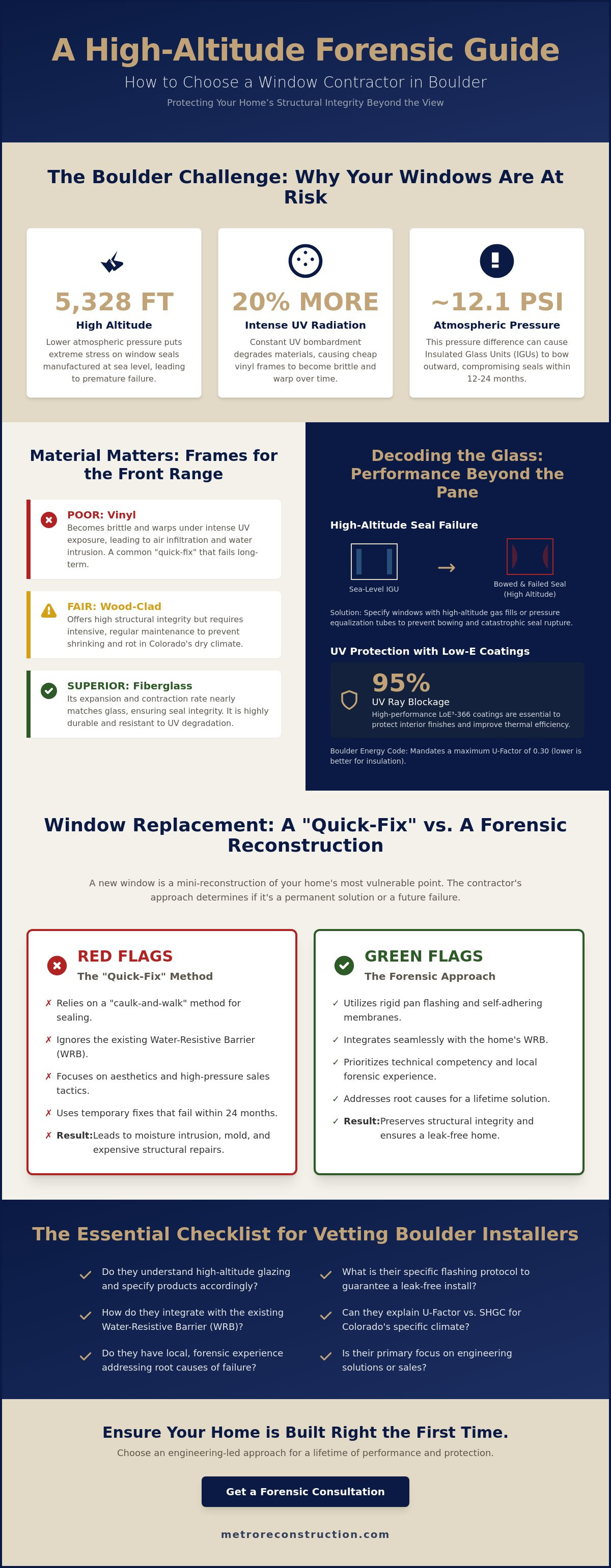
Boulder’s environment is notoriously aggressive toward the exterior envelope of a home. At a base elevation of 5,430 feet, the city experiences atmospheric conditions that standard window products, designed for sea-level pressures, simply cannot withstand. When homeowners investigate how to choose a window contractor in Boulder, they must prioritize technical knowledge over aesthetic sales pitches. National advice often emphasizes general R-values, but it ignores the specific physics of the Front Range. High-altitude seal failure isn’t a possibility here; it’s a statistical probability for improperly specified products. This occurs when the pressure inside a factory-sealed glass unit exceeds the external atmospheric pressure, leading to permanent deformation or catastrophic seal rupture. Understanding Fenestration at this altitude requires a forensic approach to material science that accounts for the 12.1 pounds per square inch of atmospheric pressure common in our region.
High-Altitude Glazing and Pressure Challenges
Standard Insulated Glass Units (IGUs) manufactured at sea level will bow outward when transported to Boulder’s lower atmospheric pressure. This physical stress compromises the primary and secondary seals within 12 to 24 months of installation. To prevent this, specialized windows utilize capillary tubes to equalize pressure. However, these tubes allow the insulating argon gas to escape, which can reduce thermal efficiency. Advanced contractors specify units with high-altitude gas fills or reinforced glass panes to exceed Boulder’s strict Energy Conservation Code, which currently mandates a maximum U-factor of 0.30 for most residential replacements. Selecting a glass package that balances pressure equalization with gas retention is vital for long-term performance.
UV Degradation and Material Durability
The UV radiation in Boulder is approximately 20% more intense than at sea level. This constant bombardment causes cheap vinyl frames to become brittle and warp, a root cause of air infiltration and water intrusion. While wood-clad windows offer high structural integrity, they require intensive maintenance to prevent the dry Colorado air from shrinking the organic fibers. Fiberglass emerges as a superior solution because its expansion and contraction rates nearly match those of the glass itself. High-performance Low-E coatings, specifically those with three silver layers like LoE-366, are essential. They block up to 95% of UV rays, protecting your interior finishes from the same solar energy that degrades exterior frames. Knowing how to choose a window contractor in Boulder involves finding a partner who understands these material interactions at a molecular level to ensure your investment is built right the first time.
Evaluating a Contractor’s Technical Approach to the Exterior Envelope
Windows represent the most vulnerable points in your home’s exterior envelope. This critical assembly of materials acts as a protective barrier against Colorado’s drastic temperature swings and heavy precipitation. When you replace a window, you’re not just swapping a product; you’re performing a mini-reconstruction project on that barrier. Understanding how to choose a window contractor in Boulder requires looking beyond the window brand or the aesthetic of the frame. You must evaluate whether the contractor understands the complex layers hidden behind your siding or stucco. If they don’t account for the water-resistive barrier (WRB), they risk compromising the entire wall system.
Moisture Management and Flashing Details
A forensic approach starts by identifying why the old window failed. Water stains, mold growth, or soft wood often signal that the original flashing failed years ago. Most retail installers rely on a “caulk-and-walk” method, using sealant as their primary defense against rain. This is a temporary fix that often fails within 24 months as the house expands and contracts. High-performance installations utilize rigid pan flashing and self-adhering membranes to direct water away from the framing. Proper installation requires seamless integration with existing stucco restoration systems to ensure the drainage plane remains uninterrupted and moisture cannot reach the structural studs.
Structural Integrity and Expansive Soils
Boulder’s geography presents unique challenges, specifically expansive soils rich in bentonite clay. These soils can exert thousands of pounds of pressure on a foundation, causing window headers to sag or shift over time. Simply measuring for “square and level” is insufficient in homes built before 1990. When learning how to choose a window contractor in Boulder, ask for their protocol regarding out-of-plumb openings. If a window is difficult to slide or won’t lock correctly, the issue might be a 5-millimeter structural shift rather than a simple hardware failure. A qualified contractor identifies when a window issue is actually a symptom of a larger structural foundation problem. Our team believes in addressing the root cause to ensure your investment lasts for decades. If you suspect your window issues are tied to deeper building failures, consider a comprehensive forensic assessment before purchasing new units.
- Forensic Inspection: We look for hidden rot before the new unit arrives.
- Integrated Flashing: We connect the window to the home’s existing drainage plane.
- Structural Awareness: We account for soil movement and header deflection.
The Essential Checklist for Vetting Boulder Window Installers
Selecting a professional requires looking past surface-level aesthetics. While digital reviews provide a snapshot of customer service, they rarely reflect the technical integrity of the exterior envelope. When learning how to choose a window contractor in Boulder, you must prioritize forensic competency over marketing polish. A manufacturer certification often indicates a contractor meets specific sales quotas; it does not guarantee they understand the complex moisture management required for Colorado’s climate. In the City of Boulder, contractors must hold a valid Class B or C Contractor License. They should also provide proof of general liability insurance and workers’ compensation to protect your property from unforeseen liabilities.
Questions to Ask During the Estimate
Direct technical inquiries reveal a contractor’s depth of expertise. Ask how they handle the transition between the new window unit and your specific exterior cladding, whether you have traditional brick or modern EIFS. A generic bead of caulk is a temporary fix, not a professional solution. Inquire about their protocol if they discover rot or moisture intrusion behind the old frame. A specialist addresses the root cause of structural decay rather than concealing it. Finally, confirm if the installers are W-2 employees. Dedicated staff members typically adhere to higher quality standards than third-party sub-contractors who might lack a long-term stake in the company’s reputation.
Verifying Local References and Past Projects
Authentic local experience in Boulder County is vital for long-term success. Genuine testimonials often mention specific regional challenges, such as navigating local building codes or managing high-wind loads near the foothills. When you understand how to choose a window contractor in Boulder, you look for a team that has a proven history in these specific conditions. Request to see a project completed between 2014 and 2019. Observing how an installation performs after nearly 10 years of Front Range UV exposure and extreme temperature swings provides the ultimate proof of technical skill. Proximity matters for more than just the initial install. A local presence ensures the team is available for future service and warranty calls. We believe every project must be built right the first time to preserve the home’s value and structural health.
Avoiding the “Quick-Fix” Trap: Red Flags in Local Estimates
Many homeowners prioritize the bottom line when comparing bids, but the cheapest estimate often becomes a significant liability within five to seven years. High-volume companies frequently rely on “Buy 3 Get 1 Free” gimmicks or “limited-time” seasonal discounts to distract from standardized, low-performance products. When you are learning how to choose a window contractor in Boulder, you must look past the flashy marketing. A 15-minute in-home consultation is rarely enough time to assess the structural integrity of your window openings. It signals a contractor who values speed and volume over technical precision and home preservation.
The Problem with High-Pressure Sales Tactics
High-pressure sales tactics, such as the “sign today for a 20% discount” trap, are specifically designed to bypass your due diligence process. These companies typically send a salesperson trained in closing techniques rather than a project manager with a forensic understanding of the exterior envelope. This distinction matters because a salesperson sells a product, while a project manager engineers a solution. You should look for several indicators of a professional approach during the bidding process:
- A detailed, multi-page proposal that specifies flashing materials and moisture management steps.
- A refusal to provide a “ballpark” figure without inspecting the condition of the existing rough opening.
- A consultative dialogue that addresses the root cause of your current window failure.
A one-page estimate is a red flag. It lacks the forensic detail required to ensure the installation will withstand the unique climate pressures of the Front Range. True professionals provide a roadmap for the project, not just a price tag.
Hidden Costs of Improper Installation
The most common shortcut in the industry is the “pocket” or “insert” installation. This method involves placing a new window into the old, deteriorating frame. While it’s faster and cheaper, it ignores the health of the building’s structural studs. This approach often traps moisture inside the wall cavity, which can lead to catastrophic failures. Neglecting these underlying issues often results in secondary damage, eventually requiring expensive stucco replacement or structural repair to fix rot within the building envelope.
Improperly sealed units also create thermal bridging, where heat escapes through the gaps between the new window and the old frame. This can increase energy loss by up to 35% compared to a full-frame replacement. Understanding how to choose a window contractor in Boulder means finding a partner who treats the window as a critical component of a high-performance exterior. We focus on fixing the entire opening to ensure your investment is built right the first time.
Don’t settle for a temporary patch that ignores the structural health of your home. Contact Metro Reconstruction today for a comprehensive evaluation of your window project.
Why a Forensic Reconstruction Perspective Ensures a Lifetime Solution
Choosing a window contractor is more than picking a product. It is about securing your home’s structural integrity against the volatile Colorado climate. At Metro Reconstruction, we approach every installation through the lens of forensic engineering. With over 40 years of local experience in the Front Range, we have spent decades identifying why windows fail before we ever pick up a tool. This technical background allows us to see beyond the glass and frame. We focus on the critical flashing and moisture management systems that protect your investment. When you evaluate how to choose a window contractor in Boulder, remember that the most important part of the job is often what remains hidden behind the trim.
The Metro Reconstruction Difference
Our team does not just swap out units; we specialize in the entire exterior envelope. This holistic perspective is vital because a window is only as effective as the wall surrounding it. If your Boulder home features complex masonry or delicate stucco, we coordinate the reconstruction to ensure a seamless, watertight finish. We address the root cause of previous failures, whether they stem from original 1990s construction defects or damage from recent high-wind events. Our commitment is simple: your project is built right the first time. We manage every detail of the process, providing a level of technical oversight that general window installers cannot match. We handle everything from the foundation to the roofline, ensuring your home functions as a unified, high-performance system.
Your Next Steps Toward a Protected Home
Moving from uncertainty to a clear plan requires a shift in perspective. If you are researching how to choose a window contractor in Boulder, look for a partner who values engineering over aesthetics. Instead of a high-pressure sales pitch focused on seasonal discounts, we invite you to schedule a technical consultation. This is an educational process designed to provide clarity on your home’s specific needs.
During a Metro Reconstruction site visit, you can expect a methodical process:
- Structural Assessment: We examine existing moisture levels and structural alignment to identify hidden rot.
- Cladding Integration: Our experts analyze how new windows will interface with your specific siding, stucco, or stone.
- Customized Scope: You receive a detailed plan that prioritizes long-term performance and building code compliance.
This grounded approach ensures your new windows contribute to a healthier, more durable home environment. We want to help you move from being confused by conflicting quotes to being confident in a professional solution. Our goal is to provide the peace of mind that comes from knowing your home is protected for another 40 years.
Consult with our Boulder window experts today to begin your home’s forensic assessment and secure a lifetime solution.
Secure Your Home’s Exterior Integrity
A window replacement is a significant investment in your property’s longevity. It requires a deep understanding of how individual components interact within the entire exterior envelope to prevent moisture intrusion. When you prioritize technical expertise over low-bid estimates, you avoid the recurring costs of failed seals and structural rot. Understanding how to choose a window contractor in Boulder involves vetting for a forensic approach that identifies the root cause of existing failures rather than just covering them up with a temporary patch.
Metro Reconstruction has served as a dedicated partner in home preservation since 1982. Our family-owned and operated team brings 40+ years of Boulder County construction expertise to every project, specializing in complex moisture management and high-performance installations. We believe every detail matters because your peace of mind depends on a solution that is built right the first time. It’s time to move beyond the quick-fix and choose a team that values technical precision as much as you value your home.
Schedule a Forensic Window Consultation with Metro Reconstruction
You can rest easy knowing your home is in the hands of seasoned experts who care about protecting your investment for the long term.
Frequently Asked Questions
Do I really need high-altitude glass for my Boulder home?
You absolutely need high-altitude glass for your Boulder home because the pressure differential at 5,328 feet can cause standard insulated glass units to bow or shatter. Manufacturers typically install capillary tubes in units destined for elevations above 4,000 feet to equalize internal and external pressure. Without these tubes, the seal fails prematurely; this leads to fogging and a total loss of thermal performance. It’s a critical component of a durable exterior envelope.
How much does it typically cost to replace windows in Boulder County?
Based on the 2023 Cost vs. Value Report, a standard upscale vinyl window replacement project in the Mountain region averages $20,000 to $25,000 for 10 units. However, custom wood or fiberglass units often exceed $35,000 depending on the complexity of the installation and structural requirements. We focus on long term value rather than the lowest bid. Understanding these benchmarks helps you determine how to choose a window contractor in Boulder who prioritizes high performance materials.
What is the difference between an “insert” and a “full-frame” window replacement?
An insert replacement installs a new window into your existing frame, while a full-frame replacement removes the entire unit down to the rough opening. We recommend full-frame replacements for 90 percent of our forensic restoration projects because they allow us to inspect the underlying flashing and address any hidden moisture intrusion. While inserts are faster, they don’t allow for a comprehensive evaluation of the building’s exterior envelope or the correction of structural decay.
How long does a typical window replacement project take in Boulder?
A typical installation for a 15 window home takes 3 to 5 business days, though the entire procurement process often spans 12 to 16 weeks. Custom high performance units require significant lead times for engineering and manufacturing. Once on site, our team works systematically to ensure each opening is dried in by the end of the day. This careful pace ensures we protect your interior from Colorado’s unpredictable weather patterns while maintaining technical precision.
Are there specific Boulder building codes I need to be aware of for windows?
Boulder follows the 2021 International Energy Conservation Code (IECC), which mandates strict U-factor ratings of 0.30 or lower for all new window installations. Additionally, Section R310 of the International Residential Code requires specific egress dimensions for basement bedrooms to ensure occupant safety during emergencies. We verify that every unit meets these local standards. Failing to adhere to these codes can result in failed inspections and costly mid project corrections.
Can I replace my windows if I have stucco exterior walls?
You can replace windows in stucco walls, but it requires a specialized cut back method to ensure a watertight transition between the new frame and the existing stucco. We remove approximately 3 inches of the surrounding exterior finish to integrate new high performance flashing directly onto the weather resistive barrier. This forensic approach prevents the common leaks associated with flush fin installations that merely sit on top of the stucco surface.
What is the best window frame material for the Colorado climate?
Fiberglass is the superior choice for the Colorado climate because its thermal expansion rate nearly matches that of glass. In Boulder, where temperatures can swing 40 degrees in a single afternoon, vinyl frames often warp or crack due to excessive movement. Fiberglass maintains its structural integrity and seal strength across these extreme cycles. It’s a foundational element for any homeowner looking for a permanent solution to their exterior envelope needs.
How do I know if my window leak is a structural issue or just a seal failure?
A window leak is likely a seal failure if you see fogging between the panes, but it’s a structural or flashing issue if water appears on your sills or drywall. Seal failures are aesthetic and thermal problems, whereas water intrusion at the frame indicates a breach in the moisture management system. We use forensic testing to identify the root cause of these leaks. Knowing the difference is vital when deciding how to choose a window contractor in Boulder who can fix the underlying problem.