
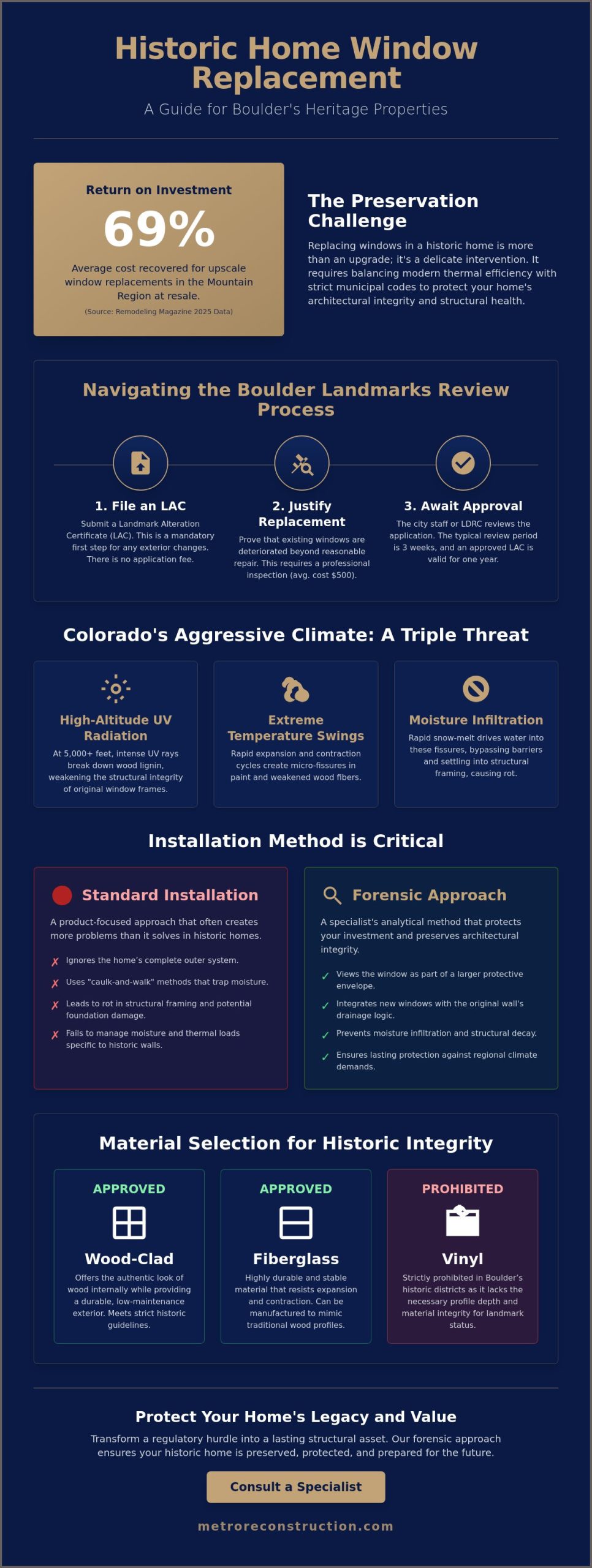
Homeowners in the Mountain Region can recover nearly 69% of their investment on upscale window replacements at resale, according to Remodeling Magazine’s 2025 data. This financial return is substantial, yet for owners of heritage properties, the process involves far more than a simple product swap. You likely feel the weight of responsibility that comes with maintaining a landmarked structure, especially when persistent drafts and rising energy bills suggest your original casings are failing. Undertaking a historic home window replacement Boulder project requires a delicate balance between strict municipal codes and the necessity of modern thermal protection. It’s common to feel a sense of hesitation regarding the complexity of the Landmark Alteration Certificate or the risk of a rejected permit.
We approach these structural challenges with the precision of a forensic diagnostic, ensuring your home’s complete outer system remains watertight while honoring its architectural soul. This guide provides the expert clarity you need to secure regulatory approval and improve your home’s efficiency without sacrificing historic integrity. We will examine the latest material standards, the nuances of the 2026 tax credit landscape, and how a specialized installation prevents the moisture damage that often plagues aging sills. By prioritizing initial accuracy, we help you transform a potential regulatory hurdle into a lasting structural asset.
Key Takeaways
- Learn how the Secretary of the Interior’s Standards for Rehabilitation guide the local approval process and protect your home’s long-term architectural value.
- Evaluate the performance profiles of wood-clad and fiberglass materials to achieve a successful historic home window replacement Boulder while meeting strict city guidelines.
- Discover the importance of a forensic installation that integrates fenestration into the building’s complete outer system to prevent moisture infiltration and structural decay.
- Understand the relationship between thermal bridging and environmental stressors to ensure your new windows provide lasting protection against regional climate demands.
- Identify why a restoration specialist’s analytical approach to property preservation offers more security for your investment than a standard, product-focused window installation.
The Challenge of Historic Window Replacement in Boulder
Boulder’s architectural heritage is a source of pride, yet it presents a unique set of technical hurdles for homeowners. When we discuss a historic home window replacement Boulder project, we aren’t simply swapping out glass; we are performing a delicate intervention on a building’s complete outer system. These structures, often featuring original stucco or masonry, were built with a specific drainage logic that modern, mass-produced windows rarely respect. Successful Historic preservation requires an analytical understanding of how the original fenestration interacts with the surrounding wall. If you ignore these hidden mechanics, you risk more than just a rejected permit; you risk the structural health of your home.
We view every window as a critical component of a larger protective envelope. In 19th-century masonry and early 20th-century stucco homes, the window frame isn’t just an aesthetic choice. It’s a structural anchor. Standard “product-focused” installers often overlook the relationship between the window casing and the underlying wall assembly. This leads to a disconnect where the new unit may look correct but fails to manage moisture or thermal loads effectively. Our forensic approach identifies the underlying decay within the wall cavity rather than just addressing the superficial wear on the sash.
Environmental Stressors on Boulder’s Historic Exteriors
The Colorado climate is particularly aggressive toward historic materials. At an elevation of over 5,000 feet, high-altitude UV radiation is significantly more intense than at sea level. This radiation penetrates deep into original wood fibers, breaking down the lignin that provides structural rigidity. When these weakened fibers encounter Boulder’s extreme temperature swings, the resulting expansion and contraction cycles create micro-fissures in the paint and wood. Rapid snow-melt patterns then drive moisture into these openings. Without a forensic assessment of these stressors, a superficial repair will inevitably fail as water bypasses the primary barrier and settles into the structural framing.
Why “Off-the-Shelf” Solutions Fall Short
Standard replacement windows are engineered for modern stick-frame homes with consistent wall thicknesses and standard drainage planes. They don’t account for the irregular depths of 19th-century masonry or the specific flashing requirements of old-world stucco. Modern vinyl, while popular in new construction, is strictly prohibited in Boulder’s historic districts because it lacks the profile depth and material integrity required for landmark status. More importantly, generic installations often rely on “caulk-and-walk” methods that trap moisture behind the frame. This trapped water leads to rot in the underlying structural framing, which can eventually compromise the foundation. Precision is our foundational promise. A historic home window replacement Boulder is only as effective as the system that integrates it into the wall.
Navigating the Boulder Landmarks Design Review Process
Securing city approval for a historic home window replacement Boulder project requires a technical narrative that aligns with the city’s preservation goals. The process begins with the Landmark Alteration Certificate (LAC), a mandatory requirement for any exterior changes to landmarked properties or homes within historic districts. While there’s no fee for the application, the review period typically spans three weeks. Once approved, an LAC remains valid for one year. This collaborative phase allows city staff or the Landmarks Design Review Committee (LDRC) to ensure your proposal respects the building’s original character. It’s not a mere hurdle; it’s a safeguard for your property’s long-term value.
Boulder’s criteria are deeply rooted in national best practices. To meet the Standards set by the Secretary of the Interior, you must first prove that the existing windows are deteriorated beyond reasonable repair. A professional window inspection, which averages around $500, is required for this assessment. This diagnostic step provides the objective data necessary to justify replacement over restoration. When replacement is deemed necessary, the new units must be “in-kind,” meaning they must match the original dimensions, profiles, and divided-light patterns with high precision.
Design Guidelines for Individual Landmarks and Districts
In districts such as Mapleton Hill and Whittier, the LDRC focuses heavily on the visual impact of muntins and sash profiles. They look for specific shadow lines that define the home’s historic era. Vinyl windows are strictly prohibited in these areas due to their lack of material integrity and incorrect profiles. However, modern wood-clad metal or fiberglass frames are often permitted if they replicate the historic aesthetic while offering superior thermal performance. The goal is a seamless transition between the old and the new.
Working with the Landmarks Board
Successful applications depend on thorough documentation. Many homeowners face denial because their submissions lack technical depth or fail to address the structural origins of the window failure. Preparing for a Design Review Committee meeting involves presenting a forensic case for your project. This includes detailed photographs of rot or moisture intrusion that prove the current system is failing to protect the building envelope. Partnering with specialists who understand the nuances of window replacement in historic contexts ensures your documentation is accurate from the start. This level of precision minimizes delays and fosters a productive relationship with the Landmarks Board.
Materials and Performance: Balancing Heritage with Efficiency
Choosing the right components for a historic home window replacement Boulder project involves more than matching a paint color. It requires a technical analysis of how modern materials behave within a legacy structure. The primary goal is to mitigate thermal bridging, a process where heat transfers through the window frame and glass, leading to drafts and inefficient energy consumption. While original single-pane windows offered narrow sightlines, they provided virtually no resistance to Colorado’s temperature extremes. We now utilize advanced glazing systems that achieve high R-values while maintaining the slender profiles required by the National Park Service standards for replacement windows. This ensures your home remains comfortable without compromising its architectural soul.
Protecting your home’s interior is equally vital. High-altitude UV radiation doesn’t just damage your exterior stucco; it also causes rapid fading of flooring and furniture. Modern low-emissivity (Low-E) coatings are engineered to filter these harmful rays while allowing visible light to enter. This proactive protection preserves your investment in your home’s interior finishes, providing a long-term solution that goes beyond mere aesthetics. By viewing the window as part of the building’s complete outer system, we ensure that performance and preservation work in tandem.
Wood vs. Modern Clad Alternatives
Traditional wood remains a viable option for those committed to absolute historical accuracy, though it requires a rigorous maintenance schedule to survive Boulder’s climate. For many homeowners, aluminum-clad wood serves as the “gold standard” because it offers the warmth of a wood interior with a durable, weather-resistant exterior shell. Alternatively, fiberglass replacement windows provide exceptional stability and resistance to expansion and contraction. This material is particularly effective in high-altitude environments where extreme temperature swings can cause other materials to warp or seal-fail over time.
Aesthetic Precision in Historic Profiles
Achieving regulatory approval often hinges on the details of the window’s construction. Modern Simulated Divided Lites (SDL) use internal spacers and external grids to replicate the depth and shadow lines of original “putty glaze” windows. This technology allows us to provide the efficiency of dual-pane glass without the flat, modern appearance that the Landmarks Board often rejects. Even the hardware selection plays a decisive role. We source period-correct latches and lifts that offer the security of modern locking mechanisms while maintaining the tactile feel of the 19th century. This meticulous attention to detail ensures that your restoration is both functional and historically faithful.
The Forensic Installation: Protecting the Building Envelope
A window is only as resilient as the system that surrounds it. In the context of a historic home window replacement Boulder, we view the unit as one component within the building’s complete outer system. Most standard installers focus on the sash and the glass, failing to recognize that the interface between the frame and the wall is where structural integrity is either preserved or lost. When we remove a failing historic unit, our first priority is a forensic diagnostic of the rough opening. We look for the hidden mechanics of moisture travel that often hide behind old trim and plaster. Precision at this stage prevents future failures.
Thick, historic wall assemblies require advanced flashing techniques that modern stick-frame construction simply doesn’t utilize. Whether your home features multi-wythe brick or early-century stucco, the transition between the window frame and the wall must be seamless. We use high-performance sealants and custom-fabricated flashing to ensure that water is directed away from the structural core. This analytical approach moves beyond superficial fixes, providing the peace of mind that comes from a long-term solution. Every detail, from the slope of the sill to the depth of the caulk bead, is calculated to resist Boulder’s environmental stressors.
Moisture Mitigation and Structural Integrity
Poor window installation is one of the leading causes of premature stucco restoration needs. If the window isn’t properly integrated into the drainage plane, water will eventually find its way behind the stucco lath, leading to unseen rot in the rough opening. Identifying this damage before it spreads to the structural framing is a foundational part of our process. By utilizing high-performance sealants and breathable barriers, we create a watertight system that allows for the natural expansion and contraction of historic materials. This proactive maintenance is essential for long-term property preservation.
Masonry and Stucco Integration
Stone and brick-mold window replacements present unique challenges, specifically regarding the structural bond between the new frame and the stucco exterior walls. Generic installations often ignore the weight and rigidity of these materials, leading to stress cracks in the surrounding envelope. We pay close attention to the load-bearing requirements of the opening, ensuring the new window is seated correctly without putting undue pressure on the masonry. This level of care prevents the spiderweb cracking that often follows a hasty installation. If you’re ready to protect your home with a specialized window installation, our team is here to guide you through the process.
Selecting a Partner for Historic Property Preservation
Selecting a partner for a historic home window replacement Boulder project is a decision that impacts the structural health of your property for decades. Most retail window companies operate on a high-volume, product-first model that prioritizes speed over structural integration. In contrast, a restoration specialist views the window as a critical failure point within the building’s complete outer system. This distinction is vital because a simple “insert” window often masks deeper issues like frame rot or moisture trapped within the masonry. Choosing a partner with local, family-owned roots ensures they understand the specific architectural vernacular and regulatory climate of Boulder County.
A contractor’s track record with the Boulder Landmarks Board acts as a reliable metric for their technical depth. We recommend evaluating whether a firm provides fixed-price proposals; this indicates they’ve performed the necessary forensic diagnostics to anticipate the complexities of historic wall assemblies. This transparency prevents the “hidden cost” surprises that often plague restoration work. Accuracy at the start is our foundational promise to every client. We would rather explain the difficult truth of a structural failure than offer a temporary, low-quality patch that fails within a few seasons.
The Metro Reconstruction Difference
With over 40 years of experience in Boulder’s most demanding regional environments, we’ve refined a methodology that transcends surface-level work. Our forensic approach identifies the underlying structural origins of failure rather than offering a temporary patch. We don’t just sell windows. We restore the integrity of your home’s envelope. From the initial diagnostic phase to the final finish, our commitment to precision ensures that every component, including stucco, masonry, and frame, works as a unified protective system. This engineering-led perspective provides the peace of mind that comes from long-term solutions.
Securing Your Investment
High-quality, historically accurate windows offer a substantial long-term ROI by improving thermal performance and preserving architectural heritage. More importantly, professional installation prevents the water infiltration that leads to costly foundation repair services later on. When the building envelope is compromised at the fenestration, the entire structure is at risk. Your next step should be a thorough assessment of your home’s current condition. Scheduling a forensic diagnostic allows us to identify the hidden mechanics of your structure and provide a solution that protects your investment for the long term.
Preserving Your Property’s Structural Legacy
A successful historic home window replacement Boulder project is a sophisticated technical undertaking that requires more than a simple product purchase. It’s a commitment to the long-term health of your building’s complete outer system. By prioritizing forensic diagnostics over superficial fixes, you ensure that new units integrate seamlessly with existing masonry and stucco. This analytical approach not only secures necessary Landmarks Board approval but also prevents the moisture intrusion that leads to structural decay. We’ve spent over 40 years refining these specialized building systems to meet the unique demands of our regional environment.
Our team brings deep expertise in moisture mitigation and the specific nuances of Boulder’s regulatory landscape to every project. We believe in providing the difficult truth of a structural failure so you can make informed decisions for your property’s preservation. Precision is our foundational promise; it ensures your home remains a protected and efficient asset for the next generation. Schedule a Forensic Window Diagnostic with Metro Reconstruction today to begin your restoration journey. Let’s work together to protect the character and integrity of your historic investment.
Frequently Asked Questions
Do I need Landmarks Board approval to replace windows in a Boulder historic district?
Yes, you must obtain a Landmark Alteration Certificate (LAC) for any exterior changes on properties within a historic district or those designated as individual landmarks. There is no fee for the application or the review process. Once issued, an approved LAC remains valid for one year. This requirement ensures that any modifications respect the architectural heritage and structural logic of the building’s complete outer system.
Can I use vinyl windows in a historic home in Boulder?
Vinyl windows are strictly prohibited in Boulder’s historic districts, even if they are marketed as a composite material. The city requires replacement materials to match the historic character of the property as closely as possible. While original wood is the standard, modern alternatives like wood-clad metal or high-performance fiberglass are often permitted. These materials provide the necessary durability to withstand intense high-altitude UV radiation without warping.
What is the difference between repair and replacement in historic preservation?
Repair focuses on fixing original materials through measures like weather-stripping or adding storm windows to improve efficiency. Replacement is only permitted when a qualified professional determines the units are deteriorated beyond reasonable repair. A window inspection, which averages around $500, is required to assess this condition. We prioritize identifying the underlying structural origins of decay to determine if a full replacement is technically necessary.
How long does the Boulder historic design review process take?
The initial review of a complete LAC application is typically conducted within three weeks by city staff or the Landmarks Design Review Committee (LDRC). This timeframe allows for a collaborative evaluation to ensure the project meets specific design standards. Providing detailed forensic documentation of the window’s failure can help streamline the process. Accuracy in your initial submission is essential to avoid delays or requests for additional structural data.
Are modern replacement windows as durable as original 100-year-old wood?
High-performance materials used in a historic home window replacement Boulder project, such as fiberglass or aluminum-clad wood, are engineered for exceptional longevity in extreme climates. While original old-growth wood was uniquely dense, modern units offer superior thermal protection and moisture resistance. The long-term durability of a new window depends entirely on the precision of the installation and how well it integrates with the existing building envelope.
Will replacing my windows significantly lower my heating bills in Colorado?
Replacing single-pane windows with energy-efficient models can save Colorado homeowners up to $465 annually on heating and cooling costs, according to 2025 Energy Star data. This reduction is achieved by eliminating thermal bridging and air infiltration at the fenestration. Beyond the financial savings, these upgrades provide a more stable interior climate and protect your home’s finishes from environmental stressors. It’s a proactive step toward long-term property preservation.
What are Simulated Divided Lites (SDL) and why are they required?
Simulated Divided Lites (SDL) use grids attached to the interior and exterior of the glass to replicate the look of individual panes. They are required because they match the historic profiles and shadow lines of original windows while allowing for modern dual-pane efficiency. This technology is a critical component for securing regulatory approval, as it preserves the home’s architectural soul without sacrificing the performance of a modern window system.
How do I know if my window frames have underlying moisture damage?
Visible signs like soft wood, peeling paint, or cracks in the surrounding stucco often indicate that moisture is bypassing the primary barrier. However, much of the damage remains hidden within the wall assembly or the rough opening. A forensic diagnostic is the only way to identify these underlying structural failures. By analyzing the complete outer system, we can find the root cause of the leak and prevent rot from spreading to the framing.