
A standard double-pane window that performs perfectly in Denver can experience catastrophic seal failure in less than 36 months when installed at an elevation of 8,500 feet in Nederland. You already know that living in the Front Range requires a different level of durability, especially when it comes to the intense UV exposure and extreme pressure changes inherent to Boulder County. Selecting custom windows for mountain homes is more than a design choice; it is a vital investment in your property’s exterior envelope. You deserve a home that remains comfortable during a 90 mph wind event while protecting your interior finishes from the 300 days of high-altitude sun we experience annually.
In this guide, you’ll learn how to identify high-performance windows engineered to last 30 years or more without the fogging or drafts typical of inferior products. We’ll examine the technical necessity of capillary tubes for pressure equalization and how proper moisture management during installation prevents long-term structural decay. This article provides the technical framework needed to choose a window system that balances mountain-modern aesthetics with the rugged engineering required for Colorado’s highest peaks.
Key Takeaways
- Understand the physics of high-altitude living and why atmospheric pressure and intense UV radiation at 8,000+ feet require more than just standard glass solutions.
- Identify the critical technical specifications, such as capillary tubes and specific Low-E coatings, required to make custom windows for mountain homes truly high-performance.
- Evaluate the durability of fiberglass and aluminum-clad wood to select materials that withstand the Front Range’s extreme thermal shifts while maintaining aesthetic warmth.
- Learn why most window failures are actually “flashing failures” and how integrating your windows into the entire exterior envelope is the only way to ensure a permanent seal.
- Discover how a forensic approach to installation addresses the root cause of moisture intrusion, ensuring your investment is built right the first time.
The High-Altitude Challenge: Why Standard Windows Fail in Boulder County
Living in the foothills or the high peaks of Boulder County requires an understanding of physics that standard window manufacturers often overlook. Most off-the-shelf windows are engineered for sea-level pressures and temperate climates. When these units are installed at elevations exceeding 5,000 feet, the structural integrity of the entire exterior envelope is compromised. Choosing Insulated glazing technology designed for coastal or midwestern environments often results in catastrophic failure when subjected to the harsh realities of the Front Range. We don’t just see aesthetic issues; we see total mechanical breakdowns of the window system.
Atmospheric Pressure and Glass Deflection
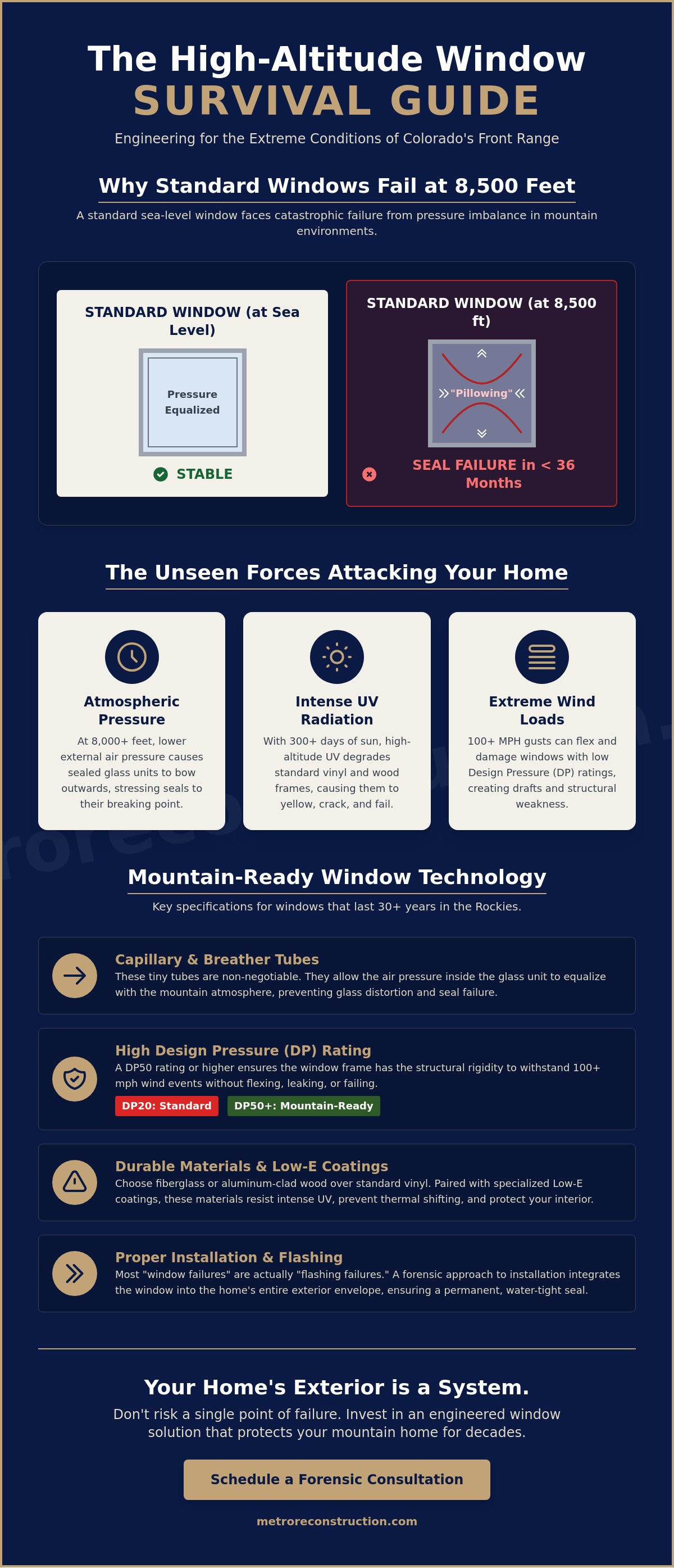
The air trapped inside a factory-sealed window at sea level exerts a constant outward force. In mountain communities like Nederland or Ward, where elevations often surpass 8,000 feet, the external atmospheric pressure drops significantly. This imbalance causes the glass to “pillow” or bow outward. This constant deflection puts immense stress on the primary seals and spacers.
Over time, this movement breaches the seal, leading to the “fogging” epidemic where moisture infiltrates the panes. We consistently see standard units fail within 60 months of installation because they lack capillary tubes or specialized high-altitude gas fills. Once the seal is compromised, the insulating value vanishes, and the root cause of your rising energy bills becomes clear.
Intense UV Exposure and Thermal Expansion
The thin air of the Front Range fails to filter the high-frequency UV radiation that degrades common building materials. Standard vinyl frames often become brittle and yellow within 36 to 60 months, while wood finishes peel and crack under the intense solar load. This radiation also accelerates the thermal bridge effect, where the temperature differential between the interior and exterior glass surfaces causes rapid expansion and contraction. The relentless bombardment of high-altitude UV radiation creates a cycle of material fatigue that rapidly destabilizes the molecular structure of standard window frames.
Boulder County Wind Loads and Seal Integrity
Mountain homes frequently face gusts exceeding 100 mph, requiring a high Design Pressure (DP) rating that standard products cannot meet. A typical residential window might carry a DP rating of 20, but high-performance custom windows for mountain homes in Colorado typically require a DP50 rating or higher to prevent frame deflection. When a window lacks this structural rigidity, the frame flexes during wind events, pulling away from the rough opening and creating air leaks.
By investing in custom windows for mountain homes, you’re not just buying glass; you’re investing in an engineered solution that accounts for:
- Pressure equalization tubes to prevent glass pillowing.
- Advanced UV-resistant coatings that protect the sash and frame.
- Reinforced frame profiles that exceed local 100+ mph wind load requirements.
- Moisture management systems that prevent internal condensation.
Technical Specs for Mountain Performance: Beyond the View
High-altitude environments demand more than just aesthetic appeal; they require an engineering-led approach to the entire exterior envelope. When transporting custom windows for mountain homes from sea-level manufacturing plants to Boulder County elevations exceeding 5,300 feet, atmospheric pressure changes can cause glass units to bow or even shatter. This structural failure is a root cause of premature seal failure and compromised thermal performance. Addressing these physical realities is essential for any high-performance mountain build.
Understanding Capillary and Breather Tubes
Capillary tubes are small-diameter stainless steel tubes integrated into the window spacer bar. They serve as a pressure relief valve, allowing the air inside the insulated glass unit to equalize with the thinner mountain atmosphere. Without these tubes, the pressure differential between the manufacturing site and a home at 8,500 feet would cause the glass to “pillow,” leading to distorted views and eventual glass breakage.
While these tubes are vital for structural stability, they dictate the type of insulation used between the panes. Argon gas cannot be used effectively in windows with open breather tubes because the gas molecules will eventually escape through the opening, replaced by standard air. This slightly reduces the R-value, but it’s a necessary trade-off to maintain the integrity of the glass. Once the windows arrive at their final destination, a specialist must crimp or seal these tubes to prevent long-term moisture management issues like internal fogging.
Glass Packages and Solar Heat Gain
Selecting the right glass package involves a calculated trade-off between thermal resistance and solar control. In the Colorado Front Range, we often recommend specific “flavors” of Low-E coatings based on the home’s orientation. For north-facing windows, a Low-E 180 coating helps maximize passive solar heat gain during the winter. Conversely, south and west-facing elevations typically require a high-performance coating like Low-E 70/36 to mitigate the intense UV radiation found at higher elevations.
- U-Factor: Aim for 0.30 or lower to ensure the window retains heat during sub-zero nights.
- Tempered Glass: This is a requirement for the large-scale picture windows common in Boulder architecture to resist thermal stress and meet safety codes.
- Triple-Pane vs. Double-Pane: Triple-pane glass offers superior insulation, but the added weight requires a robust frame to prevent sagging over time.
For south-facing mountain windows, the Solar Heat Gain Coefficient (SHGC) must be lower to prevent the interior from overheating due to the increased solar intensity of the thin atmosphere. Ensuring your project is built right the first time means analyzing these technical specifications before the first frame is ordered. This forensic attention to detail protects your investment and ensures the comfort of your home for decades.
Selecting Materials for Durability and Aesthetics
Choosing the right materials for custom windows for mountain homes requires an engineering-first approach to material science. Boulder County properties face unique environmental stressors, including 40-degree diurnal temperature swings and intense UV radiation at elevations exceeding 5,000 feet. These conditions cause standard building materials to expand and contract at different rates, often leading to seal failure and air infiltration. We focus on materials that maintain structural integrity while providing the high-performance thermal resistance necessary for Colorado winters.
Fiberglass stands as the gold standard for high-altitude stability. Because fiberglass is composed primarily of glass fibers and resin, its thermal expansion coefficient is nearly identical to the glass panes it holds. This synergy prevents the frame from pulling away from the glass during a deep freeze. For homeowners seeking a traditional look, aluminum-clad wood offers a sophisticated compromise. It pairs a warm, authentic wood interior with a heavy-gauge extruded aluminum exterior that resists damage from wind-blown debris and heavy ice accumulation.
Composite frames provide a necessary alternative to traditional vinyl. Standard vinyl often warps or becomes brittle when exposed to the 15 percent higher UV intensity found in mountain environments. Composites utilize a blend of wood fibers and thermoplastic polymers to offer twice the stiffness of vinyl. We also recommend “Coastal Grade” finishes for mountain builds. While originally designed for salt spray, these high-performance coatings provide a 10-year defense against the abrasive grit and high-velocity winds common along the Front Range.
Fiberglass vs. Aluminum Cladding
The choice between fiberglass and aluminum cladding often comes down to the specific architectural goals of the project. Fiberglass is virtually maintenance-free and offers incredible aesthetic flexibility, as it can be painted in custom dark tones without the risk of heat-related warping. Aluminum cladding provides a more rugged, industrial feel and superior structural rigidity for oversized spans of glass. While aluminum is highly durable, it is a natural conductor of heat; therefore, it must feature a robust thermal break to prevent energy loss. Fiberglass is a natural insulator, making it slightly more efficient in extreme cold. Both materials outperform wood alone by protecting the exterior envelope from the relentless Colorado sun.
Interior Wood Species and Moisture Management
For the interior of your custom windows for mountain homes, the species of wood selected dictates how well the unit handles indoor humidity fluctuations. We recommend Douglas Fir or Mahogany. These species possess a tight grain structure that naturally resists the swelling and shrinking that leads to hardware misalignment. However, even the best wood species will fail if the window-wall interface is not managed correctly.
Interior wood rot is rarely a result of the wood itself; it is usually a symptom of a compromised exterior seal. When moisture penetrates the outer barrier, it becomes trapped against the wood frame, leading to hidden decay. This is particularly critical in homes with specialized exteriors. If your property features a cementitious finish, professional Stucco Restoration is often necessary to ensure the transition between the new window and the existing wall is watertight. Addressing the root cause of moisture intrusion ensures your investment remains protected for decades.
The Critical Role of the Exterior Envelope in Window Installation
Most homeowners assume a leaking window is a product defect. In 90% of our reconstruction projects, the root cause is actually a flashing failure at the rough opening. When installing custom windows for mountain homes, the window unit itself is only one part of a complex moisture management system. We treat every installation as a critical integration point within the entire exterior envelope. This ensures that wind-driven rain and heavy snowmelt don’t penetrate the structural framing. Our “Built Right the First Time” philosophy dictates that we address the underlying mechanics of the wall rather than just the visible opening.
High-Performance Flashing and Sealants
Traditional 15lb or 30lb organic felt was once the industry standard, but it often degrades in the extreme temperature swings of Boulder County. We’ve transitioned to liquid-applied flashing membranes that create a seamless, monolithic bond to the substrate. This technology eliminates the laps and seams where traditional tapes often peel away over time. Standard caulking cannot withstand the 100 mph wind gusts common in the foothills. We utilize pre-formed sill pans to collect and redirect any water that bypasses the primary seals; this protects the subfloor and studs from rot. These secondary drainage planes ensure that moisture that gets behind the cladding has a clear path to escape the building.
Managing the Stucco-to-Window Interface
Stucco and stone are common in mountain architecture, but they’re also porous. Moisture often migrates through these materials, making secondary drainage planes essential for long-term durability. A common error involves finishing stucco directly against a window frame without a proper expansion joint. This leads to cracking as the house settles and fluctuates with the seasons. We use closed-cell backer rods and high-movement sealants to maintain a flexible, watertight seal. In existing stucco homes, our forensic approach is a diagnostic process that identifies the precise failure point of the building’s moisture barrier before a single new component is installed. This methodology ensures we aren’t just covering up a problem, but solving it. By integrating these custom windows for mountain homes into the existing stucco system with technical precision, we prevent the moisture intrusion that plagues standard replacements.
Investing in Resilience with Metro Reconstruction
Metro Reconstruction brings 40 years of specialized experience to the unique challenges of Boulder County mountain construction and forensic repair. We don’t just swap out units; we manage the entire lifecycle of the installation. Our process begins with technical specifications and ends only when the final envelope seal is verified. This comprehensive project management ensures that every component of your exterior works in harmony to resist the harsh Front Range climate. Our fixed-price model provides peace of mind for complex mountain retrofits, eliminating the financial uncertainty that often plagues high-altitude renovations. You receive a transparent cost structure that respects your budget while prioritizing the long-term structural integrity of your property.
Our team understands that a window is only as effective as the flashing and sealant surrounding it. In the mountains, wind-driven rain and heavy snow loads can easily bypass subpar installations. This is why we provide a level of analytical depth that typical contractors lack. We focus on how different building components interact over time, ensuring your investment in custom windows for mountain homes pays dividends in durability and comfort. The Metro promise is simple: we protect the aesthetic value of your home by reinforcing the engineering that keeps it standing.
Our Forensic Process for Window Replacement
Before we order a single component, we perform a forensic moisture and structural assessment of your existing openings. This step identifies hidden rot or compromised framing that standard installers often overlook. We coordinate our specialized masonry, stucco, and window teams to create a unified moisture management system. By addressing the root cause of previous failures, we ensure your new custom windows for mountain homes are integrated into a resilient, high-performance exterior. We don’t believe in aesthetic patches. We believe in structural solutions that prevent future damage.
- Detailed analysis of existing flashing and drainage planes.
- Identification of thermal bridging and air infiltration points.
- Integration of new windows with existing cladding like stone or EIFS.
- Verification of structural headers and sill plates for moisture damage.
Start Your Boulder Mountain Project
High-altitude environments demand adherence to strict building codes and an understanding of extreme thermal cycles. Our local roots in Boulder County mean we’ve spent decades refining our techniques for these specific conditions. We’ve seen how the sun and wind degrade inferior materials, and we choose products that exceed local requirements. We invite you to schedule a consultation for a comprehensive exterior evaluation. We’ll look beyond the glass to ensure your project is built right the first time. Contact Metro Reconstruction for a high-performance window consultation to begin securing your home’s future with a partner who values substance over style.
Securing Your Mountain Legacy
Selecting custom windows for mountain homes requires more than an eye for design; it demands a forensic understanding of how high-altitude pressure and intense UV exposure impact the entire exterior envelope. We’ve spent over 40 years in Boulder County refining a methodology that prioritizes technical precision over temporary aesthetic fixes. Because standard units often fail under the thermal stress of the Front Range, our approach focuses on mountain-grade specifications that ensure your home remains airtight and efficient for decades. We don’t just swap out glass. We analyze the root cause of potential failures to guarantee your investment is built right the first time. By integrating high-performance windows with a comprehensive moisture management strategy, you’re securing the structural integrity of your property against the unique challenges of the Colorado climate as we head into 2026. Our team brings a specialized skill set to every project, ensuring that every seal and flashing detail exceeds industry standards. You deserve the peace of mind that comes from a home built to endure.
Invest in a high-performance exterior. Contact Metro Reconstruction today.
Frequently Asked Questions
Do I really need capillary tubes for my mountain home in Boulder?
Capillary tubes are essential for any installation where the elevation change between the factory and the job site exceeds 3,000 feet. Without these small breather tubes, the pressure differential between the sealed glass unit and the thin mountain air causes the glass to bow or implode. This structural stress compromises the entire exterior envelope and leads to premature glass breakage.
What is the best window frame material for Colorado’s high-altitude climate?
Fiberglass is the most reliable frame material for the Front Range because its expansion rate is nearly identical to glass. When temperatures swing 40 degrees in a single afternoon, fiberglass doesn’t warp or pull away from the sealant. This stability is critical for custom windows for mountain homes to ensure the air barrier remains intact against high-altitude winds and heavy snow loads.
How much more do custom mountain windows cost compared to standard ones?
Custom units command a higher investment because they incorporate specialized glass thicknesses and reinforced spacers to handle atmospheric pressure. Industry data from high-performance building reports indicates that these specialized components increase the total project cost to prevent future structural failures. We focus on these long-term solutions to protect your home’s value rather than using cheaper, standard alternatives that fail within five years.
Can I use Argon gas in windows installed at 8,000 feet elevation?
You can’t effectively use Argon gas in windows that require capillary tubes for pressure equalization. Since the tubes create an open path to the atmosphere to prevent glass bowing, the Argon gas will escape within a few months of installation. At 8,000 feet, we prioritize structural integrity and pressure management over gas fills that won’t remain inside the unit.
Why is my mountain window seal failing so quickly?
Seal failure in high-altitude environments is typically the result of solar pumping, where the glass constantly expands and contracts due to intense UV exposure. This repetitive movement fatigues the primary seal until it develops microscopic gaps. Addressing the root cause requires selecting high-performance spacers that can withstand the 25% higher UV radiation levels found in mountain regions compared to sea-level locations.
What is the difference between Low-E 272 and Low-E 366 for Colorado homes?
Low-E 272 uses two layers of silver to reflect heat while allowing 72% of visible light, whereas Low-E 366 uses three layers for maximum solar rejection. For north-facing rooms in Boulder County, 272 is often preferred to maintain natural light. However, 366 is the standard for west-facing elevations to block 95% of damaging UV rays and prevent overheating during summer afternoons.
Does window replacement require a permit in Boulder County?
Boulder County requires a building permit for window replacements when the project involves changing the opening size or meeting current energy codes. According to the Boulder County Building Safety and Inspection services, even replacements that don’t change the frame size must comply with the 2021 International Energy Conservation Code. We manage this process to ensure your installation meets every safety and egress requirement for your specific municipality.