
Most homeowners believe a standard low-E coating is enough to shield their interiors, yet at 5,430 feet, the atmospheric reality is far more aggressive than many national products are designed to handle. You have likely noticed your hardwood floors losing their richness or felt uncomfortable solar heat gain in south-facing rooms. When standard glass fails to protect your property, investing in specialized UV protection windows for homes Boulder becomes a necessity for long-term preservation. It’s frustrating to watch expensive artwork and finishes deteriorate despite having what seemed like modern windows. True resilience in this environment requires a holistic understanding of how high-altitude radiation interacts with your building’s complete outer system.
This guide explores how high-altitude window technology safeguards your property by addressing both solar radiation and the unique pressure demands of the Front Range. We’ll examine the 2026 ENERGY STAR Version 7.0 standards, which now mandate a U-Factor of 0.22 or lower for our region, and the implications of the 2024 City of Boulder Energy Conservation Code. You will discover why integrated glass coatings and pressure-balanced seals are essential for maintaining thermal efficiency without sacrificing your mountain views. We focus on identifying the underlying structural origins of window failure to ensure your next investment provides the reliability and peace of mind you deserve.
Key Takeaways
- Understand why Boulder’s 5,430-foot elevation requires specialized glass technology to prevent the rapid degradation of interior furnishings and architectural finishes.
- Learn why professional window replacement is the only reliable method for achieving long-term UV protection windows for homes Boulder, avoiding the thermal stress risks associated with aftermarket films.
- Discover the mechanical necessity of capillary tubes in high-altitude environments to equalize internal pressure and prevent premature seal failure.
- Identify how to balance thermal efficiency with mountain views by selecting the optimal Solar Heat Gain Coefficient for south-facing elevations.
- Explore a forensic installation methodology that treats windows as a critical component of your building’s complete outer system to ensure moisture protection and structural integrity.
Why Boulder Homes Face Extreme UV Challenges
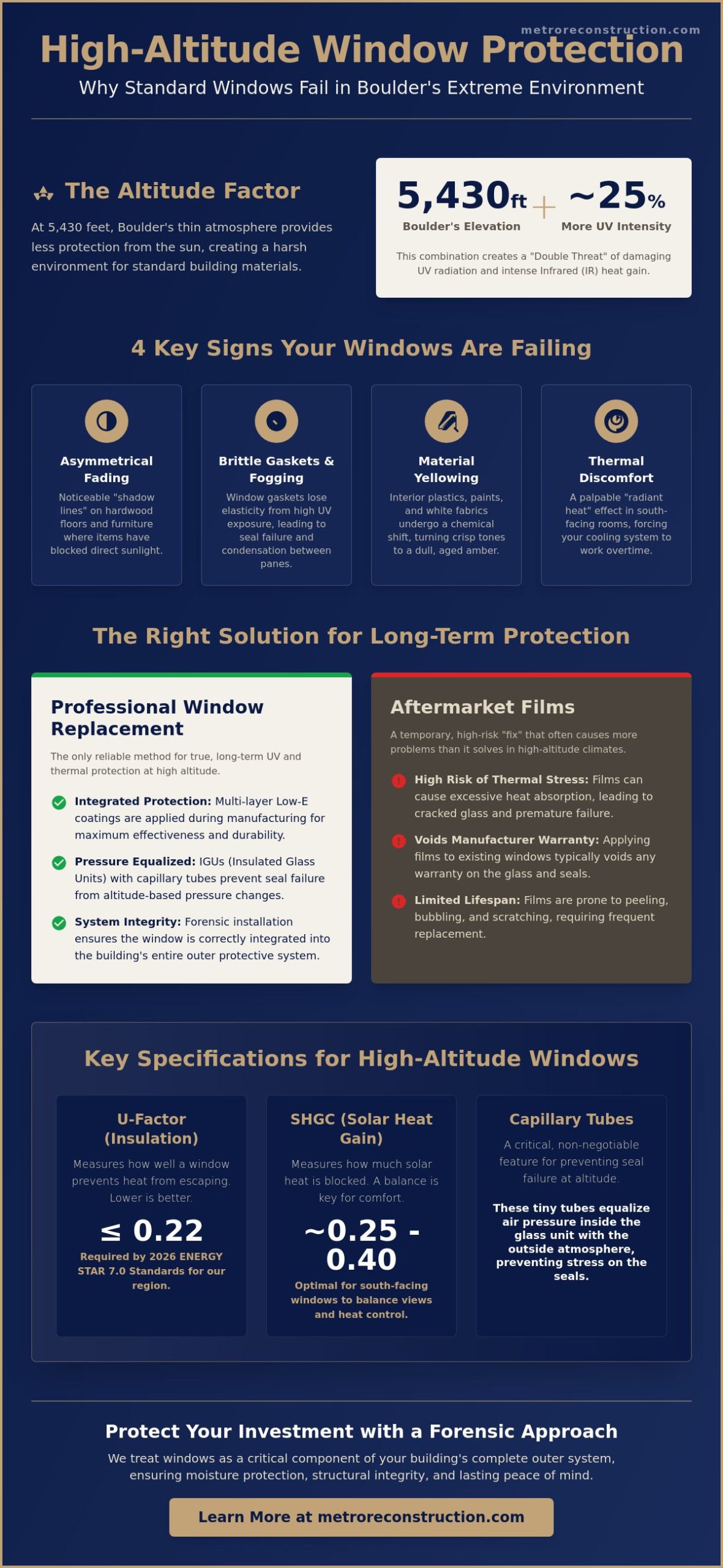
Boulder’s geographical profile creates a unique set of environmental stressors that most standard building materials simply aren’t engineered to withstand. At an elevation of 5,430 feet, the atmosphere is significantly thinner than at sea level, providing less filtration for the sun’s most aggressive rays. Scientific data indicates that UV intensity increases by approximately 4 to 5 percent for every 1,000 feet of gain in altitude. For a Boulder resident, this translates to a 20 to 25 percent increase in radiation exposure compared to coastal regions. When you combine this intensity with our legendary 300 plus days of annual sunshine, the cumulative impact on your home’s interior becomes a matter of structural and aesthetic urgency.
The challenge isn’t just the visible light we enjoy; it’s the “Double-Threat” of ultraviolet (UV) radiation and infrared (IR) heat. While UV wavelengths are the primary culprit behind the chemical breakdown of dyes and fibers, IR radiation accounts for the excessive solar heat gain that forces your cooling systems to overwork. Many off-the-shelf windows found in big-box stores are designed for average national climates. These units often lack the sophisticated Low-E coatings necessary to bifurcate these wavelengths effectively. Without a forensic approach to selecting UV protection windows for homes Boulder, property owners often find themselves replacing interior finishes long before their natural lifespan expires.
The Altitude Factor: UV Intensity at 5,000+ Feet
In high-altitude environments, the solar spectrum is particularly rich in the 300 to 380nm wavelength range. This specific band of ultraviolet light is responsible for the majority of “photo-degradation,” a process where high-energy photons break the chemical bonds in wood stains, fabric pigments, and even the lignin in natural flooring. Standard glass provides almost no protection against these specific wavelengths. Choosing specialized UV protection windows for homes Boulder ensures that these destructive photons are reflected away from the glass surface rather than being absorbed into your living space.
Signs of UV Damage in Colorado Residences
Identifying the early signs of solar degradation is key to proactive property preservation. We frequently observe specific patterns of failure that signal the need for a more robust window system. These indicators include:
- Asymmetrical Fading: Distinct “shadow lines” on hardwood floors where area rugs or furniture have shielded the wood from direct exposure.
- Gasket and Seal Brittleness: The high-energy environment causes the internal window gaskets to lose elasticity, eventually leading to seal failure and fogging.
- Material Yellowing: A chemical shift in interior plastics, paint finishes, and white upholstery that turns crisp tones into a dull, aged amber.
- Thermal Discomfort: A palpable “radiant heat” effect in south-facing rooms, even when the air temperature is controlled.
Addressing these issues requires more than a superficial fix. It demands a technical solution that acknowledges the window as a critical component of the building’s complete outer system, ensuring your investment remains protected against the relentless Colorado sun.
The Science of UV Protection: Low-E Coatings and Glass Technology
Low-emissivity technology operates on the fundamental principle of reflecting long-wave infrared energy while managing the transmission of ultraviolet light. Unlike aftermarket films that sit on the surface of the glass, integrated Low-E glass utilizes microscopic metallic layers applied during the manufacturing process. For homeowners seeking effective UV protection windows for homes Boulder, understanding the distinction between hard-coat and soft-coat applications is vital. Hard-coat options are durable but offer limited thermal control. In contrast, soft-coat or sputtered Low-E provides the high-performance spectrum control required to mitigate Boulder’s intense solar exposure. This technology isn’t just a tint; it’s a sophisticated engineering solution integrated into the building’s complete outer system.
Selecting the right glass involves evaluating window energy performance ratings to ensure the system meets local environmental demands. It’s a precise science of balancing visible light with invisible protection. UV protection shouldn’t be viewed as a binary feature; it’s a measurable spectrum where the quality of the metallic stack determines how much of your interior investment is preserved over time. By reflecting UV radiation before it enters the home, these windows prevent the chemical breakdown of materials that leads to fading and structural brittleness.
Low-E 366 vs. Standard Glazing
Standard double-pane windows often fall short in high-altitude environments because they lack the necessary density of reflective layers. Low-E 366 glass features three distinct layers of silver, which allows it to block approximately 95% of harmful UV rays. This triple-silver configuration is the gold standard for property preservation. While it provides exceptional protection, it also maintains a high Visible Light Transmittance (VLT). This means you don’t have to live in a dark, tinted environment to keep your hardwood floors from fading. It’s the ideal balance for Boulder residents who value their mountain views but require uncompromising protection from the sun.
Argon Gas and Thermal Performance
The space between your glass panes isn’t just empty air. In high-performance units, this gap is filled with argon, a noble gas that is significantly denser than oxygen. Argon acts as a thermal buffer, effectively stopping convective heat transfer between the exterior and interior of your home. This is particularly important for Boulder’s fluctuating temperatures, where a winter morning might be 10 degrees and the afternoon sun brings a rapid spike in radiant energy. By stabilizing the internal temperature of the glass, argon fill prevents the thermal expansion and contraction that can stress UV-protective coatings.
If you’re noticing fogging or excessive heat gain, it may indicate that your current system’s seals have reached their limit. Our team at Metro Reconstruction Services, Inc. can provide a forensic assessment to determine if a full window replacement is the most reliable path forward for your home. We prioritize long-term solutions that address the underlying mechanics of your property’s protection.
Window Replacement vs. Aftermarket Films: Which Offers Better Protection?
Many homeowners consider aftermarket films as a cost-effective alternative to full window replacement. While the lower initial price is tempting, this approach often overlooks the complex physics of high-altitude fenestration. Applying a film to an existing unit is essentially adding a secondary layer to a system that was never engineered to accommodate it. This creates a fundamental shift in how the glass manages solar energy. Over time, the adhesive bonds degrade under relentless UV exposure, leading to the common bubbling and peeling that compromises your mountain views and your home’s aesthetic value.
In Boulder’s environment, the risk of thermal stress fractures is a significant concern. Dark films often work by absorbing heat rather than reflecting it at the first surface. When applied to the interior of a dual-pane unit, the film causes the glass temperature to rise rapidly. This uneven heating creates expansion that can exceed the structural tolerance of the glass, resulting in spontaneous cracking. Integrated UV protection windows for homes Boulder solve this by embedding the protective layers within the glass chemistry itself. This ensures the unit remains thermally balanced and performs reliably for decades rather than years.
Warranty Implications and Glass Integrity
It’s vital to understand that applying aftermarket film frequently voids the original manufacturer’s warranty. Manufacturers recognize that film alters the heat absorption profile, which can lead to premature seal failure or glass breakage. From a forensic perspective, film often acts as a superficial mask for underlying structural issues. It may temporarily reduce glare, but it does nothing to address a failing frame or an exhausted desiccant system. Choosing a full window installation ensures that every component of the building’s complete outer system is functioning at peak efficiency, providing a permanent solution rather than a temporary patch.
Long-Term ROI for Boulder Homeowners
The financial comparison between film and replacement requires a multi-decade perspective. A quality film typically lasts five to ten years before it requires removal and reapplication. In contrast, new high-performance units are engineered for a 30-year lifespan. When you factor in the 2026 ENERGY STAR requirements and the preservation of interior assets like hardwood and artwork, the return on investment for a complete replacement becomes clear. For those researching a window installation service near me, it’s important to weigh these long-term gains against the recurring costs of temporary fixes. Modern windows provide superior thermal efficiency and property value that a surface-level film simply cannot replicate.
Key Specifications for High-Altitude UV Windows in Boulder
Selecting the right fenestration for the Front Range requires a deep understanding of atmospheric physics and material science. At Boulder’s 5,430-foot elevation, the standard specifications used in coastal or midwestern climates are often insufficient. To ensure your investment provides lasting protection, you must look for hardware and glass configurations that are specifically calibrated for high-altitude environments. This level of technical precision is what distinguishes a high-performance installation from a superficial fix. When you invest in UV protection windows for homes Boulder, you aren’t just buying glass; you’re securing a critical component of your building’s complete outer system that must withstand extreme pressure and radiation.
Every window unit should carry a National Fenestration Rating Council (NFRC) label, which provides a standardized way to compare performance. For our region, the 2026 ENERGY STAR 7.0 standards mandate a U-factor of 0.22 or lower. However, homeowners with large, south-facing mountain views should pay close attention to the Solar Heat Gain Coefficient (SHGC). While a low U-factor keeps heat in during the winter, a low SHGC, typically between 0.20 and 0.25, is necessary to block the intense infrared heat that accompanies our 300 plus days of sunshine. Balancing these numbers ensures your home remains comfortable without overtaxing your mechanical systems.
Pressure Balancing with Capillary Tubes
Shipping a sealed window from a sea-level manufacturing plant to our elevation creates a significant pressure differential. As the external air pressure drops, the air trapped between the glass panes expands, causing the glass to bow outward in a convex shape. This distortion places immense strain on the perimeter seals and can even cause the microscopic silver layers in Low-E coatings to crack. To mitigate this, we specify the use of capillary tubes, or breather tubes. These small, stainless steel components allow the internal pressure of the insulated glass unit to equalize with Boulder’s atmosphere. It’s a forensic detail that ensures the glass remains perfectly flat, preserving both the view and the window’s protective capabilities. At Metro Reconstruction Services, Inc., we insist on altitude-calibrated units to prevent the structural origins of seal failure.
Frame Selection for Intense Sun Exposure
In our dry climate, the frame material is just as vulnerable to UV damage as your interior finishes. Fiberglass has emerged as the superior choice for Colorado homes because it is made of glass fibers and resin, giving it a thermal expansion coefficient nearly identical to the glass panes it holds. This means the entire unit expands and contracts at the same rate, reducing stress on the seals. In contrast, low-quality vinyl frames have a much higher expansion rate, which often leads to warping, corner cracks, and air leaks under the relentless high-altitude sun. Fiberglass is also inherently resistant to the UV-induced brittleness that plagues older vinyl products, ensuring your window installation remains air-tight and structurally sound for decades.
If you suspect your current windows are failing due to altitude stress or UV degradation, contact Metro Reconstruction Services, Inc. for a technical assessment. We specialize in window replacement solutions that are engineered specifically for the demanding Boulder environment.
Metro Reconstruction Services, Inc.’s Forensic Approach to Window Installation
At Metro Reconstruction Services, Inc., we treat every window replacement as a critical intervention within the building’s complete outer system. A high-performance unit designed for UV protection windows for homes Boulder is a significant investment that requires more than a simple sealant bead around the perimeter. If the interface between the window frame and the surrounding wall is compromised, even the most advanced glass technology won’t prevent structural decay. We approach every project with the mindset of a forensic specialist, identifying the precise mechanisms of past failures to ensure the new installation provides permanent reliability. This level of technical depth ensures that your home remains protected from both atmospheric stressors and moisture intrusion.
Our process begins with a detailed diagnostic phase to uncover existing moisture intrusion or structural shifts that may have occurred over time. Many Boulder homes suffer from hidden damage caused by previous low-quality installations that prioritized speed over precision. By identifying these underlying structural origins, we can restore the integrity of the wall cavity before the new windows are set. This thoroughness is the hallmark of a family-owned firm with over 40 years of local expertise in the demanding Colorado climate. When you choose a partner who understands the hidden mechanics of a structure, you’re investing in the long-term health of your property.
Integrating Windows with Stucco and Masonry
Poorly integrated windows are one of the most common catalysts for stucco restoration needs. When flashing is not expertly woven into the drainage plane behind stucco or masonry, water is inevitably trapped against the wooden substrate. We utilize precision flashing techniques that respect the specific architectural requirements of Boulder’s diverse home styles. This ensures that your new UV protection windows for homes Boulder don’t just block destructive radiation, but also act as a primary defense against the moisture cycles typical of our high-altitude environment. Our commitment to architectural accuracy ensures that the restoration is both structurally sound and aesthetically seamless.
The Metro Process: Accuracy as a Foundation
Initial accuracy is our foundational brand promise. We believe in providing a transparent experience, which is why our forensic diagnostics lead to fixed-price project fees. This eliminates the budgeting uncertainty that often plagues complex restoration work. You deserve the peace of mind that comes from a partner who values substance over style and integrity over high-pressure sales tactics. We don’t offer temporary patches; we provide engineering-led solutions that preserve your investment for decades. If you are ready to protect your home with the highest standard of care, we invite you to schedule a consultation for high-performance window replacement and experience the difference of a truly professional installation.
Securing Your Home’s Future Against the Colorado Sun
Protecting a home at 5,430 feet requires a shift from standard building practices toward high-altitude engineering. We’ve explored how pressure-balanced glass and triple-silver Low-E coatings work together to neutralize the aggressive UV radiation and infrared heat gain unique to our region. These technical components are most effective when integrated into the building’s complete outer system through a forensic installation process. Investing in UV protection windows for homes Boulder is a fundamental step in property preservation that safeguards your interior finishes and improves thermal efficiency for decades.
With over 40 years of Boulder County expertise, our team specializes in high-altitude window calibration and identifying the underlying structural origins of failure. We prioritize substance over superficial fixes to ensure your home remains a sanctuary of clarity and comfort. Our commitment to initial accuracy ensures your project starts on a foundation of technical truth. Request a Forensic Window Evaluation for Your Boulder Home to begin your path toward long-term structural reliability. Your property’s legacy deserves the precision that only a seasoned expert can provide.
Frequently Asked Questions
Do I really need UV protection windows in Boulder if I have blinds?
Yes, because blinds only provide a secondary barrier that often absorbs heat and radiates it back into your living space. High-altitude UV radiation is approximately 20 to 25 percent more intense in Boulder than at sea level, meaning destructive photons penetrate even small gaps in window treatments. Integrated UV protection windows for homes Boulder reflect these rays before they enter the home, preserving your blinds from becoming brittle while protecting the rest of your interior.
Can I get UV protection without making my home look dark?
Modern spectrally selective coatings allow for high visible light transmittance while blocking up to 95 percent of harmful UV rays. Unlike dark aftermarket films that rely on heavy tints, these microscopic metallic layers are engineered to distinguish between different wavelengths of the solar spectrum. You can maintain your mountain views and natural interior lighting while achieving the necessary protection for your property’s complete outer system.
What is the best Low-E glass rating for Colorado high-altitude homes?
For homes in the Front Range, a triple-silver coating like Low-E 366 is often the superior technical choice. According to the 2026 ENERGY STAR 7.0 standards, windows in our climate zone must achieve a U-factor of 0.22 or lower. Combining this low U-factor with a low Solar Heat Gain Coefficient ensures the unit manages both conductive and radiant energy effectively at 5,430 feet.
Will new UV windows help lower my cooling bills in the summer?
Installing high-performance UV protection windows for homes Boulder significantly reduces cooling costs by reflecting infrared heat away from the glass surface. This reduction in solar heat gain prevents the “greenhouse effect” in south-facing rooms, allowing your HVAC system to operate more efficiently. By stabilizing the temperature of the building’s complete outer system, you reduce the mechanical load and extend the lifespan of your cooling equipment.
How do I know if my current window seals have failed due to altitude?
Common indicators of altitude-related seal failure include permanent fogging between the panes or a visible bowing of the glass. This occurs when units lack capillary tubes to equalize internal pressure with Boulder’s thinner atmosphere. We utilize forensic diagnostics to identify these underlying structural origins of failure, ensuring that replacement units are properly calibrated for our specific elevation to prevent future issues.
Is window replacement better than just adding a UV film?
Professional window replacement provides a long-term structural solution that surface-level films cannot replicate. Films often trap heat within the glass, which can lead to thermal stress fractures and voided manufacturer warranties. A new window installation integrates the protective layers within the glass chemistry, offering a 30-year lifespan compared to the much shorter 5 to 10 year cycle of aftermarket films.
Do UV protection windows also block infrared heat?
Yes, high-quality spectrally selective glass is designed to block both destructive UV radiation and long-wave infrared energy. While UV rays are the primary cause of material fading, infrared heat is responsible for the palpable warmth you feel near a window. By reflecting both, the windows preserve your interior investments and maintain a consistent, comfortable thermal environment throughout the year.
Are there specific Boulder building codes for window efficiency in 2026?
The City of Boulder has adopted the 2024 Energy Conservation Code, which sets rigorous standards for fenestration performance. All new and replacement windows must meet the ENERGY STAR Version 7.0 Northern Climate Zone standard as of January 1, 2026. These regulations require a U-factor of 0.22 or lower, reflecting a city-wide mandate to improve energy efficiency and reduce building emissions.