
The most beautiful stucco finish in the world becomes a liability if it cannot survive the ground moving beneath it. When comparing synthetic stucco vs traditional stucco Colorado homeowners often focus on the visual texture, yet the real decision lies in how these materials interact with our state’s expansive soils and rapid thermal shifts. You likely recognize the frustration of seeing hairline fractures expand after a single harsh winter, or perhaps you worry about the silent threat of moisture trapped behind an aging system. It’s a valid concern because a home’s exterior must function as a complete, protective envelope rather than just a decorative skin.
This guide explains the critical technical differences between these systems so you can make an informed choice for your property’s preservation. We will examine how each material responds to extreme freeze-thaw cycles and how they align with the new 2026 Colorado building codes for wildfire resiliency and energy efficiency. You will discover which system provides the best insulation to lower your bills and the crack-resistance needed to ensure your investment remains secure for decades. Understanding these structural origins is the first step toward a durable, maintenance-free exterior that stands up to the elements.
Key Takeaways
- Understand the mechanical relationship between your home’s exterior and the environment by comparing traditional cement systems with multi-layered synthetic insulation.
- Compare synthetic stucco vs traditional stucco Colorado systems to understand how they respond to the significant stress caused by expansive soils and 50-degree daily temperature shifts.
- Discover how modern moisture management technology protects the complete outer system of your home from the hidden risks of rot and structural decay.
- Review the long-term maintenance requirements and energy performance metrics to determine which material provides the most reliable protection for your specific property.
- Learn why identifying the underlying structural origins of a failure is essential for long-term protection. Connect with our experts at 303.543.9549 or via our contact page for a detailed evaluation.
Understanding the Basics: Traditional vs. Synthetic Stucco Systems
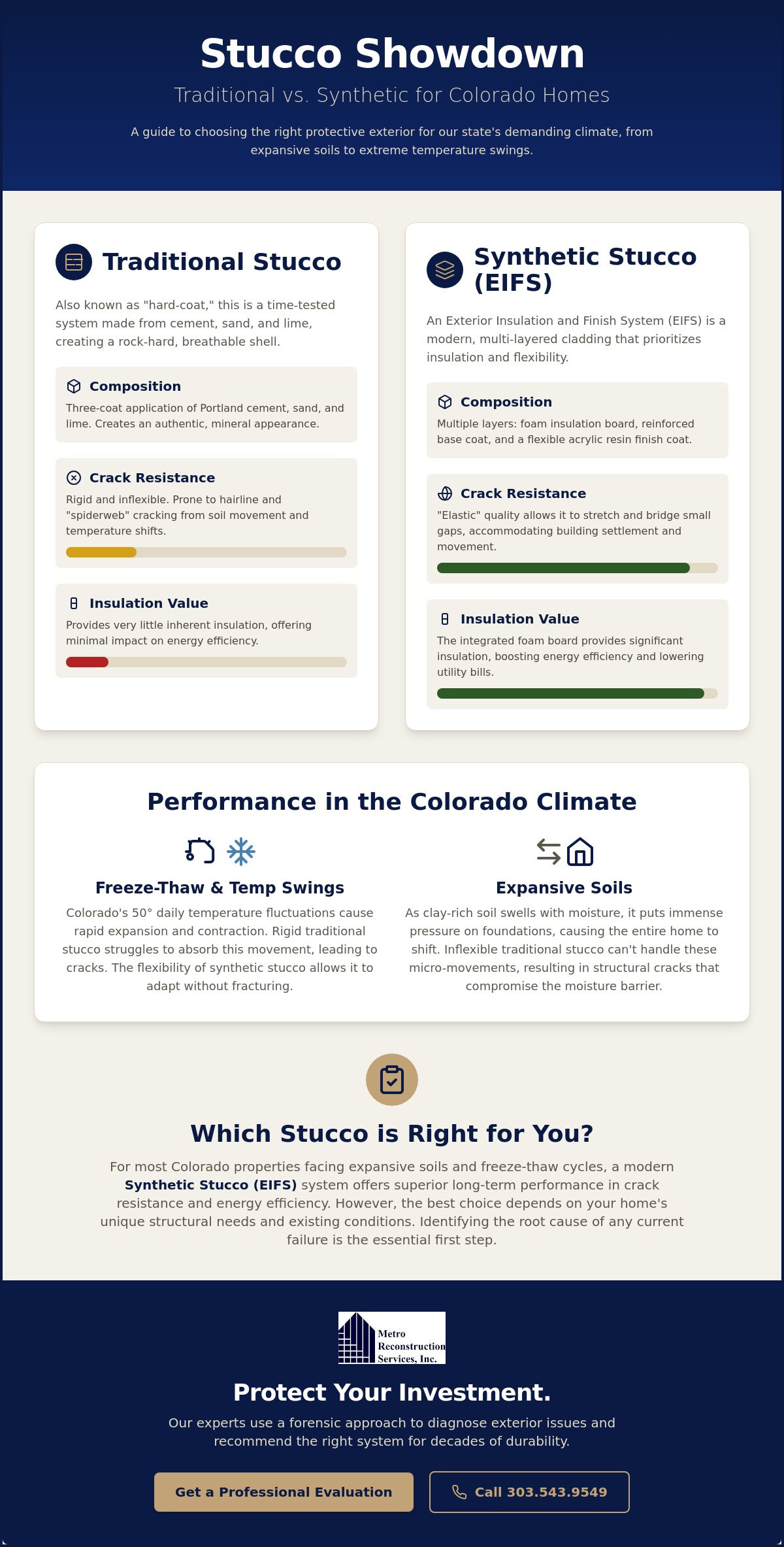
When evaluating synthetic stucco vs traditional stucco Colorado homeowners often find themselves caught between conflicting advice from various contractors. To make a sound investment, you must first understand that these are fundamentally different engineering approaches to home protection. Local professionals often use the term “hard-coat” to describe the traditional cement method. This name is a direct reference to the rock-hard shell it creates, which offers excellent impact resistance but lacks the ability to move with your home. Synthetic systems, on the other hand, are designed with chemistry that allows for greater flexibility and thermal management.
The Composition of Traditional Cement Stucco
Traditional stucco is a time-tested, three-coat application that has protected homes for generations. It begins with a scratch coat that creates a mechanical bond to the building’s frame, followed by a brown coat to level the surface, and a final finish coat for texture. This system relies on a specific mixture of Portland cement, lime, and sand. Many property owners in Boulder and Cherry Creek choose this option because of its authentic mineral appearance and its natural fire-resistant properties. It is a breathable material, which is a significant advantage for certain structural designs, although it provides very little inherent insulation value on its own.
The Modern Layers of Synthetic Stucco (EIFS)
Modern Exterior Insulation and Finish Systems (EIFS), commonly known as synthetic stucco, function as a complete outer system for your home. Unlike the cement-based alternative, EIFS utilizes multiple layers designed to work in harmony. It starts with a foam insulation board that is attached to the substrate, followed by a reinforced base coat and a final finish coat made of high-quality acrylic resins. These resins give synthetic stucco an “elastic” quality, allowing the material to stretch and bridge small gaps as the building settles. This flexibility is a primary reason why synthetic finishes often show fewer surface cracks than their rigid cement counterparts. Additionally, the acrylic finish allows for a much wider range of vibrant, long-lasting colors that resist the fading typically caused by Colorado’s high-altitude UV exposure.
Choosing between these systems requires a deep understanding of your home’s specific structural needs and the regional environmental stressors it faces. We believe in precision from the very first diagnostic step to ensure your home remains a secure asset. If you are noticing cracks or suspect your current system is failing, our team can help identify the structural origins of the issue. For a professional evaluation of your property’s exterior, contact us at contact us or call our experts at 303.543.9549.
Performance in the Colorado Climate: Freeze-Thaw and Expansive Soils
Colorado’s environmental profile presents a unique set of challenges that test the limits of any building material. When choosing between synthetic stucco vs traditional stucco Colorado residents must account for the state’s notorious 50-degree daily temperature fluctuations. These rapid shifts cause building materials to expand and contract at different rates, often leading to structural tension within the exterior cladding. Rigid materials like traditional cement struggle to absorb this movement, which frequently results in the fine, “spiderweb” cracking seen across Front Range properties.
In communities such as Parker and Longmont, the presence of expansive soils adds another layer of complexity to property preservation. As the clay-rich soil absorbs moisture and swells, it exerts upward pressure on foundations, causing subtle shifts in the home’s framing. Because traditional stucco is inflexible, it cannot accommodate these micro-movements, leading to larger fractures that compromise the building’s moisture barrier. Synthetic finishes, however, utilize acrylic polymers that allow the surface to flex, maintaining the integrity of the complete outer system even when the ground is in flux.
High-altitude environments like Vail or Breckenridge introduce intense UV exposure that can degrade lower-quality finishes. Synthetic stucco systems are specifically engineered with high-grade acrylic resins that offer superior UV resistance, preventing the color fading and surface chalking common in these mountain regions. This chemical stability ensures that the aesthetic value of your investment remains intact despite the harsh alpine sun.
Managing Thermal Shock on the Front Range
The elastic nature of acrylic finishes allows the material to contract safely as temperatures drop rapidly at sunset, preventing the stress fractures that plague rigid systems. Beyond flexibility, synthetic stucco (EIFS) provides a significantly higher R-value because of its integrated foam insulation board, which helps stabilize indoor temperatures during freezing Colorado winters. To manage the inherent rigidity of historic traditional stucco, builders must install precise control joints to direct structural stress, a detail often overlooked by less experienced contractors.
Wildfire Protection and Home Hardening
For homeowners in Evergreen and Genesee, the fire-resistive qualities of an exterior are a critical safety consideration. Both traditional and synthetic systems provide excellent protection against ember ignition, serving as a primary defense in a comprehensive home hardening strategy. For those living in high-risk zones, we recommend reviewing our fire mitigation and prevention services to ensure your home meets the upcoming 2026 wildfire resiliency standards.
If you are concerned about how your current exterior is handling the local climate, a forensic evaluation can identify the underlying structural origins of any visible damage. Contact our specialists at 303.543.9549 or visit our contact page to schedule a detailed assessment of your home’s complete outer system.
The Moisture Debate: Addressing the EIFS Reputation
The reputation of synthetic stucco was significantly impacted by a series of high-profile moisture failures during the 1990s. At that time, many installations relied on a “barrier” design, which was intended to keep all water out but lacked a mechanism to let water escape if it eventually bypassed the sealants. This historical context is vital when debating synthetic stucco vs traditional stucco Colorado, as many homeowners still harbor fears of hidden rot. Modern engineering has since evolved to prioritize moisture management through “drainable” technology. This Building Science Corporation analysis of EIFS highlights how modern systems now include a drainage plane that creates a dedicated path for incidental moisture to exit the wall assembly safely.
Today’s Colorado building codes require these drainage systems for a reason. While traditional cement stucco is naturally breathable and allows moisture to vaporize through its surface, synthetic systems are largely non-porous. This means that if water enters through a crack or a failed window seal, it must have a physical way to drain out. Metro Reconstruction Services, Inc. approaches every project as forensic experts, looking beyond the surface to ensure the underlying structural origins of potential moisture intrusion are addressed before they become catastrophic failures. Reliability in these systems depends entirely on the precision of the installation and the integrity of the secondary moisture barrier.
Forensic Moisture Mitigation Strategies
Water damage rarely happens overnight. It typically begins with a failure in the secondary moisture barrier or a lack of a proper drainage plane behind the insulation board. In older Colorado homes, we often find that water has been trapped for years, slowly compromising the wood sheathing and framing. Common red flags include dark staining near rooflines, swelling at the base of walls, or a “soft” feel when pressure is applied to the exterior. Our diagnostic process involves identifying these specific points of failure to restore the building’s complete outer system rather than applying a temporary, low-quality patch.
The Role of Proper Window Flashing
Windows are the most common entry points for moisture in any stucco home. When homeowners pursue window replacement, they often don’t realize that the integrity of the stucco seal is intimately tied to the window’s flashing. A high-quality window is only as effective as the secondary weather barrier surrounding it. Metro Reconstruction Services, Inc. believes in a holistic approach where window installation and stucco restoration are treated as a single, integrated task. This ensures that the transition between the window frame and the exterior finish remains watertight for the long term. If you are planning an upgrade, read our High-Performance Window Installation Service guide to see how we integrate these critical structural components.
Precision in caulking and flashing isn’t just a finishing touch; it’s a foundational requirement for property preservation. To discuss a forensic evaluation of your home’s moisture protection, call Metro Reconstruction Services, Inc. at 303.543.9549 or reach out through our contact page.
Decision Framework: Which Stucco is Right for Your Property?
Choosing between synthetic stucco vs traditional stucco Colorado homeowners must weigh long-term structural performance against immediate aesthetic goals. This decision is rarely about which material is “better” in a vacuum, but rather which system aligns with your property’s specific location, architectural style, and exposure to environmental stressors. A home in the historic districts of Boulder or Cherry Creek faces different regulatory and physical demands than a modern build on the expansive soils of the plains. We believe in providing a clear analytical framework to help you navigate these technical complexities with confidence.
| Performance Factor | Traditional Cement Stucco | Synthetic Stucco (EIFS) |
|---|---|---|
| Primary Benefit | Impact resistance and authenticity | Energy efficiency and flexibility |
| Insulation (R-Value) | Minimal inherent insulation | High (integrated foam layers) |
| Crack Resistance | Prone to hairline surface cracks | High (elastic acrylic finish) |
| Maintenance | Requires periodic painting | Integrated color; requires sealant care |
Aesthetics often drive the initial conversation. Traditional cement offers a matte, earthy texture that is difficult to replicate with synthetic materials. It feels substantial and “local” to the Colorado landscape. Synthetic acrylic finishes, however, provide a cleaner, more uniform appearance with colors that remain vibrant despite our high-altitude UV exposure. Maintenance is another critical differentiator. While traditional stucco eventually requires painting to refresh its look and seal minor cracks, synthetic systems have color integrated throughout the acrylic layer, though they require meticulous inspection of caulking and sealants to maintain their protective envelope.
When to Choose Traditional Cement Stucco
Traditional cement stucco is the standard for historic restoration where architectural accuracy is a requirement. If your home is located in a high-traffic area or a region prone to heavy hail, the “hard-coat” nature of cement provides superior resistance to physical impact. It remains the preferred choice for homeowners who value a natural mineral finish and a material that has proven its longevity over decades of use in varied climates.
When Synthetic Acrylic Stucco (EIFS) Wins
Synthetic systems are the superior choice when energy efficiency is the primary goal. The integrated insulation board significantly reduces thermal bridging, leading to lower heating and cooling costs throughout the year. This system is also the logical choice for properties built on expansive soils. Its elastic properties allow the complete outer system to flex without fracturing, providing peace of mind for homeowners in areas like Parker or Larkspur where ground movement is a constant factor. Modern designs with complex shapes or bold color palettes also benefit from the versatility of acrylic resins.
Selecting the right system requires a forensic understanding of your home’s unique environment. If you are ready to upgrade your property’s protection, explore our stucco restoration and installation services to find the perfect fit for your home. Our experts at Metro Reconstruction Services, Inc. are available at 303.543.9549 to discuss the technical requirements of your specific project.
Metro Reconstruction Services, Inc.’s Forensic Approach to Stucco Restoration
For over 40 years, Metro Reconstruction Services, Inc. has served as a dedicated partner for homeowners across the Front Range and Mountain communities, addressing the specific environmental challenges that threaten property value. We understand that the debate between synthetic stucco vs traditional stucco Colorado isn’t just about surface aesthetics; it’s about the long-term health of your home’s complete outer system. Our history in the region has taught us that every failure has a story. Whether your property features a classic cement finish or a modern insulated system, we apply a meticulous diagnostic process to identify the structural origins of every crack or moisture stain we encounter.
Our forensic approach sets us apart from contractors who only offer superficial patches. We don’t just cover up damage. Instead, we analyze the relationship between your home’s framing, the local soil conditions, and the existing cladding to determine why a failure occurred in the first place. This analytical depth ensures that the restoration services we provide aren’t just temporary fixes but engineering-led solutions that restore the integrity of your investment. Every client receives personalized project management, where we guide you through the technical complexities of your restoration with transparency and quiet confidence.
Comprehensive Structural Preservation
We recognize that a home’s exterior doesn’t exist in isolation. Often, issues with your siding are symptoms of deeper movement, which is why our expertise in stucco and masonry repairs is so critical for holistic preservation. In many cases, foundation stabilization and stucco repair go hand-in-hand to address the stress caused by expansive Colorado soils. By using premium materials specifically designed for our rugged environment, Metro Reconstruction Services, Inc. ensures that your restored exterior can withstand the thermal shock and intense UV exposure unique to our region.
Start Your Restoration Project Today
Protecting your home from the elements requires initial accuracy and a commitment to precision. If you’ve noticed hairline fractures, staining, or suspect your current system is failing, don’t wait for a minor issue to become a complex structural challenge. We invite you to schedule a professional evaluation where our seasoned experts will provide a straightforward assessment of your property’s needs. We take pride in being more than a service provider; we’re your partner in property preservation.
Contact Metro Reconstruction Services, Inc. today to discuss your project in detail and discover the peace of mind that comes from a long-term solution. You can also reach our team directly at 303.543.9549 to begin the diagnostic process for your home.
Securing Your Home’s Structural Future
Deciding between synthetic stucco vs traditional stucco Colorado homeowners often find that the right choice depends on a property’s specific environmental exposure and architectural needs. Whether you prioritize the impact resistance of traditional cement or the superior insulation and flexibility of a modern acrylic system, the success of your exterior depends on a complete outer system that functions as a unified barrier. We’ve seen how regional stressors like expansive soils and rapid temperature shifts can compromise even the most beautiful finishes if the underlying structural origins of failure aren’t addressed with precision.
Metro Reconstruction has been family-owned and operated since 1982, providing over 40 years of local expertise to property owners facing complex challenges. As specialized moisture mitigation experts, we’re dedicated to restoring the long-term value of your investment through forensic diagnostics rather than temporary patches. We invite you to Request a Forensic Stucco Evaluation or call our team directly at 303.543.9549 to discuss your project. Your home is one of your most significant assets, and we’re here to ensure it remains protected for decades to come.
Frequently Asked Questions
Is synthetic stucco or traditional stucco better for Colorado weather?
The choice depends on whether you prioritize impact resistance or thermal management. Synthetic stucco offers superior flexibility to handle our state’s rapid 50-degree temperature swings and provides better insulation for cold winters. However, traditional cement stucco is much more resilient against the heavy hail frequently seen along the Front Range. When comparing synthetic stucco vs traditional stucco Colorado homeowners should choose based on their specific local environment and energy goals.
How can I tell if I have traditional or synthetic stucco on my home?
A simple “knock test” is often the most effective diagnostic tool for identification. When you tap on traditional stucco, it feels solid and sounds like you are knocking on a concrete sidewalk. Synthetic stucco (EIFS) sounds hollow and feels slightly softer because of the foam insulation board located directly behind the acrylic finish. You can also check around light fixtures or outlets to see the thickness of the material layers.
Does synthetic stucco (EIFS) still have moisture problems in 2026?
Modern synthetic systems have largely resolved the moisture issues that plagued older barrier designs. Current 2026 building codes require the installation of a dedicated drainage plane behind the insulation board. This technology allows incidental water to exit the complete outer system safely rather than becoming trapped against the wood sheathing. Reliability now depends almost entirely on the precision of the professional installation and the quality of the secondary moisture barrier.
Can you apply synthetic stucco over existing traditional stucco?
It is possible to apply a synthetic finish over traditional cement, but the existing surface must be structurally sound and properly prepared. We must first identify any underlying structural origins of failure, such as moisture damage or significant cracking, before adding new layers. If the original system is stable, an acrylic finish can provide a refreshed look and improved flexibility to bridge minor hairline fractures that often appear in older cement coatings.
How often does stucco need to be repainted or sealed in Colorado?
Traditional cement stucco typically requires repainting or a new fog coat every 7 to 10 years to maintain its protective seal. Synthetic systems have integrated color that resists fading, but the caulking around windows and doors is a critical vulnerability. You should have these sealants inspected every 3 to 5 years. Proactive maintenance of these joints is essential to prevent water from bypassing the exterior shell and causing hidden rot within the wall assembly.
What are the signs of hail damage on a stucco exterior?
Look for circular “starburst” cracks, indentations, or areas where the finish has physically chipped away. In synthetic systems, large hailstones can puncture the acrylic layer and damage the underlying foam, creating a path for moisture intrusion. Traditional stucco is harder but can still develop deep fractures or surface spalling during severe storms. Any visible breach in the surface should be evaluated by a specialist to ensure the building’s complete outer system remains watertight.
Is traditional stucco completely fireproof for mountain homes?
Traditional stucco is a non-combustible material that provides an excellent fire-resistive barrier, but no material is entirely fireproof under extreme conditions. It is a foundational component of home hardening strategies required by the 2026 Colorado Wildfire Resiliency Code. When combined with proper soffit protection and fire-rated windows, a stucco exterior significantly reduces the risk of ember ignition. This level of protection is vital for properties in high-risk zones like Evergreen or Genesee.
How much does it cost to repair stucco cracks in the Denver area?
Repair costs are determined by the severity of the damage and whether the cracks are superficial or structural. While simple surface patches are less intensive, addressing fractures caused by expansive soils requires a more comprehensive approach to ensure long-term stability. We focus on identifying the structural origins of the failure to provide a permanent solution. For an accurate assessment of your property’s needs, contact us at 303.543.9549 or through our contact page.